On this page
- Why an evening dress needs a functional check
- The four failures that pass a measurement check
- 1. Measurements and size identification
- 2. Symmetry and balance
- 3. Lining and internal structure
- 4. Closures and stress points
- 5. Surface and presentation
- The functional check: seated, walking and under load
- Tolerances, defect classes and what a fail means
- The inspection record
- Practical buyer worksheet
- The checklist on one page
- FAQ
- Next step
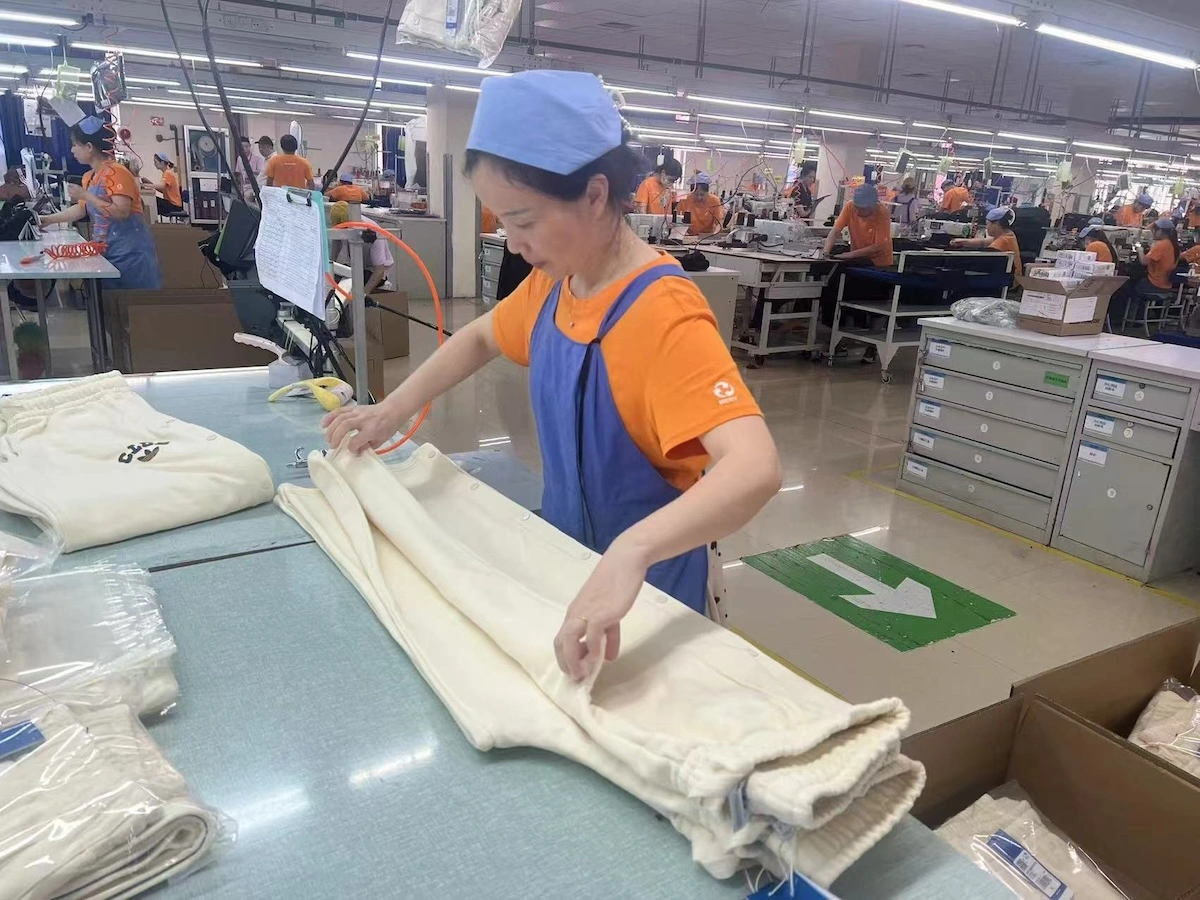
What follows is an inspection sequence for a finished eveningwear garment, in the order an inspector actually works through it, with the checks that catch the failures a tape measure does not.
This is written for fashion brands, retailers and sourcing teams inspecting evening, prom, bridesmaid and gala production. It assumes the general quality framework, which our garment quality control checklist, our guides to AQL inspection and inline versus final inspection, and our pre-bulk checklist cover. What follows assumes those and adds the two things none of them carries: the physical station sequence for a finished eveningwear garment, and a functional check. The category is on our evening dress manufacturing page, and gala and showpiece construction is on our gala dress page.
Why an evening dress needs a functional check
A blouse has to be the right size. An evening dress has to be the right size and then behave, for several hours, under load, in a posture the customer did not plan for. It is the only category where the garment's weight distribution, its internal support and its hem behaviour all change after the wearer sits down, and none of those properties is visible on a table.
The three dimensions of eveningwear QC
| Dimension | What it checks | How it is done |
|---|---|---|
| Dimensional | The garment matches the approved size chart within tolerance | Measure the critical points against the specification, flat and hung |
| Visual | The garment presents correctly — symmetry, surface, finish and colour | Compare left to right, look at it hung, and look at it under the light it will be sold in |
| Functional | The garment works on a body in motion and at rest | Put it on a form or a fitter, sit, walk, raise the arms and load the skirt |
Most rejections found late in a programme are failures of the third dimension that passed the first two. A gown that measures correctly, looks correct on a hanger and cannot be sat down in is a production problem that existed from the second sample and was never tested for.
What has to exist before inspection begins
An inspection without a written standard is a set of opinions. Before the first carton is opened, three documents should be in the inspector's hands: the approved measurement specification with tolerances, the approved construction and material specification, and the reference sample against which the bulk is being compared. Where a garment has an approved pre-production sample, that sample — not a photograph of it — is the standard. Without those three, every finding becomes a discussion and the inspection produces no decision.
The four failures that pass a measurement check
It is worth naming these before the station sequence, because they are the reason the sequence includes checks that have nothing to do with numbers. Each one is dimensionally invisible and commercially expensive.
| Failure | Why measurement misses it | Where it is caught |
|---|---|---|
| Hem and skirt imbalance | The hem measures correctly flat and drops unevenly once hung or worn, particularly on bias and on a curved hem | The hung check and the walking check |
| Internal structure under load | Every point measures correctly while the garment is supported by a table; the failure appears when the skirt's weight is carried by the bodice | The functional check, held for several minutes |
| Lining twist and sheerness | The outer garment is correct; the lining has been cut or set slightly off and pulls or shows through in movement | The inside check and the walking check |
| Embellishment loss and stress | Nothing has fallen off at inspection; threads are already abraded at the attachment point and fail after two or three wears | The surface check with a light tension test, and the inside check at the seam |
1. Measurements and size identification
The first station, and the one most often done in the wrong order. Identity before dimension, because a garment measured against the wrong size chart produces a finding that sends the whole inspection in the wrong direction.
Confirm identity first
Style, colour and size label, checked against the order and against the garment itself rather than against the carton. Mis-labelling is the defect that reaches the customer most often and costs the most to fix after dispatch, because it is invisible until someone opens a bag and finds the wrong size inside.
Measure the critical points
For an evening dress the critical points are not the same as for a top. Bust, waist and hip matter, but so do bodice length, the distance from the shoulder or strap point to the waist seam, the skirt length from the defined reference, and the sweep at the hem. The reference point for length has to be written into the specification, because measuring from the shoulder and measuring from the waist seam give different numbers for the same garment and both are correct.
Measure flat and hung
A bias-cut or draped garment measures differently on a table and on a hanger, and the hung number is the one the customer experiences. Where a style is cut on the bias or has a heavy skirt, both measurements are worth recording, and the specification should state which one the tolerance applies to. Recording only the flat measurement and rejecting on the hung one produces disputes that are about method rather than about the garment.
Record the failure, not the impression
A finding written as a size issue cannot be acted on. A finding written as a waist measurement four millimetres outside tolerance on the upper limit, on three pieces out of a sampled lot, tells the factory which operation to look at. The inspector's job is to produce a number and a location, and the corrective action follows from that rather than from a description.
2. Symmetry and balance
Symmetry is checked left against right on the same garment. Balance is checked front against back and top against bottom. They fail differently and they are found by different actions.
The left-right comparison
Compare the neckline, the straps or shoulder line, the armholes, the darts and the position of each seam. On an asymmetric design, the comparison is against the approved pattern rather than against the other side, which is why an asymmetric style needs its reference marked rather than described. Small asymmetries are cumulative: a neckline that is two millimetres lower on one side is not visible alone and is obvious once the garment is on a body, where the eye reads the shoulders as a horizontal line.
Hang it
Centre-front and centre-back alignment, and skirt and hem balance, are only visible hung. This is the check that catches the failure measurement cannot: a hem that is dimensionally correct and hangs unevenly because one panel was cut slightly off grain or because the skirt was hung before the bias had dropped. A skirt that must be hung before finishing should be hung at inspection, and the hem re-measured after it has been allowed to settle.
The specific problems of a long skirt
- Hem sweep that is uneven across the panels, visible only once the garment is hung or worn.
- A slit whose two sides are at different heights, or whose top is not reinforced on both sides.
- A train whose centre does not fall behind the wearer, which shows immediately in a photograph.
- A tier or a seam that sits lower at one side because the panels were not matched at the seam.
- An underskirt or petticoat visible at the hem on one side and not the other.
3. Lining and internal structure
The inside of an evening dress is where its structure lives, and it is the part of the inspection that a buyer cannot do from a photograph. This station is worth doing properly because the failures here appear in wear rather than at delivery, which means they are found by the customer.
Check the lining as a garment
A lining should not twist, pull, or bind. It should be cut to allow the outer garment to move without dragging it, attached so that it does not show at a slit or a hem, and long enough to do its job at the point where the garment opens. The lining is also an opacity decision: hold the garment against a strong light and confirm that the lining does what the specification says it does at the thinnest point, which is usually the bodice or the side seam rather than the skirt.
Check the structure where it is used
Interfacing at a neckline should be attached without blisters, and its edge should not be visible from the outside. Where there is a stay or an internal support, it should be attached at the points that carry the garment's weight rather than sewn in as a decorative band. Boning should sit in its channels without piercing them, the channel ends should be closed and finished rather than left raw, and no bone end should be capable of working through the fabric. Cups, whether bought in or moulded, should be positioned symmetrically and covered so that no edge shows.
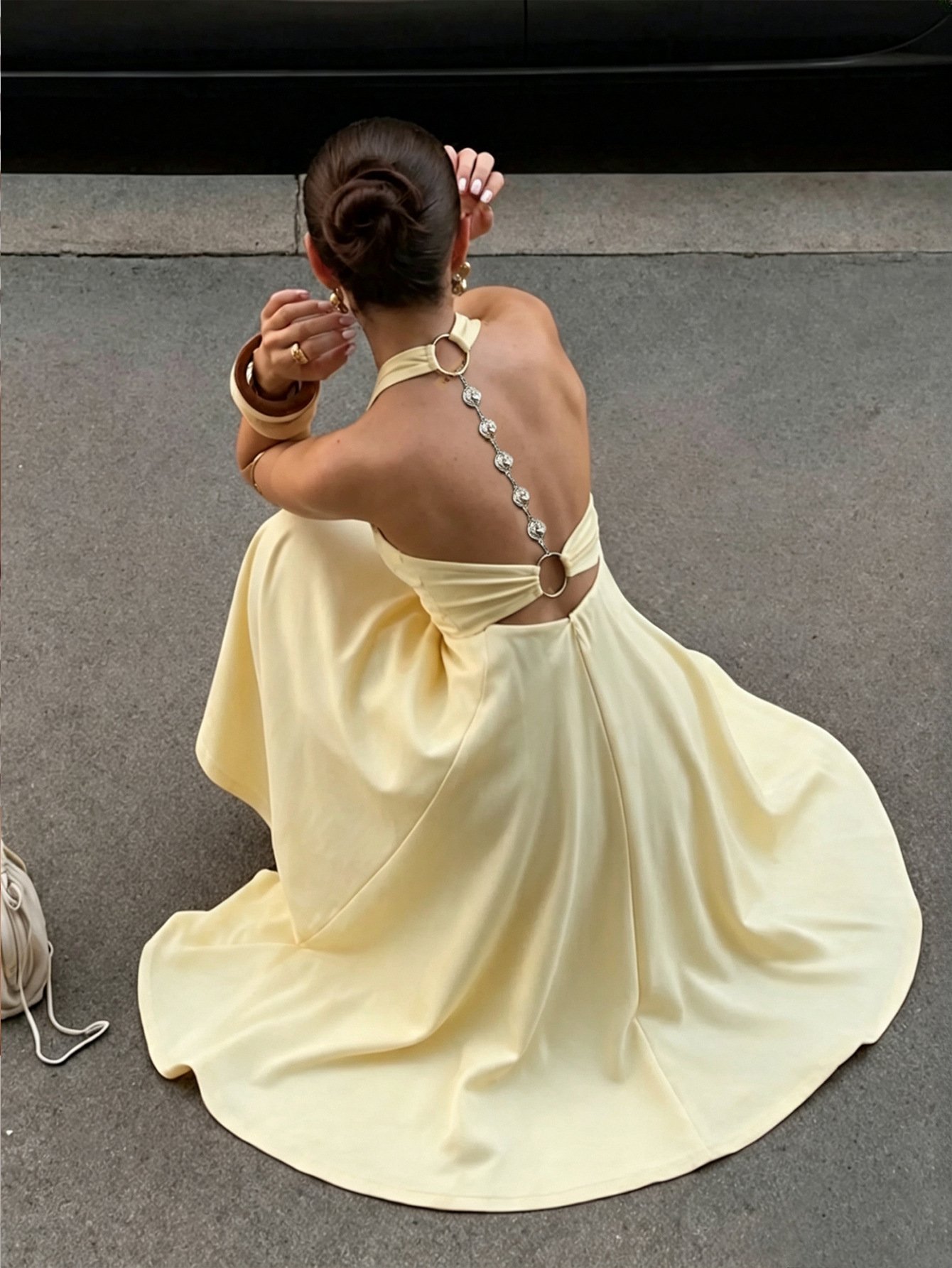
The inside is a comfort surface
Internal seam finishing, sharp edges at the waist seam, raw bone ends and exposed thread ends all sit against the wearer's skin or against a thinner layer of the dress. They are the reason a customer says a dress is uncomfortable without being able to say why. Inspecting the inside for feel, not only for appearance, is a specific check worth writing into the standard: run a hand along the waist seam and the bodice edge and note anything that catches.
4. Closures and stress points
Closures fail because they are the places where the garment is opened and closed under tension, and because a closure that works on a table may not work on a body. This station is done with the garment on a form.
Run the closure more than once
A zip should be run fully up and down several times, not once. The failures worth finding are the ones that appear on the second or third pass: a slider that stiffens, a tape that has been caught in the seam, a curve in a bias panel that makes the zip wave, or a top stop that sits too low and lets the slider leave the tape. On a hidden zip, confirm that the seam above and below the opening is straight and that the placket covers the tape completely when closed.
Check every secondary closure
Hook and eye, loops, buttons, press studs and lacing all have their own failure modes and are easy to pass over because the zip is where attention settles. Test the hold of each: a hook and eye that releases under light tension will release while the wearer is dancing. On a laced back, check the cord, the eyelet spacing and the finish of the eyelets, since a raw eyelet abrades the cord on every wear.
Inspect the stress points with light tension
The places that fail are predictable: the top and bottom of a slit, the point where a strap joins the bodice, the end of a zip, the point where a boned bodice meets the skirt, and the attachment point of any heavy beadwork. Apply light tension by hand at each and look for skipped stitches, a seam that opens, or a thread that has been cut by a needle. A stitch density that has been reduced to save time is most visible here, and it is the defect most likely to reach the customer.
The reinforcement detail
Reinforcement at a slit top, a strap join or a zip end is a small piece of construction that is invisible when present and expensive when absent. In the inspection it is worth confirming physically rather than visually: the point should not move under light tension, and the reinforcement should be inside the garment rather than a visible bar tack in the middle of a clean seam.
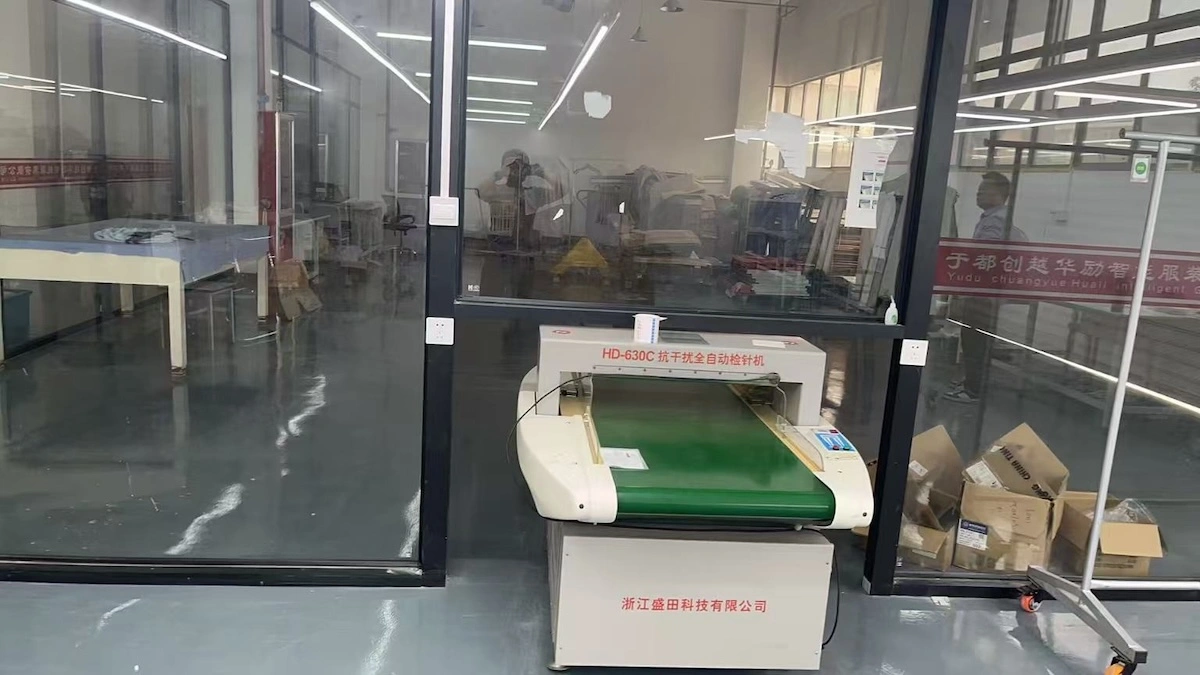
5. Surface and presentation
The last station before the functional check, and the one where a garment is usually either released or held. Surface inspection is done under the lighting the garment will be sold in, because a fault that is invisible under a warm lamp is obvious under daylight and the reverse.
The surface checks
- Loose beads, missing stones or sequins, and any bead that moves under a fingertip.
- Exposed thread ends, particularly at the ends of seams and at handwork attachment points.
- Glue residue or adhesive marks on a ground fabric, which are common where a trim has been tacked.
- Motif or applique alignment against the pattern, including any repeat that must run continuously across a seam.
- Snags, pulls or needle marks on a delicate ground, which do not repair and cannot be pressed out.
- Stains, oil marks or hand marks, which are usually introduced by the inspector's own handling and are worth a separate check at the end.
- Shine or press marks on a satin or a pile, which are permanent and appear where a hem or a seam was pressed too hard.
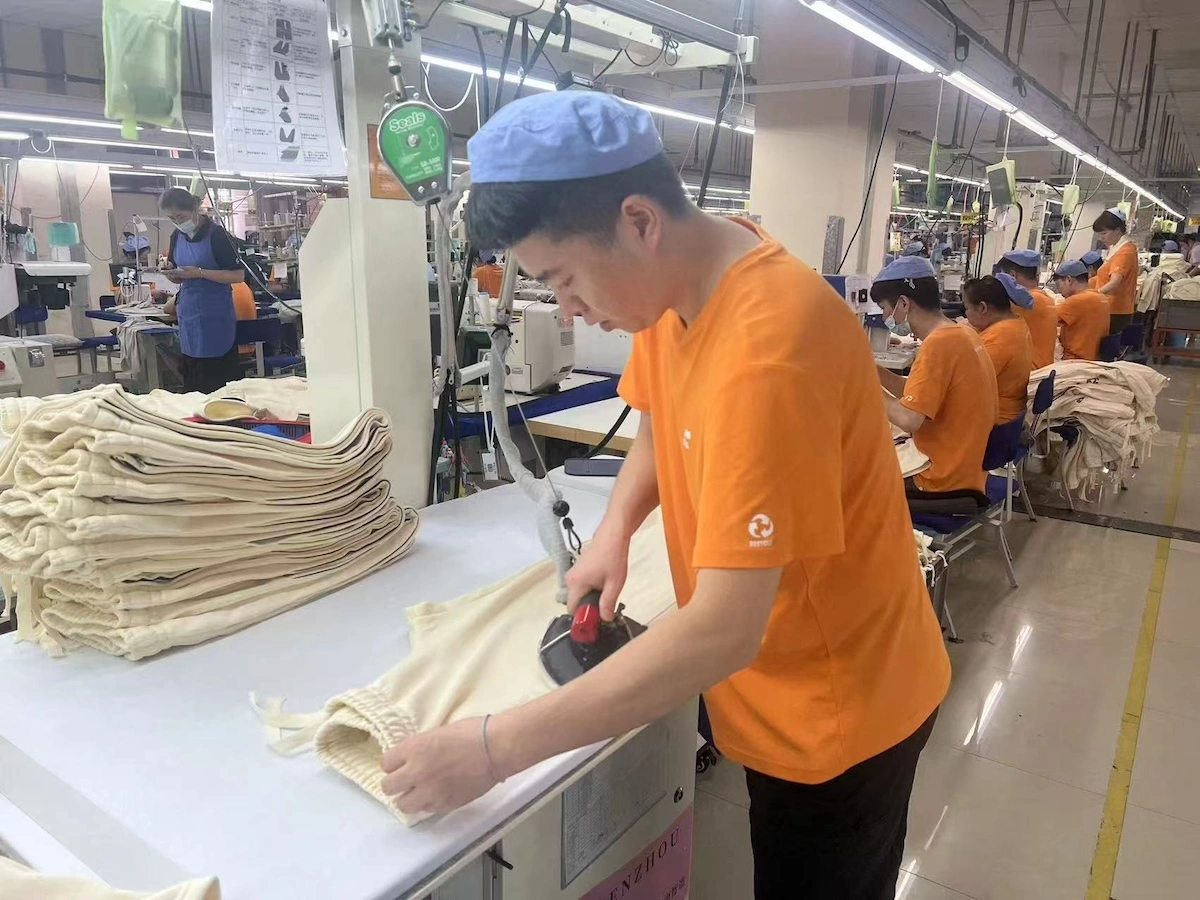
The confirmation checks
Final pressing and shape: the garment should sit the way the approved sample sits, with the folds where the design intends them. Labels, care information and hangtags, checked for content, position and orientation. Protective packing, checked against the method the specification requires — an evening dress is usually not a flat-fold garment, and a beaded bodice needs a barrier between the surface and whatever it rests against.
Check it under the light it will be sold in
Colour and surface read differently under different sources. An eveningwear inspection done only under a warm factory lamp will approve shades that shift under daylight and surfaces that flash under a camera. Where a shade or a surface finish is critical, confirm it under at least two sources, and where a garment has a metallic or high-gloss surface, check it from more than one angle, because that is how the customer will first see it.
The functional check: seated, walking and under load
This is the station that most eveningwear programmes omit and the one that produces the findings worth the most. It requires a form that matches the sample's measurements, or a fitter, and a few minutes of deliberate movement.
The sequence
- Fit the garment and confirm the neckline and straps hold their position without adjustment.
- Sit down, and stay seated long enough for the skirt's weight to settle onto the bodice and for any shift at the waist to become visible.
- Stand and walk several steps, checking hem clearance, slit behaviour and whether the skirt returns to its intended position.
- Raise both arms, and check that the bodice does not ride up and the straps do not fall.
- With the garment on, check the lining at the slit and the hem for show-through and twist.
- Load the skirt where it is heavy, and observe the bodice, the waist seam and the shoulder line under that load.
What each movement is testing
Sitting tests the load path: whether the skirt's weight is carried by structure or by a seam. Walking tests hem clearance and slit behaviour, and is where an uneven hem becomes visible. Raising the arms tests whether the bodice needs the wearer to hold it, which is the difference between a dress that can be worn for an evening and a dress that has to be managed. Loading the skirt tests the internal structure and the bodice-to-skirt join together, which is the single most common structural failure in a ball gown or a mermaid silhouette.
What cannot be checked this way
A form is not a body, and the functional check does not replace a fit session on a real person at the development stage. What it does is confirm that the production garment still behaves like the approved sample. If the sample passed the seated check and the bulk does not, the difference is a production finding — a boning channel sewn slightly short, a stay omitted, a seam allowance reduced — and it is worth finding before the cartons leave.
Tolerances, defect classes and what a fail means
An inspection produces data, and data only becomes a decision when the standard defines what counts as a fail and what has to happen next.
Write the tolerance, not the target
A specification that states the target measurement without a tolerance leaves the inspector to decide, and different inspectors will decide differently. Tolerances are usually asymmetric for a reason — a skirt that is marginally long can be shortened, one that is short cannot be lengthened — and that asymmetry should be in the document. Where a style is graded across a wide size range, the tolerance may also need to widen at the extremes, which is a decision to take at the specification stage rather than at inspection.
Classify every defect
The industry convention of critical, major and minor exists so that a lot can be judged as a whole rather than piece by piece. The classification decisions worth making deliberately for eveningwear are: a sharp internal edge or an exposed bone end is critical, because it causes injury or a return; an uneven hem on a long skirt is major, because it is visible and it is the reason the customer chose the dress; a loose thread end is minor, because it is removable. The value of classifying is that it prevents a lot being rejected for a set of minor findings, which is the most common way a working inspection becomes an unproductive one.
| Finding | Class | Why it sits there |
|---|---|---|
| Exposed bone end, sharp internal edge or a pin left in the garment | Critical | Causes injury or a return, and cannot be accepted at any lot quality |
| Uneven hem on a long or bias skirt, visible in movement | Major | Visible to the customer and central to why the garment was chosen |
| Zipper waviness, lining twist or show-through at a slit | Major | Visible in wear, and not repairable by pressing or steaming |
| Structural failure under the seated check | Major | Indicates the bulk does not behave like the approved sample |
| Loose thread end, removable mark, minor surface dust | Minor | Removable at packing and not visible to the customer |
What a fail actually requires
A failed inspection needs a disposition rather than a verdict: rework and re-inspect, accept with a documented deviation, or reject the affected units. The disposition should be agreed in advance for each class of finding, because the moment a failure is discovered is the worst moment to invent a policy. Where a finding is systemic — the same measurement out on every piece, or the same seam opening under tension — the correction belongs upstream, and inspecting the rest of the lot harder will not fix it.
The inspection record
The value of an inspection is mostly in what it produces afterwards. A record that names the lot, the size and colour, the checks performed, the measurements taken with the specification they were compared against, the findings by class, and the disposition of each, is what makes a reorder easier than the first order.
What to keep, and why
- The approved specification the inspection was measured against, so the numbers remain interpretable months later.
- The measurements themselves, not only the pass or fail, so a drift across lots can be spotted.
- Photographs of each finding, marked on the garment rather than described in words.
- The disposition of each finding, so that a decision to accept a deviation is a record rather than a memory.
- The reference sample or its equivalent documentation, retained and controlled.
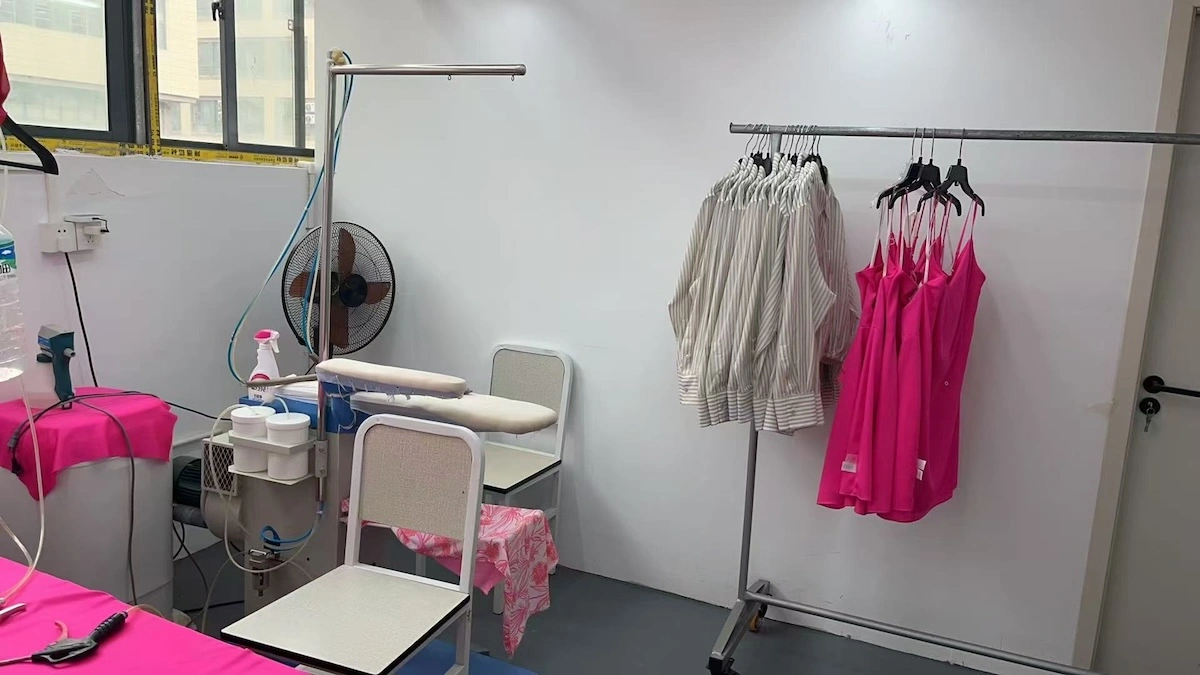
The check that pays for itself
If only one additional check can be added to an existing eveningwear programme, it should be the seated functional check. It costs a few minutes per style, it requires nothing but a form or a fitter, and it catches the failures that measurement cannot see and that a customer will find within an hour of putting the dress on. Every other check on this page protects the brand's specifications; this one protects the brand's returns rate.
Practical buyer worksheet
The checklist on one page
The stations above, in the order they are worked, with the test each one uses and the failure it is there to catch. This is the sheet to hand to an inspector; the sections above explain why each line exists.
| Station | The test | The failure it catches |
|---|---|---|
| Identity | Style, colour and size label against the order and the garment | Mis-labelling, which reaches the customer most often |
| Measurements | Critical points flat and hung, against the approved chart and tolerances | Measurement creep across a lot, and reference-point errors |
| Symmetry | Left against right; asymmetric styles against the approved pattern | Cumulative asymmetry that reads as a crooked shoulder line |
| Balance | Hang the garment, check centre lines and hem sweep | Uneven hems on long, curved and bias-cut skirts |
| Inside | Lining behaviour, interfacing, stays, boning channels, cup placement, sharp edges | Structural and comfort faults invisible from the outside |
| Closures | Run the zip several times; test every secondary closure | Failures that appear on the second or third use |
| Stress points | Light hand tension at slit tops, strap joins, zip ends, heavy handwork | Skipped stitches and seams that open in wear |
| Surface | Loose or missing embellishment, glue, snags, stains, shine, motif alignment | Permanent faults introduced in finishing, and attachment points already abraded |
| Function | Seated, walking, arms raised, skirt loaded, lining checked in movement | The four failures that pass a measurement check |
| Record | Measurements, findings, class and disposition captured against the lot | A repeat of the same finding on the next order |
The worksheet below is the order file in brief. For inspection purposes the last two lines matter most: without a stated latest acceptable delivery date and a named inspection point, the findings arrive when there is no longer anything to do about them.
- Target customer and use occasion
- Target retail and wholesale price
- Target ex-factory or landed cost
- Core fabric and backup fabric
- Size range and base fit size
- Colour count and continuity colours
- Critical construction risks
- Approval sample required
- Inspection checkpoints
- Latest acceptable delivery date
FAQ
What are the common defects?
They cluster in the same places across the category. Uneven hems on long and bias-cut skirts. Zipper waviness where a zip is set into a curve or a bias panel. Lining that twists, pulls or shows at a slit. Loose or missing embellishment where the attachment thread has been abraded rather than broken. Seam puckering on a light ground. Stains and press shine introduced during finishing. And measurement creep, where the same point is out on a whole lot because a pattern or a marker decision was made once and not corrected.
Should every garment be measured?
Sampling plans vary with order size, and measuring every piece is usually neither necessary nor useful. What matters more is which points are measured and which styles justify a tighter check. Critical measurements and high-risk constructions — a boned bodice, a bias skirt, a heavily beaded panel — justify a wider sample than a simple style at the same quantity, and a style in its first production run justifies a wider sample than the same style on a reorder.
Why inspect the inside?
Because corsetry, lining and internal support components can fail even when the exterior is perfect, and because the inside is where the garment's structure and its comfort both live. An inspection limited to the visible surface will approve a dress that is structurally compromised and physically uncomfortable, and both of those faults reach the customer rather than the brand. The inside is also the fastest check to perform: it takes a minute and it answers questions that the outside cannot.
When should quality control happen?
At incoming, in-line and final stages where the construction justifies them, with the functional check added at the final stage for any style with a structured bodice, a long skirt or load-bearing embellishment. The general rule is that inspection should happen before the cost of fixing a defect rises, and on an evening dress the final functional check is the last point at which a structural finding is still repairable rather than a reason to hold a shipment.
Next step
We develop and produce evening, prom, bridesmaid and gala wear at our production facilities in Guangzhou and Dongguan, with documented specifications, agreed tolerances and defect classification, inline inspection on the constructions that carry risk, final measurement and workmanship inspection, and a functional check on structured and long-skirt styles before packing. Send the specification you intend to inspect against and the checkpoints you want reported, and we will come back with an inspection plan rather than a statement that quality is guaranteed. Request a quote, or see the constructions we run on our evening dress manufacturing page.
Our guide to common dress manufacturing defects covers how these findings are prevented rather than detected, and our style library and ready stock both show constructions already in production. The wider category we work across is on the women's dresses page.