On this page
- Durability Is a Condition, Not a Single Result
- Build the Plan From Product Risk
- Core Test Areas, and What Each Is Really Checking
- A Product-Specific Test Matrix
- Four Stages, Four Different Questions
- Common Ways a Durability Plan Fails
- Turning a Result Into a Specification
- Running a Wear Trial So It Produces Evidence
- Who Owns Test Selection
- Why Testing Cannot Guarantee Zero Returns
- Frequently Asked Questions
- Working With Luxudress
- Related pages

Durability is not one laboratory result. It is the garment’s ability to maintain fit, appearance and function through the conditions it is designed to experience. A satin evening dress, tailored blazer and washable lounge set need different test plans because their materials, construction and care routes are different.
The useful question is not “Has the garment been tested?” It is “Which failures would make this product unsaleable, and which tests or wear trials detect them before bulk?”
The reason that framing matters is that testing is expensive and time is short, and a template plan spends both evenly. A plan built from risk spends them where failure would actually cost the brand — a returns spike, a marketplace delisting, a review photograph of a split seam on the first wear. Two styles can have identical fabric and completely different risk profiles because of how they are worn and cleaned.
This article is about building that plan rather than copying one. It covers how each core test area is really used, why material reports do not cover garments, how a result becomes a specification, what a wear trial has to do to produce evidence rather than opinion, and where the responsibility sits between brand and factory. It deliberately does not present a fixed suite, because no such suite exists for womenswear.
Durability Is a Condition, Not a Single Result
A test result is a number produced under a defined method. Durability is a behaviour observed under a defined use-and-care condition. The two are related but not identical, and the difference decides whether a test plan is useful or decorative.
A satin evening dress worn twice a season and dry cleaned sits at one end of the range. A tailored blazer worn weekly, pressed and occasionally cleaned sits in the middle. A washable lounge set worn twice a week and machine washed sits at the other end. Applying the same suite to all three wastes money on two of them and can still miss the third.
The consequence is that the same fabric can pass the same test and still fail two different products. A satin that performs acceptably in a lightly worn column dress may slip at the seam in a close-fitting satin bodysuit. The test measures the fabric; the failure happens in the garment, under a wear condition the fabric report never saw.
There is a second consequence that costs brands money: a plan built around a care route the customer will not follow records the wrong risk. If the label says dry clean and the customer machine washes anyway, the tests that matter are the ones behind the behaviour that actually happens. A durability plan is therefore also a statement about the care instructions the brand is prepared to stand behind, and the two should be written together rather than one after the other.
Build the Plan From Product Risk
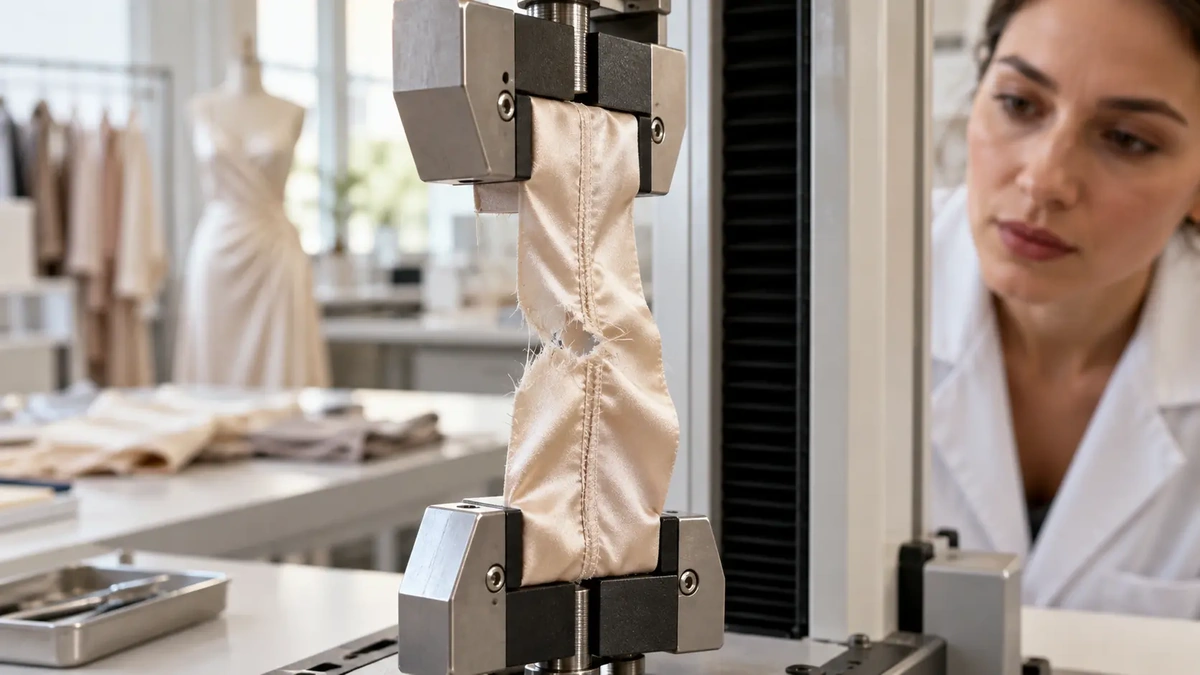
Risk is the product of two things: how likely a failure is, and what it costs when it happens. A loose thread on a hem is cheap to forgive. A snapped hook at the back of a corset dress, a slipped satin seam at the seat, or a bead field shedding stones across a floor are not. The plan should spend its budget where failure is expensive, not spread it evenly across a template.
Consider each of the following before selecting a single test:
- intended frequency of wear;
- care method;
- fitted or relaxed silhouette;
- stretch and recovery;
- fabric surface sensitivity;
- seam stress points;
- zippers, snaps, buttons and hooks;
- cups, boning and internal support;
- beads, sequins, lace and appliqué;
- marketplace or retailer requirements.
Two of those factors do most of the work. The care route decides which colourfastness and dimensional tests matter, because a dry-clean-only garment and a machine-wash garment fail in different ways. The construction decides which mechanical tests matter, because a fitted bodice and a relaxed kaftan stress different seams. Get those two right and the rest of the plan mostly follows.
| Risk factor | What it usually triggers |
|---|---|
| Machine wash and tumble dry | Dimensional stability, colourfastness, pilling, seam comfort |
| Dry clean only | Solvent colourfastness, pressing sensitivity, lining behaviour |
| Close-fitting silhouette | Seam slippage, seam strength, opacity, stretch recovery |
| Heavy embellishment | Attachment security, snagging, base-fabric damage, packing trial |
| Internal structure | Boning recovery, cup support, channel strength, closure cycling |
| High wear frequency | Abrasion, pilling, elastic recovery, repeated laundry |
The table is a starting point, not a decision. When a retailer supplies its own protocol, that protocol governs, and the risk review becomes a way of checking that the protocol covers the failures you can see coming in your particular construction.
Core Test Areas, and What Each Is Really Checking
Dimensional stability
Checks shrinkage or growth after the approved care process. Test the complete garment when construction and components interact, not only the shell fabric.
The common mistake is to test the shell and call the garment covered. A shell that shrinks two percent may be fine on its own; a lining that shrinks five percent inside that shell will pull the hem up and distort the bodice. Where a garment has a lining, an interlining and a shell with different behaviour, the meaningful test is the assembly, because that is what the customer receives.
Colourfastness
Select relevant routes such as washing, rubbing, perspiration, water or dry cleaning. Dark linings, contrast panels and saturated colours deserve attention because transfer can damage the garment or other items.
The route matters more than the label. Perspiration fastness is the route that catches dark linings against light shells and trims that darken against skin. Rubbing fastness is the route that catches a strong colour transferring onto a pale bag strap. Water fastness is the route for a garment described as rain-friendly. Choose the route the product will actually meet, then hold the result against the standard the brand or retailer has set.
Pilling and abrasion
Important for fabrics exposed to rubbing at underarms, hips, seat and bag-contact areas. The acceptable result depends on product positioning and fabric character.
These two are often discussed together because they fail together, but they answer different questions. Abrasion is about whether the surface survives repeated friction; pilling is about whether loose fibres form visible balls. A knit lounge set and a wool blazer both rub, and they fail in ways the customer reads very differently — a pilly lounge set gets returned quietly, a pilled blazer gets photographed.
Seam strength and seam slippage
A strong sewing thread cannot compensate for a fabric that slips at the seam. Fitted dresses, skirts and lightweight satins often need construction-specific assessment.
This is the area where the distinction between the two tests is most valuable. Seam strength asks whether the seam itself holds under load; seam slippage asks whether the yarns in the fabric move apart where the seam runs. A brand can specify the strongest available thread and still see a satin skirt fail at the seat, because the failure is in the fabric rather than in the stitch. For fitted dresses and lightweight satins, both questions have to be asked, and the seam type, stitch density and seam allowance are part of the answer.
Construction is the lever when slippage is the risk. A French seam, a bound seam or a wider seam allowance distributes load differently from a plain overlocked join, and a stay tape at a stressed curve can change the result. Those are decisions a factory can propose and a brand can specify, and they are cheaper to agree at the sample stage than to discover in returns. Slippage is rarely fixed by a better thread; it is fixed by a better seam.
Stretch and recovery
Evaluate whether elastic fabrics return after wear and whether seams stretch with the fabric. Poor recovery changes fit even when the garment does not tear.
Recovery is the quieter failure. Nothing breaks, nothing is visibly damaged, and the garment simply grows. A bodycon dress that relaxes through a long evening, a waistband that stops returning, a shoulder seam that stays stretched after a night on a hanger — all of these are recovery problems, and none of them is detected by a test that only measures breaking strength.
Fastener performance
Cycle zippers, hooks, snaps and buttons. Check attachment, alignment and interaction with the fabric. An invisible zipper may function but still distort a lightweight satin seam.
Cycling is the part teams skip. A zip that closes once in a sample room has not been asked the question the customer will ask over a season. Cycle it, then look at the fabric beside it, because a fastener can pass its own test and still ruin the seam it is set into. Hooks on a corset back, snaps on a bodysuit and buttons on a blazer each concentrate load differently, and each deserves its own check.
Embellishment attachment
Test beads, sequins, stones, appliqué and decorative hardware according to intended use. Inspect both attachment security and damage to the base fabric.
Attachment security and base-fabric damage are two separate results and both matter. A stone that holds firmly but is sewn through a delicate mesh may be secure and still tear the ground. A bead that damages nothing may still shed under abrasion. Embellished styles also need a packing trial, because a decoration that survives wear can still be crushed in a folded carton.
Internal support
For corsetry and structured dresses, review cup stability, boning ends, channel strength, underbust support and recovery after sitting or movement.
Internal support is where laboratory testing and wear trials most need each other. A bench test can measure channel strength and tolerance at a boning end, but only a person sitting through an evening tells you whether the boning rides up, whether the cup shifts and whether the underbust support holds after an hour in a chair. For corsetry, plan both.
A Product-Specific Test Matrix

The matrix below maps common womenswear categories to their priority checks. It is a starting position for a conversation with a laboratory, not a substitute for one, and a retailer protocol always overrides it where the two differ.
| Product | Priority durability checks |
|---|---|
| Satin occasion dress | Seam slippage, snagging, colourfastness, zipper seam, pressing sensitivity |
| Corset dress | Boning recovery, cup position, channel strength, hook/zipper performance |
| Blazer | Seam strength, fusible performance, pilling, dimensional stability, button attachment |
| Stretch dress | Recovery, seam extension, opacity, dimensional stability |
| Sleepwear / loungewear | Washing, colourfastness, pilling, seam comfort, elastic recovery |
| Embellished dress | Decoration attachment, snagging, surface protection and packing trial |
Read the matrix as a set of absences as well as presences. The satin dress row does not mention pilling, because pilling is not its characteristic failure. The blazer row does not mention bead attachment, because there are no beads. The value of writing the plan down is that it makes the omissions deliberate rather than accidental, and an omission you chose is very different from one you forgot.
Four Stages, Four Different Questions
It is common to hear the whole sequence described as “testing”, which blurs four stages that answer four different questions. Keeping them separate is what stops a material report from being mistaken for garment approval.
| Stage | Question it answers | Typical evidence |
|---|---|---|
| Material testing | Does this fabric meet the required material properties? | Fabric test report by colour and batch |
| Garment-level testing | Do the materials, seams and components behave together in the finished garment? | Garment test report on the assembled piece |
| PP-sample validation | Does the production-ready sample, in actual materials, meet the approved standard? | Sealed PP sample with measurements and construction notes |
| Bulk inspection | Does the shipped production follow the approved standard? | Inline and final inspection records |
The failure mode this prevents is treating a fabric report as proof that the garment has been tested. A fabric report cannot see a seam, a zip, a lining that shrinks differently from the shell, or a cup that shifts. Conversely, a garment test cannot tell you whether the next dye lot of the same fabric will behave the same way. The stages are complements, not alternatives, and a brand that runs only one of them is testing a different question from the one it thinks it is answering.
Common Ways a Durability Plan Fails
Most weak durability plans fail in one of a small number of recognisable ways, and none of them is about the laboratory. They are about what the brand commissioned, what sample was sent and what happened to the result afterwards.
- A template suite for every style. The same tests are booked regardless of construction, so budget is spent on risks the product does not have and saved on the ones it does.
- A material report treated as garment approval. The fabric passed, the seams and components were never assessed, and the file reads as complete.
- A sample that cannot be traced. The laboratory receives a piece of fabric with no colourway, batch or construction noted, and the result cannot be tied to the product.
- A result with no decision. The test passed or failed and nothing in the specification, construction, care label or inspection plan changed as a result.
- Testing after bulk instead of before. The evidence arrives in time to explain a problem rather than to prevent one.
- A care label that contradicts the test route. The garment was tested for one condition and labelled for another, so the evidence does not cover the instruction the customer reads.
The remedies are unglamorous: build the plan from risk, send a traceable sample, record a decision against every result and test before cutting rather than after shipping. A durability plan is judged less by how many reports it produces than by how early and how clearly it changes something.
Turning a Result Into a Specification

A report is useful only when the result influences material selection, construction, care labels, tolerances or inspection. A file of reports that changed nothing is a cost, not a control.
The conversion is mechanical if the record is complete. For every result, capture the method used, the identity of the sample, the colour, the date and the decision taken. The decision is the part that turns a number into a specification, because it states what the business will now do differently — accept the material, change the seam, adjust the care label, tighten a tolerance or reject the option.
- Method — the standard or in-house method the test followed, so the result can be compared with another.
- Sample identity — which fabric, style, colourway and construction the sample represented.
- Colour — recorded separately, because colourfastness and dyeing behaviour can differ between colourways of the same fabric.
- Date — the test date, since methods and material lots change over time.
- Result — the outcome against the stated limit or requirement.
- Decision — what was changed, approved, rejected or monitored as a result.
Running a Wear Trial So It Produces Evidence
Laboratory tests are controlled and repeatable, but a wear trial can reveal movement, comfort, strap behaviour, cup shift, lining twist and closure problems. Those are exactly the failures a bench test cannot see, which is why wear trials exist — and exactly why they so often produce opinion instead of evidence.
The difference between an opinion and evidence is structure. A wear trial earns its place when the participants, the wear conditions, the duration and the observations are defined in advance and recorded consistently. “Everyone liked it” is an opinion. “Four wearers, two hours of seated and standing wear, three reported the strap slipping on the left shoulder after forty minutes” is evidence, and it points at a pattern correction.
- Define the wearers and their body measurements against the sample size.
- Define the wear conditions — duration, activity, undergarments and movement.
- Define what is being observed: fit drift, strap behaviour, cup position, lining twist, closure function, comfort at seams.
- Record observations against a time sequence rather than as a single summary.
- Photograph any visible change rather than describing it in adjectives.
- Feed the findings back into the pattern, construction or care decision.
Use wear trials where the risk is behavioural rather than measurable. If a seam will slip, a machine will find it faster than a person. If a bodice feels wrong after an hour of sitting, only a wearer will find it at all.
Who Owns Test Selection
Test selection is shared, and confusing the roles is how gaps appear. The brand or importer should confirm the requirements with its compliance team, the retailer and a qualified laboratory. Those parties hold the standards, the market requirements and the accredited methods. The factory identifies construction risks and provides representative samples for the tests to run on.
The factory’s contribution is easy to underestimate. A test is only as good as the sample it runs on, and the factory is the party that knows which construction, which colourway and which production lot the sample represents. A factory that supplies a sample without knowing which colourway it is, or which batch of fabric it came from, hands the laboratory a result that cannot be traced to the product.
Why Testing Cannot Guarantee Zero Returns
Testing reduces known risks and provides evidence against defined criteria. It does not eliminate returns, and a brand that treats a pass as a guarantee will be disappointed in a way the test plan cannot prevent.
The reasons are structural. A test evaluates a sample against a method; the customer evaluates a garment against expectation. Fit, sizing perception, how the garment is actually worn and cared for, and whether production stayed consistent with the tested sample all sit outside the test. A garment can pass every test and still come back because it did not fit the person who bought it, or because the bulk run drifted from the approved sample.
The realistic promise of a durability plan is narrower and more useful: it finds the failures that would otherwise show up across a whole production run, it gives the brand documented evidence when a claim or a return is disputed, and it converts avoidable risk into a specification before cutting begins. That is a real return on the cost of testing, and it is the honest one.
It is also worth separating two kinds of return. Some returns are durability failures — a seam that opens, a colour that runs, a zip that jams — and those are the ones a test plan can reduce. Others are fit and preference returns, where the garment performed exactly as designed and the customer did not want it. Treating a test plan as a solution to the second kind of return leads to over-testing and disappointment; the two problems need different responses.
Frequently Asked Questions

Does every style need every test?
No. Use a risk-based plan built from the material, construction, care route, market and buyer requirements. A template plan spends budget evenly; a risk plan spends it where failure would cost the most.
Can a fabric report cover the finished garment?
It may support material properties but does not evaluate seams, trims, component interaction or garment construction. A fabric report and a garment test answer different questions, and one cannot substitute for the other.
Who chooses the test methods and limits?
The brand or importer should confirm requirements with its compliance team, retailer and a qualified laboratory. The factory identifies construction risks and provides representative samples.
Can testing guarantee zero returns?
No. It reduces known risks and provides evidence against defined criteria. Fit, customer use, sizing perception and production consistency also affect returns and sit outside the test.
When is a wear trial more useful than a laboratory test?
When the risk is behavioural rather than measurable — fit drift, strap behaviour, cup shift or comfort after sitting. A machine detects a slipping seam faster than a person, but only a wearer can report that a bodice feels wrong after an hour.
What is the difference between material testing and PP-sample validation?
Material testing checks whether a fabric meets its required properties. PP-sample validation checks whether the production-ready sample, in actual materials and construction, meets the approved standard. They sit at different stages and answer different questions.
What should be recorded when a test is completed?
Record the method, the sample identity, the colour, the date, the result and the decision. The decision is what turns a result into a specification, because it states what the business will change as a result.
How should a brand decide how much testing to commission?
Start from the failures that would make the product unsaleable, then test the highest-consequence risks first. Add tests where a retailer protocol, a market requirement or a new construction introduces a risk the existing evidence does not cover.
Working With Luxudress
Luxudress is the factory-direct front end for womenswear production across production facilities in Guangzhou and Dongguan, covering development, sampling, material sourcing, manufacturing, inspection and export packing.
On durability we do the part that sits with production rather than the part that sits with the laboratory. We review womenswear materials, construction and finishing against the approved brief, identify the construction risks that a test plan should cover, and supply representative samples tied to the right style, colour and production lot for buyer-nominated testing. We do not set the limits; those follow the brand’s requirements, the retailer protocol and the laboratory’s methods.
Send the target market, care route, retailer protocol and the product risks you are most concerned about, and we will tell you which samples to prepare and which construction points to look at. You can also see how we manage quality control, review how we source and approve fabrics, or read why approved samples change in bulk production.
Request a quote and we will confirm the evidence, samples and inspection points your order needs before testing is booked.