On this page
- Quick answer: what should a garment QC checklist cover?
- What has to exist before quality control means anything
- Material inspection and cutting checks
- In-line checks: where most problems are still cheap
- Why defects cluster, and what that tells you
- Practical example: the same defect at three stages
- Common mistakes buyers make on quality control
- What inspection does to cost and lead time
- What to prepare before the run starts
- How quality control works with us
- Frequently asked questions
- What to take away
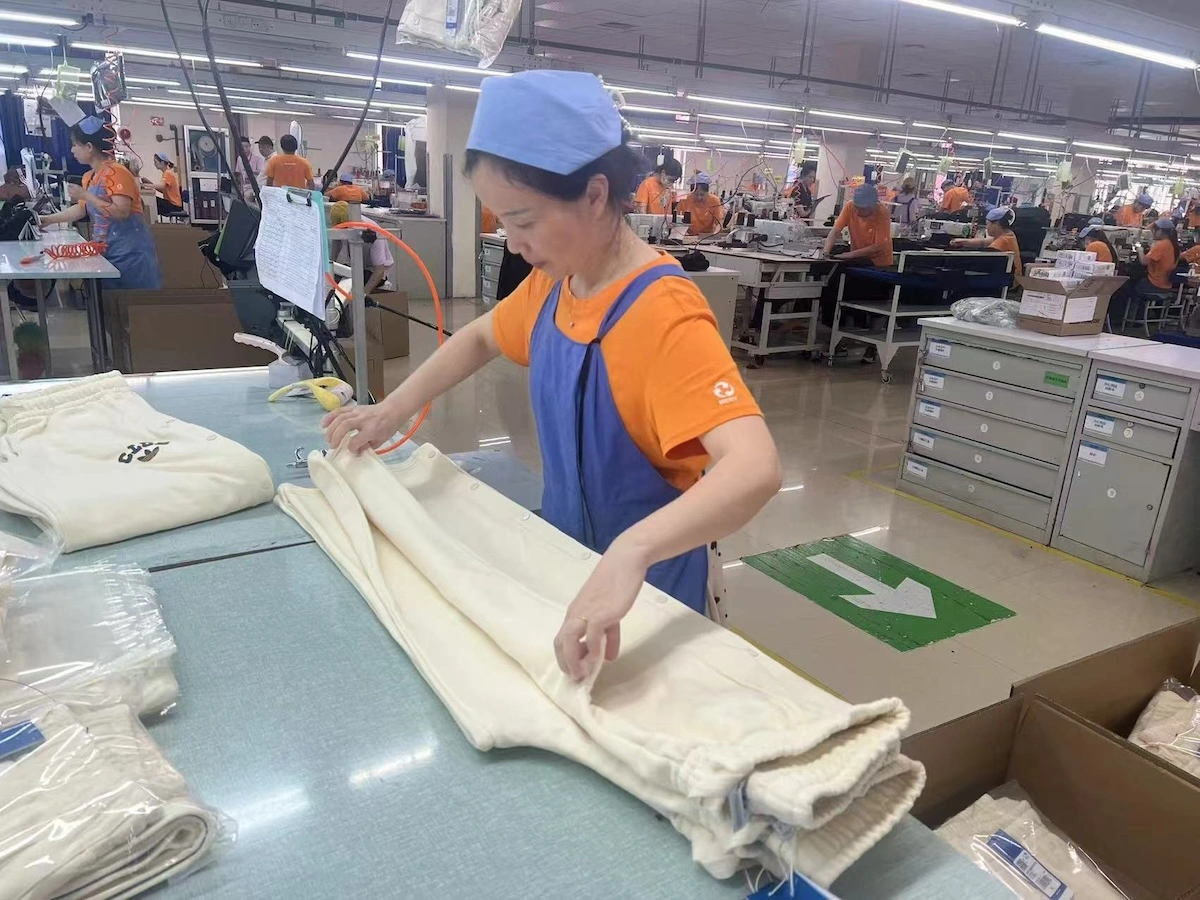
A quality control checklist that only lists what to look at is of limited use, because the hard part is not knowing that seams matter. The hard part is knowing when in the production calendar each check is still cheap to act on, and what to do when a check fails.
Buyers usually meet quality control at the end, as a final inspection report. By then the only remedies left are rework, replacement or a discount, and all three cost more than the problem would have if it had been caught earlier. This guide puts the checks in production order and says what each one can and cannot catch.
It is written for the buyer rather than for the inspector, so it covers the checks you can reasonably ask about and the evidence worth keeping. If you want the sequence from the factory's side, what a womenswear manufacturer actually does describes how a style moves through the floor.
Quick answer: what should a garment QC checklist cover?
Six things, checked at six different points: incoming material, cutting, in-line sewing, finishing and trims, pressing and appearance, and a final inspection against an agreed standard before packing. Each stage catches a different class of defect, and a defect that survives to the next stage usually costs more to fix than the check that would have found it.
| Stage | What it catches | What it cannot catch |
|---|---|---|
| Material on receipt | Shade variation between rolls, width, faults, weight | Whether the fabric suits the pattern |
| Cutting | Ply slippage, mismatched panels, print placement | Anything introduced at the machine |
| In-line sewing | Seam strength, stitch density, measurement drift as the line runs | Faults on garments not yet inspected |
| Finishing and trims | Buttons, zips, labels, loose threads, missing components | Fit as worn |
| Pressing and appearance | Pressing marks, shine, distorted hems | Invisible construction weakness |
| Final inspection before packing | Measurement against the chart, workmanship, packing accuracy | Anything that left the line before the check |
The right-hand column is the honest part. No inspection stage proves a garment will wear well — it proves the garment matches a written standard at a moment in time.
What has to exist before quality control means anything
Inspection compares a garment to a standard. Without an agreed standard, an inspection produces an opinion, and opinions do not resolve a shipment dispute. Four documents have to exist before the first check is worth running.
An approved sample
The sample that was signed off becomes the physical reference for construction, colour and finish. It should be sealed and kept, not used as a display piece, and the approval should state which sample round it was.
A graded measurement chart with tolerances
Every measurement that matters, with an acceptable range for each. A chart without tolerances turns a good garment into a rejected one over two millimetres, and a chart with generous tolerances accepts garments the customer will return.
An agreed defect list and inspection basis
Which defects are critical, which are major and which are minor, and how the sample will be drawn from the shipment. Agreeing this in advance is what turns a final inspection from an argument into a measurement.
A packing specification
Labels, hang tags, folding method, polybag or box, and the carton mark. Packing defects are the most common reason a shipment is unusable to a retailer even when the garments themselves are correct.
Material inspection and cutting checks
These are the two cheapest stages to get right, and the two that cause the most expensive problems when skipped. A shade difference between two rolls is almost impossible to correct once the garment is cut, because the fix is to cut a replacement in a matching shade, from a roll that may not exist.
Incoming material
- Shade continuity across the whole delivery, checked roll against roll and against the approved standard
- Usable width against the width the marker was planned for
- Visual faults — slubs, pulls, dye spots — against an agreed acceptance level
- Weight and hand-feel against the approved swatch
- Trims and components counted and matched to the bill of materials
Cutting
- Panels cut to the correct size and with the correct grain direction
- Print or pattern placement matching across panels at the seam
- Ply count and cutting method appropriate to the fabric's stability
- Marked and bundled by size and shade so the line cannot mix them
In-line checks: where most problems are still cheap
An in-line check catches a fault while the garments are still on the line. The distinction from a final inspection is financial rather than philosophical: a measurement drift found at the sewing stage is corrected on the next twenty pieces, while the same drift found at the end is corrected on the four hundred already made.
- Measurement drift. Check the same few critical measurements at intervals as the run progresses, because a machine setting or a pattern edge can shift.
- Seam quality. Stitch density, seam allowance and whether the seam holds under a light pull.
- Symmetry. Shoulder to shoulder, sleeve length, hem levels — asymmetry is the defect a customer notices without being able to name it.
- Component attachment. Zips, hooks and fastenings tested on the garment rather than on the component.
Why defects cluster, and what that tells you
Defects rarely distribute evenly across a run. They cluster around a change: a new operator on the line, a new roll of fabric within the same shade, a rethreaded machine, or the point where the line speeds up to recover a delay. Understanding that clustering is more useful than any total defect count, because it tells you where to spend attention rather than how much.
It also changes what a defect rate means. A handful of scattered minor faults on a large run is normal variation. The same number of faults all appearing on the garments cut from one roll is a shading problem, and the appropriate response is to reject that portion of the delivery rather than to accept the average.
This is why a useful QC report has a pattern in it. If the faults are concentrated in one size, the fault is in the grading or the marker. If they are concentrated in one colour, it is the dye lot. If they are spread across the first fifty pieces of the day, it is a start-up adjustment. Each of those has a different fix, and none of them is "improve quality".
Practical example: the same defect at three stages
A zipper that sits slightly wavy is a common enough fault. What it costs depends entirely on when it is found, and the table below is the argument for early checking in one column pair.
| Found at | What is available to you | What it costs |
|---|---|---|
| In-line sewing | Reset the machine and the seam allowance, recut the affected panels | Minutes of line time |
| Finishing | Unpick and resew the affected garments, or replace the zip | Operator time on finished garments, plus risk of needle marking |
| Final inspection before packing | Rework the same garments again after pressing, or negotiate a concession | Rework plus the calendar risk of holding the shipment |
| After delivery | Claim, return, or sell the goods at a lower price | Freight both ways, the customer relationship, and the sale |
The fault itself never changes. Only the cost does, and it multiplies roughly each time it moves a stage down the line. That is the entire case for in-line checking, and it is why a buyer who only attends the final inspection is inspecting at the most expensive possible moment.
Common mistakes buyers make on quality control
- Specifying quality as an adjective. "High quality" cannot be inspected. A defect list with tolerances can.
- Waiting for the final inspection. It is the last chance to influence anything, and the most expensive place to find a problem.
- Approving a sample without keeping it. The approved sample is the only physical record of what was agreed.
- Ignoring measurement tolerances until the goods arrive. A chart without tolerances transfers the whole argument to the week the shipment is due.
- Checking the garment and forgetting the packing. A perfect dress in the wrong polybag is still not sellable to a retailer.
- Treating a defect rate as a single number. Where the defects cluster tells you what to change; the total does not.
What inspection does to cost and lead time
Inspection is a real cost and a real slice of the calendar, and the honest framing is that it is bought as insurance rather than as an improvement. The table below is left without figures deliberately: the numbers only mean something against a specific construction and a specific defect list, and a generic figure would mislead more than it informs.
| Decision | What it adds | What it protects |
|---|---|---|
| In-line inspection | Line time and inspector time during the run | Prevents a systematic fault reaching the whole order |
| Final inspection against a written standard | Time at the end of the schedule | Prevents an unusable shipment leaving the factory |
| Tighter measurement tolerances | Fabric allowance and rework risk | Fit consistency across the size run |
| Measurement of every piece rather than a sample | Substantially more inspection time | Nothing beyond what a sample already shows, unless the defect is invisible |
| Third-party inspection | External fee and a booking slot in the calendar | Independence, where the buyer has no presence at the factory |
The last two rows are the ones worth thinking about hardest. Measuring every garment sounds rigorous and mostly duplicates what a sample already tells you. Third-party inspection buys independence rather than accuracy, and its value depends on how much visibility you already have.
What to prepare before the run starts
- A sealed approved sample, labelled with the round it came from
- A graded measurement chart with a tolerance against every value that matters
- A written defect classification: critical, major and minor, with examples
- The inspection basis you want used, and who is entitled to attend
- A packing specification covering labels, folding, packaging and carton marks
- A named contact on both sides, and the point in the schedule where each check is expected
The value of preparing these in advance is not bureaucratic. It is that a written standard converts a disagreement at the end of a production run into a measurement taken against something both sides accepted at the start.
How quality control works with us
Our inspection runs as six checkpoints rather than one: material on receipt, cutting, in-line sewing, finishing and trims, pressing and appearance, and a final inspection against the approved standard before packing. What that means for a buyer is that the first opportunity to catch a problem is at the fabric, not at the shipment.
- Approved standard. We work from a sample you have signed off, plus the measurement chart and defect list behind it.
- Stage checks. Each of the six stages has a defined check and a defined owner, so a fault is caught by the stage that can still fix it cheaply.
- Evidence. Inspection records and, where it helps, photographs of the points you flagged as high-risk on your style.
- Concession before shipping. If something cannot be brought back to standard, you hear about it before the goods move rather than after.
The detail of the sequence is on our quality control service page. If you have a shipment or a style in progress, send us the specification and we will tell you which checks that construction actually needs.
Frequently asked questions
When should quality control start?
At the sample approval, before production begins. The approved sample, the measurement chart and the defect list are all quality control documents; without them there is nothing to inspect against. Waiting until the goods are ready reduces quality control to a negotiation about price.
What is AQL inspection?
It is a statistical method for deciding how many pieces to examine and how many defects are acceptable in that sample. It gives both sides a predictable basis instead of an argument, but it describes a sample rather than the whole shipment — a result within the limit is not a guarantee that every carton is correct.
Do I need a third-party inspection?
It depends on what visibility you already have. If you have no presence at the factory and no history with them, an independent inspection buys information you cannot otherwise obtain. If you have run several orders with the same factory, the same money is often better spent earlier in the calendar, at the in-line stage.
How should garment measurements be checked?
Against the approved chart, with a stated tolerance, on a garment that has been allowed to relax rather than straight off the machine. Measuring immediately after sewing gives a different answer from measuring after pressing, and the disagreement is one of the most common causes of a rejected shipment.
What happens if a garment fails inspection?
There are three honest options: rework the piece, replace it, or accept it with a documented concession. Which one applies depends on the defect class and on how much of the order is affected, and the decision should be taken before the goods are packed rather than after they arrive.
Does better quality control cost more?
It costs more per order and usually less per season. In-line checking adds inspection time during production and removes rework at the end, and it prevents the outcome that is genuinely expensive: a shipment that arrives unusable, with the calendar already spent.
Is in-line inspection better than final inspection?
They catch different things and are not substitutes. In-line inspection catches systematic faults while they are still cheap to correct, across the garments still to be made. Final inspection confirms that what is about to ship matches the standard you agreed. Running only one of them leaves a predictable gap.
What to take away
Quality control is a calendar decision before it is an inspection decision. Agree a sample, a chart with tolerances and a defect list; check at the six stages rather than at the end; and read the pattern in the defects rather than the total. Do those three things and the final inspection becomes a confirmation rather than a discovery.