On this page
- Quick answer: how do you choose fabric for a dress?
- Start from what the dress has to do
- The four properties that decide whether a cloth works
- Substrate and finish are two decisions, not one
- The lining question arrives earlier than buyers expect
- From the factory floor: why one sketch costs differently in two fabrics
- Practical example: one dress, two fabric routes
- How to run a fabric selection properly
- Common mistakes in fabric selection
- What the fabric decision does to cost and minimums
- What to bring to a fabric conversation
- How we handle fabric selection
- Frequently asked questions
- What to take away
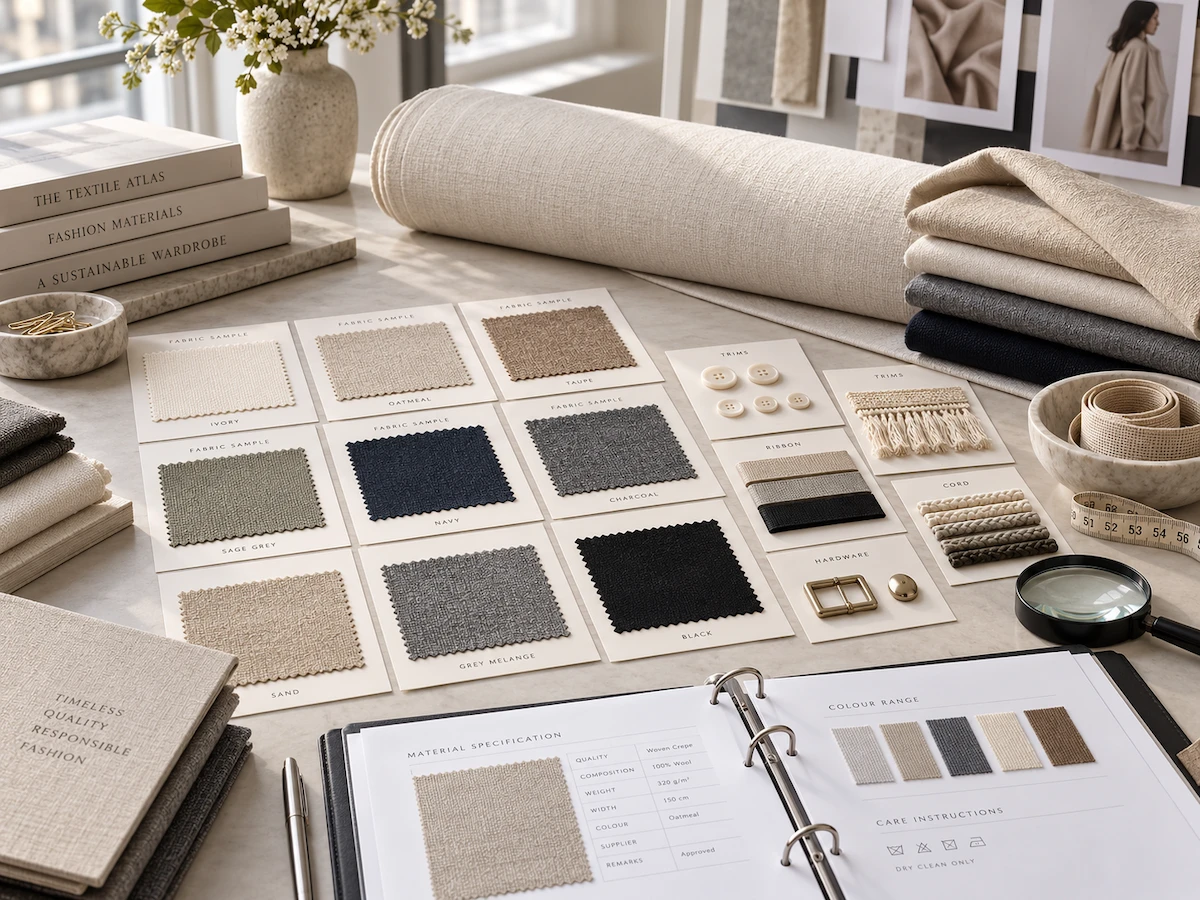
Fabric gets chosen twice on most projects, and only one of those choices is visible in the final garment. The first choice decides what the dress looks like in a photograph. The second decides whether five hundred of them arrive behaving the same way — and the second one is what a factory has to live with for the whole production run.
Most fabric problems are not the result of picking a bad cloth. They come from picking a cloth before deciding what the dress has to do, then finding out during development that the drape, the opacity or the recovery cannot deliver it. By that point the pattern has already been drafted around the wrong behaviour, and correcting it costs a sample round.
This guide works through selection in the order it happens in a development room: start from the garment's job, separate the substrate from the finish, then check the three constraints that usually decide the answer anyway. If you would rather see where fabric sits inside the whole production sequence, how clothing manufacturing works from design to finished garment covers that end to end.
Quick answer: how do you choose fabric for a dress?
Choose by function before name. Decide the drape, the opacity and the recovery the silhouette needs, find the substrates that deliver them, and only then decide the finish. A familiar name — satin, crepe, chiffon — describes a weave and a surface treatment, not a behaviour, and the same name from two mills can behave like two different cloths.
| What actually decides the fabric | What does not |
|---|---|
| The drape, opacity and recovery the silhouette needs | The name written on the swatch |
| Whether the cloth can hold this seam and this hem in this shape | How it looked in a reference photograph |
| Whether the cloth is stocked, booked or made to order | What a competitor used last season |
| The weight the garment has to carry and where it hangs from | How a single sample behaved in a single colour |
The right-hand column is the one that produces returns. A fabric can be genuinely beautiful and still be wrong for a pattern, and the mismatch almost never shows up in a sketch — it shows up at the first fit.
Start from what the dress has to do
Before opening a swatch book, write three sentences: what the silhouette does, where the garment is supported, and how the wearer moves in it. A bias-cut slip, a boned bodice and a pleated A-line are three different engineering problems. Each one narrows the fabric list before aesthetics get a vote.
Match the cloth to the silhouette's mechanics
A draped or bias-cut dress needs a cloth that falls under its own weight and recovers slowly. A structured bodice needs enough body to hold a fold and enough memory to return to shape after a fitting. A pleated skirt needs a cloth that accepts a heat-set pleat rather than relaxing out of it. Choosing in the other order — swatch first, silhouette second — is how a dress ends up needing more interlining than the design intended.
Decide where the garment is supported
Anything supported at the shoulder hangs differently from anything supported at the waist. Shoulder-supported dresses put the load into the neckline and the upper back, which turns fabric weight and stretch into a structural question rather than a comfort one. Once you know which part of the body carries the garment, the acceptable weight band narrows sharply.
The four properties that decide whether a cloth works
Drape
How the cloth falls, and how tightly it holds a curve. Drape is the difference between a silhouette that reads as designed and one that reads as merely sewn together.
Opacity
What shows through in daylight, under flash, and against skin. Opacity is the usual reason a dress ends up lined, which means the lining decision was really taken at swatch stage — either you chose a cloth that needs it or you chose one that does not.
Recovery
How the cloth returns after being stretched at a seam, at a zip, or across a sitting position. Low recovery shows up as a bagged elbow, a wavy zip or a seat that never presses flat again however well it is finished.
Hand-feel against the market
The same construction can be finished to feel crisp, fluid or dry. Hand-feel is the fastest thing a buyer notices and the hardest thing to specify in words, which is why it belongs in a brief as a comparison to something the mill already makes rather than as an adjective.
The four are not equally weighted for every dress. On a structured evening piece, recovery and opacity usually outrank drape. On a summer slip, drape and opacity decide everything and recovery barely enters the conversation.
Substrate and finish are two decisions, not one
Satin, crepe and chiffon are usually spoken about as three fabrics. More accurately they are three combinations of a substrate and a finish. A satin surface can be built on different yarns. A crepe effect can come from a twist, from a weave, or purely from finishing. Chiffon is defined as much by its weight as by its structure. Two mills can both ship a correct crepe and hand you two different garments.
That is why a swatch on its own is not a specification. What has to travel with the swatch is the substrate, the weight band, the finish, the colour reference and the usable width. Without those five, a mill can match your swatch exactly and still deliver a different cloth — and the argument that follows is about opinions rather than about a document.
Where the main dress fabrics actually differ in behaviour, and where each one fails, is set out in satin vs crepe vs chiffon for womenswear manufacturing.
The lining question arrives earlier than buyers expect
Whether a dress is lined is normally treated as a design decision made at the sketch. In production it is a consequence of two fabric properties — opacity and how the cloth behaves against the body — plus one commercial one, which is whether the market you sell into expects a lining at your price point.
Deciding it late is expensive. A lining changes the pattern, the seam allowance at the neckline and armhole, the finishing method at the hem, and the weight of the garment on the hanger. It also changes what the fabric has to do: a fully lined bodice can carry a lighter face cloth than an unlined one, because the lining is doing part of the structural work.
From the factory floor: why one sketch costs differently in two fabrics
Two dresses can be visually identical and carry different production costs, and the reason is nearly always the cloth rather than the construction. A fabric that frays changes the seam finish. A fabric with low recovery changes the interlining. A fabric whose print has to be matched at the seam changes the cut plan and the fabric allowance. None of those differences appear in the sketch, and all of them appear in the cost.
The same logic runs through the sample room. A cloth that presses well hides small construction errors and presses into a clean edge. A cloth that marks easily, or that shows every needle hole, forces the operator to work more slowly and raises the rework rate at the end of the line. That is a real cost, it is not visible in the garment, and it is the single most common reason a quote comes back higher than a buyer expected.
This is also why a factory will ask to see a physical swatch rather than a photograph before quoting a new style. The photograph tells them what the dress should look like. The swatch tells them what the line has to do to get there.
Practical example: one dress, two fabric routes
Take a single midi dress with a fitted bodice and a softly gathered skirt. The sketch does not change. Only the fabric route changes, and the difference runs through almost every subsequent decision.
| Decision | Route A: stocked woven, unlined | Route B: made-to-order crepe, lined | What the change actually moves |
|---|---|---|---|
| Fabric availability | Reorderable from stock | Made to order in the colour | Whether a top-up order is possible at the same shade |
| Colour range | Limited to the mill's existing shades | Open, subject to a dye minimum | How many colourways the collection can carry |
| Lining | Not required at this opacity | Required at this opacity | Pattern, hem finish and garment weight |
| Seam finish | Standard overlock inside | French or bound seams where visible | Sewing time per garment, and how the inside looks |
| Sample rounds | One, because the cloth is predictable | Often two, because drape reads differently on the body | Calendar risk rather than unit cost |
| Reorder behaviour | Same cloth from the same shade card | Shade approved per dye lot | Whether season two matches season one |
Neither column is better. Route A is faster, cheaper and repeatable, which matters enormously if you intend to reorder. Route B buys a specific hand-feel and a wider colour range, and pays for it in sampling time and in a colour that has to be approved again each time it is dyed. The useful question is not which fabric is nicer — it is which of these two sets of consequences your business can absorb.
How to run a fabric selection properly
- Write the brief in behaviour, not in names. Three sentences on silhouette, support and movement, plus the season and the market the dress is sold into.
- Narrow to two or three substrates. Ask the mill or the factory which of their existing cloths delivers that behaviour, rather than browsing a shade card first.
- Order physical swatches. Photographs do not transmit drape, weight or surface. Two swatches of the same cloth at different widths will tell you more than a catalogue page.
- Test the swatch against the pattern. Drape it over a form in the shape you intend, in daylight, and check the opacity where the dress will actually be worn.
- Confirm the specification in writing. Substrate, weight band, finish, colour reference, usable width, and the shade the swatch represents.
- Take the fabric decision before the pattern is finalised. A pattern drafted around the wrong drape is a rewritten pattern.
- Keep a physical standard. Whatever you approve, keep a piece of it. It is the only reference that settles a dispute in season two.
Common mistakes in fabric selection
- Choosing from a screen. Monitors normalise colour and hide texture. A swatch that arrived by post costs less than a sample round.
- Specifying a name instead of a behaviour. Writing "satin" on a brief leaves a mill free to deliver a correct satin that is wrong for the dress.
- Ignoring opacity until the fit. By then the lining, the pattern and the finishing method all have to change together.
- Forgetting how the cloth behaves in the machine. Fraying, needle marking and pleat relaxation are all properties of the cloth, and all of them land on the production floor.
- Approving a colour without a physical standard. Screen colour, lab-dip colour and bulk colour are three different things, and only one of them is what the customer receives.
- Treating the fabric decision as reversible. Past the cutting table it is not. Changing cloth after cutting means recutting.
What the fabric decision does to cost and minimums
Fabric is normally the largest single material input in a dress, which makes it the fastest lever on cost and the slowest to reverse. The table below is deliberately left without figures: a unit price is only meaningful against a confirmed specification, and quoting one before the specification exists produces a number that has to be revised. We would rather give you the direction of each effect and the real number against your actual cloth.
| Fabric decision | Direction of effect on cost | Direction of effect on minimum | Why |
|---|---|---|---|
| Stocked cloth versus made-to-order cloth | Stocked is lower | Stocked is lower | A made-to-order cloth carries the mill's own dyeing minimum per colour |
| More colourways | Increases | Increases | Each colour is a separate cut, a separate shade approval and often a separate dye lot |
| Lining added | Increases | Broadly unchanged | Additional material and additional sewing operations, but the same pattern setup |
| Heavier cloth | Increases | Broadly unchanged | Material is priced by weight and by usable width |
| Narrower usable width | Increases | Broadly unchanged | More linear metres are consumed for the same garment |
| Larger print repeat | Increases | Broadly unchanged | Matching at the seam raises the fabric allowance per garment |
The two rows that matter most for a new brand are the first and second. Moving from a made-to-order cloth to a stocked one, and cutting the colour count, does more for both cost and minimum than any negotiation on unit price.
What to bring to a fabric conversation
- The dress, as a flat, a reference photograph or a sample — whichever makes the construction clearest
- The behaviour you are specifying: drape, opacity, recovery and hand-feel, in the order you care about them
- The season, the market and the price position the dress is sold at
- Any colour reference you already have, physical rather than screen
- Whether you intend to reorder the style, and roughly when
- Whether the fabric has to come from a particular origin for your customer
The reorder question matters more than it looks. A brand that intends to run the same style for three seasons should be selecting for repeatability, and sometimes that means choosing the second-best drape.
How we handle fabric selection
We treat the fabric decision as part of development rather than as a shopping step, because it is the decision that most of the rest of the project is built on. In practice that means:
- You send the style and the behaviour you need. A sketch, a reference or an existing sample, plus what the dress has to do.
- We shortlist against what is actually available. Cloths we know the behaviour of, rather than a catalogue of everything a mill can produce.
- We send physical swatches. Including, where it matters, two options at different weights so you can feel the difference the choice makes.
- We tell you which constraint is binding. If a colour is limited by a dye minimum or a cloth only exists in one width, that is stated before you commit rather than discovered at cutting.
- We keep the approved standard. Your approved swatch becomes the reference the bulk cloth is checked against.
The fabric side of what we do is described on our fabric sourcing service page, and if you have a style in front of you, send it over and we will tell you which cloths behave the way you are describing.
Frequently asked questions
Where should I start when choosing fabric for a dress?
Start with the silhouette and the support point, not with a swatch. Write down what the dress has to do — how it falls, where it is carried, how much opacity it needs — and ask for cloths that deliver that. Selecting from a shade card first usually produces a dress that looks right in a photograph and behaves wrongly on a body.
Can I change fabric after the sample is approved?
You can, but expect to resample. Changing the cloth changes drape, seam behaviour and often the lining requirement, and a pattern drafted around one behaviour will not automatically suit another. Treat a fabric change after approval as a new development round rather than as a substitution.
How do I know whether my dress needs lining?
Test the swatch in daylight against your hand and against the skin tone you are designing for, then decide with the market in mind. Opacity is the deciding property, but expectation matters too — some markets and price points treat a lining as standard regardless of what the cloth does.
Should I use stocked fabric or a made-to-order cloth?
If you intend to reorder the style, stocked cloth is usually the better commercial decision because it keeps the shade repeatable and avoids a dyeing minimum per colour. Made-to-order cloth buys a specific hand-feel or a colour that stock cannot offer, and pays for it in sampling time and in shade approval each time it is run.
How many fabric options should I develop at once?
Two or three is usually enough. Beyond that the comparison stops being about behaviour and starts being about preference, and each additional option adds a swatch round to the calendar. Narrow by function first, then choose within the shortlist.
Which fabric decisions affect cost the most?
Colour count and stock status, in that order. Every additional colour is a separate cut and often a separate dye lot, and a made-to-order cloth inherits the mill's minimum per shade. Lining and weight matter too, but they move the unit cost rather than the viability of the order.
Is a fabric swatch enough to quote from?
It is enough to start. A physical swatch tells a factory what the line has to do, which is more than a photograph can. A firm quote still needs the specification behind it — substrate, weight band, finish, colour reference and usable width — because the swatch alone does not fix any of those.
What to take away
Choose the cloth by what the dress has to do, and write that down before looking at a swatch book. Separate the substrate from the finish, because they are two decisions and most disputes come from treating them as one. Then check the commercial consequence — stock status and colour count — while it is still cheap to change your mind, rather than after the cutting table has settled the question for you.