On this page
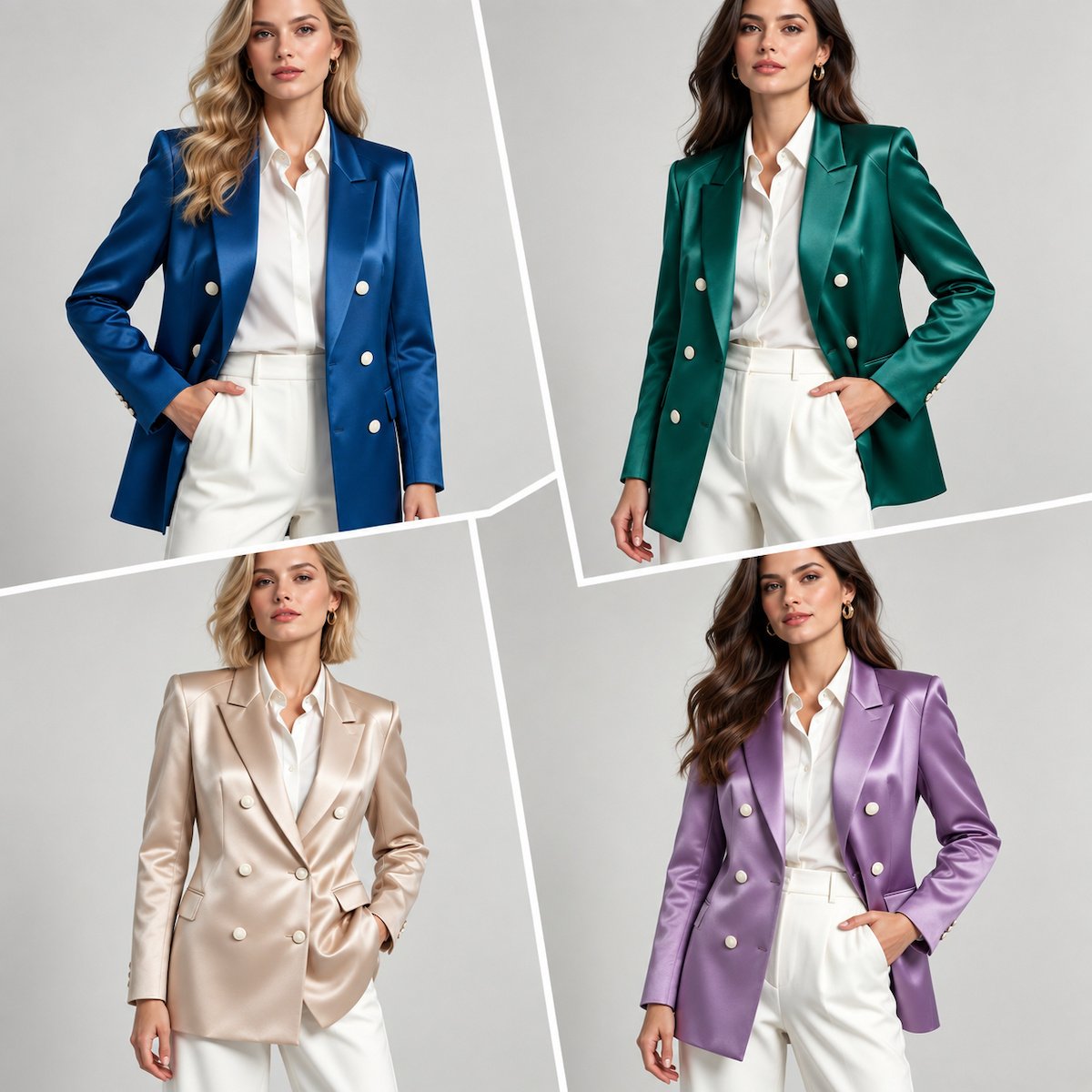
Satin is one of the few fabrics whose name describes how it is made rather than what it is made of. The weave produces a smooth, lustrous face by floating the warp or the weft across the surface, and the same construction can be built in silk, in polyester, in acetate, in blends, and across a wide range of weights. That is why “satin” on a specification sheet is close to meaningless on its own, and why two dresses both described as satin can feel like they come from different fabric families.
The weight is the variable that most changes behaviour, and it is the variable most often left unspecified. Browsing a mill's satin range, the choices may span a wide band from a light, fluid cloth to a substantial, structured one. At the light end the fabric moves and drapes; at the heavy end it holds a shape and resists movement. A design developed on one and produced on the other will not match its own sample, and the difference will be read by the customer as a quality problem.
The fix is not complicated. It is to specify a satin by weight and hand as well as by name, and to settle that specification at the same time as the silhouette it has to serve.
“Satin” Describes a Weave, Not a Weight
It is worth being precise about what varies, because the word satin conceals several independent decisions.
- The fibre sets the hand, the sheen, the drape and the price, and it determines how the fabric takes to cleaning and to heat.
- The weight sets how much the fabric falls and how much it holds, and it is the variable this article is about.
- The weave density and the float length set how pronounced the sheen is and how susceptible the surface is to marking.
- The finish sets whether the surface is dry or liquid, matte or mirror, and whether it holds a crease.
- The stretch, if any sets how the fabric behaves on the body and at the seam — a variable that interacts with weight and is easy to overlook.
A specification that names only the fibre and the word satin has fixed one of those five and left the rest to the factory. That is survivable on a style where the fabric is doing nothing difficult, and it is the source of most satin problems on a style where the fabric is doing the work — a bias-cut skirt, a draped bodice, a structured panel, a wide leg. In each of those cases the weight and the hand are the decision, not the fibre.
Without a number, weight is judged in the hand, and the test that correlates best with behaviour is how the fabric falls when a corner of it is held up. A lightweight satin hangs in a narrow fold close to the hand and shifts when the hand moves; a heavyweight satin hangs in a broader, slower fold and stays where it is put until it is deliberately disturbed. A second useful check is to gather a length in one hand and release it: a light satin drops and falls immediately, while a heavy satin unfolds under its own weight and settles.
Neither test replaces a sample garment, but both will separate two satins that a mill presents as adjacent, and both can be done on a swatch before there is any commitment. The tests that matter most, though, are performed on the finished piece: whether the folds in the skirt hang the way the design intended, and whether the bodice still holds its line after an hour of wear. Weight shows itself in movement and in time, not in a showroom.
How Weight Changes Drape, Shine and Structure
Three properties move together as satin gets heavier, and they move in the same direction on every satin, which makes the behaviour predictable once you have seen it.
| Property | Lightweight satin | Heavyweight satin |
|---|---|---|
| Drape | Falls closely and moves readily; follows the body and the bias | Falls in broader, slower folds; holds its own line away from the body |
| Structure | Almost none — it needs interfacing, lining or an underlayer to hold a shape | Substantial — a garment can be built from the fabric itself |
| Shine | The surface is more mobile, so the sheen shifts as the fabric moves and reads as liquid | The surface is more stable, so the sheen reads as a broad, even glow |
| Seam behaviour | Prone to puckering, ripple and print-through; needs care at every seam | More forgiving at the machine; seams sit flatter and stay flatter |
| Edge behaviour | Edges need finishing that does not add bulk | Edges hold a press and can take a heavier finish |
The drape row is the one that decides most silhouettes. A bias-cut skirt, a cowl neck, a draped wrap and a fluid column dress all depend on the fabric falling under its own weight in a controlled way, and all of them are built on the lighter end of the range. A heavy satin in those shapes does not drape; it hangs in panels, and the design's whole idea disappears.
The structure row works in the opposite direction. A corset bodice, a sculpted peplum, a defined waistline and a stand-away hem all need the fabric to contribute some of the shape, and all of them are easier — and often better — in a heavier cloth. The same design in a lightweight satin needs the structure to come from elsewhere: from interfacing, from a bonded underlayer, from boning. That is not impossible, but it is a different garment with a different cost.
The shine row is the one buyers notice last and customers notice first, because it is what makes a satin read as expensive or as cheap. A light satin's sheen moves with the fabric, which is the effect most people mean when they say a fabric looks rich. A heavy satin's sheen is broader and flatter, which reads as substantial. Neither is better; both are wrong in the other's design.
Weight and the Silhouette You Can Build
It is easier to work backwards from the silhouette than to reason forwards from the fabric, because the silhouette names the job the fabric has to do.
| Silhouette | What the fabric has to do | Where the weight usually lands |
|---|---|---|
| Bias-cut slip or column | Fall closely and move with the body | Lightweight; the lighter the better, within the limit of opacity |
| Cowl neck and draped bodice | Fall into folds that hold their shape briefly and then release | Light to mid; a heavy satin makes a stiff, dead cowl |
| Corset bodice and sculpted waist | Hold a shape and resist folding | Mid to heavy, usually with structure added for the parts the fabric cannot hold alone |
| Full skirt with defined folds | Take a controlled fullness and hold the fold | Mid to heavy; a light satin collapses the fold and reads as limp |
| Structured panel with a crisp hem | Keep an edge and hold a plane | Heavy, almost always with interfacing at the edge |
Where a collection uses one satin across several silhouettes, this table explains why one of them will disappoint. The fabric that makes the corset bodice work is the fabric that kills the slip dress. The practical answer on a range is either to accept two satins — which is common and not a problem if it is deliberate — or to choose a mid-weight and accept that some silhouettes are compromised in both directions.
There is also an interaction with lining that changes the effective weight of the garment without changing the fabric. A light satin lined in a heavier cloth behaves as a heavier garment; a heavy satin with a light lining keeps its own behaviour but gains a softness at the edge. Lining is therefore a legitimate way to move a silhouette without changing the satin, and it is worth considering before deciding that the satin itself is wrong. The relationship between a shell and its lining is covered in the guide to lining an evening dress.
Weight, Stretch and Recovery
Stretch is a separate variable from weight, but the two interact in ways that matter on fitted garments, and the interaction is easy to specify badly because it is invisible on the roll.
- A satin may have no stretch at all, in which case the garment has to be built with enough ease to move and the pattern has to allow for it.
- A satin may have mechanical stretch from its construction, which behaves differently from added stretch and recovers differently after wear.
- A satin may contain elastane, which gives it recovery but changes its heat behaviour and its ageing — and makes the care instruction more critical.
- Recovery is what decides whether a fitted dress still fits at the end of the evening. A fabric that stretches and does not come back produces a garment that looks right in the studio and bagged on the body.
- Stretch changes the seam. A stretch fabric needs a stitch that can extend with it, and on satin that also means managing the risk of a seam that ripples when it is stretched.
The combination to be careful of is a heavyweight satin with stretch on a fitted style. The weight makes it feel structured and the stretch makes it move, and if the recovery is not adequate the garment will hold its shape on the stand and lose it on a body. That is a specification that cannot be judged by hand in a showroom; it has to be judged on a moving fit model.
For fitted occasionwear, the practical discipline is to state the stretch and the required recovery on the specification, and to test both on the actual fabric rather than on a similar one. Two satins of the same weight and fibre can differ in recovery enough to change the fit of the final dress, and the difference is only visible after the garment has been worn.
Weight and Seam Behaviour
Seam behaviour is where the weight difference becomes a production issue rather than a design issue, and it is the reason a factory can prefer one satin over another on a style that looks identical on paper.
- A lightweight satin shows every imperfection. Needle marks, a slightly uneven feed, a tension that is marginally off, a seam allowance that prints through — all of it reads on the face of a light satin and much of it does not read on a heavy one.
- Lightweight satin moves under the machine. It is smooth, and smooth fabrics feed unevenly, which is the same mechanism that makes a light satin difficult at a centre-back zip.
- Heavy satin is more forgiving at the seam but less forgiving at the edge, because a heavy seam has more bulk to control and the finished edge has to be managed so it does not read as a ridge.
- Seam finishing has to match the weight. A finish that works on a heavy satin can add visible bulk on a light one, and a finish that disappears on a light satin can be inadequate on a heavy one.
- Seam allowance behaviour differs. A wide allowance pressed open on a light satin shows as a shadow line; on a heavy satin the same allowance may be necessary to carry the seam's weight.
This is one of the few places where a heavier fabric is genuinely easier to manufacture. It is a real advantage on a first production run, and it is occasionally the reason a factory steers a buyer toward a heavier cloth — sometimes for good reasons and sometimes because it makes their own job simpler. Knowing which is happening is worth the effort, particularly on a style where the design depends on the lighter material.
The seam-side remedies for the light end of the range are the ones that apply to smooth fabrics generally: appropriate needles, reduced foot pressure, correct stitch length, stabilising the seam before it is sewn, and a test on an offcut at the actual grain direction. None of them change the fabric; they change whether the fabric is given a chance to behave.
Weight, Pressing and Shine Marks
Satin is the fabric on which pressing errors are most visible and least recoverable, and the weight changes the risk rather than removing it.
- A shine mark on a light satin is a change in surface character that stands out against a surface which is otherwise uniformly mobile.
- A shine mark on a heavy satin is often subtler and easier to miss, which means it can be missed at inspection and found by the customer.
- Both weight bands want a pressing cloth and an indirect method, and neither wants a hot plate directly on the face.
- Seams on a light satin want pressing around rather than across, because a plate pressed flat over a light seam flattens it and can mark both sides.
- Cooling matters as much as heat. Satin takes an impression from whatever it rests against while warm, including a table edge or a hanger.
Pressing is also where the two weights interact with the garment's other components. A heavy satin with a bonded interfacing at the neckline is at risk from the bonding process; a light satin with a bonded interfacing is at risk from both the bonding and the weight of the interfacing itself. On a style where the shell is light and the edge has to hold, the interfacing decision is effectively a fabric decision, which is the territory covered in choosing interfacing for a structured dress.
The practical rule is that satin deserves its own line in the pressing specification, and that the line should be written for the weight in use. A generic instruction to press carefully is not a specification; an instruction that names the method, the cloth and the areas to avoid is.
Consumption and Cost at Each Weight
Weight affects cost through more than the price per metre, and the second-order effects are easy to miss at development.
- Price per metre rises with weight on the same fibre and finish, because there is more material in the cloth.
- Consumption is not the same at both weights. A silhouette cut in a heavy satin may need more fabric for the same effect, or less, depending on whether the design relies on drape or on a panel.
- Structure comes free at the heavy end. Where a light satin needs interfacing, an underlayer or boning to hold a shape, a heavy satin may hold it unaided — so the total garment cost can be closer than the fabric prices suggest.
- Handling time is higher at the light end on any decisive seam, because a light satin demands more care at the machine and more care in pressing.
- Rework risk is higher at the light end for the same reason, and rework on a finished occasionwear garment is expensive.
- Freight differs between a garment that packs flat and one that has to be protected, and between a fabric that compresses and one that does not.
The consequence is that the cheaper satin is not automatically the cheaper dress. On a structured style the light option may need components and labour that the heavy option does not, and on a draped style the heavy option may need work to make it drape at all. The comparison that settles it is the costed style at both weights, which is the same discipline used for comparing fabric families in satin against crepe and chiffon.
Where a range contains several styles, it is worth doing that comparison once at the fabric-selection stage rather than style by style. The relationships between weight, structure and consumption are stable enough across a collection that the conclusions carry over, and settling them early avoids the situation where half the range is built on a weight that cannot deliver the silhouettes the other half needs.
There is a further cost consideration that applies to ranges rather than to styles. A collection built on two satins of different weights needs two fabric inventories, two sets of components matched to those weights and two sets of pressing settings, and that overhead is real. It is the reason some brands accept a compromise weight across a range instead of optimising each style, and it is a defensible decision either way provided it is made deliberately. What is not defensible is discovering at production that the range needed two fabrics.
Where a range is still being planned, the sequencing matters. Choose the silhouettes first, assign a weight to each, and then look at how many distinct weights the range actually requires. Done in that order, the exercise usually shows that several silhouettes can share one weight and only one or two cannot — which is a much cheaper problem to discover on paper than after the fabric has been bought and cut.
Matching Weight to Category
The category does not determine the weight, but the silhouette expectations within each category narrow it considerably.
| Category | What the garments have to do | Where the weight usually lands |
|---|---|---|
| Evening and gala | Hold a sculpted or draped line and read as high-value fabric | A range in the same collection, chosen per silhouette rather than once for the range |
| Bridesmaid | Read consistently across several sizes and several units, often in the same fabric | Mid-weight, because consistency across a grade matters more than any single drape |
| Cocktail | Hold a short, defined shape that stays crisp through an evening | Mid to heavy, since a short garment has less length in which to drape |
| Ready stock | Be reproducible run after run without re-development | Whichever weight the style was developed on, specified so that it can be repeated |
The bridesmaid row deserves a note. A bridesmaid programme is judged on how the group looks together, which makes consistency between units the primary requirement and makes a mid-weight the safest choice. It also tends to be produced in larger runs than a designer's eveningwear, so the fabric that behaves most predictably at the machine has a real advantage. The category-specific view of that is covered in choosing satin, chiffon and crepe for bridesmaid dresses.
The ready-stock row is a different kind of constraint. A ready-stock garment has to be repeatable over a long period and across re-orders, which makes the exact weight and the exact mill part of the product rather than an internal detail. For a stocked style, the specification should name the reference and the grade, not just the broad weight band, because a stocked garment whose fabric drifts is a stocked garment whose customers notice.
FAQ
How do I specify a satin weight if I do not know the numbers?
Describe the job rather than the number: the silhouette it has to build, whether it has to hold a shape or fall, and what the garment must do in wear. A good mill or factory can translate that into a reference, and a physical sample is then the confirmation. What you should not do is leave the weight unstated and assume it will match your reference garment.
Can I use two different satins in one collection?
Yes, and on a range that spans draped and structured silhouettes it is often the correct answer. What matters is that it is deliberate and specified per style, so that the bulk run does not substitute one for the other on a style where the swap would change the design.
Will a heavier satin give a more expensive look?
It gives a different look. A heavier satin reads as substantial and structured; a lighter one reads as fluid and luxurious when it is moving. On a draped design, a heavy satin reads as stiff rather than as expensive, so the answer depends entirely on the silhouette.
My light satin sample puckered at the seam. Is that the fabric?
Partly. A lightweight satin is genuinely harder at the seam because it is smooth and less forgiving, but puckering is usually a machine and handling outcome rather than a property of the cloth. The remedies are needle choice, foot pressure, stitch length and stabilising the seam — the same set that applies to any smooth fabric.
Should I specify a stretch satin for a fitted dress?
Only if the recovery is adequate, and that has to be confirmed on the actual fabric. A stretch satin that does not recover gives a fitted dress that looks correct on the stand and loses its shape in wear, which is a worse outcome than a non-stretch fabric that was given enough ease.
Can lining fix a satin that is the wrong weight?
Lining can change the effective behaviour of a garment without changing the shell, and it is worth considering where a fabric is close but not quite right. It cannot turn a light satin into a structured one, or make a heavy satin drape — those are properties of the cloth itself.
Is heavy satin always more expensive?
Per metre, usually. On the finished garment, not always — a light satin that needs interfacing, underlayers and extra care can cost more to produce than a heavy satin that holds the shape on its own. The comparison that matters is the costed style at both weights.
Working With Luxudress
Luxudress is the factory-direct front end for womenswear production across production facilities in Guangzhou and Dongguan, covering development, sampling, material sourcing, manufacturing, inspection and export packing. Satin occasionwear across the weight range is a routine part of what we build.
On a satin style we will name the weight and the hand against the silhouette rather than against a price, tell you where a lighter or heavier cloth will change the design, and cost the style at the weight it actually needs — including the structure a lighter satin would require.
If you have a satin style in development, send the silhouette and your reference fabric. You can also see how we approach evening dress production, browse the style library to see satins developed at different weights, or order from ready stock by the piece to examine a satin construction before committing to a production run. For the wider fabric picture across the collection, the guide to evening dress fabrics sets out how the families relate.
Request a quote and we will return a costed plan including the satin specification it assumes.