On this page
- Opacity is a specification, not an opinion
- Failure: the dress looks transparent under flash
- Failure: lining and shell fight each other
- Failure: the lining rides up
- Failure: seams show through the face fabric
- Build a lining test protocol
- What the lining specification has to carry
- The four lighting tests
- Practical buyer worksheet
- FAQ
- Next step

This is written for fashion brands, retailers and product developers building evening, prom, bridesmaid and gala styles. It assumes the material decisions, which our guide to evening-dress fabrics covers by property, and it links to the bodice-side equivalent in our corset bodice fit and boning guide. What follows is the opacity and movement problem: how the whole stack behaves together, and how to write it down. The category is on our evening dress manufacturing page.
Opacity is a specification, not an opinion
Opacity is usually treated as something the sample either has or does not have, which is why it produces so much late rework. It is a property of a stack — shell, lining, mesh, interlining, underskirt — under a stated light, at a stated degree of tension, on a stated skin tone. Change any of those and the answer changes. A brand that specifies the test rather than the opinion converts an argument into a measurement.
The four variables that decide whether a dress is see-through
| Variable | Why it matters | What to fix it with |
|---|---|---|
| Light source | A dress approved in a warm showroom can be transparent under a phone flash or in daylight | Approve under the light the customer will photograph it in, plus a flash test |
| Tension | Fabric stretched across the bust, hip or seat loses cover far sooner than the same fabric hanging | Test on a body, seated and standing, not on a table |
| Layer stack | Two pale sheer layers can read as less opaque than one layer over a lining of the right tone | Specify the finished stack, not the top cloth |
| Contrast beneath | A dark undergarment changes what a pale shell reads as | Stress-test with a dark undergarment during development |
Why the shell gets blamed
When a dress is returned as too sheer, the shell fabric is the visible suspect and is usually replaced. That is an expensive way to fix nothing, because in most of these garments the shell was adequate and the lining, the interlining, the lining tone or the fit was wrong. The diagnostic that saves the most money is to test the stack as it is before changing any single component in it.
Failure: the dress looks transparent under flash
This is the failure that reaches a brand as a customer photograph rather than a complaint, because the dress looked correct in the fitting room and photographs correctly only under controlled light.
The cause
Direct flash is a short, intense, near-parallel light source, and it passes through a pale fabric in a way that diffused daylight does not. A shell that has adequate cover under even shop lighting can be visibly transparent under flash, and the effect is strongest on pale shades, on light grounds, and on any area of the garment that is under tension. It is a property of transmission, not of quality, which is why it appears in dresses made from perfectly good fabric.
The test
- Photograph the sample with a direct phone flash, not only in showroom light.
- Test the palest colour in the range, not the darkest.
- Test on a body, on the areas that are under tension.
- Wear a dark undergarment as a stress test during development rather than discovering the contrast later.
The correction
Opacity is best added where it is needed rather than everywhere. Increasing the weight of the whole shell to fix one panel changes the drape, the cost and the hand of the entire garment. A targeted lining or interlining panel behind the affected area, a lining in a tone closer to the skin rather than to the shell, or a slightly denser lining at the same weight will often resolve the problem with no change to the outer appearance at all.

Failure: lining and shell fight each other
This failure presents as a dress that never quite hangs correctly. It looks acceptable on a form, develops a diagonal pull when worn, and misbehaves differently on different wearers.
The cause
Two layers with different mechanical behaviour attached to each other do not move as one garment. A rigid woven lining inside a stretch shell restricts the shell's recovery and distorts the seams that join them. A woven lining cut on the straight under a bias shell relaxes in a different direction, so the two layers end up at different lengths. Neither fault is visible in a flat measurement, and both are properties of the relationship rather than of either fabric.
The correction
Match the mechanical behaviour where the design depends on it. On a stretch shell, the lining should have comparable stretch and recovery rather than being chosen for handle alone. Under a bias shell, the lining either follows the bias or is cut shorter and allowed to hang independently, with the relationship tested after hanging rather than before. The specification line this produces is a statement of direction and recovery, not just a lining article code.
The test
Hang the finished garment for a period that matches the way it will be stored and shipped, then look at the hem relationship again. Bias garments drop; the lining and the shell rarely drop by the same amount. Where the two are found at different lengths after hanging, the correction is a construction decision, not a hemming one — and it is a great deal cheaper to make at the sample stage than after cutting.

Failure: the lining rides up
A lining that creeps upward as the wearer moves is one of the most common comfort complaints in occasionwear, and it is entirely a construction problem.
The cause
Ride-up comes from three forces working together: insufficient hip ease, so the lining is already under tension before the wearer moves; friction between the lining and whatever it sits against, which pulls it upward as the body moves; and static, which makes a synthetic lining cling to the shell or to a slip beneath it. A fitted lining can need different ease from the shell, because the two are being asked to do different jobs.
The correction
Check the hip ease of the lining as a garment in its own right rather than as a copy of the shell, and treat the hem finish and lining length as part of the silhouette rather than as a default. A lining that ends above a slit or a vent has to be positioned so it cannot appear in movement, which sometimes means a different length from the shell rather than a shorter one. Where static is the mechanism, the fix is the material and the finish rather than the length.
The test
Sit down. Sitting is the test that standing fittings cannot perform, because it changes the geometry at the hip and the seat and loads the lining in directions the wearer will experience for most of an evening. A sample that passes standing and fails seated has an ease problem, and a brand that tests only standing will discover it in returns.
When static is the mechanism
Static produces a specific version of the ride-up problem, and it is worth separating from the ease problem because the correction is different. Where a synthetic lining and a synthetic shell rub against each other, or where the lining rubs against a slip beneath it, the charge that builds up makes the lining cling to the layer it is touching. The garment then behaves as though it were too tight even when its measurements are correct, and the behaviour changes with the weather, the undergarment and the surface the wearer has been sitting on.
The remedies are material and finish decisions rather than length ones. A lining in a different fibre composition, a softer finish, or, where the shell allows it, a construction that lets the two layers slide rather than cling will remove the effect. Testing is straightforward: wear the garment over the undergarment the customer will use, in a dry indoor environment, and watch for the lining creeping upward as the wearer moves. A sample that shows the behaviour in a ten-minute test will show it more clearly across an evening.
Failure: seams show through the face fabric
On a smooth, lightly textured or glossy shell, an internal seam can print through to the outside as a visible ridge or line. The garment is structurally correct and looks wrong, and the fault is a specification problem rather than a workmanship one.
The cause
Three mechanisms produce it. A bulky lining seam sits proud under a thin shell and telegraphs through. A seam allowance pressed to one side rather than opened, or pressed too hard, creates a hard edge that the outer fabric follows. And a seam positioned where the fabric is under tension becomes more visible than the same seam elsewhere, because the cloth is stretched thinner over it.
The correction
Choose thinner internal components in the zones that are visible — which is a material decision taken at the sampling stage, not a pressing instruction given to an operator — and specify the direction and pressure of seam finishing. Where the surface needs support, an underlining spreads the load across an area rather than concentrating it on a line, and that is the technique that removes the ridge rather than hiding it. Where a seam must run through a highly visible zone, moving it or changing its type is often cheaper than trying to press it away.
The test
Look at the shell under a low, raking light rather than a flat one. Raking light makes a ridge visible in a way that diffused light does not, which is why this fault is so often missed in a well-lit fitting room and noticed under a camera flash or an evening light. Photographing the garment under both a flat and a raking source gives the brand an image it can compare across production.
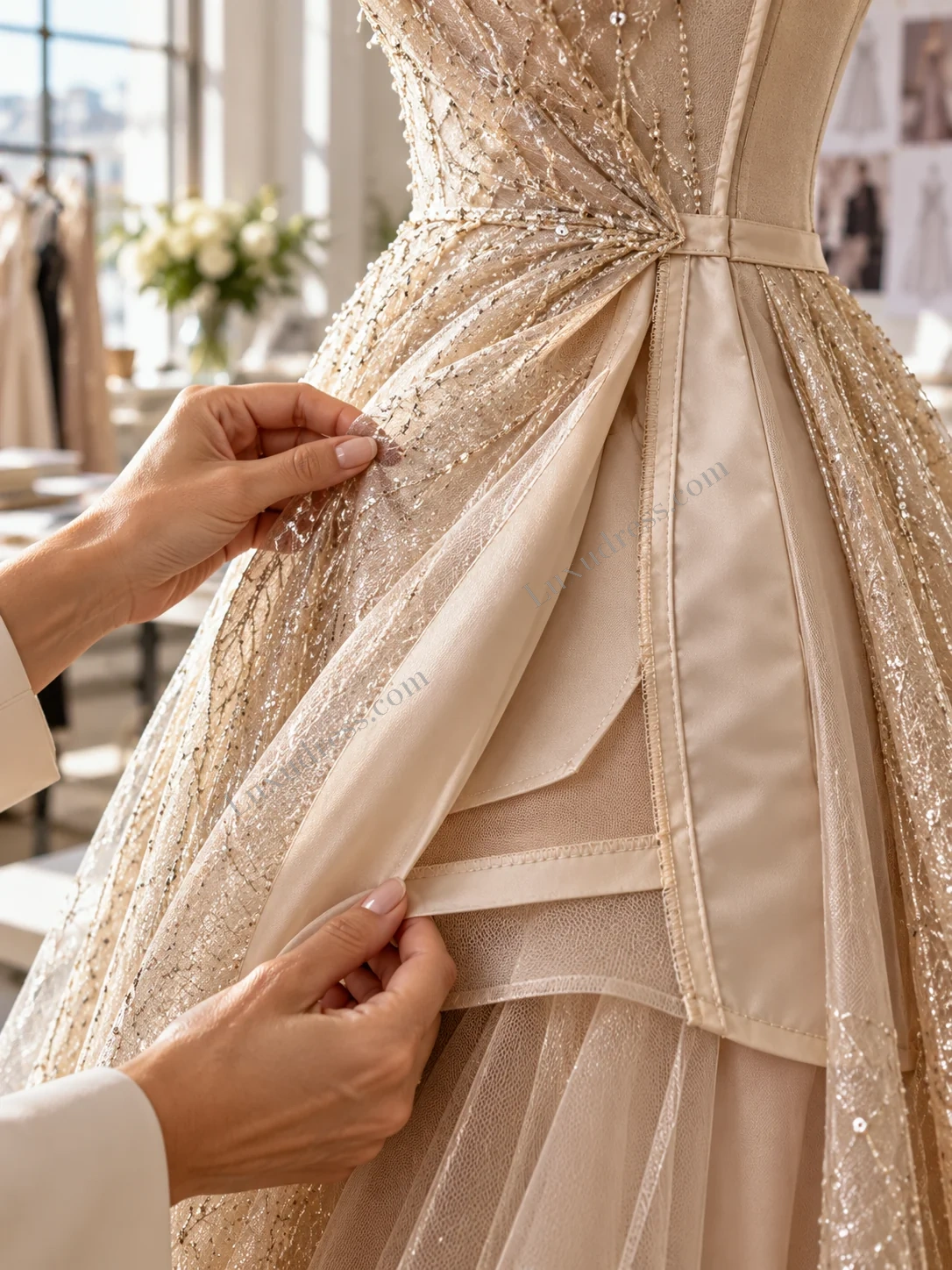
Build a lining test protocol
The four failures above have one thing in common: each was cheap to find at the sample stage and expensive to find afterwards. A short protocol attached to the sample approval turns them into checks.
The seven checks
- Opacity, under daylight, showroom light and a direct flash on the palest shade in the range.
- Movement, on a body, walking and with the arms raised, watching the lining at any opening.
- Static, with the garment worn over the undergarment the customer will wear.
- Stretch and recovery, on any construction where either layer is elastic.
- Seam show-through, under raking light as well as flat light.
- Hem behaviour, on the bias and on long skirts, after the garment has been hung.
- Comfort, at the waist seam and the neckline edge, by hand and on a body for several minutes.
Wear-test rather than form-test
A form confirms proportion and cannot confirm any of the four failures above, because all four depend on the garment being under load, in motion, or on a surface that behaves like a body. The protocol is therefore a wear test: several minutes on a person, seated for part of it, with the undertones the customer will use. Where a brand has no fitter available, the next best test is a form loaded and left seated under the skirt's weight — which catches the ride-up and the load problems even though it cannot catch the comfort ones.
Photograph under more than one light
Photographs taken during the test are the record that makes the approval reproducible. Front, back and side, under at least two sources, and one with flash. Those five or six images answer most later questions about whether the bulk behaves like the sample, and they cost nothing at the sample stage compared with the cost of re-testing a production lot.
Keep the approved lining in the bill of materials
The lining article, its weight and its tone belong in the bill of materials with the shell rather than in a separate note, because the failures above are all products of the pairing. A lining entry that says only a colour name allows a substitution that satisfies the colour and breaks the opacity or the movement. Where a style is reordered, the lining is the component most likely to have been changed quietly, and it is the one that changes what the customer sees.
Choosing between a lining, an underlining and an interlining
The three terms describe three different jobs, and confusing them is what produces a correction that fixes one fault and introduces another. A lining sits behind the shell and finishes the inside of the garment; it is the layer that supplies both opacity and slip. An underlining is attached to the shell piece by piece and travels with it, so it adds body and supports the surface across an area rather than at a point. An interlining is inserted to provide structure in a defined zone, and it is usually invisible from both sides.
| Component | Attached to | What it is for | What it costs |
|---|---|---|---|
| Lining | The garment, at the waist, the neckline or the armhole | Opacity, comfort and slip against the body | A full set of seams, plus its own hem and its own behaviour under gravity |
| Underlining | Each shell piece individually | Surface support and body, spread across an area | Extra handling on every piece, and weight through the zone it covers |
| Interlining | A defined zone, usually a neckline or a waist | Local structure without stiffening the whole garment | A zone boundary that can print through a smooth shell if it is not blended |
Read against the four failures in this article, the choice becomes mechanical. An opacity failure is a lining or an underlining question, and an underlining is the better answer where the problem is one visible area rather than the whole garment. A ride-up failure is almost always a lining question about ease and friction. A seam show-through failure is a component-weight question that an interlining can make worse. And a movement failure where the shell is elastic is a pairing question that no added layer solves on its own.
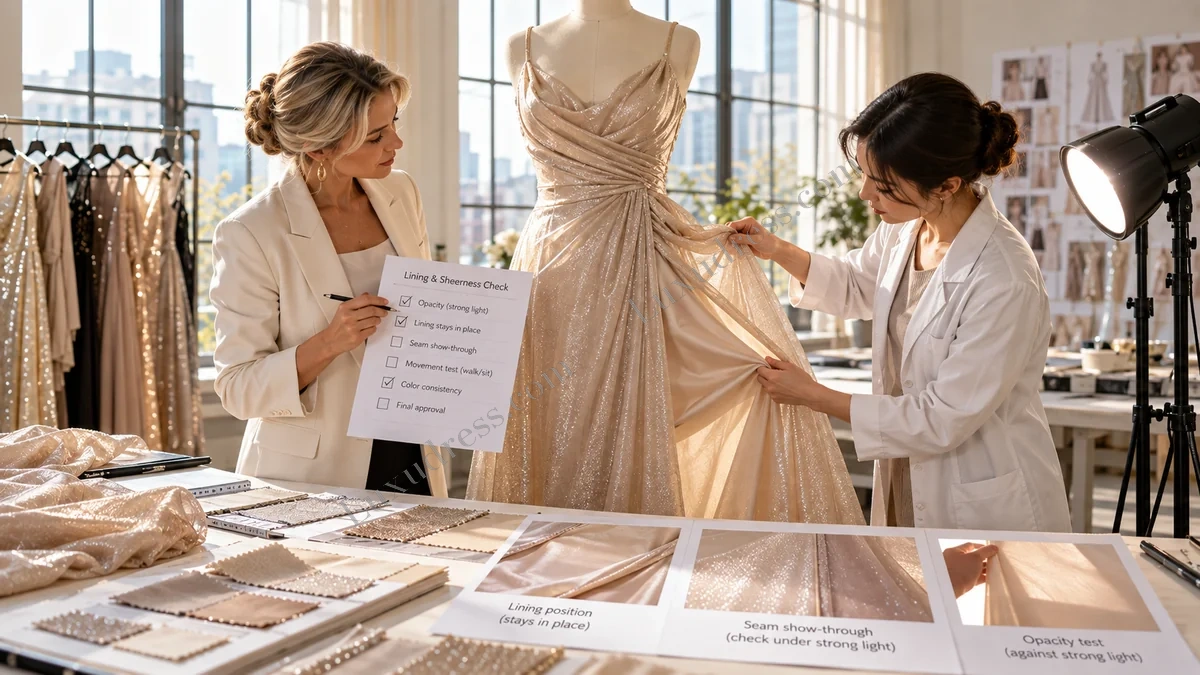
What the lining specification has to carry
This is the practical output of the protocol. Each line exists because leaving it out has produced one of the four failures above.
| Line | What it prevents | How it is stated |
|---|---|---|
| Lining article, weight and finish | Substitution that satisfies the colour and breaks the behaviour | Supplier and article code, plus a retained approved swatch |
| Lining tone relative to the shell | A shade or opacity result nobody predicted | Approved as a pair with the shell, under the agreed lights |
| Stretch direction and recovery, where relevant | A rigid lining restricting a stretch shell | Direction and recovery range, or an explicit note that the shell is stable |
| Hip ease of the lining | Ride-up in wear | A measurement for the lining, separate from the shell |
| Lining finished length and hem finish | Show-through at a slit or a vent, and bias drop | Length relative to the shell, and the finish method |
| Seam allowance direction and press method in visible zones | Seams printing through a smooth shell | Direction, opening, and pressure limits |
| Underlining or support placement | Adding weight everywhere to fix one area | Zones where it is used, and the material |
The four lighting tests
Because every failure in this article is invisible under one light and obvious under another, the lighting protocol is worth writing down separately from the construction specification. It is four tests and it takes minutes.
What the protocol does not cover
Two things sit outside it and are worth naming so they are not assumed. The first is cleaning behaviour: a garment intended to be cleaned repeatedly, such as a bridesmaid dress worn for more than one event or a rental piece, can respond differently from one worn once, because a lining that relaxes or shrinks differently from its shell changes the hem relationship the protocol just approved. Where repeat cleaning is expected, the stack should be tested after a cleaning cycle rather than only in its new state.
The second is the boundary between the sample and the bulk. A tested stack confirms the components, and it does not confirm that the bulk used the tested ones. The check that closes that gap is a physical comparison at goods-in: the bulk lining against the retained approved swatch, under the light it was approved in. It takes two minutes at the cutting stage and it is the only point at which a quiet substitution can still be reversed cheaply.
| Test | What it reveals | When to run it |
|---|---|---|
| Diffused daylight | Shade, tone and general opacity as the customer will see the dress outside | At the first sample and at the approval sample |
| Showroom or interior light | Whether the garment reads as intended where it is sold | At the approval sample |
| Direct flash | Transmission through pale shells and any area under tension | At every sample round on the palest shade |
| Raking light | Internal seams, ridges and press marks on a smooth shell | Before the garment is pressed for the final time, then again after |
Practical buyer worksheet
Fill this in before the first sample is commented on. For a lining fault, the third and fourth lines matter most: a stated target cost and a named construction risk are what keep an opacity correction from becoming a change to the whole garment.
- Target customer and use occasion
- Target retail and wholesale price
- Target ex-factory or landed cost
- Core fabric and backup fabric
- Size range and base fit size
- Colour count and continuity colours
- Critical construction risks
- Approval sample required
- Inspection checkpoints
- Latest acceptable delivery date
FAQ
What is the best lining for satin?
It depends on the satin's weight and the silhouette, and the deciding factor is what the lining has to do rather than what it is made of. Under a lightweight satin the lining is providing most of the opacity, so it needs a tone and a density that produce the intended final appearance. Under a heavy satin on a structured shape the lining is providing comfort and slip, and a lighter, smoother lining does less damage to the outer hand. In both cases the lining should be approved as part of a tested pair with the shell, because a lining that is right on its own can still produce the wrong garment when it is combined.
Why does lining hang below a bias dress?
Because the shell and the lining relax differently under gravity. A bias-cut shell drops along the bias, which is the direction of its greatest stretch, while a lining cut on the straight has much less of that behaviour. Hung for long enough, the two end up at different lengths, and the lining appears below the hem. The remedy is usually a construction decision — the lining cut to follow the bias, or cut deliberately shorter and allowed to hang independently — and the final levelling happens after the garment has hung, not before.
Can a fully lined dress still be see-through?
Yes, and it is one of the more confusing cases for a quality inspector, because the garment is built exactly as specified. Opacity is a property of the whole stack under a light and at a given tension, so a fully lined dress can read transparent under direct flash, on an area that is stretched, or where the lining tone works against the shell rather than with it. The reason to test under flash and on a body is that both conditions are part of normal use, and neither is present in a hanging inspection.
Should lining match the shell colour?
Often it should, and it is not automatically the right answer. The correct choice is the one that produces the intended final appearance of the garment, and that is an optical result rather than a colour match. On a pale sheer shell a lining closer to the skin tone can be more effective at producing an even result than one matched to the cloth; on a dark saturated shell a matched lining prevents a lining shadow at the edges. Where a brand carries a shade across several styles and fabrics, the lining for each pairing belongs in the specification alongside the shell rather than in a single range-level rule.
Next step
We develop and produce evening, prom, bridesmaid and gala wear at our production facilities in Guangzhou and Dongguan, and we treat the lining as a specified system rather than an accessory: lining and interlining selected against the shell, opacity tested under flash and on a body, bias and stretch behaviour hung out before the hem is settled, and the tested stack recorded in the bill of materials. Send the shell you intend to use and the failures you keep seeing, and we will come back with a stack and a test protocol rather than a lining colour. Request a quote, or see the constructions we run on our evening dress manufacturing page.
Our evening dress quality control checklist covers the same components at the inspection stage, and our fabric guide covers the material choices upstream of this. Silhouettes already in production are on our style library and ready stock pages, and the wider category is on the women's dresses page.