On this page
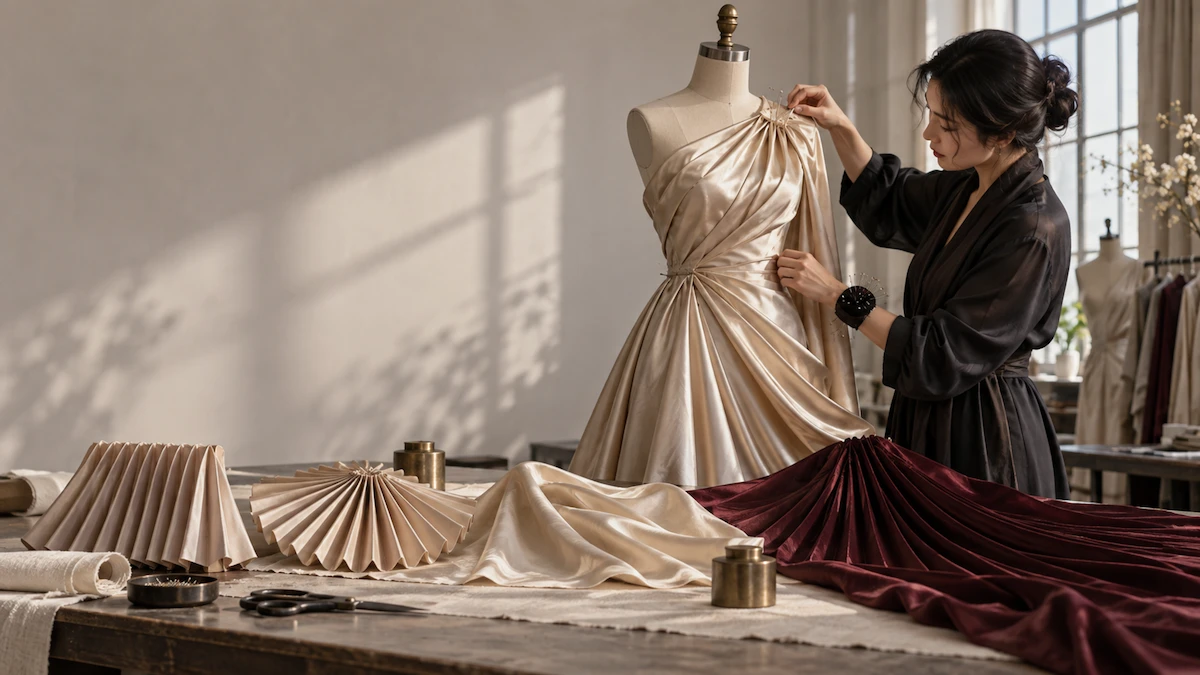
A pleat looks like a single design gesture. To a factory it is three separate operations. There is the fold in the fabric. There is the method used to fix that fold so it survives cutting, sewing, pressing and wear. There is the line it draws on the cost sheet. The fold is the easy part. The fixing is where the methods split apart, and it is where your unit price actually moves.
We run pleating through our production facilities in Guangzhou and Dongguan, and the same sketch arrives from buyers in very different states. Some send a technical pack that names the pleat type, the depth, the direction and the tolerance. Some send a photo of a dress on a hanger and expect us to know which of three methods they meant. The difference is not cosmetic. It is the gap between a sample that matches and a sample that comes back wrong, with the clock already running on a seven to ten day sampling window.
This piece is written the way we would brief our own floor. If you can put the result onto a tech pack, the factory can execute it without a single clarifying question. That is the only test that matters, and it is the one most buyers fail without knowing why.
The three ways a pleat is made
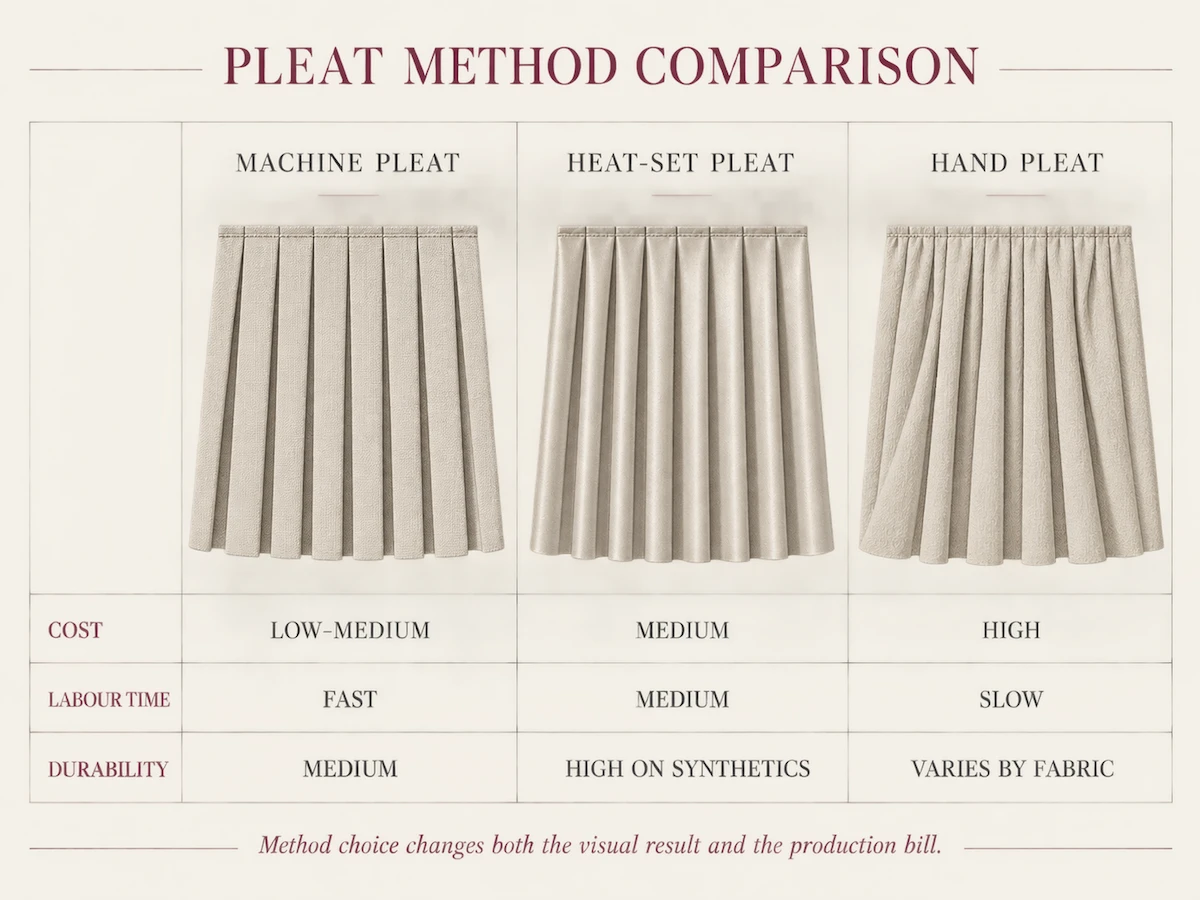
There are three methods in regular commercial use. They are not interchangeable, and picking the wrong one is the most common reason a pleated style costs more than the buyer budgeted. Each one fixes the fold by a different physical principle, and that principle decides everything downstream.
Machine-stitched pleats
This is the oldest production method and still the most common on woven dresses and skirts. An industrial sewing machine is fitted with a folder, a metal guide that folds the fabric edge as it feeds under the needle. The operator runs the panel through and a line of stitching locks the pleat in place. The fold is held by thread, not by the fibre's memory.
Knife pleats, box pleats and inverted box pleats are all made this way. The pleat runs the full length of the panel or stops where the pattern dictates. On a skirt the pleats are usually stitched to a point a few centimetres below the waistband and left free below, so the panel can still swing. On a dress yoke the pleats may be topstitched down entirely for structure. The folder has to be set to the pleat depth before the run starts, and the operator sews a short test length to confirm the fold is even before the real panel goes through.
The advantage is simplicity. Any operator who can run a straight seam can run a folded seam with a folder set up, and the running cost per piece is low because the machine does the folding. The disadvantage is that the pleat is only as permanent as the stitching. Press the garment wrong and the fold relaxes. The thread also shows on the right side unless the pleat is designed as a visible feature, which means a stitched pleat is a design statement as much as a construction choice.
Mechanical heat-set pleating
This method does not use a needle at all. The fabric is fed through or laid over a heated, ridged form, a pleating machine whose rollers or mould carry the fold pattern. Heat and pressure set the fold into the fibre. For thermoplastic fibres, polyester, nylon and most modern blends, the fold becomes part of the material's memory. The pleat will hold through washing and wearing until the fibre is melted or crushed beyond recovery.
This is the method behind crush pleats, sunray pleats, accordion pleats and the fine knife pleats you see on evening fabric. The pattern is carried by the machine, so a single setup can run metres of consistent pleat. Depth and spacing are set by the roller or the board, not by hand, which is why a heat-set panel is more uniform along its length than anything a folder can produce. The front cost is in the board and the machine time to set it, but the per-metre running cost is low.
The catch is fibre. Heat-set pleating only works on cloth that will take a thermal set. Pure silk, cotton, linen and viscose will not hold a heat set on their own. They need a fusible backing or a resin treatment, and even then the result is weaker than a synthetic set. We tell buyers this early, because a sketch that says "fine sunray pleats in 100 percent silk" is a specification that cannot be met by heat setting alone, and the sample will fail the moment it is finished.
Hand-set pleats
The third method is exactly what it sounds like. A worker folds each pleat by hand, pins or bastes it, and presses it with an iron, a ham or a clapper. On fine garments the pleat may then be tacked invisibly at the waist or shoulder so it stays put without visible machine stitching. The fold is fixed by hand pressure and, usually, by a few hidden stitches.
Hand setting is used where a machine folder cannot reach, where the pleats follow a curved or bias line, or where the buyer is paying for a finish that reads as couture. It is slow. A single panel can take many times longer than the same panel run through a folder, and the time scales with the number of pleats, not with the length of the panel. The durability depends entirely on the tacking. Done well, a hand-set pleat holds for the life of the garment. Done carelessly, it drifts within a few wears.
We use hand setting for development samples where the buyer needs to see the shape before committing to a production method, and for low-volume styles where the labour cost is acceptable against the retail price. It is the right tool for a one-off or a small run and the wrong tool for a few thousand pieces.
What each method can support, and what it cannot
A pleat is not a free-standing feature. It sits on a garment with a waistband, a hem, a closure and a fabric that all have to cooperate. Each method has a ceiling, and the ceiling is set by physics, not by preference.
Machine-stitched pleats support straight, repeating folds on stable wovens. They do not support fine pleats under about two centimetres deep on slippery fabric, because the folder cannot hold the fold cleanly and the stitching puckers. They do not support radial or sunray arrangements, because those folds radiate from a point and a straight folder cannot create them. They are poor on heavy coating fabric, where the locked pleat becomes stiff and the seam allowance bulks at every fold, so the panel stands away from the body instead of falling.
Heat-set pleating supports crush, sunray, accordion and micro pleats on synthetic and blended cloth. It does not support natural-fibre fabric without a backing, and it does not support a pleat that must later be opened, such as a pleat the wearer is meant to iron flat for a different look. Once set, the fold is fixed. It also struggles with very thick fabric, because the heat and pressure cannot push a deep, clean fold through heavy weight, and the result looks pressed rather than pleated.
Hand-set pleats support anything the other two cannot, including bias pleats, curved pleats and mixed-depth pleats on delicate fabric. They cannot support volume. Our minimum is 100 pieces per design, with 100 to 200 per colour, and at that floor the hand labour is containable. At a few thousand pieces the method becomes the dominant cost on the garment, and most buyers move to machine or heat-set for the bulk run while keeping hand finishing for a development sample they show to investors or press.
There is a fourth option buyers sometimes ask for, which is no fixed pleat at all. A draped panel that is gathered or twisted and held only by the cut and the construction is not a pleat in the production sense. It is shaping, and it is priced as part of the make, not as a pleating operation. We separate the two on the tech pack so the cost lands in the right column and the buyer is not charged for a pleating step that was never performed.
Cost, labour and durability compared
The table below is the short version of what the three methods cost and return. The per-piece figures are illustrative and marked TBC, because they move with fabric weight, pleat depth, pleat count and order volume. The relationships between the columns are the stable part, and those are what you should read first.
| Method | Relative cost per piece | Labour per panel | Durability | Holds on natural fibre? |
|---|---|---|---|---|
| Machine-stitched | Low (TBC) | Low, operator at folder | Good if pressed correctly | Yes, no backing needed |
| Heat-set | Medium (TBC) | Low, machine run | High on synthetics, permanent until melted | No, needs fusible or resin |
| Hand-set | High (TBC) | High, per pleat by hand | Variable, depends on tacking | Yes, with care |
Read the table by column, not by row. The cost column tells you the method. The labour column tells you why. The durability column tells you what the customer gets at home. The last column tells you whether your chosen fabric is even eligible, which is the question that ends more pleat projects than any other.
A few specifics from the floor. Machine-stitched pleats add a setup step, the folder has to be set to the depth and the operator runs a few test centimetres before the panel goes through, but the running cost per piece is low because the machine does the folding. Heat-set pleating fronts the cost into the machine setup and the board, then runs cheap per metre, which is why it suits long continuous panels like a pleated skirt shell. Hand-set carries no machine setup but every pleat is paid for in minutes, so the per-piece cost climbs with pleat count rather than with panel length.
Durability is where buyers get surprised. A heat-set pleat on polyester is more durable than a stitched pleat, because there is no thread to break and no fold to relax under a warm iron. A hand-set pleat, if the tacking is loose, can be the least durable of the three. The method does not guarantee the result. The execution does, and execution is what our ISO 9001 certified lines and SGS-inspected final checks are built to protect.
The cost column also hides a sequencing cost. A pleated panel passes through at least one extra operation that a flat panel does not, the setting or stitching of the fold, and that operation has to happen before the panel is joined to the rest of the garment. On our production facilities in Guangzhou and Dongguan the pleat is set as part of the same line that builds the dress or skirt, not as a separate afterthought, which is why a pleat specified early stays consistent through the run.
How fabric decides whether the pleat holds
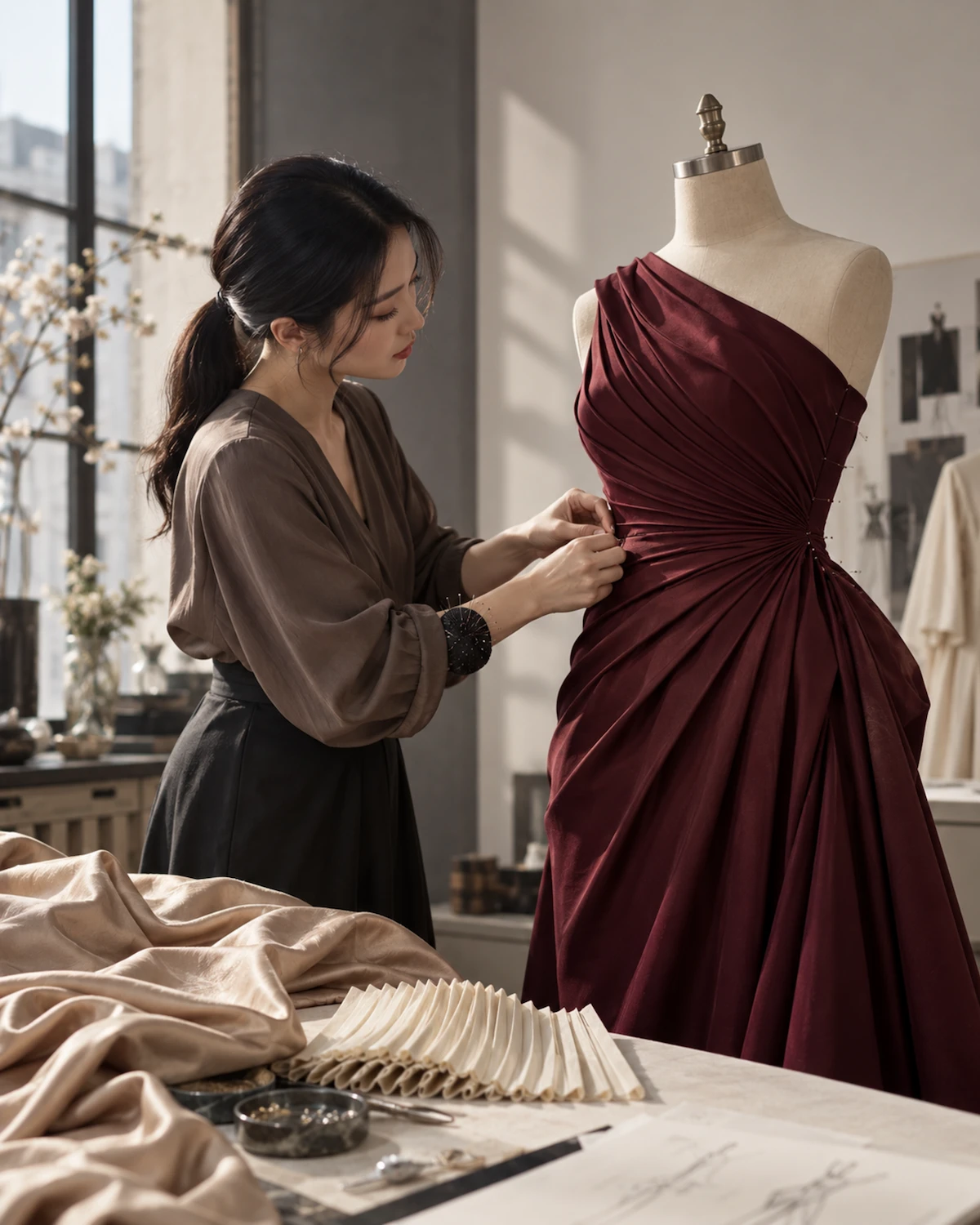
Fabric is the first variable, before method, before price, before anything else. A pleat is a fold held under stress, and different fibres resist that stress differently. Get the fibre wrong and no method will save the look.
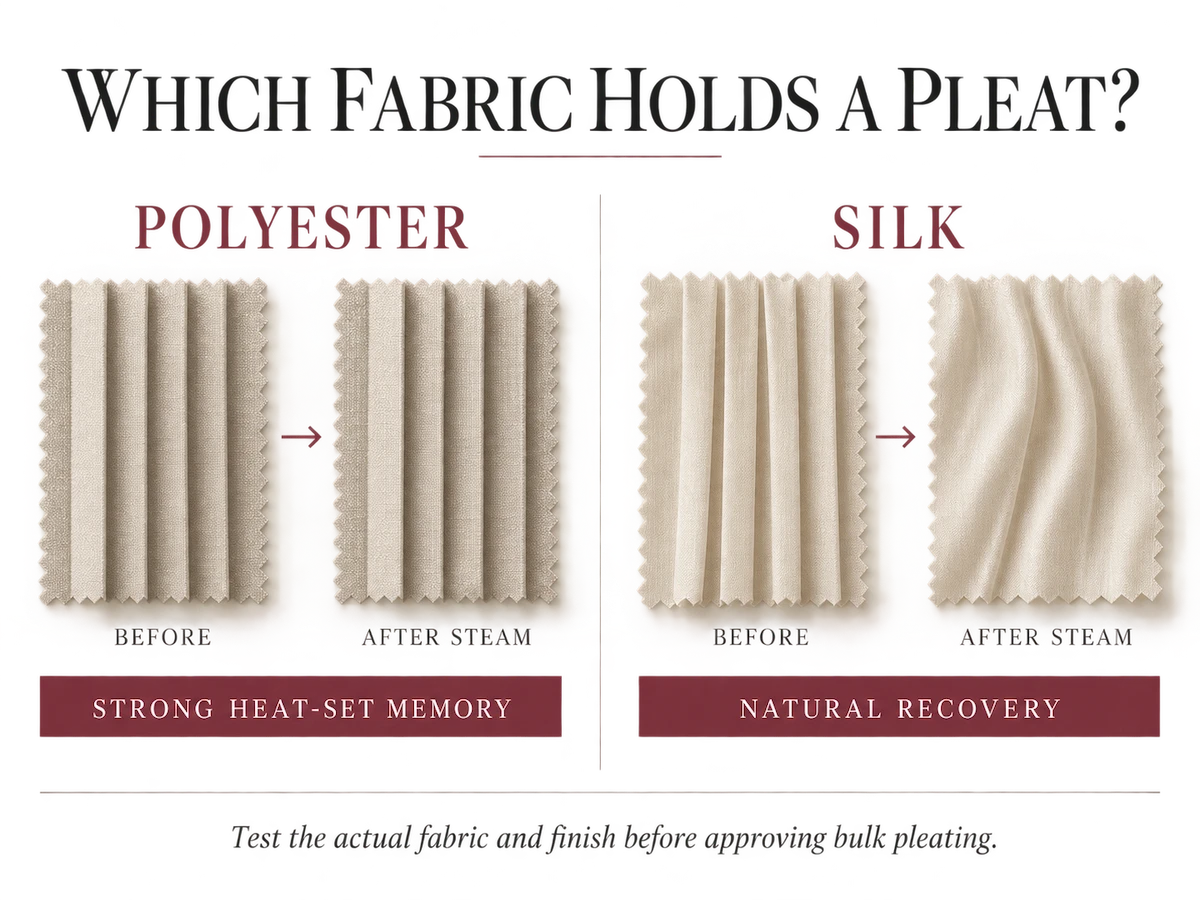
Thermoplastic synthetics take a heat set and keep it. Polyester crepe, polyester chiffon, nylon blends and most bonded fabrics will hold a heat-set pleat through dozens of washes. This is why so much pleated occasionwear is synthetic. The fibre wants to return to the shape the heat gave it, and it does, wash after wash, until the garment is worn out.
Natural fibres do not. Silk will take a temporary press and lose it. Cotton and linen relax as soon as they meet steam. Viscose and rayon are the worst of the group for pleats, because they are weak when wet and they move as they dry, so a pleat in 100 percent viscose is a pleat fighting the fibre every day it is worn. A buyer who specifies viscose and expects a permanent pleat has set up a failure before the first sample is cut.
Blends sit in the middle. A polyester and viscose mix will hold a set better than pure viscose and worse than pure polyester. The higher the synthetic content, the more reliable the pleat. We read the fibre composition before we quote a pleating method, not after, because a fabric that cannot be heat set has to be stitched or backed, and that changes the cost line as well as the look.
Weight matters as much as fibre. Lightweight fabric sets and holds a finer pleat. Heavy fabric resists deep folds and, when it is forced, the pleat edge thickens and the panel stands away from the body. A coating fabric pleated by machine looks architectural but feels rigid. A chiffon pleated by heat looks soft and moves. The same pleat type in two weights is two different garments, and the tech pack should say which weight was sampled so the bulk matches.
A fusible can rescue a natural fibre. A light fusible bonded to the back of silk or cotton gives the fold something to grip, so a heat-set or a stitched pleat will hold longer than it otherwise would. The cost is a small addition per piece and a slight change in hand feel, which some buyers can feel and some cannot. We note it on the tech pack so the buyer chooses, rather than discovering it on the finished garment and wondering why the fabric feels different from the swatch.
We keep 260 ready-stock styles with real RMB prices on file through our ready-stock hub, and a large share of them are pleated or draped styles where the fabric was chosen specifically because the pleat had to hold. Looking at those styles is a faster education than any table, because the fabric and the pleat type are already matched by people who had to make it work on a production line. The skirts and dresses in that range are the proof that the method and the material have to be chosen together, not separately. You can browse them through our dresses and skirts category pages as well as the ready-stock hub.
What happens after wash and wear
A pleat that leaves the factory is not the same pleat six months later in a customer's wardrobe. The shift is predictable, and writing for it on the tech pack avoids complaints and returns later. Most returns on pleated styles are not quality failures. They are expectation gaps, and a note on the pack closes most of them.
Machine-stitched pleats relax with heat. A warm iron passed over the fold, or a tumble dryer on high, softens the stitch line and the pleat opens. Washing cold and line drying keeps them. This is the most common reason a buyer reports that the pleats "came out", when in fact they were never meant to survive a hot wash. The care label has to match the method, and we print it that way, but the buyer has to ask for the right label in the first place.
Heat-set pleats on synthetics survive washing well. They survive it almost too well in one sense, because a synthetic pleat that is crushed in packing or shipping can be hard to restore without re-pressing. The fibre remembers the set, not the crush, so a re-press at the right temperature brings it back. We pack heat-set panels flat or on hangers for this reason, and we state it on the packing spec so the buyer's warehouse does not fold a finished panel into a carton and flatten the very thing they paid for.
Hand-set pleats move with the tacking. If the tack is at the waist only, the lower pleat can drift as the fabric is pulled in wear. If the pleat is tacked at two points it holds. This is a design decision the buyer makes, and it should be on the tech pack as a note, not left to the operator to invent. An operator who is not told will tack at the waist by default, and the result may not be what the designer drew.
Draping changes differently. A draped panel that is held by construction, not by a fixed pleat, will settle with the wearer's body and may need reshaping after wash. That is expected for the style. It is not a defect, but a buyer who does not know it will treat it as one and send it back. The tech pack note "drape to be re-formed after wash" prevents the return. We have seen this exact return on draped styles where no such note existed, and the garment was fine.
Colour and finish shift too. A pleat edge on a dark fabric shows abrasion faster than a flat panel, because the fold concentrates light and rub at the same line. This is normal and we point it out on development samples so the buyer sees it before bulk, rather than on a customer photo three months later. Our amfori BSCI-audited and OEKO-TEX STANDARD 100 certified processes cover the fabric and the finish, but they do not change the physics of a fold catching light.
Writing pleats into a tech pack
This is the part that decides whether the factory gets it right. A photo is not a spec. A line that says "pleated skirt" is not a spec. The floor needs four things, and they need to be written, not implied, because an operator cannot ask a question about a sketch that arrived by email at midnight.
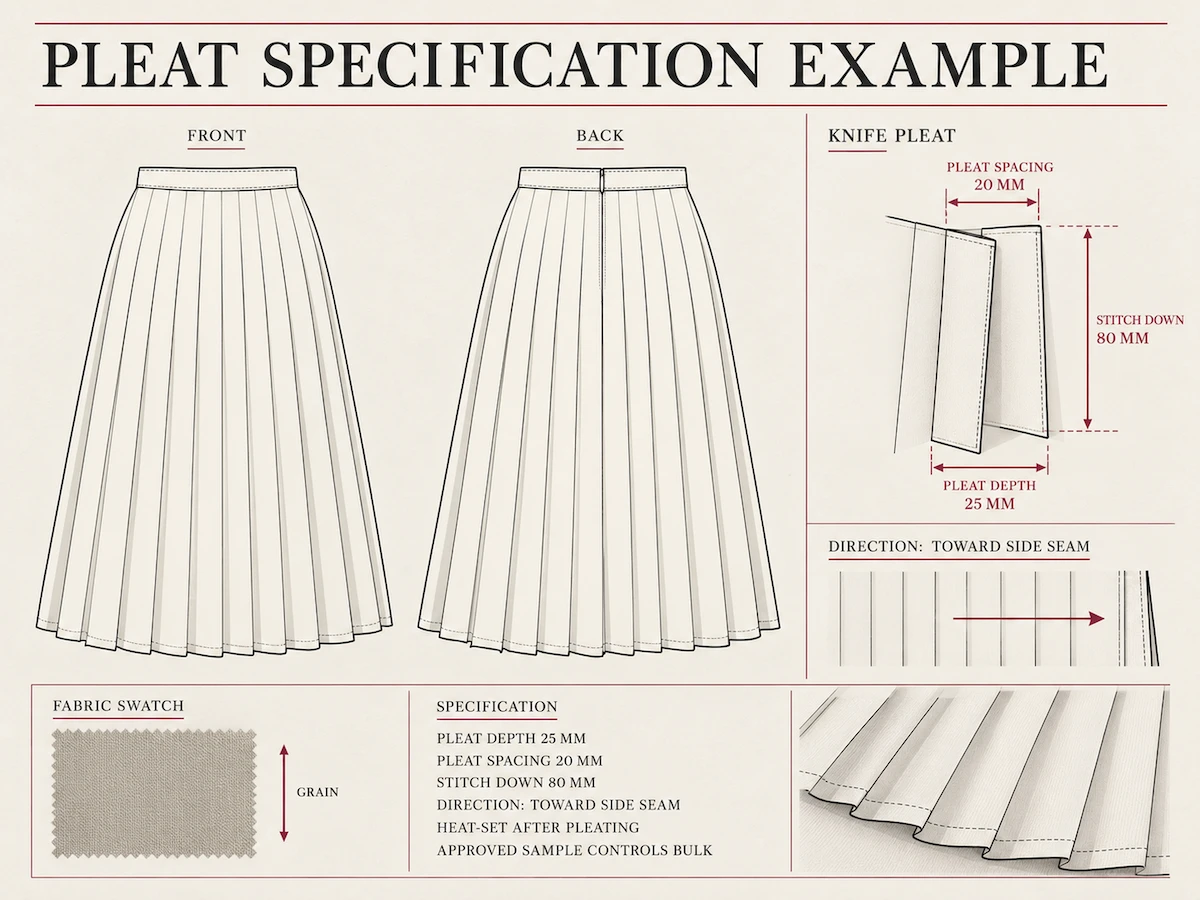
Name the method. State machine-stitched, heat-set, or hand-set. If you do not care which, say "method at factory discretion" and we will choose by fabric, but name it when you do care. A single word here removes most errors before they start. It also tells the costing engine which column to use, so the quote is right the first time.
State the pleat geometry. Depth in centimetres, direction, and spacing. Knife pleats face one way. Box pleats alternate. Sunray pleats radiate from a point, and you must name the point, usually the waist or the hem centre. Crush pleats have no fixed spacing and that itself is the spec. Without the numbers the operator guesses, and guessing on pleats is expensive because the whole panel is usually scrapped when the fold is wrong.
Show it as a diagram. A placement map for the panel, even a hand sketch scanned into the pack, removes ambiguity about where the pleats start and stop. Mark the start line, the end line, and any section left unpleated, such as a yoke or a vent. We read the diagram before we cut, and a clean diagram is worth more than a paragraph of prose because it cannot be misread the way a sentence can.
Set the tolerance. Pleat depth varies along a panel, and a tolerance of plus or minus a few millimetres is realistic. Tighten it and the cost rises because more panels get rejected at inspection. Loosen it and the garment looks uneven. We suggest a depth tolerance of TBC on fine pleats and TBC on heavy pleats, confirmed against your approved sample. State the tolerance so the inspector knows what to pass and what to pull.
Here is a notation block we can read without a question. Drop it into your pack exactly as written and the floor will execute it.
``` PLEAT SPEC (skirt shell, front panel only) Method: heat-set Type: knife, facing wearer left Depth: 1.5 cm Spacing: continuous, edge to edge Start: 3 cm below waistband seam End: at hem, pleats released Tolerance: +/- 1.5 mm on depth Fabric note: 100% polyester crepe, set at TBC deg C ```
Add the fibre note. If the fabric is natural and you still want a fixed pleat, write "fusible backing required" so the make includes it. If the fabric is synthetic, write "heat-set, do not stitch" if you want the invisible look. These two lines prevent the single most common mismatch, which is a stitched pleat on a fabric the buyer expected to be heat-set, an error that is invisible until the sample is pressed and compared to the reference.
Reference the construction around the pleat. A pleated skirt needs the waistband specified so the pleats are caught or released correctly. A pleated dress yoke needs the release point marked. The pleat does not exist alone on the garment, and the tech pack should show where it meets everything else, because a pleat that is perfect in isolation and wrong at the seam is still a wrong garment.
We turn a complete brief into a quote within twenty-four hours. A brief that names the method, the geometry, the fabric and the tolerance is a complete brief. One that sends only a photo starts a conversation instead of an order, and the sampling clock, seven to ten days, starts only when the spec is settled. Bulk then runs twenty to twenty-five days in peak season and fifteen to twenty days off season, so a settled spec early is worth real calendar time, not just money.
Common misunderstandings about pleats
A few beliefs reach us repeatedly, and most of them cost the buyer money before a single panel is cut.
That all pleats are permanent. They are not. Only heat-set pleats on synthetics are close to permanent. Stitched and hand-set pleats are held mechanically and can be undone by heat or wear. A buyer who prints "permanent pleats" on a viscose dress is advertising a claim the fibre cannot keep.
That a finer pleat costs less. The opposite is often true. Fine pleats need precise machine setup or precise hand work, and the per-piece labour rises as the pleat gets smaller and more numerous. A wide box pleat is cheaper to run than a micro sunray, and a buyer who asks for the micro sunray should expect the higher line, not argue it down after the sample.
That the same pleat works on any fabric. The fibre decides. A sunray pleat that is beautiful in polyester chiffon may be impossible in silk without a backing, and the buyer who insists pays for the backing and still gets a weaker result. The fabric choice is the pleat choice, and they cannot be made separately.
That pleats add only fabric. They add machine setup, a labour step, a pressing step, and often a packing change. On our lines a pleated panel passes through at least one extra operation that a flat panel does not. The cost is real and it should be on the quote, not buried in a lump sum that the buyer cannot read.
That ready-stock pleated styles are a compromise. They are the opposite. A pleated style in the 260 ready-stock range has already had its fabric and pleat method matched by people who had to make it hold through a production run. Starting there, then developing your own version, is faster than starting from a sketch and a hope, and it shows you the method that actually worked before you commit to tooling.
Related reading
- How Evening Dresses Are Made From Pattern to Finished Garment
- Three Dresses, Costed: What a Factory Actually Charges For
- What affects clothing manufacturing costs
Ready to spec your pleated style? Send us your tech pack with the method, geometry and fabric and we will quote within twenty-four hours.