On this page
- The three first orders we see most
- What each order actually ties up in cash
- How unit price actually moves with quantity
- Loss-limit your first run, then reorder
- When ordering more is actually the right call
- Why the minimum is 100 per design and 100 to 200 per colour
- Six questions to ask the factory on your first order
The question "how many should I order" is usually asked as if it were a question of nerve. Buyers talk about being brave enough to commit, or about not wanting to get stuck with a warehouse of unsold stock. The bravery framing is wrong. Order quantity is a cash arithmetic problem. You are deciding how much money leaves your account before a single garment sells, and what happens to that money if the style does not move. The factory's minimum is only one input. Your cash flow, your sales channel, and your dead-stock tolerance are the other three, and they matter more.
We have built production for startup founders working out of a spare room, for boutique buyers placing their fourth seasonal reorder, and for DTC brands shipping container loads to three warehouses. The order quantity that fits each of them is different, and none of the answers is "as much as you can." This piece walks through the three order shapes we see most, puts real numbers against each, and shows the price curve and the minimum that sit underneath. By the end you should be able to do the sum for your own business with a calculator and a freight quote.
The three first orders we see most
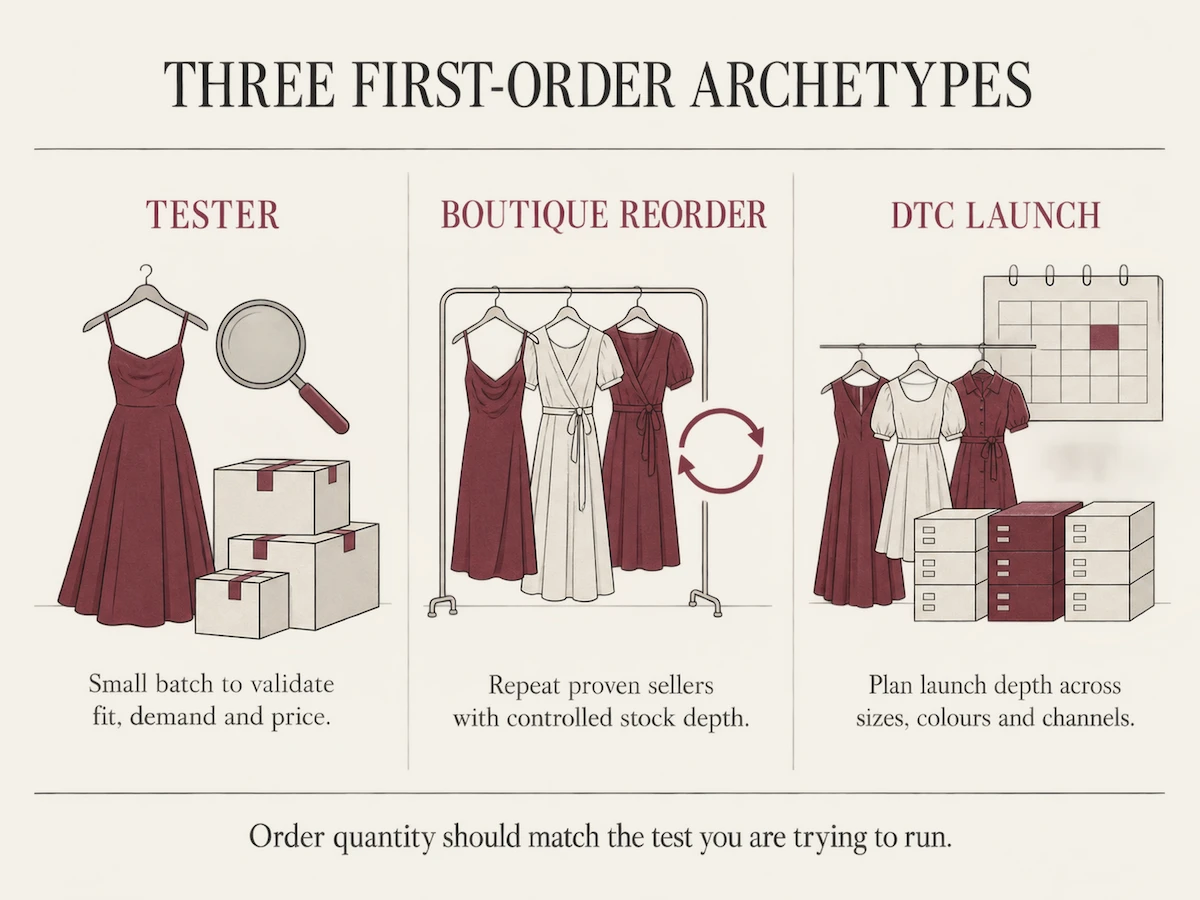
Most new brands fall into one of three shapes. We call them the tester, the boutique-reorder, and the DTC launch. They are not personality types. They are cash positions. The right order for one of them is the wrong order for the others, and the difference shows up in the bank before it shows up on the rail.
The tester
The tester is a founder with one design they believe in and a budget that ends this month. Often it is a first product, sometimes a single style pulled from our /ready-stock/ range because the 260 styles there already carry real RMB prices and can ship without a development cycle. The tester wants proof that the product sells before any serious money is committed. The order is small on purpose.
A typical tester order runs one design, one hundred pieces, one colour. That is exactly our minimum, and it is no accident that the minimum and the tester profile line up. At this size the whole point is to learn. Does the fit read the way the sketch promised. Does the colour photograph the way it looked on the screen. Will a stranger pay for it. None of those questions need five hundred units to answer. They need one hundred units that arrive, get photographed, and go on a listing.
The risk for the tester is not the factory. The risk is ordering so little that the per-unit cost sits at the top of the curve, then treating that top-of-curve price as the real cost of the garment. It is not. It is the cost of being small, and it falls fast as the quantity rises. We come back to that.
The boutique-reorder
The boutique buyer is different. They already sell. They have a rail, a customer list, and a sense of which silhouettes their shoppers reach for. The boutique-reorder order is a small spread across several styles, sized off last season's sell-through rather than off a guess.
A common shape is three designs at one hundred fifty pieces each, two colours per design, nine hundred pieces in total. The buyer is not testing the concept. They are topping up a working assortment. Because the buy is spread, no single style carries the whole order, and because it follows real sales, the dead-stock exposure is lower than the tester's in percentage terms even though the absolute cash is higher.
This buyer cares most about two things we can name precisely. First, that the reorders match the sealed sample from the season before, because a boutique's reputation rests on consistency. Second, that the bulk window lands inside the season. Our bulk lead time runs twenty to twenty-five days in peak season and fifteen to twenty days off season, and a reorder placed in March is a different conversation from one placed in August.
The DTC launch
The DTC launch is a brand going straight to a full launch with paid traffic behind it. The order is sized to fill a warehouse and absorb the spike that good ads produce, not to test the market. A typical launch runs five designs at two hundred pieces each across three colours, three thousand pieces total. The unit economics only work if the product converts, so the launch order is a bet backed by a marketing plan.
This buyer gets the best unit price of the three because the fixed costs spread across the largest run, and because fabric can sometimes be bought at a better rate in the larger lots. The trade is risk. Three thousand pieces is real money tied up before revenue starts, and if the ad creative misses, the dead-stock sits at container scale. The DTC launch should only take this size when the founder has already validated the product on a smaller run or has a channel committed enough to move the volume.
What each order actually ties up in cash
The number that matters is not the unit price. It is the cash that leaves your account when you open the purchase order, plus what you cannot get back if the style does not sell. Below is the cash occupation for each of the three shapes, built on illustrative unit prices marked TBC. The structure is the part to copy. Goods cost is only the start. Freight and duty sit on top, and dead-stock exposure is the part most buyers forget to count.
| Archetype | Order profile | Goods cost (EXW) | Ocean freight | Import duty | Cash tied at PO | Dead-stock exposure |
|---|---|---|---|---|---|---|
| Tester | 1 design, 100 pcs, 1 colour | USD 2,400 (USD 24.00/pc TBC) | USD 450 TBC | USD 300 TBC | USD 3,150 | USD 960 (40% of goods) |
| Boutique-reorder | 3 designs, 150 pcs each, 2 colours = 900 pcs | USD 23,400 (USD 26.00/pc TBC) | USD 1,150 TBC | USD 2,800 TBC | USD 27,350 | USD 3,510 (15% of goods) |
| DTC launch | 5 designs, 200 pcs each, 3 colours = 3,000 pcs | USD 61,500 (USD 20.50/pc TBC) | USD 3,200 TBC | USD 7,380 TBC | USD 72,080 | USD 18,450 (30% of goods) |
Read the last column before you read the first. The tester ties up the least cash, just over three thousand dollars, but carries the highest dead-stock rate because everything is riding on one unproven style. The DTC launch ties up the most cash by a wide margin, but the dead-stock exposure as a share of goods is moderate only because the buy is spread across five designs and three colours. If one of those five misses, the exposure on that one style looks more like the tester's problem at larger scale.
The freight and duty rows are where first-time buyers get surprised. A small LCL shipment to a US port costs almost as much to book as it does to fill, which is why the tester's freight is a heavy share of a low goods value. Duty is your cost, not ours, and it lands on the goods value at the rate your country assigns to women's dresses. We can tell you the HS classification when you ask, and you should build it into the cash sum before you sign. None of these figures include the cost of a specification change after the pre-production sample is sealed, because that cost is unpredictable by definition and shows up as a revision to the invoice rather than the quote.
The practical move for a tester is to treat the three thousand dollars as tuition. If the style sells, the next order is bigger and cheaper. If it does not, you have lost under a thousand dollars of goods value and learned what does not work. That is a cheaper education than a nine-hundred-piece buy that sits.
How unit price actually moves with quantity
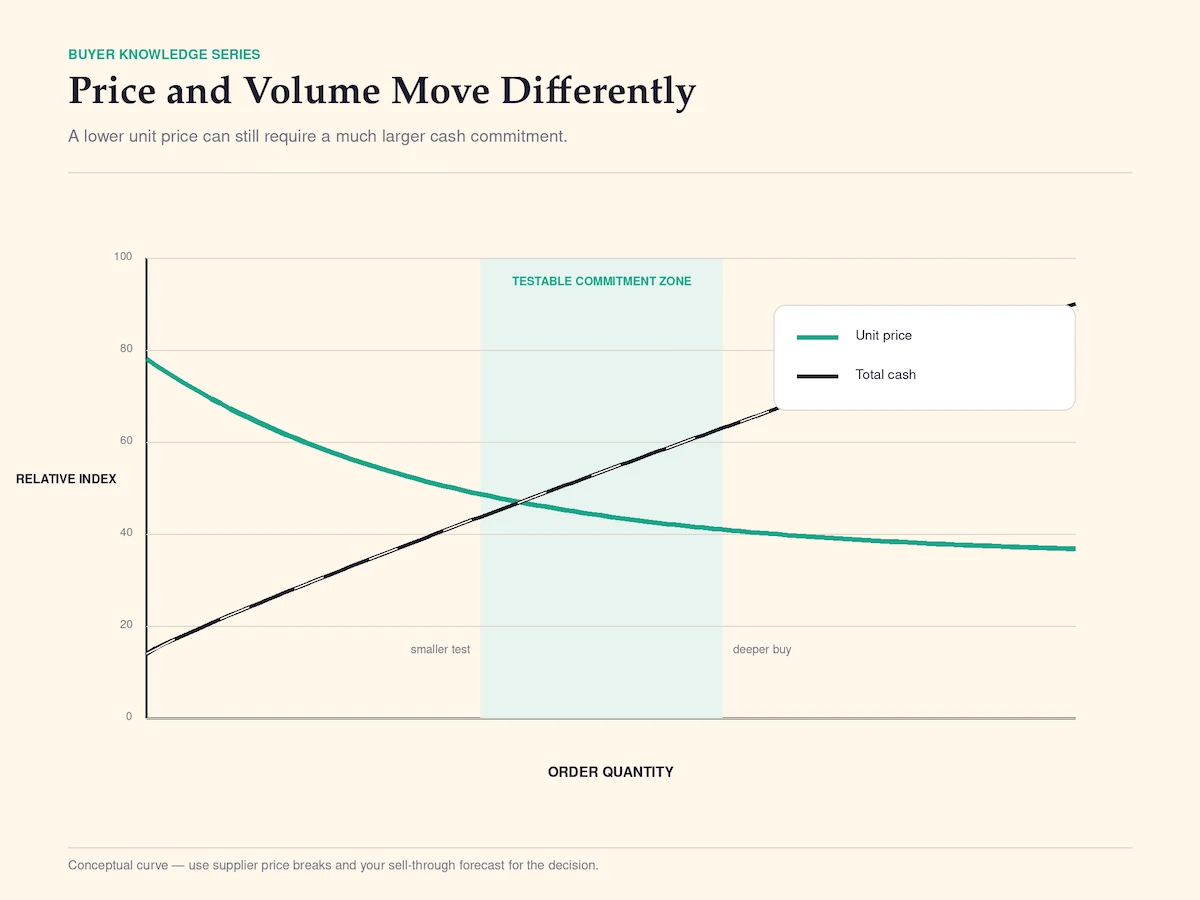
Buyers expect a steep volume discount. The reality is flatter than the expectation, and understanding the shape of the curve stops you from over-ordering to chase a discount that is not there.
Nothing about making the garment gets cheaper when the run grows. The same stitches are sewn, the same fabric is cut per piece, the same fifty-eight minutes of operation time applies at one hundred pieces and at one thousand. What changes is the fixed spread. Grading and marker is a fixed cost per style, around USD 60, whether you order sixty pieces or six hundred. Sampling is a fixed development cost, typically USD 120 across two rounds for a lined woven style, and it does not move with quantity either. Those two lines divide by the order size, so they dominate the per-unit number at low quantities and shrink toward zero as the run grows.
On top of the fixed spread there is a real but smaller efficiency curve. Operators settle into a rhythm after the first few dozen units. Cutting can be batched more cleanly on a longer lay. Fabric can sometimes be bought at a better rate in larger lots. Together those effects are in the region of three to eight per cent between a hundred-piece run and a five-hundred-piece run of the same style. They are not linear and they are not dramatic.
Here is the curve for one woven midi style, using an illustrative variable base of about USD 35.05 per piece with the fixed spread applied at each quantity. All unit prices are TBC pending live quote data.
| Quantity per design | Fixed spread / pc | Efficiency adjustment | Unit EXW (USD) | Basis |
|---|---|---|---|---|
| 100 pcs | USD 1.80 | 0% | USD 36.85 TBC | grading USD 60 + sampling USD 120 over qty |
| 200 pcs | USD 0.90 | -1% | USD 35.95 TBC | fixed cost halved per piece |
| 300 pcs | USD 0.60 | -2% | USD 34.90 TBC | fixed cost a third of 100-pc rate |
| 500 pcs | USD 0.36 | -4% | USD 33.95 TBC | fixed cost near-flat; efficiency builds |
| 1,000 pcs | USD 0.18 | -6% | USD 33.05 TBC | fixed cost negligible per piece |
The drop from one hundred to three hundred pieces is the meaningful one. That move takes the unit price down by about five per cent on the fixed spread alone, before any efficiency gain. Beyond five hundred pieces the curve flattens hard, because the fixed cost is already a rounding error and the efficiency ceiling is close. Ordering one thousand instead of five hundred to chase a lower unit price usually saves you a few cents a garment while doubling the cash you have tied up. For most new brands that trade is backwards.
This is also why a quote that drops twenty per cent between minimum and five times minimum should be read carefully. Most of that drop is fixed-cost spreading, not a cheaper garment, and it disappears as a lever once you are past the early part of the curve.
Loss-limit your first run, then reorder
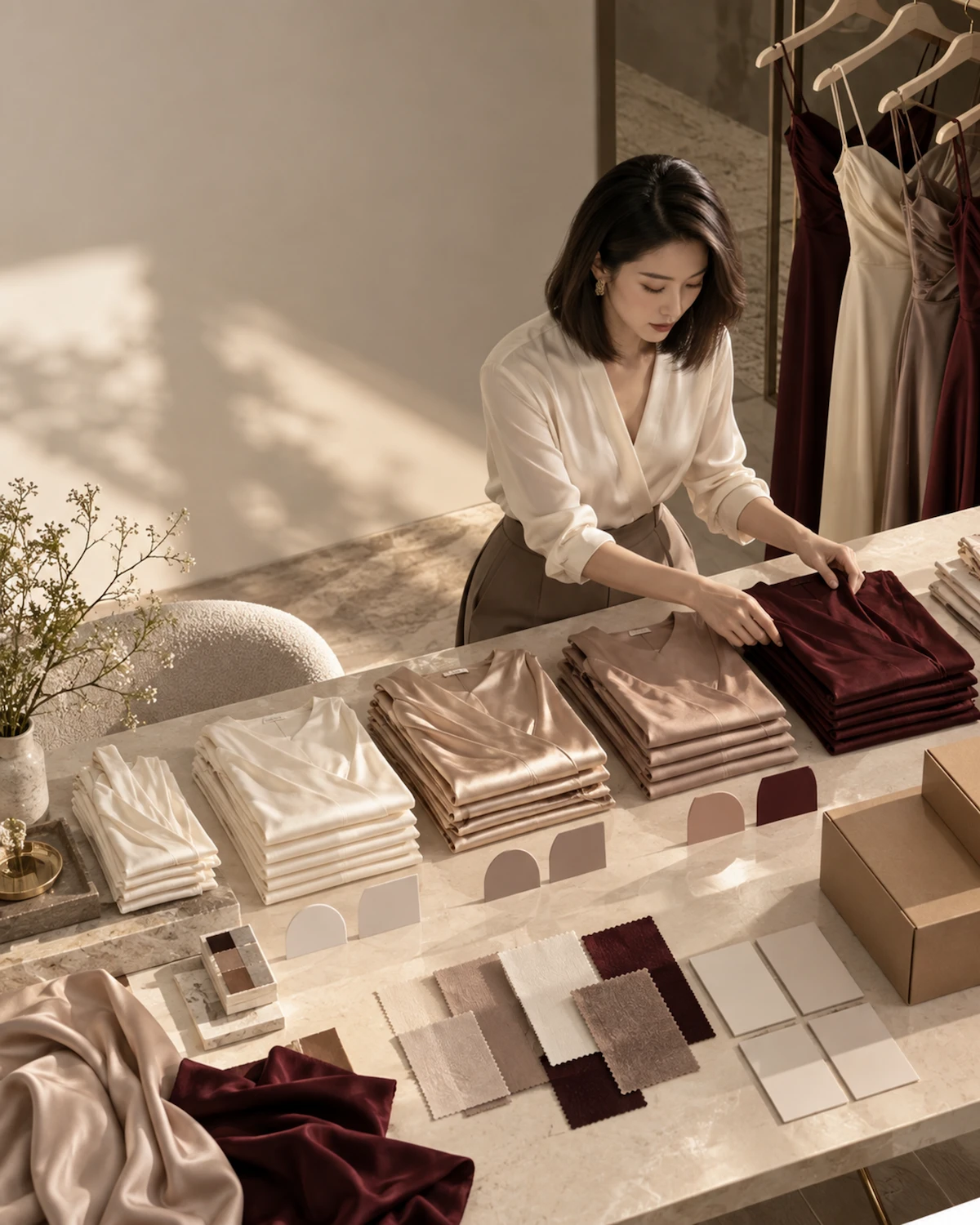
The single most useful habit for a new brand is to size the first order to the loss you can afford, not to the volume you hope to sell. Treat the opening buy as a test with a known worst case, then let proved demand pull the reorder.
The mechanism is straightforward. You commit to the minimum that still gives you a sellable quantity, one hundred pieces per design in our case, and you watch what happens. If the style sells through at the rate you expected, the reorder is a different and cheaper order, because the sealed sample already exists and the development cost does not repeat. Sampling on a reorder is a confirmation round, seven to ten days, not a from-scratch development. The bulk window also shortens because there is no pattern redraw and no first-article debate.
The cash argument is the strong one. A tester who opens with one hundred pieces ties up roughly three thousand dollars and risks under a thousand in dead stock. The same founder who opens with five hundred pieces of an unproven style ties up perhaps five times the cash and accepts five times the exposure, for a unit-price saving in the low single digits. The saving does not pay for the risk unless the product is already proved.
We see the loss-limit pattern work best when the founder treats the first run as a photo and sales sample as much as inventory. One hundred pieces split across a few sizes gives you enough units to list, to shoot, and to fulfil the first real orders, while the reorder rides the demand signal. Our /ready-stock/ range exists for exactly this step. Because those 260 styles carry real RMB prices on file, a tester can skip development entirely, take a small confirmed buy, and reorder the same style without reopening the spec.
When ordering more is actually the right call
The advice above is not a rule to always stay small. There are clear cases where a larger first order is the correct financial decision, and pretending otherwise would cost you money.
The first case is a committed channel. If a retailer or a marketplace has given you a confirmed order for a specific volume, your reorder risk has already moved to near zero, and buying to that volume at the better unit price is simply correct. The dead-stock column in the cash table collapses when the buyer on the other end is already named.
The second case is a hard freight cliff. Ocean freight to most destinations has a step between a partially filled container and a fully filled one, and air freight is priced in a different universe. If your goods fill a container at three thousand pieces but only half a container at fifteen hundred, the per-piece freight at the larger size can drop enough to outweigh the fixed-spread saving you would have earned by staying small. This is why the DTC launch column shows freight at a lower per-piece rate than the boutique column despite the larger cash total. The shipping maths, not the bravado, earns the bigger buy.
The third case is a genuine fabric or trim economy. Some shell fabrics are only offered in full rolls or in dyed lots that make sense above a threshold. If your target cloth costs markedly less per metre at a larger intake, and you are confident the style will sell, the volume buy pays for itself in material before it reaches the sewing line. We will tell you when this applies. It does not apply to most first orders, and a factory that claims it always does is selling you quantity rather than advising you.
The fourth case is season. If you are buying for a fixed selling window and the bulk lead time plus the freight transit puts a small order at risk of missing the season, the larger, earlier order is the safer one even at higher cash occupation. A dress that arrives after the wedding season is dead stock by definition. Our peak-season bulk window of twenty to twenty-five days and off-season window of fifteen to twenty days should sit in your calendar before you choose the quantity.
Why the minimum is 100 per design and 100 to 200 per colour
Our minimum is one hundred pieces per design, with one hundred to two hundred pieces per colour depending on the fabric and whether it has to be dyed to order. That number is not a sales tactic. It comes out of the floor cost of setting up a production run, and you can reproduce the arithmetic for any factory you talk to.
Two fixed costs have to be paid before a single sellable garment exists. Grading takes the approved sample and builds the full size set, and marker planning lays those graded patterns onto the fabric width to plan the cut. Those are skilled, one-time operations billed per style, not per piece. Below a certain quantity the per-unit share of those costs is so large that the garment stops being price-competitive, and the factory either loses money or has to quote a number that scares the buyer off. One hundred pieces is roughly where that share becomes tolerable for a standard women's dress.
The cutting lay sets the colour minimum. A spreading table runs a lay of fabric in a given colour, and the lay has a practical minimum length because the marker has to repeat enough times to be worth setting up. For a woven shell that arrives finished, one hundred pieces in one colour is a clean lay. For a fabric that must be dyed to your colour, the dye house has its own lot minimum, and that is where the colour floor rises toward two hundred pieces. This is also why some /products/eveningwear-gowns/ and /products/occasionwear/ styles show a two-hundred-piece colour minimum in the spec. The dye lot, not the sewing line, is the constraint.
The pre-production sample and the sealed sample sit underneath all of this. The pre-production sample is the garment we make to confirm the construction, the measurements, and the workmanship before the line runs. The sealed sample is the one both sides sign off and keep, and every bulk piece is measured against it. Those steps cost the same whether the run is one hundred pieces or one thousand, and they are part of why very small runs carry a per-unit penalty that has nothing to do with sewing. Our sampling window is seven to ten days, and it is the same window regardless of the bulk quantity that follows.
Certifications matter here because they affect whether a small order is worth your risk at all. Our production facilities in Guangzhou and Dongguan operate under ISO 9001, and our fabrics and processes carry OEKO-TEX STANDARD 100 where applicable. We are amfori BSCI-audited and SGS-inspected. None of that changes the MOQ maths, but it changes the confidence with which a new brand can place a first hundred-piece order and know the sealed sample means what it says.
Six questions to ask the factory on your first order
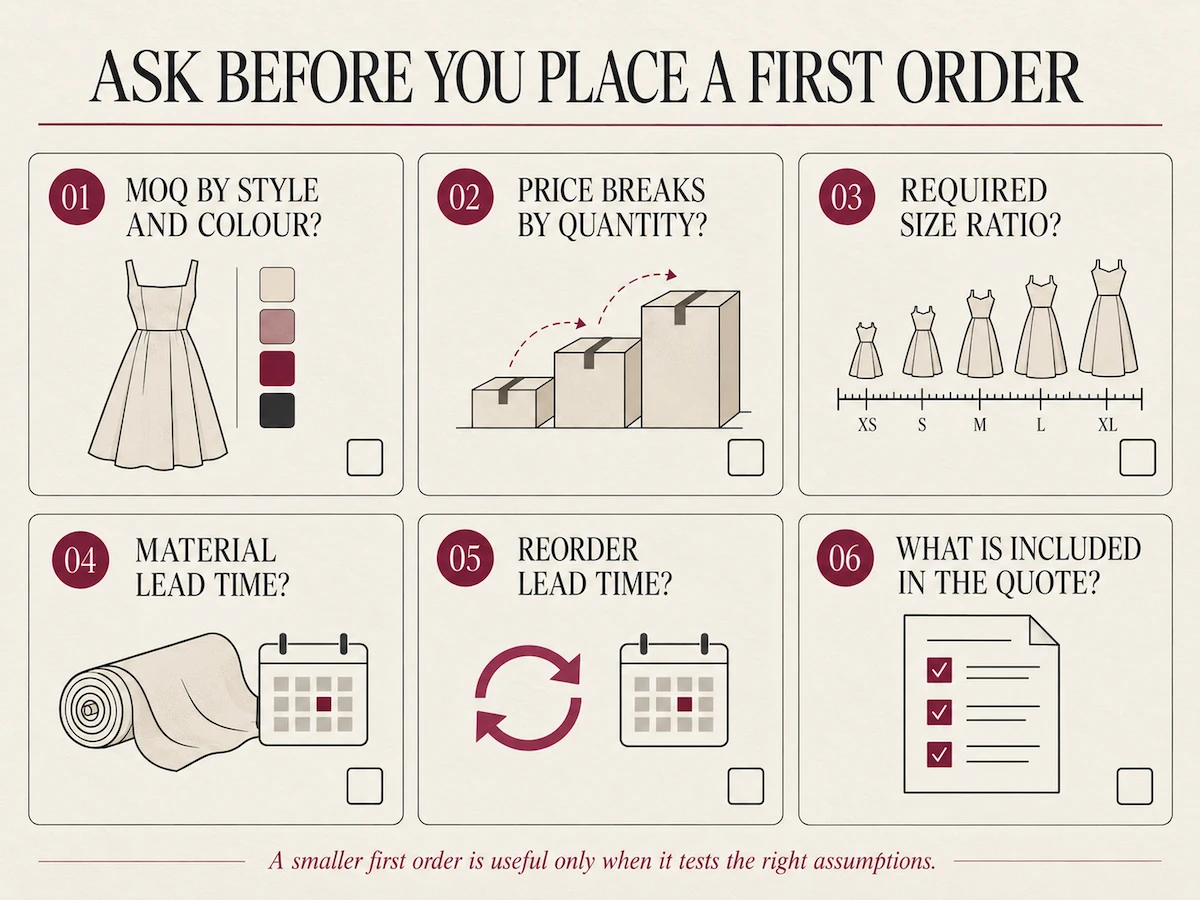
The first order is where the expensive misunderstandings happen, because neither side has a track record with the other yet. Six questions settle most of them before they cost money.
One. What exactly is in the quoted unit price, and is it EXW, FOB, or DDP. These terms decide who pays freight and duty and where the cash leaves your account. A quote with no incoterm named is not a quote you can budget against.
Two. What is the sampling timeline and what does the pre-production sample and the sealed sample cover. You want seven to ten days confirmed, and you want the sealed sample to be the measurement authority for the bulk. If the factory will not keep the sealed sample, your quality argument later is weak.
Three. What is the bulk lead time right now, and are we in peak or off season. Twenty to twenty-five days peak and fifteen to twenty off season is our window. The same order placed in different months is a different promise, and you should hear that from the factory, not discover it in transit.
Four. How is the minimum applied across colours, and does my target fabric need a dye lot that raises the colour minimum toward two hundred. This is the question that prevents a surprise colour surcharge after you have committed.
Five. What happens to the unit price if I reorder the same sealed sample in sixty days. A factory that can name the reorder price and the shortened sampling step is one that treats your first order as the start of a run, not a one-off. That is the relationship you want.
Six. Can you itemise the quote the way a cost sheet reads, with fabric, trims, CMT labour, grading and marker, sampling amortised, inspection, and packing each on its own line. If the number cannot survive being itemised, that tells you something. We quote within twenty-four hours when the brief is complete enough to quote from, and the itemised form is the one we send, because it is the one you can read.
Those six questions also tell you about the factory. A production partner who answers them plainly, names the incoterm, keeps the sealed sample, and shows the cost lines is one you can grow the order with. One who hedges on lead time or refuses to itemise is one to order small from until proven.
Related reading
- Three Dresses, Costed: What a Factory Actually Charges For
- How MOQ is calculated in clothing manufacturing
- What should be in a clothing manufacturing quote?
Work out your first order on paper, then send us the brief. Request a quote with your design, target quantity, and delivery window, and we will come back within twenty-four hours with an itemised number you can read against the tables above.