On this page
- Reverse 1: sizing is where most returns are decided
- Reverse 2: packaging and labelling that FBA will actually receive
- Reverse 3: durability and wash testing keep the returns off the second wear
- Reverse 4: compliance paperwork is your file, built on our certificates
- Reverse 5: replenishment speed is your inventory turn
- The spec sheet you paste into an RFQ
- Where Amazon orders commonly fail

The fastest way to lose money on Amazon Fashion is not a bad factory. It is a competent factory building a dress to a standard that does not match the channel. The order ships, the listing photos look right, the price holds, and then the return rate quietly climbs. Returns on apparel are dominated by fit and condition, and every unit that comes back has already cost you the FBA inbound fee, the forward pick and pack, the return processing fee, and most of its resale value. Apparel returned to FBA is frequently unsellable because it arrives worn, opened, or without its original packaging. So the returned dress is a pure cost, and a few points of return rate can erase the margin on a whole style.
We make women's wear for Amazon sellers at our production facilities in Guangzhou and Dongguan. Browse the dresses we run to see the constructions this article refers to. What those sellers need from a factory is rarely an exotic fabric or a lower stitch rate. What they need is a garment whose every manufacturing decision lines up with the way Amazon penalises mistakes. The useful move is to think about this backwards, and this article is written that way. Each section starts with what Amazon does to a seller who gets it wrong, then walks back to the single production decision that prevents it. By the end you have a spec sheet you can paste into a quote request without leaving the factory room to guess.
Reverse 1: sizing is where most returns are decided
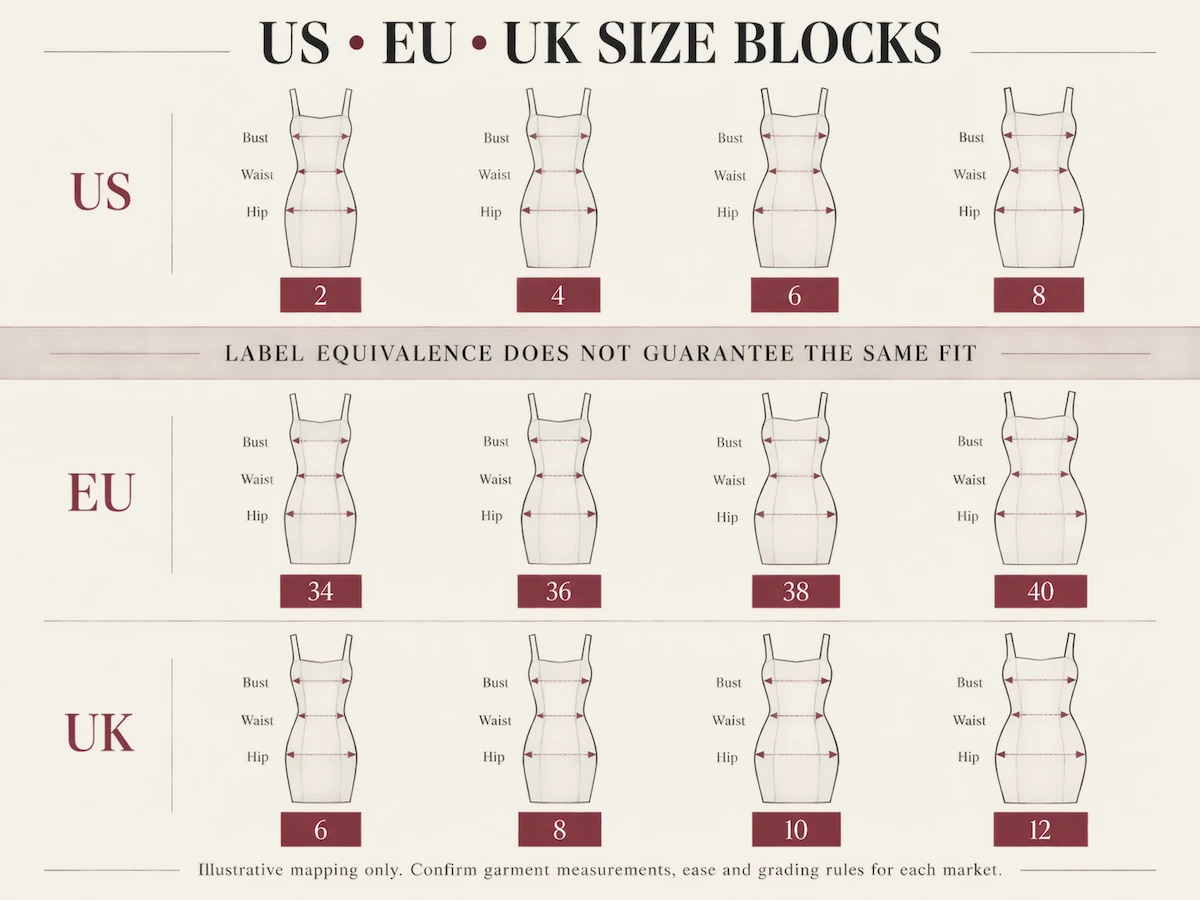
Fit is the largest single driver of apparel returns on Amazon. Buyers leave "runs small" or "wrong size" far more often than they leave "poor quality," and those reviews suppress conversion on the whole listing, not just the one order. The root cause is almost always a mismatch between the size block the dress was graded to and the size block the customer expected.
There are three blocks in play for Western sellers, and they are not the same garment. The US block, the UK block, and the EU block each put the same letter or number on a slightly different body. A US size 8, a UK size 12, and an EU size 40 are often sold as equivalent, but the underlying body measurements differ by market, and the per-size grade step differs too. If you list a dress as "US size" but the factory graded it to an Asian block, or quietly used a UK grade, the dress will not fit the body your customer is measuring herself against. The result is a return, and it is not a quality problem.
The size sticker is the second half of this. The label sewn into the garment must state the block you actually graded to. A common failure is a spec that says US sizing, a factory that sews an Asian grade, and a label that still reads "US 8." The dress is internally consistent but externally wrong, and the customer has no way to know until she tries it on. The fix is to state the block in the tech pack, supply the target market's size chart, and require a graded spec sheet that names the block at every size.
Grading itself deserves attention at the size extremes. The per-size step, the amount the pattern grows from one size to the next, is typically around 2.5 cm at the bust, waist, and hip for a misses' dress, but the step and the shape change at plus sizes. A plus block is not a small block scaled up. It needs its own pattern, its own grade, and its own fit sample. We build a separate plus block and fit it on a real plus mannequin rather than scaling, because a scaled block throws the shoulder and the bust point out of place and the customer feels it even if she cannot name it. If your range runs from XS to 3XL and you graded only the middle, the ends will fit badly and the returns will cluster there.
Lock the size spec with a sealed sample. That is the reference garment, measured and signed off, against which bulk production is checked. Production must match the sealed sample within an agreed tolerance, usually 1.0 to 1.5 cm on key measures. The pre-production sample should be measured at every size in the range, not just one, because a grade that is correct at the middle can drift at the ends. We measure the PP sample across the full size run before bulk cuts, and any size that drifts past tolerance is regraded before the line opens.
Fit returns also carry a second cost that the unit maths misses. A returned dress tends to leave a one-star or two-star review on the way back, and that review sits on the listing depressing conversion for every future buyer. So a single misgraded size can cost you the returned unit and the next ten sales it quietly suppresses. That is why the block and the sticker are worth the argument up front.
Here is the block comparison we use when a seller is not sure which market they are actually selling into.
| Size label | US M (8) | UK M (12) | EU M (40) | Grade step per size |
|---|---|---|---|---|
| Bust | 91.5 cm | 94.0 cm | 96.0 cm | 2.5 cm |
| Waist | 71.0 cm | 74.0 cm | 76.0 cm | 2.5 cm |
| Hip | 96.5 cm | 99.0 cm | 101.5 cm | 2.5 cm |
| Shoulder to waist | TBC | TBC | TBC | 1.0 cm |
The numbers above are illustrative of standard misses' blocks and should be confirmed against our actual graded blocks (TBC) before you publish a size chart. The point is not the exact centimetres. The point is that the same letter maps to a different body by market, and the sticker has to say which one you used. Get that wrong and no amount of stitch quality saves the return rate.
Reverse 2: packaging and labelling that FBA will actually receive
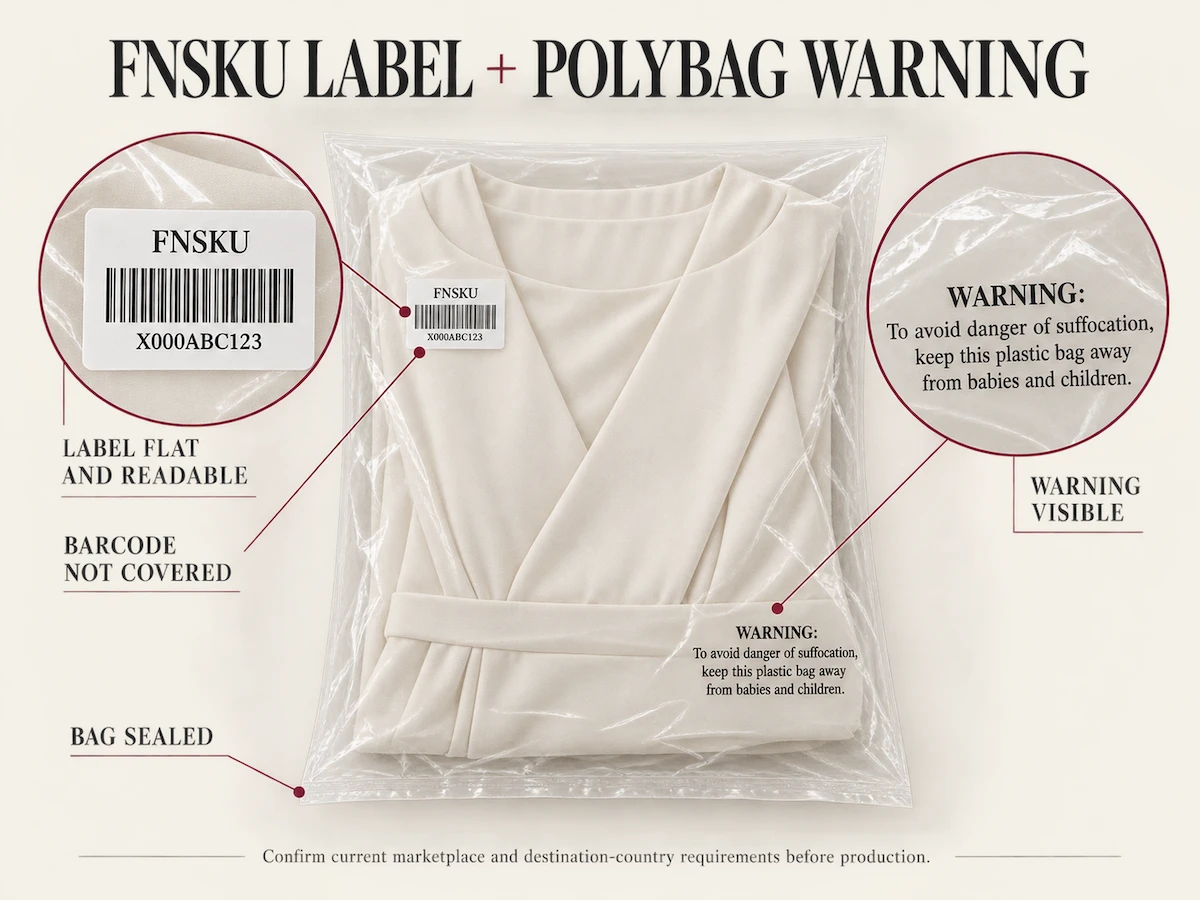
A dress that is perfectly made can still be rejected at the Amazon fulfilment centre, or mixed into the wrong inventory, because the labelling and packing do not match what FBA expects. This is a manufacturing decision, because the factory is usually the last place the unit is touched before it ships to the warehouse.
FNSKU is the first item. That is the Amazon-specific barcode that ties each unit to your listing. There are two ways to handle it. The factory can apply the FNSKU label during packing, which means you supply the label files and we print and place them. Or you generate the labels in Seller Central and the factory leaves a flat, unscannable area on the polybag or carton for you to apply later. Either path works, but the label must be unique per SKU and scannable, and it must survive the bag. A carton packed with two FNSKUs mixed together, or a label placed over a seam so it wrinkles, creates a receiving exception that can sit for weeks while your inventory is frozen.
Polybags carry their own rules. In the US, polybags with an openable width of 5 inches (12.7 cm) or more need a suffocation warning printed on them. Amazon's own polybag policy adds a scannable barcode and a sealed, undamaged bag. If the barcode is printed on the garment care tag instead of on the outside of the bag, the scanner at receive cannot read it and the unit may be misrouted. The safe spec is a polybag with the suffocation warning, the FNSKU visible and scannable through or on the bag, and a sealed opening. We print these at the Dongguan facility when the spec calls for it, and we confirm placement on the pre-production sample so the barcode is not buried under a fold.
The care and composition label is where customs and compliance meet. Every imported garment needs fibre content, country of origin (Made in China), care symbols, and importer or responsible-party information. Leave any of those off and you risk a customs hold and an Amazon listing removal. This is a factory output, because the label is sewn in during make-up, so it has to be specified in the tech pack, not added later by a relabelling service that charges you twice.
Carton marks and carton cube close the loop. FBA expects each carton marked with the shipment ID, the carton sequence (1 of 12, 2 of 12), and the contents. Oversize or overweight cartons draw FBA fees and are harder to handle. We pack to FBA carton limits, 60 by 40 by 40 cm and 15 kg per carton as a working target, and we print the shipment marks when you supply the ID. Carton cube also drives your freight, because a carton that is half air costs the same to ship as a full one under FOB or DDP. On a 100-piece order of a light woven dress, a carton packed 12 deep rather than 8 deep can move from 18 kg to 27 kg, and that single change can push you past the FBA overweight line and onto the same handling fee as a carton twice its size. The fix costs nothing at the factory and saves the fee on every reorder. A packing change made after the pre-production sample is approved changes the cube, which changes the freight, which changes your landed cost. That link is why the packing spec belongs in the RFQ, not in a later email.
Reverse 3: durability and wash testing keep the returns off the second wear
Amazon customers wash apparel before wearing it, or wash it often, and they return what does not survive. The return reasons that show up after delivery are shrinkage, colour bleed, pilling, and seam opening. None of these are visible on a fresh sample, which is exactly why they surprise sellers who approved a clean pre-production sample and then watched returns climb.
The control is a wash test written into the RFQ. We can run domestic wash cycles, typically five cycles at 40 degrees Celsius, and report dimensional change and colour fastness. A knit dress that shrinks 3 percent on the first wash will not fit the customer who expected the listed size, and that is a return. A woven that bleeds onto a white liner is a return. Specifying the test before bulk, and rejecting the bulk if it fails, is cheaper than absorbing the returned units and the review damage that follows them.
Seam slippage is the one buyers miss. A dress washed warm can develop "seam grin," where the stitch holds but the fabric pulls away from it. A seam slip test, measured in millimetres of opening under a set load, catches this before bulk. Colour fastness to rubbing, the crocking test, and light fastness if the stock will sit in bright warehouse light, round out the standard set. We run these in-house and we can also commission formal test reports from SGS when a buyer needs documentation for an Amazon compliance request.
Tie this back to the size block. A dress that shrinks and a dress that was graded to the wrong block produce the same customer complaint, "wrong size," so the two problems are easy to confuse. The wash test separates them. If the returned dress measures the same as the sealed sample, the problem was the block. If it shrank, the problem was the fabric and the test. Both are fixed at the factory, but they are fixed differently, and guessing which one you have wastes a reorder.
Reverse 4: compliance paperwork is your file, built on our certificates

We are not a compliance laboratory, and the seller owns final compliance for their market. What the factory controls is whether the paperwork exists to clear customs and to satisfy an Amazon documentation request. The two are different, and conflating them gets sellers into trouble.
Our production facilities in Guangzhou and Dongguan are ISO 9001 certified, OEKO-TEX STANDARD 100 certified, amfori BSCI-audited, and SGS-inspected. Those are facts you can keep in your supplier file and show to a platform auditor. They speak to how the product is made and tested, not to whether your specific listing meets every import rule, so treat them as backing rather than as a substitute for your own conformance work.
On the US side, CPSIA applies to children's products, and adult women's fashion generally sits outside its testing mandates. That said, the lead and phthalate limits under CPSIA still matter for components like metal trims and printed surfaces, and we source trims that pass those limits. One clear boundary: children's sleepwear carries strict flammability rules under US law, and we do not manufacture children's sleepwear. Do not ask us to, because we will not, and a factory that says yes to that category without the certification is a risk you do not want in your supply chain.
On the EU side, REACH governs restricted substances in dyes, trims, and finishes. If you sell through Amazon EU, REACH relevance is real, and OEKO-TEX STANDARD 100 at the fabric level covers much of the same restricted substance list. We supply the material test reports and the facility certificates. What we will not do is hand you a generic "CE" mark or claim a certification we do not hold. Tell us which market you sell into and we will tell you exactly which documents we can provide, and which ones remain your responsibility to file.
The practical file to keep for each style is a test report, a declaration of conformity where one is required, and the facility certificates above. Build that file at the sample stage, not after your first Amazon compliance request, because the request comes with a deadline and a listing that goes inactive while you scramble for paper.
Reverse 5: replenishment speed is your inventory turn
Amazon punishes stockouts harder than almost any other mistake, because an out-of-stock listing loses rank and the recovery is slow. So the factory's lead time is not a back-office detail. It is your inventory turn, and it decides how much cash you tie up in a style.
Our numbers are fixed and worth planning around. Sampling runs 7 to 10 days. Bulk production runs 20 to 25 days in peak season and 15 to 20 days in the off season. We quote within 24 hours when the brief is complete. Minimums are 100 pieces per design and 100 to 200 pieces per colour, which lets you test a style with a small cash outlay and reorder once it sells. At 100 pieces per design, a style that fails in the market costs you one small run and a clean lesson. At 2,000 pieces per design, the same mistake is a warehouse of dead stock. The 100-piece minimum exists partly so the channel's speed requirement does not force you into bets you cannot afford to lose.
A re-run is faster than a first run, and this matters for turns. The grading, the marker, and the sealed sample already exist, so the factory re-enters production lower on the learning curve. When you plan replenishment, use the re-run time, not the first-run time, for your repeat orders. That difference is why sellers who test at 100 pieces and reorder at 200 can keep a style in stock without holding a warehouse of safety inventory.
For a seller who needs inventory this week rather than in three weeks, our 260 ready-stock styles carry real RMB prices on file and sit at the /ready-stock/ hub. That is the fastest path to a live listing, and you can take them FOB or DDP depending on whether you want to manage the freight or have it landed at your door. The trade is assortment, not speed. Ready stock is what it is; custom development is what you design.
Work the turn math once so the trigger is real. A style that sells 200 units a month and takes 22 days in bulk at peak needs its reorder placed with about 150 units still on the shelf, roughly three weeks of cover, so the new stock lands before the old runs out. Set the alert at that number, not at zero, because the factory lead time is the variable you cannot compress on short notice and it sets your reorder point. Hold less cover and you carry less cash; hold the wrong cover and you go dark.
The spec sheet you paste into an RFQ
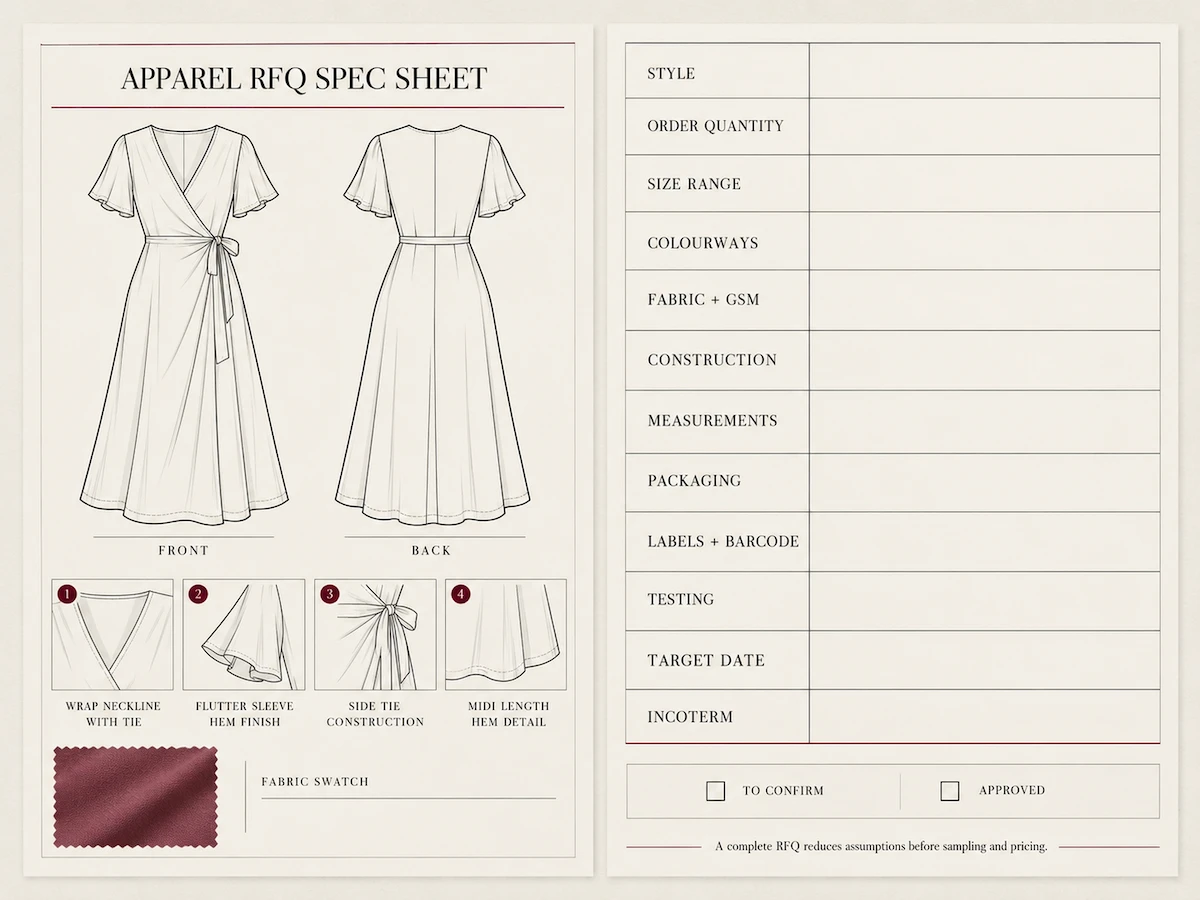
Everything above collapses into a single block you can drop into a request for quotation. The point of writing it down is to remove the assumptions a factory will otherwise fill in for you, usually in a way that matches its own habits rather than your channel. Here is the sheet we wish every Amazon seller sent.
| RFQ field | What to specify | Why it matters for Amazon |
|---|---|---|
| Target market and size block | US, UK, EU, or dual | Fixes grading and the size sticker |
| Size range | XS to 3XL, N sizes, plus own block | Stops returns at the extremes |
| FNSKU handling | Factory applies, or area left for seller | Unit traceability at FBA receive |
| Polybag spec | 5-sided, suffocation warning, scannable FNSKU | Passes US CPSC and FBA policy |
| Care and origin label | Fibre, Made in China, care, importer | Clears customs and compliance |
| Carton spec | Max 60x40x40 cm, 15 kg, shipment marks | Avoids FBA fees, sets freight cube |
| Wash test | 5 cycles at 40C, shrinkage and colour | Controls post-delivery returns |
| Seam slip and crocking | Millimetre limit, rub fastness | Catches hidden defects |
| Compliance docs | CPSIA/REACH scope, facility certs | Your file for platform audits |
| MOQ | 100/design, 100-200/colour | Our minimum, your test quantity |
| Lead time | Sample 7-10d, bulk 20-25d peak | Sets your reorder trigger |
| Quote turnaround | 24h with full brief | Your planning window |
Fill every row. The rows you leave blank are the rows where the factory guesses, and the guesses are where Amazon-specific returns come from. The size block row and the polybag row are the two we see left empty most often, and they are the two most expensive to get wrong, because both fail silently at the warehouse or in the customer's bedroom rather than at our final inspection.
Paste that block into your next RFQ and attach the reference images or tech pack. If you do not yet have a tech pack, send the measurements you want to hit and the market you sell into, and we will propose the block and the construction. The 24-hour quote assumes the brief is complete, so the more of this sheet you fill, the faster the number comes back and the fewer the surprises when bulk lands.
Where Amazon orders commonly fail
A few failure points show up often enough that they are worth naming.
The block mismatch. A dress graded to an Asian or UK block but listed and labelled as US size. The fix is to name the block in the tech pack and keep the sealed sample as the reference.
The label applied too late. FNSKU printed after the goods are sealed, placed crooked, or covered by a fold so the scanner cannot read it. The fix is to specify label placement in the packing spec and confirm it on the pre-production sample.
The missing polybag warning. Amazon rejects inbound or the unit fails CPSC, and the whole carton comes back. The fix is to write the polybag specification into the RFQ before bulk.
The overweight carton. FBA fees apply and handling gets slow. The fix is a carton cube target agreed at the sample stage, because packing changes after approval change the cube and the freight.
The untested wash. Shrinkage and colour bleed surface only after delivery, as returns. The fix is a wash and seam test written into the RFQ, not assumed.
The assumed compliance. A seller who thinks the factory "takes care of it" and has no test report when Amazon asks. The fix is to build the document file at sample stage using our SGS inspection reports and facility certificates.
The late reorder. Stockout, lost rank, slow recovery. The fix is to set the reorder trigger from the re-run lead time, three to four weeks of cover remaining, not from the moment of last unit sold.
None of these are about fabric quality. They are about congruence between the garment and the channel, and that congruence is decided in the spec, long before the first cut.
Related reading
- What affects clothing manufacturing costs
- How MOQ is calculated in clothing manufacturing
- Three Dresses, Costed: What a Factory Actually Charges For
Ready to build a dress that fits the channel? Send us your RFQ with the spec sheet above and we will come back with a complete quote within 24 hours.