On this page
- Price and MOQ Only Decide Whether a Conversation Starts
- Why Supplier Consolidation Raises the Bar
- Category Capability Is Not Product-Name Similarity
- Reading Development Capability
- Specification Discipline: Versioned Documents and Sealed Samples
- Material Control Before a Delivery Date Is Promised
- Bulk Repeatability and Reorder Control: The Real Test
- Quality Ownership Beyond Final Inspection
- Honest Lead-Time Decomposition
- Traceability and Documentation
- Communication, Ownership and Escalation
- Commercial Transparency in the Quotation
- A Weighted Supplier Scorecard, and How to Run It
- Questions to Ask During Sampling
- Piloting a New Manufacturer With a Representative Style
- When and How to Add a Second Source Safely
- Frequently asked questions
- Working With Luxudress
- Related pages

Price and MOQ determine whether a conversation can begin. They do not show whether a manufacturer can protect fit, quality and delivery across repeated seasons.
As fashion companies consolidate supplier networks, the manufacturer that remains is often the one that can solve a wider set of problems with fewer surprises. Evaluation should therefore cover development, production control, data, communication and corrective action.
Price and MOQ Only Decide Whether a Conversation Starts
Begin by being precise about what a price and an MOQ actually tell you. They are entry conditions. A price tells you whether the commercial gap is bridgeable; an MOQ tells you whether the order size is acceptable. Neither tells you whether the manufacturer can reproduce your fit across a graded range, hold a colour across dye lots, or deliver in the season you need. Those are the questions that decide the outcome, and they are answered months after the quotation.
This matters because the lowest qualified price is not automatically the lowest cost. A price that excludes development, testing, packing or corrective work is not a lower price — it is a partial one. And an MOQ quoted without the construction and material assumptions behind it is not a firm number; it is a starting position that moves as soon as the specification firms up.
So the evaluation should not stop when the numbers look workable. It should start there, because everything afterwards — how the sample is developed, how the bulk is controlled, how a problem is escalated — is what you are buying in addition to the garment.
Why Supplier Consolidation Raises the Bar
Most fashion brands are reducing the number of manufacturers they work with, not increasing it. Consolidation has obvious commercial logic: fewer relationships to manage, more volume per partner, more leverage. But it also changes what a manufacturer has to be. When a brand runs four suppliers instead of twelve, each remaining supplier is expected to absorb a wider set of problems.
That is the useful lens for evaluation. The question is not only whether a manufacturer can make your garment, but how much of the surrounding problem it can take off your desk — sourcing, testing coordination, packaging configuration, documentation, corrective action. Two factories can make the same dress, and one will generate three times as many decisions for your team. The one that absorbs the decisions is worth more, even at a higher unit price.
It follows that the wrong manufacturer is more expensive after consolidation than before it, because there is nowhere to spread the failure. With twelve partners, a problem with one was contained. With four, a partner that cannot control a category affects a material share of your range. That is an argument for evaluating harder before consolidating, not softer.
Category Capability Is Not Product-Name Similarity
The first and most common evaluation error is confusing a similar product name with a similar capability. A casual-woven dress and a corseted occasion dress are both called dresses. They are not the same manufacturing problem.
A casual-woven factory may cut and sew beautifully and still have no experience with the internal structure of a boned bodice, the shaping of a moulded cup, the pressing behaviour of a structured silhouette, or the pattern control a fitted, graded range demands. None of that is a defect in the factory. It is a mismatch, and mismatches are discovered expensively — usually at the size-set stage, when the pattern work is already committed.
So the evaluation question is specific: show me evidence of comparable construction. Not comparable products, comparable construction. Ask about the process rather than the name — has this factory built a structured bodice, inserted a boned channel, set a cup into a bodice, controlled a fitted waist across a size range? A factory that can answer with samples and pattern notes belongs in a different category from one that can only answer with a catalogue.
Reading Development Capability
Development capability is harder to assess than production capability, because it shows up before there is a product to inspect. The way to read it is to watch how the manufacturer handles a brief that is incomplete, which is how most briefs arrive.
A weak development partner executes what it is given and reports a problem after the sample is made. A strong one reads the brief, identifies the missing information, asks targeted questions about construction and intent, proposes materials with reasons, makes the pattern with the technical consequences in mind, and records every revision so the next sample builds on the last instead of restarting. The difference is visible in the first two weeks of a project, before any bulk risk exists.
So test development capability deliberately. Send a brief with a deliberate gap, or one under-specified area, and see whether it is noticed. A manufacturer that surfaces the missing information is telling you it will catch those problems at bulk scale, when they are far more expensive. A manufacturer that does not is telling you the opposite.
Specification Discipline: Versioned Documents and Sealed Samples
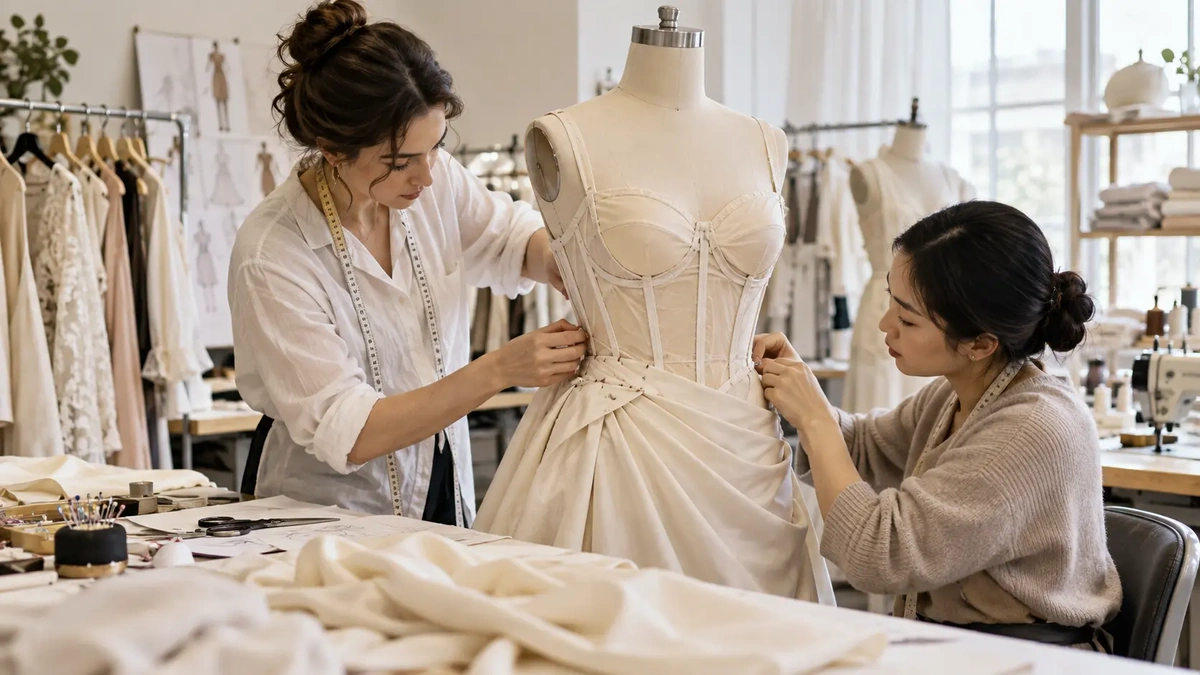
Specification discipline decides whether the approved sample becomes the bulk standard or stays a one-off garment. It is checkable, and it should be checked before you place a bulk order, not after.
What to look for is concrete. Versioned tech packs rather than a single undated document. Measurement charts that carry the same revision as the pattern. Approved material and trim references rather than trade names. A sealed sample physically held as the workmanship standard. And — the question most brands forget to ask — a rule for how obsolete versions are removed from production.
- Version control on the tech pack, so the cutting room works from one dated document rather than the most recent email.
- Measurement charts tied to the pattern revision, so fit and tolerance refer to the same version.
- Approved material and trim references, so substitutions are deliberate rather than convenient.
- A sealed approval sample, retained as the physical standard for workmanship and hand feel.
- A withdrawal rule for superseded versions, so an older pattern or chart cannot re-enter the line.
Material Control Before a Delivery Date Is Promised
A delivery date promised before the material position is settled is not a commitment — it is a hope with a calendar attached. Material control is therefore one of the earliest things to test, because almost everything downstream depends on it.
The manufacturer should be able to tell you, before it promises a date: whether the fabric is in stock or must be produced, the mill minimum for that article in that colour, the dye-lot risk if a re-order is needed, what testing the material requires for your market, and the rule for substitution if the fabric becomes unavailable. A partner that answers these before quoting a date is demonstrating that the date is built on something.
Substitution is the field most often left undefined and most often needed. When an approved fabric runs short, someone has to decide quickly whether a replacement is acceptable, and that decision has fit, colour, testing and claim consequences. Agreeing the rule in advance turns a crisis into a routine approval. Having no rule turns a routine shortage into a missed season.
Bulk Repeatability and Reorder Control: The Real Test

A good first bulk order is encouraging. A good third reorder is the actual evidence. Repeatability is where manufacturer capability separates from luck, because the second run has to reproduce a garment the first run invented, under different conditions and often with different staff.
Test it by asking how the factory transfers a sample to the line and how it controls the bulk. Look for an operation breakdown derived from the sample, defined critical measurements with tolerances rather than one broad blanket tolerance, and verification of the first production pieces before the run is allowed to continue. Then ask the reorder question directly: when this style comes back in six months, what is retained, what has to be re-approved, and how is consistency with the original checked?
Reorder control is not an administrative detail. It is the mechanism that protects your fit and quality across seasons, and it is the part of a manufacturer’s system most often left unexamined because it only shows up on the second order. A factory that cannot describe its reorder control is telling you that consistency depends on the same person still being there, which is not a control system — it is a dependency.
Quality Ownership Beyond Final Inspection
Final inspection is the most visible quality step and the least decisive one. By the time goods reach inspection, the fabric is cut, the fit is committed and the costs are sunk. Inspection confirms a result; it does not create one. A manufacturer that treats final inspection as its quality system is inspecting its way out of problems it should have prevented.
Look instead at the points upstream. Incoming material checks, so a bad lot is caught before it is cut. Inline control, so a defect is corrected at the operation rather than at the end of the line. Measurement audits during production, not only at the end. Finishing and pressing checks, because pressing is construction and can undo a good seams job. And corrective-action records, which show whether the factory learns from what it finds or simply repairs and moves on.
The corrective-action record is the tell. A factory that documents what went wrong, why, and what changed is a factory that improves. A factory that only reports pass and fail is not managing quality — it is measuring it after the fact.
Honest Lead-Time Decomposition

Lead time is the area where identical promises should make you suspicious. A manufacturer that quotes the same total for every style is not necessarily fast. It may simply not have decomposed the number.
A useful supplier can break the calendar into its parts and say which one controls the critical path for your specific style — and what would move it. A bespoke fabric, a complex construction, a colour that needs a lab dip, a size range that needs a size set: each sits in a different part of the schedule. A supplier that can name the bottleneck is describing a real plan; one that cannot is describing an average.
| Lead-time element | What it covers | What to ask |
|---|---|---|
| Material | Fabric and trim availability, dye dates, mill production | In stock, or must it be produced? What is the article minimum? |
| Sample | Development and fit samples through to approval | How many rounds are expected, and what closes the next one? |
| Approval | Lab dips, trims, size set, comments | Which approval gates exist, and who closes each one? |
| Production | Cutting through finishing and pressing | What is the capacity window, and what is the bottleneck? |
| Shipping | Booking, transit and any consolidation | Which route and mode, and what does it add to the total? |
Two things about that table are worth saying out loud. The total is only as honest as its weakest element, so a supplier who can discuss each element separately is more useful than one who defends a single figure. And the right answer to what is the lead time is generally that it depends on the category, fabric, construction, customisation and quantity — confirmed for your order rather than promised in general.
Traceability and Documentation
Traceability has become a mainstream evaluation criterion rather than a niche one, because buyers, retailers and regulators now ask for records the industry did not used to keep. Evaluating it means asking whether the manufacturer can connect materials and production sites to your specific order, not only whether it can produce a certificate.
The distinction is between a supplier list and a traceable record. A list shows possible sources; a record shows which source supplied this order. So test whether the factory can link your order to the fabric lot, the processing site and the approved substitution history, and whether it can manage the certification documents that apply to a given material rather than holding a facility certificate and calling it proof. Finally, ask whether it can feed your own data template, because increasingly the manufacturer that can populate your supplier-data record directly is worth more than one that cannot.
Communication, Ownership and Escalation
Communication is the supplier attribute that hides until it fails. In a smooth project, every factory looks well-organised. The differences appear when something goes wrong, which is exactly when you need to know who owns your project and how they behave under pressure.
So ask three questions before you commit. Who owns our project day to day? How often is progress reported, and in what form? What is the escalation path — at what point does a waiting decision move from the account handler to someone with the authority to resolve it? A manufacturer that can answer all three has thought about how projects actually go wrong.
Ownership is the part brands under-value. An account contact who escalates early is worth more than one who absorbs problems silently until the deadline. The evaluation question is not whether something will go wrong — it will — but whether the report of it arrives while there is still time to act.
Commercial Transparency in the Quotation
The quotation is a document you can read for capability as well as cost. A transparent quote states its assumptions: what the material and construction include, what packing includes, whether testing and samples are quoted separately, whether there is tooling or development cost, and what the shipping terms cover. A quote that is a single number with no assumptions behind it is not a comparable quote, because you cannot tell what you are comparing.
This is why the lowest price is such a poor shortcut. A price that appears to exclude development, testing or packing will surface that cost later, often at a point where you have no alternative. The evaluation is not which number is smallest — it is which number is most complete, and whether the gaps are disclosed up front rather than discovered mid-project.
A Weighted Supplier Scorecard, and How to Run It
A scorecard turns a scattered impression into a comparable assessment, provided it is used with some discipline. The weights matter less than the practice of scoring against evidence rather than feeling, and of doing it for more than one supplier so the scores have something to sit beside.
| Area | Weight | Evidence to review |
|---|---|---|
| Product capability | 15% | Similar construction and process samples |
| Development | 15% | Pattern and sample workflow |
| Specification control | 10% | Versioned documents and sealed standards |
| Material control | 10% | Supplier and lot approval process |
| Production quality | 15% | Inline and final records |
| Capacity / lead time | 10% | Realistic calendar and bottleneck disclosure |
| Traceability / compliance | 10% | Product and supplier records |
| Communication | 10% | Reporting and escalation method |
| Commercial clarity | 5% | Complete quotation assumptions |
How to run it properly: score only what you have seen, not what you have been told, and record the evidence behind each score so a colleague can review the decision. Score two or three suppliers on the same criteria so the weights mean something relative. And keep the scorecard alive — re-score after the first bulk order and again after the first reorder, because the early scores are predictions and the later ones are performance.
Questions to Ask During Sampling
The sampling stage is the best and cheapest opportunity to evaluate a manufacturer, because it is a controlled test of the whole relationship at small scale. These questions draw out how the factory thinks, not only what it can make.

- What information is missing from our brief?
- Which operation has the highest production risk on this style?
- Which material controls the lead time, and what is its position right now?
- What will be retained as the standard after sample approval?
- What would change the price or the MOQ?
- What requires buyer approval before bulk, and who closes each approval?
- How will you control the first production pieces when the line starts?
Read the answers as much as hearing them. A manufacturer that answers the first question with a specific gap has read your brief; one that answers nothing has not. A manufacturer that names the highest-risk operation is showing you its production knowledge. One that says every operation is straightforward is either very good or not paying attention, and the samples will tell you which.
Piloting a New Manufacturer With a Representative Style
When you test a new manufacturer, the style you choose does most of the work. Choose a representative one: a style that uses the constructions, materials and processes you actually need, and that would reveal a capability gap if one existed. Testing a manufacturer on an easy style proves only that it can make an easy style.
Run the pilot as a real project at reduced scale. Send a structured brief, expect a documented sample process, evaluate both the garment and the way the factory communicated and recorded decisions, and treat the pilot as a trial of the whole working relationship rather than a specimen test of one product. The garment tells you about construction; the process tells you about every order that will follow.
Keep the pilot honest about its purpose. It is not a test of whether the factory can make one sample. It is a test of whether it can make the sample, document it, control the first bulk pieces and handle a correction — which is what production actually is.
When and How to Add a Second Source Safely
Add a second source before you need one, not after. The moment a continuity or capacity risk becomes urgent is the worst time to start developing an alternative, because you are doing it under pressure and without time to evaluate properly. The right time is while the first source is working well and you have the bandwidth to build a second properly.
Adding a source safely is a transfer exercise, not a fresh start. The approved pattern, the specification and measurement chart, the material and trim standards and the quality plan all have to move across in a controlled way, with the same revision discipline you would apply internally. The second source should be tested against the same sealed standard and the same critical measurements as the first, so consistency is measured rather than assumed.
The commercial caution is that a second source is a relationship, not a backup file. It needs real volume at some point, or it will not prioritise you when the primary source fails. A second source held on standby and never used is not a safety net; it is a name in a spreadsheet.
Frequently asked questions
Should the lowest-priced qualified factory win?
Compare total risk and service scope, not the headline number. A price that excludes development, testing, packing or corrective work is not lower in practice — it is incomplete. And price is an entry condition, not evidence of capability.
Is a factory audit enough?
An audit evaluates defined conditions at a point in time. It can tell you about systems and facilities; it cannot tell you how the supplier handles your actual style. Development and a pilot order reveal that, and they belong in the evaluation rather than being treated as an afterthought to the audit.
How should brands test a new manufacturer?
Use a representative style, a structured brief and a controlled sample process. Evaluate communication and documentation as well as the garment, because the process is what you will rely on across every later order. Confirm the MOQ, lead time and commercial terms for that specific style and quantity rather than accepting a generic figure.
When should a brand add a second source?
Before capacity or continuity risk becomes urgent. Transfer the approved pattern, specification, material standard and quality plan under controlled conditions, test the second source against the same sealed standard, and give it real volume — a source never used is not a safety net.
How many suppliers should a brand work with?
There is no universal number. Consolidation reduces management overhead and increases leverage, but it also increases the share of your range exposed to any single partner’s failure. The right count depends on your category spread, volume and risk appetite, and it is a decision about resilience as much as cost.
Can a factory be strong in production but weak in development?
Yes, and it is common. A factory can be an excellent manufacturer and a poor development partner. That is not a defect if you do your own development, but it becomes one if you expect the factory to catch a loosely specified brief. Match the factory’s strength to the work you actually need.
What should we do if the sample is good but the bulk is not?
Treat it as evidence about the transfer process, not only the sample. Look at whether the specification was versioned, whether the first production pieces were controlled, and whether the material was the approved lot. A good sample and a poor bulk usually points to a control failure after approval, not a capability failure.
Does a higher price always mean better quality?
No. Price reflects many things — volume, overhead, position in the market, assumptions in the quote. What matters is what a given price includes and whether the manufacturer can evidence the capability behind it. The most expensive mistake is a cheap price attached to undefined assumptions.
Working With Luxudress
The best clothing manufacturer is not defined by one sample, one price or one audit. It is defined by how the supplier controls the whole sequence from brief to repeat order and how clearly it handles decisions, evidence and problems. That is what a structured evaluation is for: to see the system behind the garment before your range depends on it.
Luxudress supports womenswear brands with OEM and ODM development, sourcing, sampling, coordinated production, quality control and export packing, working factory-direct across production facilities in Guangzhou and Dongguan. We will not quote you a universal MOQ or lead time, because both vary with the category, fabric, construction, customisation, quantity and factory. What we will do is confirm them for your specific style, quantity and specification, and show you the specification, material and quality controls behind them.
Send a representative style and your project requirements — target market, size range, quantity and launch date — and we will run the working process with you before you commit to a range. You can also read the practical guide to OEM manufacturing, see how a second source is added safely, or review how we manage quality control. Request a quote and we will return a costed plan including the assumptions it is built on.