On this page

A supplier evaluation is only useful if it is evidence-based. Ask to see the exact constructions you intend to buy, ask who does the work, and then use a controlled paid sample or trial order to test what a sales conversation cannot prove. Five audits follow, in the order they matter.
Score each one rather than forming an overall impression. An impression is dominated by whoever answered the email fastest; a score tells you which audit a supplier failed, and that is the thing you need to know before you commit. The constructions this refers to are listed on our evening dress manufacturing page.
Audit product fit and sample-room strength
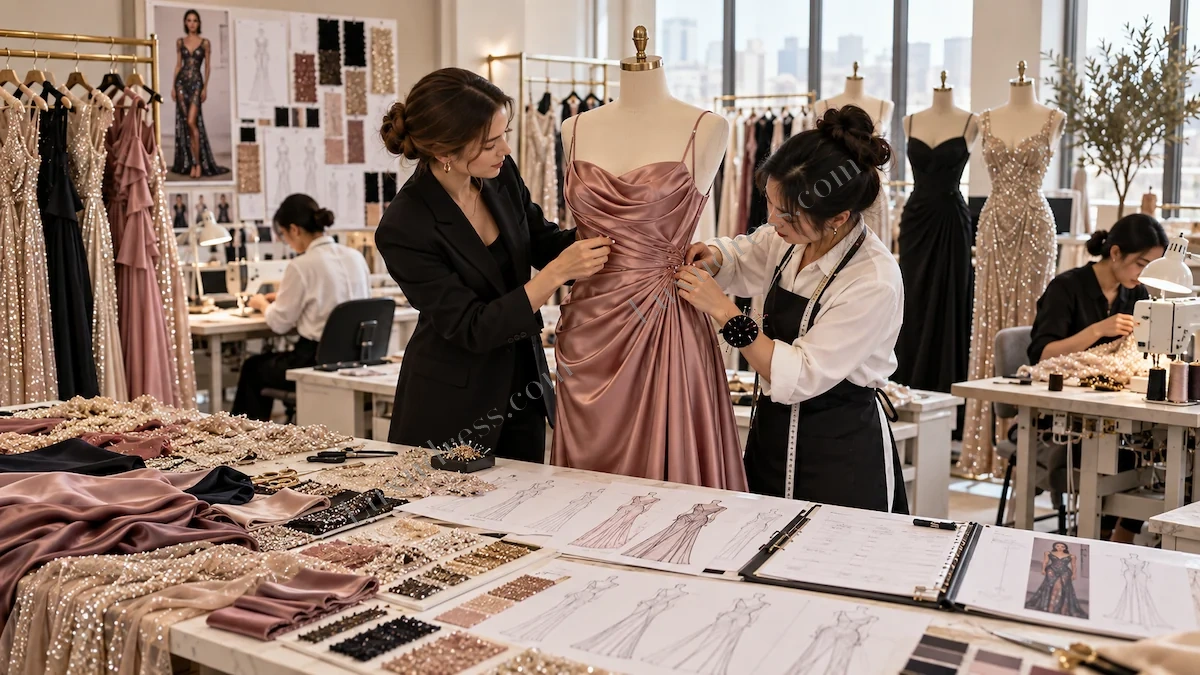
Ask for styles that match your intended construction, not the supplier's favourite styles. If you are buying boned bodices, look at boned bodices; if you are buying bias-cut satin, look at bias-cut satin. A portfolio of general womenswear tells you very little about whether a team can handle the garment you are actually planning.
What to bring to the first meeting
Five things, and they change the quality of the conversation more than any question you could ask. Reference images of the construction you want, not just the look — photographs of the inside if you have them. A size specification with your base size and the run you need. A target price, stated as a number rather than as an aspiration. A delivery window, even a rough one. And one thing you know you will not compromise on.
The last one is the most useful and the least brought. Stating a non-negotiable early lets the supplier tell you what it costs, and lets you find out in the first meeting whether the relationship is commercially viable. Discovering it in the third sample round costs three sample rounds.
Bring the target price even if you think it is unrealistic. A supplier who knows the number can tell you what is achievable inside it; one who does not will design to their own assumptions and you will spend two rounds bringing it back.
Ask to see the corrections
Request evidence of pattern correction and fitting work — not the final samples, but the versions in between. A supplier who can show you the third attempt and explain what changed between the second and the third is telling you something important about how they work. A supplier who only ever shows first samples that were perfect is usually showing you a selection, not a process.
Questions that separate a factory from a trader
Trading companies are not a problem in themselves — many good ones exist and some are better at communication than the factories they represent. What matters is knowing which you are dealing with, because the answers to technical questions travel differently through each. Four questions settle it: can I speak to the pattern maker; can I see the sewing floor; who signs off the final inspection; and what happens if I need a pattern change during bulk?
A factory answers all four directly and immediately. A trader answers the first three with a version of 'I will check' and the fourth vaguely, because the answer depends on someone they have to ask. Both can produce a good garment. Only one can change a pattern on a Tuesday afternoon.
The trial order is the last audit
Everything before this point is what a supplier says. The trial order is what they do, and it is the only audit that cannot be rehearsed. Keep it small enough to be cheap and real enough to be meaningful: one or two styles, in your actual construction, at a quantity that does not distort the result.
Score four things afterwards. Did the invoice match the quote? Did the promised date hold? Was the first problem handled before you had to chase it? And does the bulk garment match the approved sample, measured rather than looked at?
Three of those four are not about the garment at all, which is the point. By the time you are choosing a supplier, the garment is the part you can already judge for yourself; the calendar and the honesty are the parts you cannot.
For complex eveningwear that matters more than in most categories, because complex garments generate mid-production questions. If your development contact cannot reach the person cutting the fabric, every one of those questions costs a day.
Find out who carries the information
Ask who communicates technical comments to the pattern makers and the machinists. In most failures the information existed and did not travel: the buyer said it, the sales contact understood it, and the person cutting the fabric never heard it. A short chain between the comment and the pattern table is worth more than a long list of certifications.
How to read a sample room in an hour
If you can visit, spend the time on four things rather than on a guided tour. Look at the pattern table and ask how many of the patterns on it are eveningwear. Look at the fitting area and ask to see a garment mid-correction. Look at the pressing equipment, because formal pressing is what separates eveningwear from general womenswear. And ask to see the rejected samples — a sample room with no rejects is either very new or not showing you everything.
If you cannot visit, ask for the same four things as photographs and be sceptical of a portfolio with no works in progress. A video call through the sample room, unscripted, is a reasonable substitute and most suppliers will do it.
Test whether they identify risk
Notice whether the team identifies risks before saying yes. A supplier who flags that your neckline will need a stay, or that your slit height will fight the lining, is worth more than one who agrees to everything — and is telling you they have made this garment before and remember what happens.
| Signal | Strong answer | Weak answer |
|---|---|---|
| Evidence | Here are three bodices we run | Yes, we can do eveningwear |
| Process | Here is what changed between rounds | Here is the finished sample |
| Risk | That neckline will need a stay | Everything is possible |
| Chain | I take comments to the pattern maker directly | I will pass it to the factory |
- Ask for styles that match your intended construction.
- Review evidence of pattern corrections and fitting work.
- Find out who communicates technical comments to pattern makers and machinists.
- Test whether the team identifies risks before saying yes.
Audit materials and internal structure
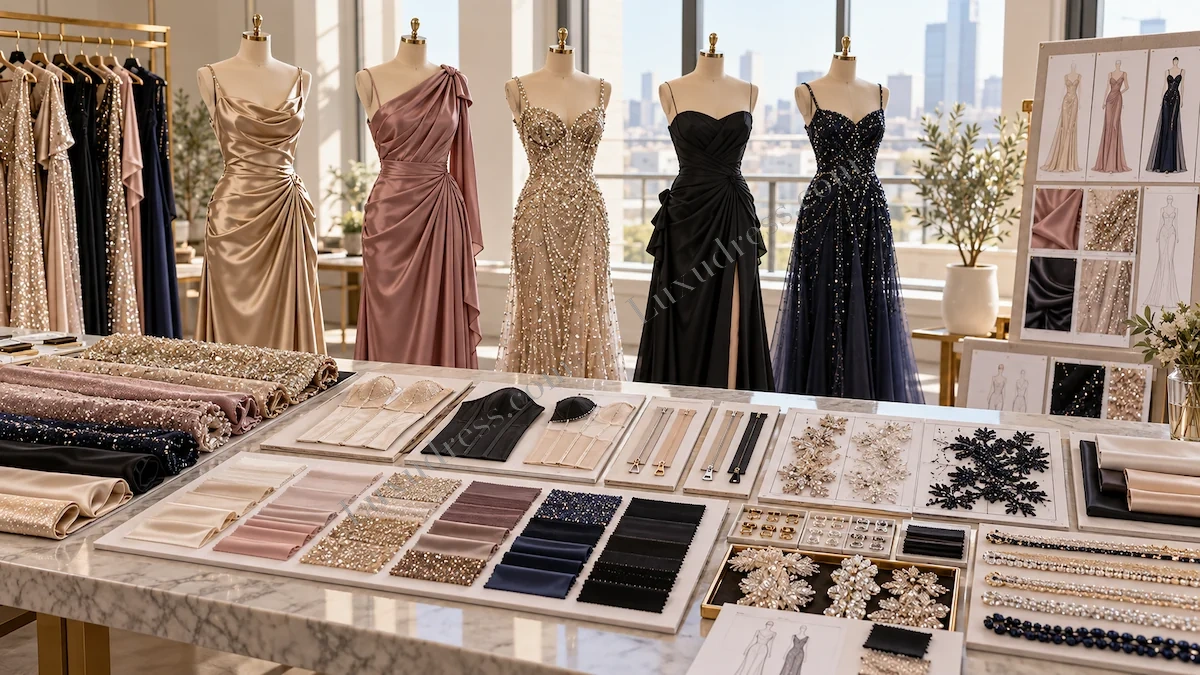
Confirm access to your target fabrics and ask directly whether substitutes will be disclosed. Fabric substitution is one of the most common sources of a bulk order that does not match an approved sample, and it is rarely malicious — it is usually a sourcing problem solved quietly. You want a supplier who tells you.
For corset styles, review the hidden structure
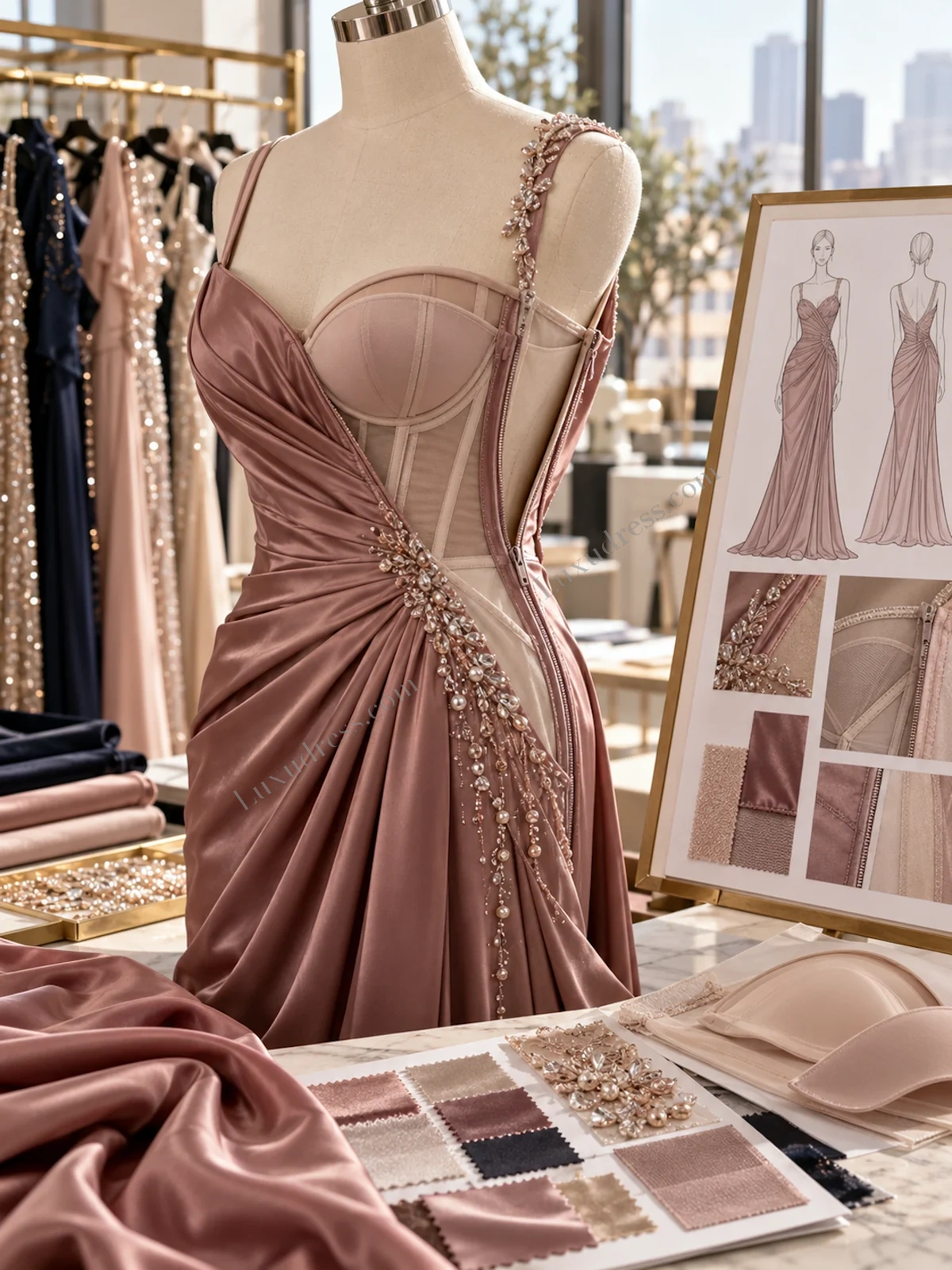
Review boning type and channel construction, cups, underlining, interfacing and closures. These are the components that determine whether a bodice holds, and they are also the components that are cheapest to downgrade invisibly. Ask what each one is, by name, and write the answer into the specification.
| Component | What to ask | Why it gets downgraded |
|---|---|---|
| Boning | Type, width, number of channels | Invisible from the outside |
| Cups | Moulded or cut-and-sew, and how anchored | Cheaper to omit than to specify |
| Underlining | What supports the shell | Adds a layer nobody sees |
| Interfacing | Weight and where it is applied | Easy to reduce without changing the look |
| Closure | Zip, lace-up, hook-and-eye, and its rating | A weak closure fails after the sale |
For embellished styles, inspect placement
Inspect motif placement and how seams are handled — whether a motif is matched across a seam or simply cut. The difference is hours of labour per garment and it is visible in photographs. A supplier who describes placement unprompted is a supplier who has costed it properly.
Put the hidden structure in the brief
Most disputes about whether a garment matches the approved sample are disputes about something invisible. The shell fabric is right, the silhouette is right, and the dress does not hold — because the underlining was changed, or the boning is a different width, or the interfacing is lighter. All three look identical from the outside and behave differently on a body.
Write the hidden structure into the specification with the same precision as the shell: boning type and channel count, cup type and how it is anchored, underlining weight, interfacing placement, and closure rating. Then ask the supplier to confirm each one in the quotation. A quotation that names them is a quotation you can hold someone to.
Check the inside
Check finishing from the inside as well as the outside. A clean inside is the most reliable single indicator of process discipline, because nobody expects you to look and there is no commercial reason to finish something that will not be seen — which is exactly why a supplier who does it anyway will also finish the parts you can see.
- Confirm access to target fabrics and whether substitutes will be disclosed.
- For corset styles, review boning, cups, underlining, interfacing and closures.
- For embellished styles, inspect motif placement and seam handling.
- Check finishing from the inside as well as outside.
Audit grading and bulk consistency
Ask how the base size is graded and whether structured styles receive a separate fit review. Grading a corset bodice like a jersey top is a genuine and common error: the rules are not the same, because a structured garment does not stretch to absorb the difference. If the answer is that everything is graded the same way, that is the answer to your question.
Why structured styles need separate grading
Grading scales a pattern up and down from a base size by rule. The rule assumes the garment behaves consistently across sizes, which is broadly true for jersey and broadly false for a boned bodice. In a structured garment the support comes from the boning, the cups and the closure, none of which scale the way a circumference does — a bodice graded two sizes up needs different boning placement, not just a wider panel.
What to ask about the extended sizes
Three questions, asked before sampling rather than after. Which sizes do you fit-test on a live model? Can I see the largest size in the run made up, not just graded? And what changes in the construction at the top of the run — more boning, a different cup, a stronger closure?
The third is the one that separates a supplier who has made extended sizes from one who has only graded into them. A structured bodice at the top of a size run is carrying more weight and needs more support, and if nothing changes between the base size and the largest, nothing has been engineered — only scaled.
Ask to see it. Photographs of the largest size, on a body, front and back, are a reasonable request and a supplier who runs extended sizes properly will have them.
This is why a single grading rule across a whole range is a warning sign. Ask what is graded by rule and what is redrafted. A good answer names the sizes at which a structured style is re-fitted rather than simply graded, and explains what changes at those sizes.
Reviewing the size set before bulk
Ask for a size set rather than a single sample at the point of bulk approval — the base size, the smallest and the largest, made up in bulk fabric. It costs a small amount, and it is the last point at which a grading error is cheap to fix.
Check three things across the set: that the proportions still read as the same garment, that the structured elements sit correctly at the top of the run, and that the hem balance holds at every size. Any one of the three failing at the extremes is a returns problem that will not show up in the sample size.
If a full size set cannot be made, ask for the largest size at minimum. Grading errors are almost always worst at the top of the run, and that is where the customers who can least be fitted by a scaled pattern are the ones most likely to return the garment.
The question that ends the audit
Finish every evaluation with the same question, asked plainly: what would you change about this garment if it were yours? A supplier who has made the construction before will answer immediately and specifically — a different closure, a heavier interfacing, a lower slit. A supplier who has not will say it looks fine.
That answer is worth more than the rest of the audit combined, because it is the only one that cannot be prepared. Everything else on this page can be rehearsed; an opinion offered unprompted, against your own design, cannot.
Then act on it. The suppliers worth keeping are the ones whose advice improves the garment, and the ones to avoid are the ones who agree with you all the way to a sample that does not work.
The cost of getting it wrong is concentrated at the top of the size run, where the customers who can least be fitted by a scaled pattern are the ones most likely to return the garment. Ask to see the largest size made up, not just the sample size.
The four occasionwear consistency risks
Look for controls around shade, nap, sequin direction and lace placement. These four are specific to occasionwear and they are where bulk quietly diverges from the approved sample.
| Risk | What goes wrong | The control |
|---|---|---|
| Shade | Two dye lots differ; visible in group photographs | Batch control and side-by-side comparison |
| Nap | Surface reads differently panel to panel | Cut all panels one way |
| Sequin direction | Light catches the surface unevenly | Specify direction, check at inline |
| Lace placement | Motif drifts across a size run | Placement map approved per size |
Relaxation and hem drop
Ask how fabric relaxation and hem drop are handled. Fabric relaxes after cutting, and a bias-cut hem that was level on the day it was cut can drop unevenly by the time it is packed. A supplier who builds relaxation time into the sequence is a supplier who has made this garment before and learned this the expensive way.
- Ask how the base size is graded.
- Check whether structured styles receive separate fit review.
- Look for controls around shade, nap, sequin direction and lace placement.
- Review how fabric relaxation and hem drop are handled.
Audit quality systems and communication
Agree tolerances, inspection points and approval samples before bulk begins, in writing. Without that agreement there is no neutral reference when a judgement call has to be made — and in eveningwear there is always a judgement call, usually about shade or hand feel, and usually made when the freight is already booked.
Ask for the written inspection standard
Evaluate documentation quality. Our facilities operate to ISO 9001 and hold OEKO-TEX STANDARD 100, amfori BSCI-audited and SGS-inspected status; more useful than the certificates is whether a supplier can produce a written inspection standard for your specific order, naming what counts as critical, major and minor. Ask for that document — it is the one that will actually be used.
How defects are corrected and tracked
Ask how defects are corrected and tracked, and notice how the question is answered. A good supplier explains tradeoffs instead of saying every request is easy — the supplier who says yes to everything will also say yes to the thing that breaks your delivery date, and will not tell you until it is too late to fix.
- Agree on tolerances, inspection points and approval samples before bulk.
- Evaluate documentation quality.
- Ask how defects are corrected and tracked.
- Good suppliers explain tradeoffs instead of saying every request is easy.
Audit commercial alignment
Compare minimums, lead time, payment terms, reorder practicality and capacity against your business model. A technically excellent factory can still be the wrong partner if its calendar is full when you need to ship, or if its minimums assume a buying pattern you do not have.
Which lever sets the minimum
For occasionwear we do not publish one blanket figure, because the real minimum is set by fabric, colour count, trim and construction and is confirmed per style, colour, fabric and construction. Ask any supplier which of those four is driving the number for your order — the answer tells you what to change if the number is too high, and it is a much more useful question than asking for a lower minimum.
Capacity is a commercial question
Ask two questions about capacity and you will learn more than any factory tour shows you. When is your busiest period, and does it overlap mine? And what is the smallest order you can run without it being resented?
What to do when the answer is no
Sometimes the honest answer from a good supplier is that your season does not fit their calendar. That is useful information, not a rejection. Ask what would fit — a different slot, a smaller first drop and a second one, or a split across two production lines — and compare that against asking a weaker supplier to do the impossible.
The second option is how most late deliveries happen. A supplier who needs the work will promise the date; a supplier who is already busy will tell you the truth about it. Choose the second one, even when the first is cheaper and more enthusiastic.
If no supplier can meet the date, the date is the problem. Either move the selling window or cut the range — a smaller range delivered on time outsells a full range that arrives three weeks into a six-week season.
The first matters because occasionwear has real peaks, and a supplier who is fully booked in your peak is effectively unavailable however good they are. The second matters because an order that is too small for a line gets pushed to the back of the queue, which is how a technically capable supplier misses your date.
Neither answer is about size or prestige. They are about fit between two calendars, which is the thing that actually determines whether the order arrives — and the reason a smaller, less busy, specialist team is often the better commercial choice for a first programme.
Run a controlled trial
Run a controlled paid trial before a strategic commitment, and score the supplier on accuracy, problem solving and timing as well as on the garment. The garment is the easy part. Whether the supplier told you the truth about the calendar is the part that predicts the next two seasons.
| Score | What to measure on the trial | Why it predicts the next order |
|---|---|---|
| Accuracy | Did the quote match the invoice | Surprises compound over a season |
| Problem solving | How the first problem was handled | There will always be a first problem |
| Timing | Did the promised date hold | The calendar is the product in occasionwear |
| Communication | How fast a technical question was answered | Speed of information is speed of production |
- Compare minimums, lead time, payment terms, reorder practicality and capacity with your business model.
- A technically strong factory can still be a poor partner if its calendar and minimums do not fit your buying plan.
- Run a controlled paid trial before a strategic commitment.
- Score accuracy, problem solving and timing as well as the garment itself.

Practical buyer worksheet
Use these ten fields as your audit sheet — one per supplier, scored side by side. The side-by-side is what makes the comparison real:
- Target customer and use occasion
- Target retail and wholesale price
- Target ex-factory or landed cost
- Core fabric and backup fabric
- Size range and base fit size
- Colour count and continuity colours
- Critical construction risks
- Approval sample required
- QC checkpoints
- Latest acceptable delivery date
FAQ
What evidence should I request?
Relevant samples in your construction, construction and trim details, fabric information, QC procedures and a clear explanation of who manages development and bulk. Ask who, not just what — the answer to "who" is the one that predicts how the order will actually go.
Is factory size important?
Only in context. A smaller specialised team can outperform a large general factory on technical eveningwear, because the work is done by people who do it every day. Capacity matters when your volumes genuinely need it, and not before — a large factory that runs your order through a general line is not a better outcome than a small one that runs it through a specialist line.
How many samples should I make?
Enough to test the critical constructions you intend to buy. One sample per construction family is usually the right answer; one sample for the whole range is not, because it tests one thing and you are buying four. Treat the trial as the last audit rather than as a formality.
What is the strongest sign of a good supplier?
Specific feedback about feasibility, risks and tradeoffs before bulk. Suppliers who tell you what will go wrong are the ones who have seen it go wrong, and they are the ones who will tell you early enough for you to do something about it.
Next step
If you are comparing suppliers, send us the same brief you sent them and compare the answers. Request a quote with your construction, quantity, size range and delivery window, and we will tell you which parts are straightforward and which are not — before you commit. Our evening dress manufacturing page shows the constructions we run repeatedly, and the occasionwear cluster covers the rest of the range.