On this page
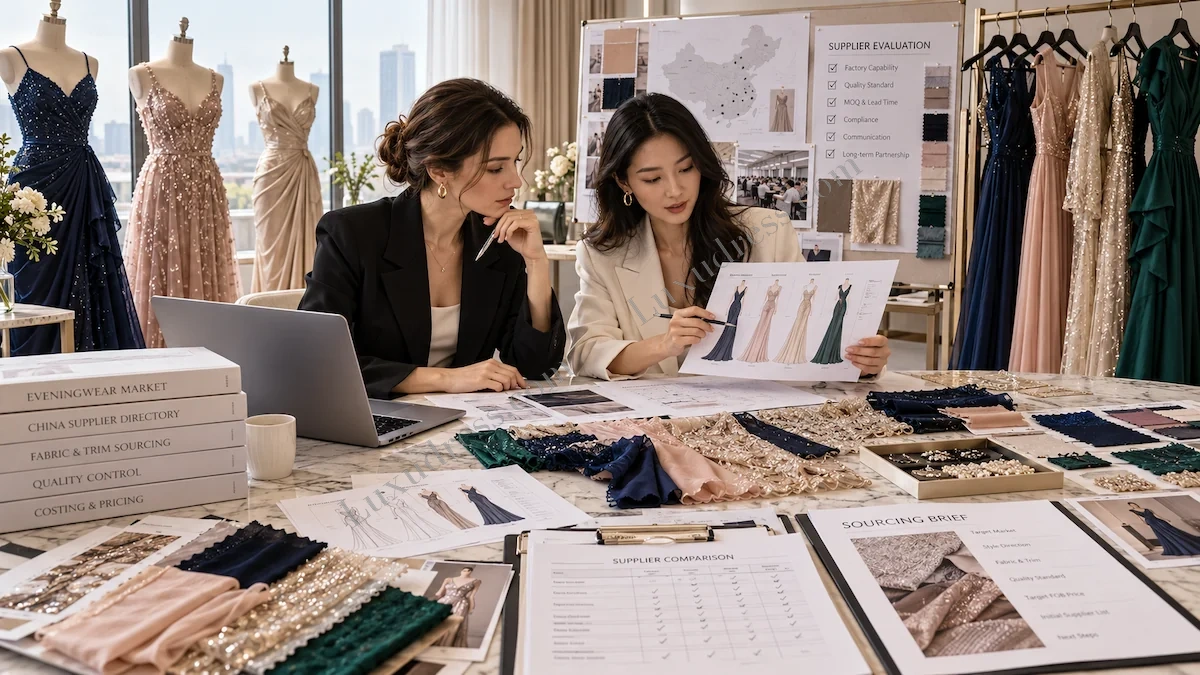
The process below separates capability, sample quality, commercial terms and production control, so that suppliers can be compared on evidence rather than on presentation. It is written for buyers who already know what they want to make and now have to decide who can make it.
China is the right answer for eveningwear more often than not, but the reason is worth being precise about: it is not only unit cost. It is the density of the supply chain — fabric, trims, boning, cups, beading and specialist pressing within a short distance of the sewing floor — which is what makes complex garments at short lead times possible at all. The relevant pages are our evening dress manufacturing range and the broader occasionwear cluster.
Screen suppliers by construction capability
Ask what types of eveningwear the supplier produces repeatedly — not occasionally, and not what their catalogue claims. A factory that runs woven shirting all year and made one ball gown last season is not an eveningwear supplier. Look for evidence in the specific constructions you intend to buy: draping, bias cutting, corsetry, sequins, lace, tulle, lining and formal pressing.
Match the evidence to your construction
Screening works best as a table you fill in per supplier. If a cell cannot be evidenced, that is the answer for that cell — and it is better to know now than at first sample.
| If you are buying | Ask for evidence of | What a good answer sounds like |
|---|---|---|
| Bias-cut satin | Bias cutting and controlled hems | We relax the fabric before cutting and re-level the hem |
| Corsetry | Boning channels, cups, closures | Here are three bodices we run and what differs between them |
| Hand beading | Placement artwork and repair process | We map placement and check the first panel before continuing |
| Tulle volume | Layer specification and underskirt construction | Here is the layer count and why |
| Lace | Motif placement across seams | We match the motif; that is why the labour line is higher |
Notice that none of the good answers are "yes, we can do that". A supplier who can do the work will describe how, because they have done it and they remember what went wrong the first time.
What a screening call should cover
One call, twenty minutes, five questions, asked of every supplier in the same order so the answers are comparable. First: what eveningwear constructions do you run repeatedly? Second: who does pattern making, sampling and final inspection, and are they in the same building? Third: what is the most difficult garment you have made in the last year and what went wrong? Fourth: how do you handle a shade difference between two dye lots? Fifth: what do you need from me before you can quote?
The third question is the most revealing and the least asked. Every supplier has had a difficult garment; the ones who describe it candidly are the ones who will tell you about yours. The fifth tells you whether the supplier is trying to sell you something or trying to understand something.
Do not ask for a price on that call. Pricing before the specification exists produces a number that will move, and once a number is in your head it anchors every later comparison even after the assumptions behind it have changed.
Ask who controls what
Pattern making, sampling and final inspection are the three functions that determine whether a complex garment comes out right, and they are the three most often outsourced or fragmented. A supplier who owns all three can answer a technical question in a day; one who does not will take a week, and the answer will be less reliable because it came second-hand.
Compare communication before price
The cheapest quote from a supplier who did not understand the specification is not a cheap quote — it is a different garment. Ask a hard technical question during screening and score the answer: specificity, honesty about tradeoffs and speed are all signals you cannot recover later from a price list. A supplier who tells you your neckline will need a stay has just saved you a sample round.
Red flags that are easy to miss
Four of them, all of which look like helpfulness at the time. First, agreeing to everything: a supplier who never pushes back has either not read the specification or does not intend to be held to it. Second, quoting before the specification exists: the number will move, and it will move after you have stopped comparing. Third, refusing to name the fabric mill or the trim supplier: you are being asked to approve something you cannot verify or reorder. Fourth, declining a video call through the sample room: there is usually a reason, and it is rarely a good one.
A fifth, subtler one: a supplier who answers technical questions with marketing language. If you ask how a bias hem is stabilised and are told that quality is their priority, you have learned something — not about the hem.
None of these are disqualifying on their own. Two or three together, in the screening stage, are worth more to you than any price difference, because they are predicting how the order will actually go.
- Ask what types of eveningwear the supplier produces repeatedly.
- Look for evidence of draping, bias cutting, corsetry, sequins, lace, tulle, lining and formal pressing.
- Ask who controls pattern making, sampling and final QC.
- Compare technical communication quality before comparing the final unit price.
Send a useful sourcing brief
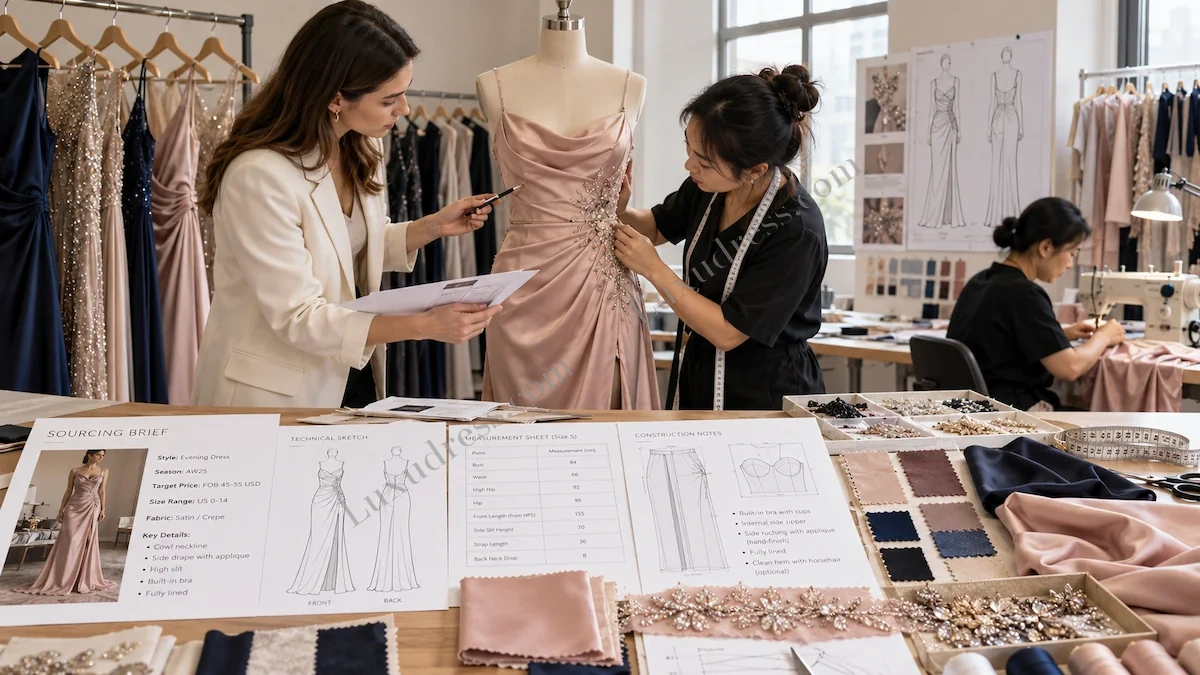
Include reference images, fabric family, quantity by colour, size range and target delivery date. State plainly whether you need OEM, ODM, or private labelling of an existing base, because those three produce three different quotes and three different timelines, and a supplier who has to guess will guess the fastest one.
| Route | What you supply | What the supplier does | Typical use |
|---|---|---|---|
| OEM | Tech pack or detailed references | Makes to your specification | You own the design and the fit |
| ODM | Direction, constraints, references | Develops styles for you to select | You need range without a design team |
| Private label | An existing base style | Applies your branding and packing | You need product fast |
Flag the expensive unknowns
Name the items that move a quote by the largest amount: custom dye, hand beading, moulded cups, specialist trims. These are also the items most often omitted from a brief, which is why a first quote and a final quote frequently differ by more than either party is comfortable with. Naming them does not make the garment cheaper; it makes the quote honest.
Ask for the assumptions in writing
A quotation that itemises what it assumed about lining weight, boning type, fabric width and finishing is a quotation you can compare against another one. A single number per piece is not comparable, no matter how competitive it looks. Ask for the assumptions explicitly — most good suppliers will produce them if asked, and the ones who will not are telling you something.
How to compare three quotes in ten minutes
Put the quotes side by side in a table with the assumptions as rows rather than the suppliers as rows. One column per supplier; rows for fabric, fabric width, lining coverage, closure, boning, embellishment placement, finishing, packing, incoterm and lead time. Fill every cell, including the ones where the supplier said nothing — an empty cell is an assumption you have not discovered yet.
The comparison usually resolves itself quickly. Either one supplier is genuinely cheaper on the same specification, or — far more often — the cheapest quote is missing two or three rows that the others included. At that point you are no longer comparing prices; you are deciding whether those rows matter to you, which is the decision you should have been making all along.
Send the completed table back to the suppliers and ask them to confirm or correct it. Most will correct it, and the correction is where the real price appears.
Fabric width deserves a special mention because it is invisible and material. Two suppliers quoting the same dress on different fabric widths are quoting different consumption, and therefore different garments. It is one of the most common reasons two honest quotes differ by a meaningful amount.
What to settle on commercial terms
Three things need to be agreed in writing before sampling: the incoterm, the payment terms and what happens to the sample fee if you proceed. None of them are glamorous and all three cause disputes later if they are left vague.
| Term | Why it matters here | What to agree |
|---|---|---|
| Incoterm | Changes who owns risk and who pays freight | Name it, and compare landed numbers on that basis |
| Payment terms | Deposits fund material booking | Deposit, balance trigger, and currency |
| Sample fee | Should not be a hidden development cost | Whether it is credited against the bulk order |
Asking whether the sample fee is credited against bulk is a small question with a useful answer: a supplier who credits it is treating sampling as the start of the order, and one who does not is treating it as a separate business. Neither is wrong, but they imply different relationships.
- Include references, fabric family, quantity by colour, size range and target delivery.
- State whether you need OEM, ODM or private labelling of an existing base.
- Flag expensive unknowns such as custom dye, hand beading or moulded cups.
- Ask suppliers to identify assumptions in the quote.
Compare samples like a buyer
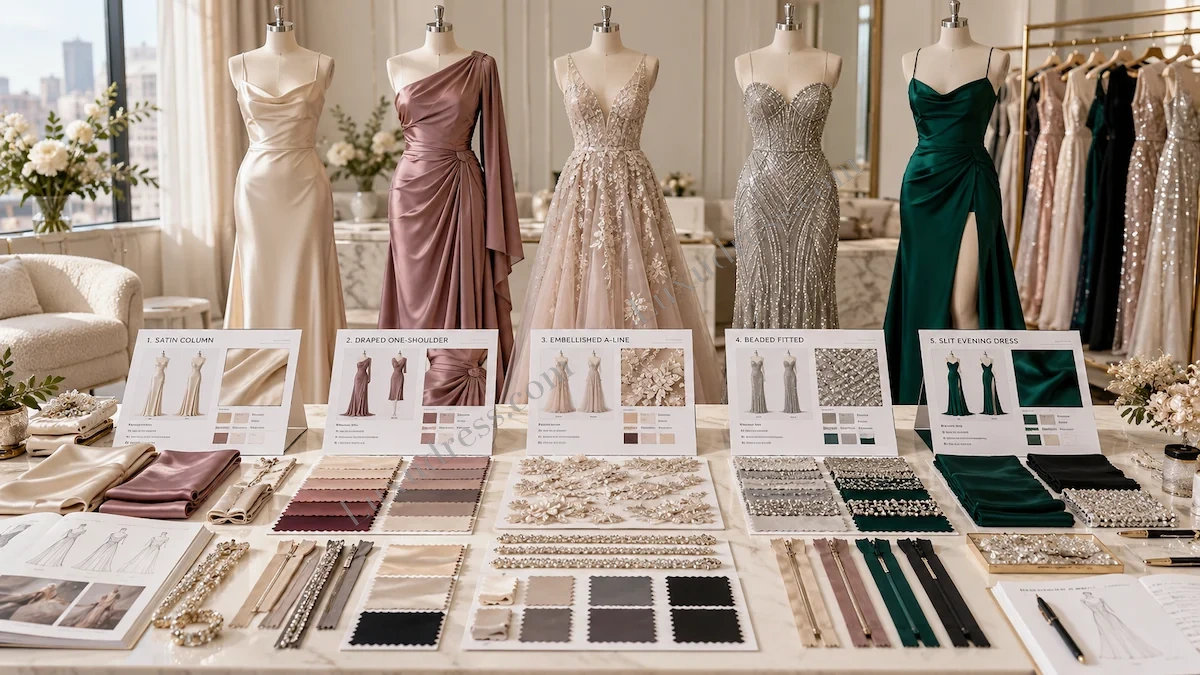
Measure the garment rather than looking at it. Then wear-test it: movement, sitting, and closure stress. An evening dress that fits standing still and fails when the wearer sits is a return, and returns in this category are expensive because the garment has usually been worn for one event and cannot be resold as new.
The failure points to check
Work through the specific failure points rather than a general impression. Each of these is a known return cause in eveningwear, and each is cheap to fix at sample stage.
| Check | What you are looking for | Why it matters |
|---|---|---|
| Lining length | Lining sits correctly against the shell | A short lining pulls the hem out of balance |
| Slit reinforcement | Reinforced and not gaping | Slits are a stress point and a modesty issue |
| Zipper | Lays flat, no waviness | Waviness is the most visible workmanship fault |
| Seams | No grin when stressed | Grin means the seam is under-specified |
| Hem | Level all round on a body | Uneven hems are the most common complaint |
Turn the garment inside out
Boning ends, seam allowances and trim finishing reveal process discipline far more reliably than the outside of a sample, because the outside is what the maker expects you to look at. An interior that is clean when nobody asked you to look is a strong signal; an interior that is rough is a reliable predictor of how bulk will be finished.
Photograph the sample under flash
This is the single cheapest test available and the one buyers skip most often. Flash exposes sheerness, shade variation and pressing marks — all of which are invisible in a sample room and obvious in a customer's photograph, which is the photograph that decides whether the dress gets returned.
- Measure the garment and wear-test movement, sitting and closure stress.
- Check lining length, slit reinforcement, zipper waviness, seam grin and hem level.
- Inspect the inside: boning ends, seam allowances and trim finishing reveal process discipline.
- Photograph the sample under direct flash.
Normalise quotes before comparing
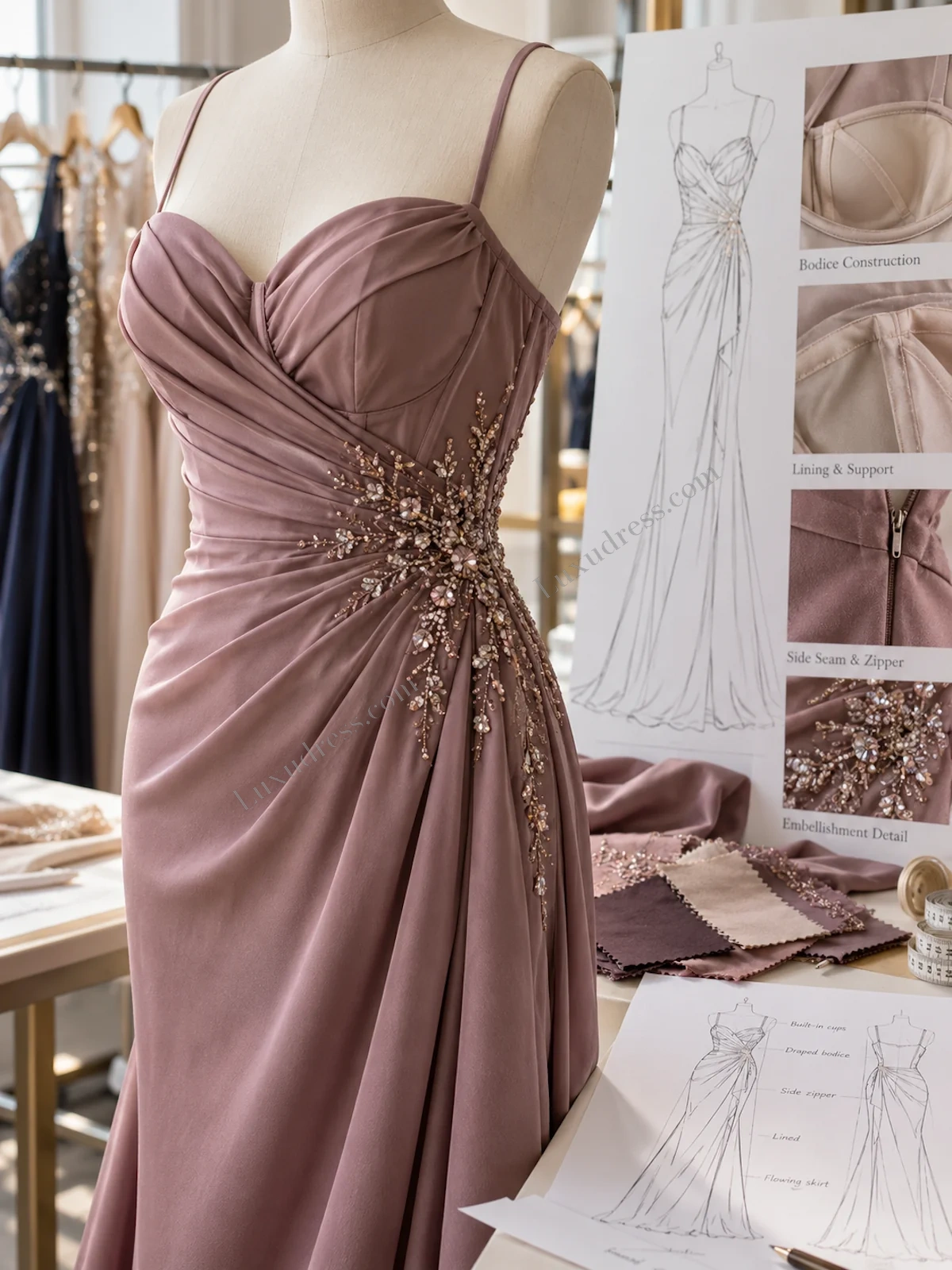
Two quotes for the same sketch are rarely for the same garment. One supplier may be quoting a better satin, a fuller lining or more internal structure; another may have assumed a narrower fabric width or a cheaper closure. Both are honest. Neither is comparable until the assumptions are written down.
| Variable | How it moves the price | How to neutralise it |
|---|---|---|
| Fabric quality | A heavier or better-finished cloth costs more per metre | Name the fabric, or approve a swatch before quoting |
| Fabric width | Changes consumption for the same pattern | State the width both must quote on |
| Lining | Full lining versus half lining is a real cost difference | Specify lining coverage |
| Embellishment placement | Matched motifs cost several times continuous ones | Describe placement in the brief |
| Finishing | Pressing, hand finishing and packing add labour | Ask what finishing is included |
Embellishment is a separate cost system
Sequin direction, lace placement and hand finishing alter labour significantly, and they are the items most often unspecified. A motif placed to match across a seam costs several times what a continuous motif costs, and that difference is pure labour. Ask for the placement to be described in the quote, not just named.
Compare landed, not ex-factory
An ex-factory number is not a cost until freight, duty and the chosen incoterm have been applied. A supplier who is cheaper ex-factory but slower to ship can easily be more expensive landed, and in a season-driven category the slower one can be more expensive still. Compare landed scenarios as a separate exercise from the unit price.
Why the cheapest quote is often the most expensive
The mechanism is always the same. A quote comes in low because an assumption was made — a lighter lining, a narrower fabric width, a continuous motif instead of a matched one, no allowance for relaxation. The sample is made to that assumption. The buyer approves the sample because it looks right. Bulk is then made to a slightly different assumption, or the buyer asks for the missing item, and the price moves after the point where switching supplier is still possible.
The defence is not to avoid cheap quotes. It is to make the assumptions explicit before you compare, and to treat any quote that is materially below the others as a specification question rather than a bargain. Ask what is not included. If the answer is nothing, ask again in writing.
On minimums for occasionwear: the figure is confirmed per style, colour, fabric and construction rather than quoted as one blanket number, because fabric and trim drive it more than piece count does. Ask which of the four is driving your number — that is the lever you can actually pull.
- One supplier may quote better satin, fuller lining or more internal structure.
- Sequin direction, lace placement and hand finishing can alter labour significantly.
- MOQ assumptions and fabric width change consumption.
- Compare landed scenarios separately from ex-factory price.
Control bulk with checkpoints
Approve a sealed sample or an equally clear written production standard before bulk starts. Without one there is no reference against which a dispute about shade, hand feel or finishing can be settled — and in a complex garment there is almost always something to settle.
Inline checks, not just final inspection
Use inline inspection for anything with embellishment or corsetry. A beading error found at final inspection means the garment is stripped and redone; the same error found on the first finished panel costs a fraction of that. Inline inspection is where complex eveningwear is actually controlled, and it is the single highest-value control available to a buyer in this category.
Who should attend the checkpoints
Decide this in advance, because it determines whether a checkpoint is a control or a formality. Material approval should be attended by whoever owns the colour decision on your side — a shade approved by someone without the standard in front of them is not an approval. The first-off check should be attended by whoever wrote the tech pack, because the point of it is to catch a misreading of the specification. Inline checks can be attended remotely, by photograph, provided the photographs are of agreed details.
Final inspection should be attended by whoever will accept the shipment, and it should be conducted against the written standard rather than against an impression. If nobody on your side can attend, ask for a documented report with measurements and photographs rather than a pass or fail — a pass tells you nothing you can act on, and a report tells you what to fix on the next order.
Agree all four at the same time as you agree the tolerances. A checkpoint nobody attends is a checkpoint that will be quietly skipped when the schedule gets tight, which is exactly when it matters.
| Checkpoint | When | What is caught |
|---|---|---|
| Material approval | Before cutting | Shade, hand feel, weight, width |
| First-off check | First garment off the line | Construction interpretation |
| Inline check | During production | Embellishment placement, boning, seam quality |
| Final inspection | Before packing | Measurements, finishing, packing, labelling |
Define tolerances and defect classes
Define tolerances and defect classifications before final inspection, in writing, with both parties agreeing on what counts as a critical, major and minor defect. Without that agreement, final inspection becomes a negotiation rather than a check — and it will be a negotiation conducted under time pressure, with freight already booked.
Our facilities operate to ISO 9001 and hold OEKO-TEX STANDARD 100, amfori BSCI-audited and SGS-inspected status. More useful than the certificates themselves is a written inspection standard for your specific order, naming the tolerances and the defect classes. Ask any supplier for that document; it is the one that will actually be used.
What a written inspection standard contains
A usable standard is short and specific. It names the checkpoint, the sample size, the tolerance and the defect classification for each check, and it names the sealed sample it is measured against. Four or five checkpoints is usually enough; a twenty-page generic checklist is not a standard, it is a document.
The two documents that prevent most disputes
Almost every bulk dispute I could describe comes down to one of two missing documents. The first is the sealed sample or written production standard — without it there is no answer to the question of what bulk was supposed to match. The second is the confirmed specification, with the hidden structure named, which is what turns a disagreement about feel into a checkable item.
Both are cheap to produce and both are usually produced late, under pressure, in the week before bulk starts. Produce them at sample approval instead, when there is still time to act on what they reveal, and get both parties to confirm them in writing rather than by silence.
If a supplier will not confirm either, treat that as the answer to the audit rather than as an administrative delay.
| Element | What it says | Why it settles disputes |
|---|---|---|
| Checkpoint | Where in the sequence the check happens | Inline or final, and who attends |
| Sample size | How many pieces are checked | Avoids arguments about a single faulty unit |
| Tolerance | The measurement tolerance in centimetres | Turns an opinion into a number |
| Defect class | Critical, major or minor | Decides whether the shipment is acceptable |
| Reference | The sealed sample or written standard | The thing both parties signed |
- Approve a sealed sample or clear production standard.
- Confirm colour, trims and labels against approved references.
- Use inline checks for complex embellishment or corsetry.
- Define tolerances and defect classifications before final inspection.
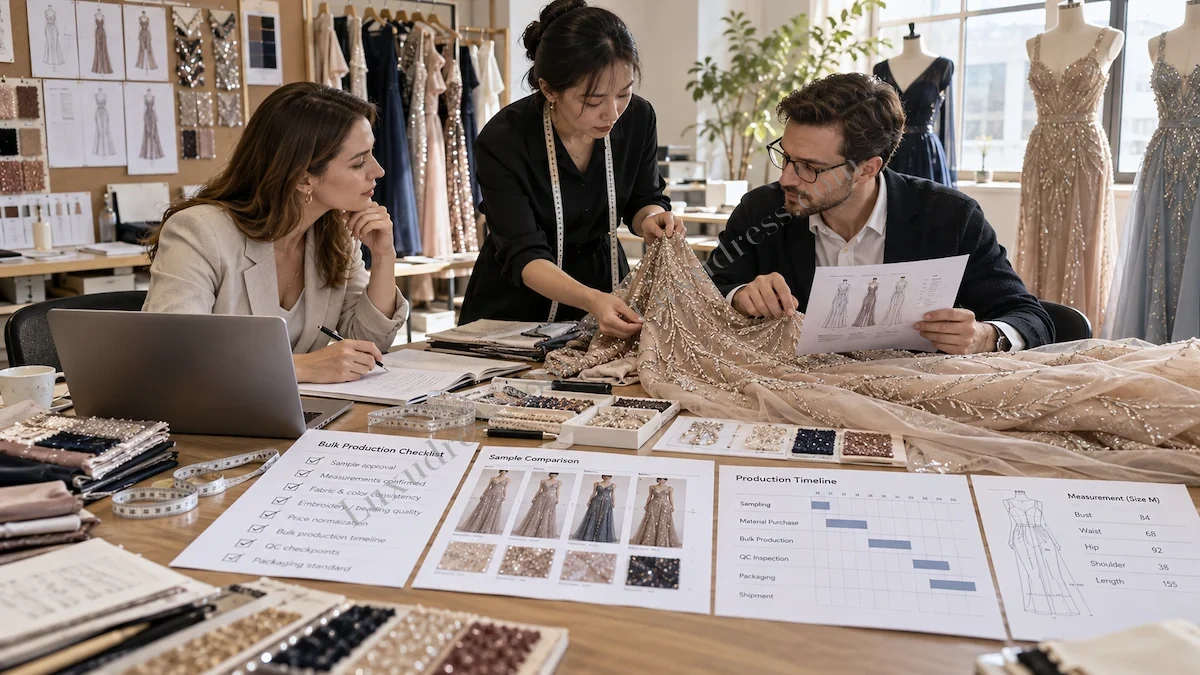
Practical buyer worksheet
Send these ten fields with your reference images and you will receive a comparable quote within twenty-four hours. They are the same fields our quote form asks for:
- Target customer and use occasion
- Target retail and wholesale price
- Target ex-factory or landed cost
- Core fabric and backup fabric
- Size range and base fit size
- Colour count and continuity colours
- Critical construction risks
- Approval sample required
- QC checkpoints
- Latest acceptable delivery date
FAQ
How do I know a supplier is right for eveningwear?
Look for repeated evidence in the exact constructions you need, then test communication and sample quality. A supplier who has made your garment type many times will tell you what will go wrong before you ask, and will describe how they handle it rather than simply agreeing that they can.
Should I choose the lowest quote?
Only after normalising fabric, lining, trim, labour and finishing assumptions. A lower quote that assumes a lighter lining, a narrower fabric width or a continuous motif instead of a matched one is not a lower price for the same dress — it is a price for a different dress.
Is a tech pack required?
It is strongly recommended for custom OEM, because it is the document the sample and the bulk standard are both built from. Early ODM discussions can start from clear references plus commercial constraints, with the specification written as the style is developed — but by the time sampling starts, something has to be written down.
What should be inspected before shipment?
Measurements, workmanship, symmetry, closures, lining, embellishment, stains, pressing, labels and packing — checked against the sealed sample, using the defect classifications agreed before bulk started.
Next step
We make eveningwear, occasionwear and private label evening dresses at our production facilities in Guangzhou and Dongguan. Send reference images or a tech pack with quantity, size range, fabric direction and delivery window, and we will return an itemised quotation — with assumptions stated — within twenty-four hours. We hold 260 ready-to-ship styles from one piece for buyers who need product without a development cycle.