On this page
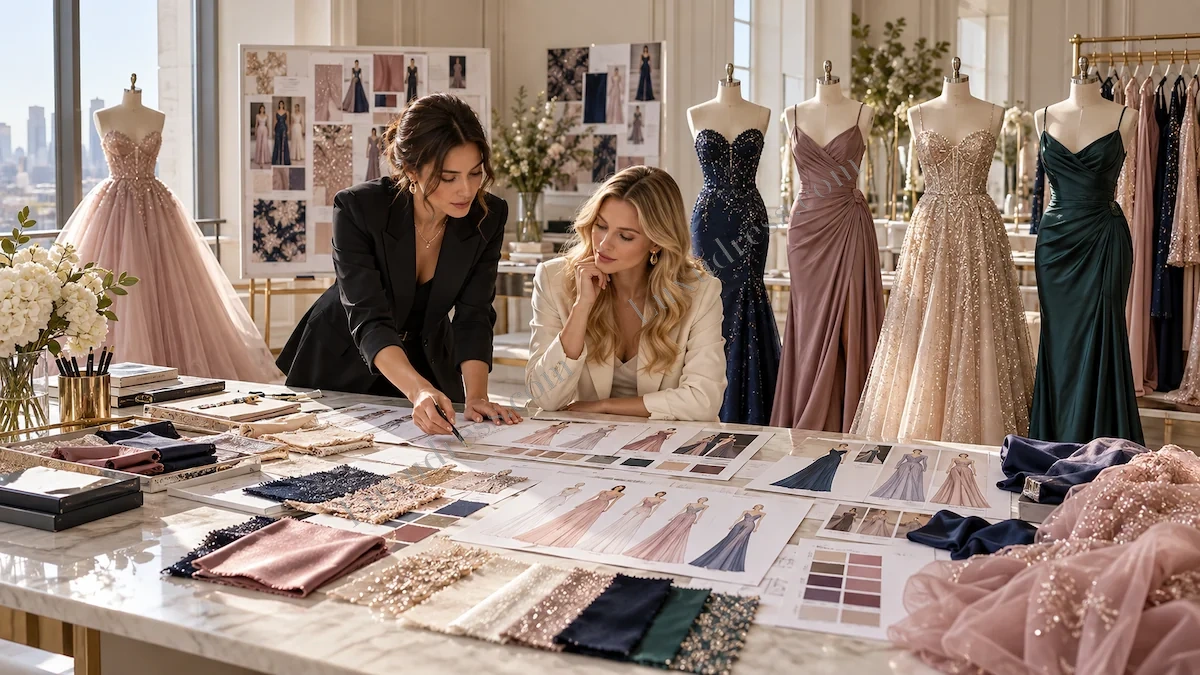
Prom is a season, not a category. The selling window is short, the purchase is emotional and usually made once, and the consequences of a stockout are worse than the consequences of a slow seller, because a missed prom season cannot be recovered until the following year. That single fact shapes every decision below: in most categories you optimise for sell-through, and in prom you also have to optimise for not running out at week three.
It is also a category where one variable moves all the others. Silhouette affects fabric consumption, fabric affects cost, colour affects minimums, and all three affect the calendar. Designing them independently is why prom ranges arrive late and over budget. The commercial page behind this article is our prom dress manufacturing range.
Start with assortment architecture
Separate the range into three jobs before you sketch anything. Core commercial styles are the ones you expect to sell in depth and reorder. Fashion styles carry the season's novelty and are expected to sell in smaller quantities. Image-driving statements exist to make the range photogenic and are not load-bearing commercially.
| Tier | Share of the range | Job | How it is judged |
|---|---|---|---|
| Core commercial | Roughly half | Sell in depth, reorder | Sell-through and reorder volume |
| Fashion | A third or so | Carry the season's novelty | Does it sell at all, and how fast |
| Image statements | One or two styles | Make the line directional | Does it lift the whole range |
Scoring each tier on a different measure is the point. Judging a statement piece on sell-through will make you cut the thing that sold the rest of the range; judging the core on press coverage will make you over-invest in a style that never reorders.
How many styles a prom range actually needs
The number is set by the retailer, not by the designer. A boutique that gives you six metres of rail space can merchandise roughly nine to twelve distinct styles before the range stops reading as a collection and starts reading as clutter. Below six, the line looks thin next to a competitor; above twelve, the buyer cannot tell what you stand for.
Within that total, the distribution matters more than the number. A common working split is around half the styles in the commercial core, a third in fashion, and one or two statements. That split keeps the range affordable to buy into, because a retailer can take the whole core and one statement without carrying the pieces that will not sell in their store.
Resist filling the range with colour variations of one style. On a line sheet, five colours of the same dress looks like breadth; on a rail it looks like one dress, and the customer who does not want that dress then has nothing else to choose.
Cover three silhouette attitudes
A workable prom range covers three attitudes: fitted, structured volume, and a clean column or slip. Those three give a retailer a reason to buy across the line and give the customer a genuine choice that is not just a colour variation. Without that spread, the range competes with itself for the same customer — three versions of the same mermaid dress are one dress with a colour problem.
Reading the three attitudes commercially
The three attitudes are not equal in what they earn you, and knowing which is which changes how you price them. Fitted mermaid and trumpet shapes carry the highest return rate and the highest alteration cost, because they are least forgiving across bodies — they are also, perversely, what customers ask for by name. Structured volume carries the highest freight and storage cost and the strongest visual impact. Columns and slips carry the best margin and the longest usable life, because they survive trend cycles that the volume shapes do not.
A balanced range accepts all three and prices them accordingly: the fitted styles carry a margin buffer for returns, the volume styles are priced knowing what they cost to ship, and the columns quietly make the money. A range built only on the first two looks spectacular on Instagram and underperforms on a profit and loss statement.
Review the mix after your first season against actual returns and actual freight, not against what sold fastest on social media. Those are different questions and they have different answers.
Create difference cheaply
Neckline and back variations generate visual range without rebuilding every block, and that is the most important efficiency available in prom: the expensive part of a new style is the pattern and the fit work, not the neckline. A single approved bodice with four neckline treatments reads as four styles on a rail and costs a fraction of four separate developments.
Keep the heaviest embellishment for a small number of hero styles where the retail price can carry it. Beading and hand-applied work are priced by hours rather than by metres, and they are the fastest way to turn a mid-price style into an unprofitable one.
- Separate core commercial styles, fashion styles and image-driving statements.
- Cover fitted, structured-volume and clean column/slip attitudes.
- Use neckline and back variations to create difference without rebuilding every block.
- Keep the most expensive embellishment for a small number of hero styles.
Plan silhouette families
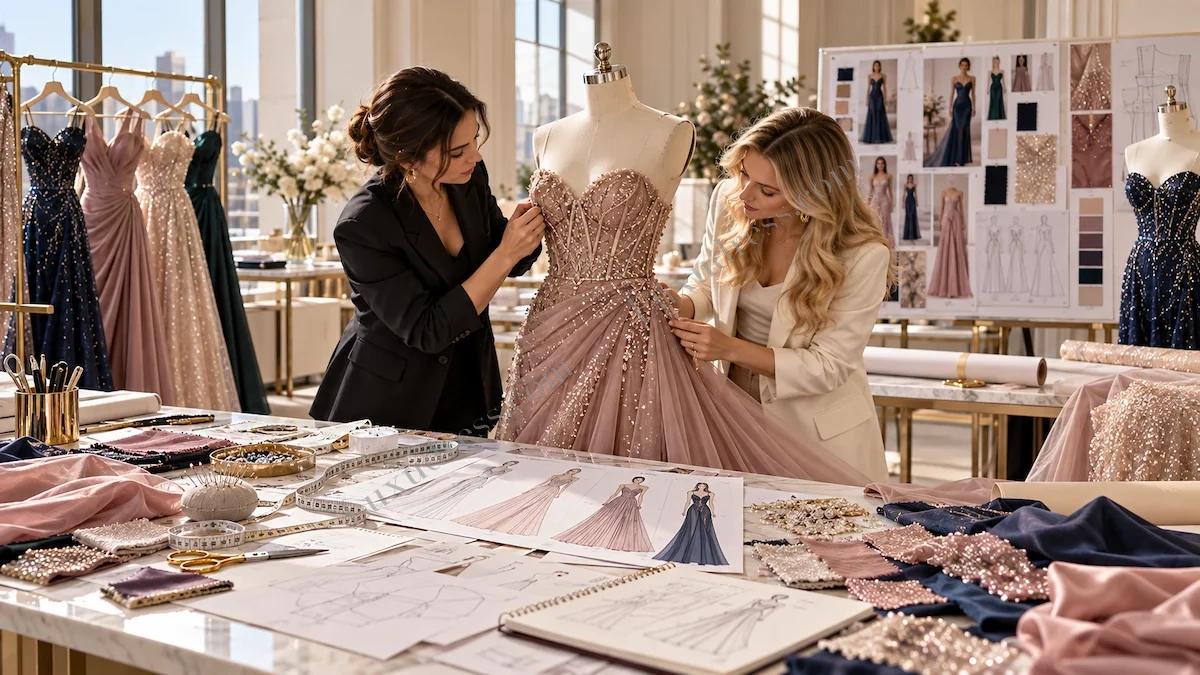
The most efficient prom ranges are families, not individual styles. One proven corset bodice carried across an A-line, a ball-gown and a mermaid skirt gives three styles that share a fit block, a boning specification and a cup specification. Three separate bodices give three separate fit risks and three separate approval processes, and each one can fail independently.
| Family | What is shared | What varies | Why it works |
|---|---|---|---|
| Corset bodice group | Bodice block, boning, cups, closure | Skirt volume and length | One fit approval covers three styles |
| Bias and column group | Shell fabric, lining, hem finish | Neckline and strap treatment | One fabric minimum covers the group |
| Tulle volume group | Layer specification, underskirt, hem | Colour and embellishment density | Construction is proven once |
Build the families deliberately rather than discovering them. Before you approve a new style, ask which family it joins and what it shares. A style that shares nothing is a new development, and you should be spending those deliberately.
The three families in practice
A ten-style prom range built on families looks something like this. Three styles share one corset bodice: an A-line, a ball-gown and a mermaid, distinguished by skirt volume and length, with neckline variation creating further difference. Three styles share a satin platform as bias-cut or column shapes, varying in neckline, strap and back detail. Two styles carry tulle volume with the same underskirt and layer specification, differing in colour and embellishment density.
That is eight styles from three fit approvals and two fabric platforms. The remaining two are the statements — the pieces where you spend the embellishment budget and accept a lower margin, because they are what gets the range photographed and what makes a buyer stop at your rail.
Compare that with ten unrelated styles: ten patterns, ten fit risks, ten fabric buys, and no mechanism for a mid-season reorder to be quick. The family approach is not a constraint on creativity. It is the thing that makes the creativity affordable.
Let bias and column styles share fabric
When four styles buy the same satin, the fabric minimum is met once, the shade is matched once, and a reorder of any one of them is a small production decision rather than a new sourcing exercise. This matters more in prom than in most categories because reorders happen mid-season, when there is no time to source.
Reuse construction, change proportion
Reusing reliable construction while changing proportion, surface and colour is how a range builds enough visual difference for a retail buyer without multiplying technical risk. It is also how a second season gets easier: the proven blocks already exist, so season two starts from a fit-approved base instead of a blank page.
What season two should reuse
The point of building families in season one is that season two does not start from nothing. Carry the fit-approved blocks forward unchanged wherever the market still wants them, and spend the new season's development budget on what actually needs to be new: the fashion tier, and one or two new surface or colour ideas applied to proven blocks.
This is where the economics of prom turn in your favour. Season one pays for the blocks; season two amortises them. A brand that redesigns its whole range every year pays full development cost annually and never gets the compounding effect, which is why third-season prom brands are usually more profitable than first-season ones at identical volumes.
Keep a written record of what was approved and why — the block, the boning specification, the cup, the closure, and any fit note from the sample rounds. That document is the most valuable thing a first season produces, and it is usually lost because nobody thought to write it down.
- Use a proven corset bodice across A-line, ball-gown and mermaid variants where appropriate.
- Let bias or column styles share fabric platforms.
- Reuse reliable construction while changing proportion, surface and colour.
- Build enough visual difference for retailers without multiplying technical risk.
Build a colour plan that can be bought
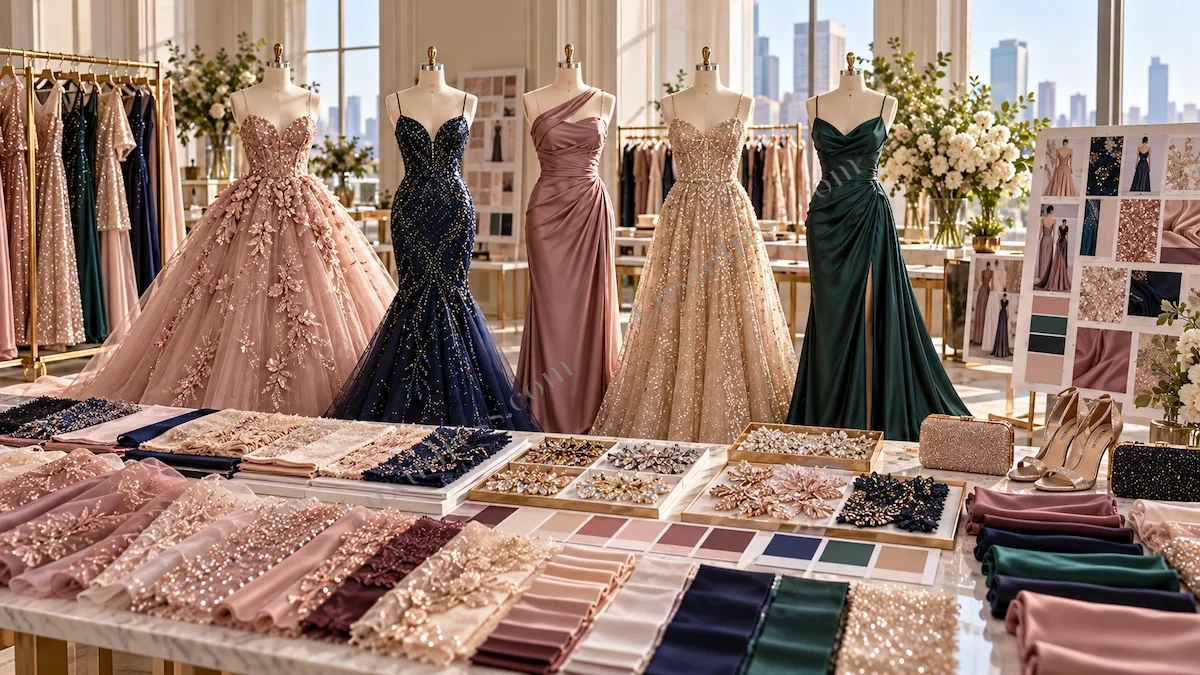
Choose anchor colours that carry across several styles, then add limited fashion colours only where demand justifies a custom dye or fabric minimum. Every additional colourway is a separate dye lot, a separate shade approval and, in most cases, a separate minimum — which is why colour count is usually the fastest way to blow a prom budget.
A worked colour architecture
Take a range of ten styles. Giving every style four colourways produces forty dye lots. Giving three anchor colours across all ten styles, plus one fashion colour on three styles, produces thirteen — and the range reads as more coherent, because the anchors tie it together.
| Approach | Dye lots | Reads to the customer as |
|---|---|---|
| Four colours on every style | Forty | A wall of similar dresses |
| Three anchors plus one accent on three styles | Thirteen | A collection with a palette |
| Three anchors only | Three | A tight, confident range |
The middle row is usually the right answer for a first prom season. It gives the customer real choice at the anchor level, creates enough novelty to feel current, and keeps the dye-lot count — and therefore the minimums and the shade-matching workload — inside what a small operation can actually control.
How the colour plan shows up on the rail
A colour plan is not finished until you have seen it hanging. Lay the range out by colour rather than by style at least once before approval; the anchor colours should form clear vertical groups that a customer reads from three metres away, and the accent colours should punctuate them rather than scatter.
What usually goes wrong is that each style was approved in isolation and the range has five colours distributed evenly — which reads as no colour story at all. Fixing it at approval costs nothing; fixing it after the fabric is booked means either living with it or re-buying.
Then check the plan against the price ladder. If the accent colour only exists on the premium styles, the customer who wants that colour has to trade up, which is a good outcome if it is deliberate and a lost sale if it is an accident.
| Colour role | How many | Job | Risk if you overdo it |
|---|---|---|---|
| Anchor | Two or three | Carry across most of the range | Few — this is the safe spend |
| Fashion accent | One or two | Make the range feel current | Custom dye minimums |
| Metallic or special | At most one | Image and press | Plating, hand feel and matching problems |
Decide continuity colours early. If a style is likely to reorder mid-season, the fabric and the dye standard have to be available later, and that is a conversation to have before the first order, not after the sell-through data arrives. A reorder that cannot be shade-matched to the first delivery is worse than no reorder at all, because the customer will see the difference.
Approve colour the way it will be seen
Photograph jewel tones, metallics and pale shades under flash as well as daylight. Several prom fabrics behave very differently under a flash: a satin that reads even in daylight can show every panel seam under flash, and a pale shade that looks clean indoors can go transparent. The customer's photographs are taken at night under flash, so that is the condition that matters.
Match the whole visible assembly
Check matching across shell, lining, mesh, cups and zippers. These are sourced separately, and a mismatch at the zip or a lining that reads a shade warmer than the shell is visible in the same photograph as the dress itself. Approve them together, as one assembly, rather than component by component.
- Choose anchor colours that carry across several styles.
- Add limited fashion colours where demand justifies custom dye or fabric minimums.
- Photograph jewel tones, metallics and pale shades under flash as well as daylight.
- Check matching among shell, lining, mesh, cups and zippers.
Engineer price bands deliberately
Create opening, middle and premium price points on purpose, and build them from construction and materials rather than from discounting. A prom range with one price point gives a retailer nowhere to trade a customer up or down, and a range whose tiers are created by marking things down is a range whose margin is fictional.
| Tier | Typical construction | What carries the cost | Watch out for |
|---|---|---|---|
| Opening | Simple satin or crepe, minimal structure | Fabric choice and cut efficiency | Do not let it look cheap next to the rest |
| Middle | Lined, light boning, some surface detail | Lining and operation count | The tier most likely to be under-priced |
| Premium | Corsetry, beading, dramatic tulle volume | Labour hours, not metres | Hours escalate faster than buyers expect |
Let the simple styles protect margin
An unlined or lightly lined satin or crepe column is a low-operation garment. It can carry a healthy margin at an accessible retail price, and it anchors the range — it is the style that makes the range affordable to a retailer who also wants the statement piece.
Put the cost where the price can carry it
Use corsetry, beading or dramatic tulle at the top, where the retail price genuinely absorbs the added labour. Beading in particular is priced by hours: a motif that has to be matched across a seam costs several times what a continuous motif costs, and that difference lands entirely on the top tier.
Cost the tiers against each other before you approve the range. If the premium tier cannot be produced at a price the market will pay at the quantity you can buy, reduce the embellishment rather than the fabric quality — fabric quality is what the customer feels, and it is the last thing you should cut.
Where prom margins actually leak
Four places, and they are rarely the ones a buyer expects. Fabric waste on volume skirts: a full circle consumes materially more than a column, and the difference lands directly on the opening price point. Operation count on structured bodices: boning channels, cups and a proper closure are operations, and operations are labour. Embellishment hours: priced by time, not by area, and easy to underestimate. And freight: prom is bulky, and volumetric weight is how a cheap garment becomes an expensive one to land.
All four are knowable before you approve the range. Ask for consumption per style, ask for the operation count on the structured styles, ask for the embellishment hours on the statements, and ask for a volumetric estimate on the packing. A range that looks profitable ex-factory can lose its margin entirely in transit, and prom — with tulle, crinoline and long skirts — is the category where that happens most.
- Create opening, middle and premium price points.
- Use construction and materials to create cost tiers rather than random discounting.
- Let simpler satin or crepe styles protect margin.
- Use corsetry, beading or dramatic tulle where the retail price can carry the added labour.
Build the season backward from delivery
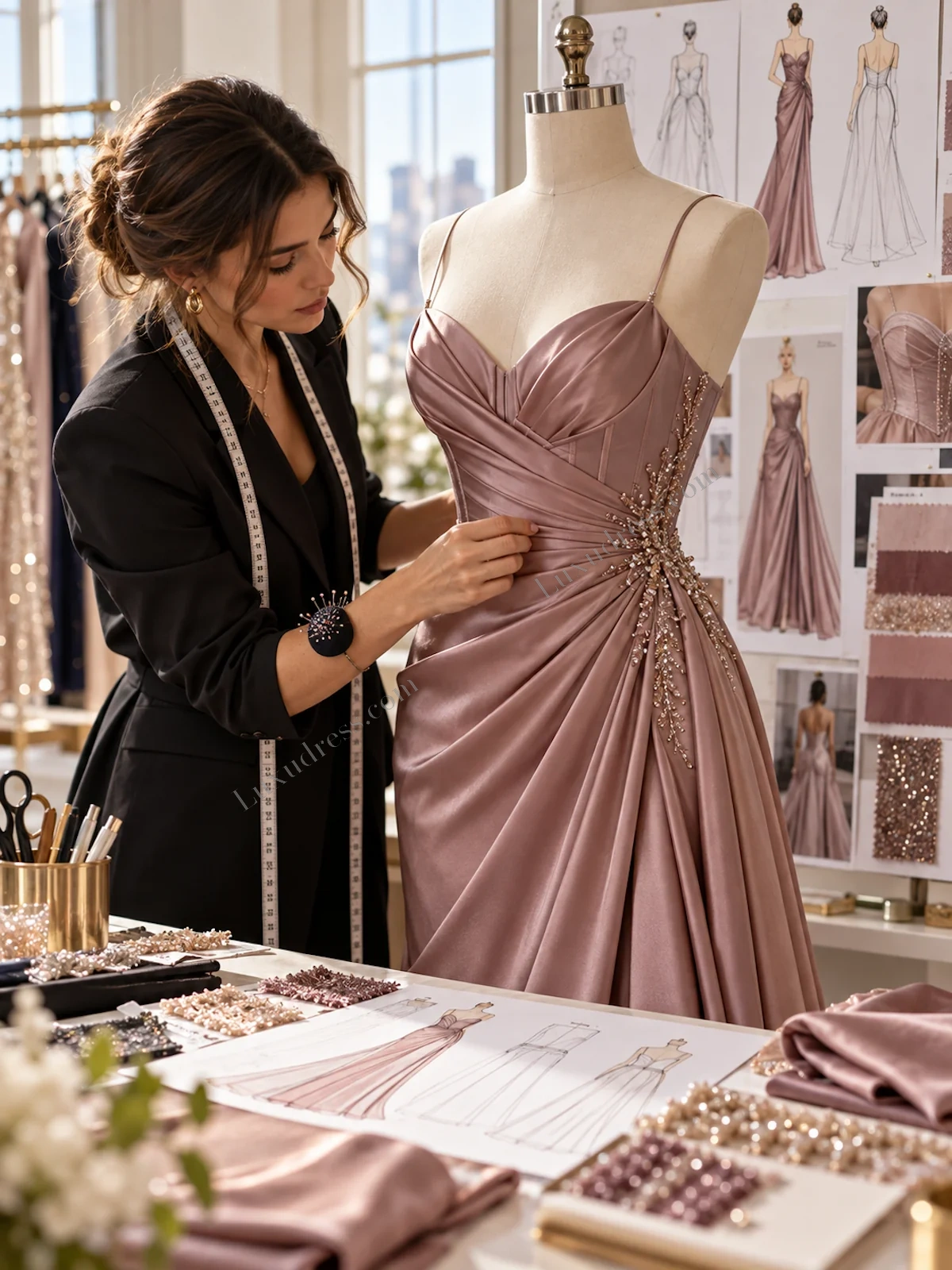
Lock core fabrics before decorative trims wherever possible. Fabric has the longest lead time and the largest minimum; trim is the last thing that should be holding up a production slot. Approve the base fit before grading, because a grading run against an unapproved fit produces a full size set of the same mistake.
| Working backward | Gate | What can still slip |
|---|---|---|
| Selling window opens | Stock available | Nothing |
| Minus freight | Goods shipped | Freight method and documentation |
| Minus bulk | Cut and sewn | Capacity and material arrival |
| Minus inspection | QC passed and packed | Rework |
| Minus bulk material | Fabric and trim booked | Mill lead time and dye approval |
| Minus grading | Base fit approved | Fit revisions |
| Minus sampling | First samples reviewed | Brief quality |
Schedule photo samples separately
If marketing deadlines are earlier than bulk approval, say so and schedule a separate sample. This is the most common source of a prom season going wrong: the imagery deadline is immovable, the bulk approval is not yet complete, and the two get conflated into one sample that is neither. A salesman sample in the correct fabric is a cheap insurance policy against shooting the wrong garment.
Keep capacity for reorders
A prom range that sells out of its best style in week three and cannot reorder has left money on the table for the remaining weeks of the season. Hold capacity and budget back for it deliberately. Reorder lead time is shorter when the fabric platform was locked early, and it is confirmed after sample and material review rather than quoted as a fixed number.
What to hold back for the reorder
Holding back for a reorder is a decision made at the first order, not at the sell-through. Three things need to be reserved: capacity, fabric and cash. Capacity because a production slot booked solid through the season cannot absorb a mid-season reorder. Fabric because a reorder without continuity fabric is a new dye lot, and a new dye lot in prom is a shade risk the customer will see. Cash because the reorder is almost always the most profitable order of the season and the one most likely to be unfunded.
The cheapest of the three is fabric. Reserving continuity fabric on two or three anchor colours costs a small carrying charge and converts a six-week reorder into a two-week one. Against a season with a hard end date, that difference is the entire margin on the reorder.
Tell your supplier at the first order which styles you expect to reorder and ask what reserving the fabric would cost. It is a five-minute conversation that most buyers never have, and it is the one that determines whether the best-selling style earns twice or once.
- Lock core fabrics before decorative trims where possible.
- Approve the base fit before grading.
- Schedule photo samples separately if marketing deadlines are earlier than bulk approval.
- Keep capacity and budget available for reorders of winners.

Practical buyer worksheet
Complete these ten fields per style family rather than per style. Working by family is what makes the range quotable, because it is what exposes the shared platforms that keep the cost down:
- Target customer and use occasion
- Target retail and wholesale price
- Target ex-factory or landed cost
- Core fabric and backup fabric
- Size range and base fit size
- Colour count and continuity colours
- Critical construction risks
- Approval sample required
- QC checkpoints
- Latest acceptable delivery date
FAQ
What core silhouettes should be in a prom line?
A balanced range usually includes structured A-line or ball-gown shapes, fitted mermaid or trumpet styles, and cleaner column or slip options. That spread covers the main customer preferences without multiplying pattern development, and it gives a retailer three reasons to put the line on the floor rather than one style in three colours.
How many colours should each style have?
Shared colour families across multiple styles are usually more efficient than giving every style a unique palette. Each additional colourway is a separate dye lot and, in most cases, a separate minimum, so the cost of colour breadth is measured in dye lots rather than in designs.
Are corset dresses harder to produce?
They can be, because cups, boning, neckline stability and grading all affect fit, and each of them has to be right at the same time. They are also the styles that most often justify a premium price point, so the real question is usually whether the retail price carries the construction — not whether the construction is difficult in the abstract.
When should the range be approved?
Work backward from the selling window and leave time for fit revisions, grading, bulk production, inspection and freight. Prom seasons do not move, so the calendar is built from the selling date rather than the design date, and the contingency belongs at the front of the calendar rather than the end.
Next step
We build prom programmes — corsetry, tulle volume, satin and crepe columns, beaded hero styles — at our production facilities in Guangzhou and Dongguan. Send your assortment plan or reference images with quantities, size range and the selling date, and we will come back within twenty-four hours with a construction and costing view. The style library shows the constructions we already run, and 260 ready-to-ship styles are available from one piece if you need to fill a gap in the range quickly.