On this page
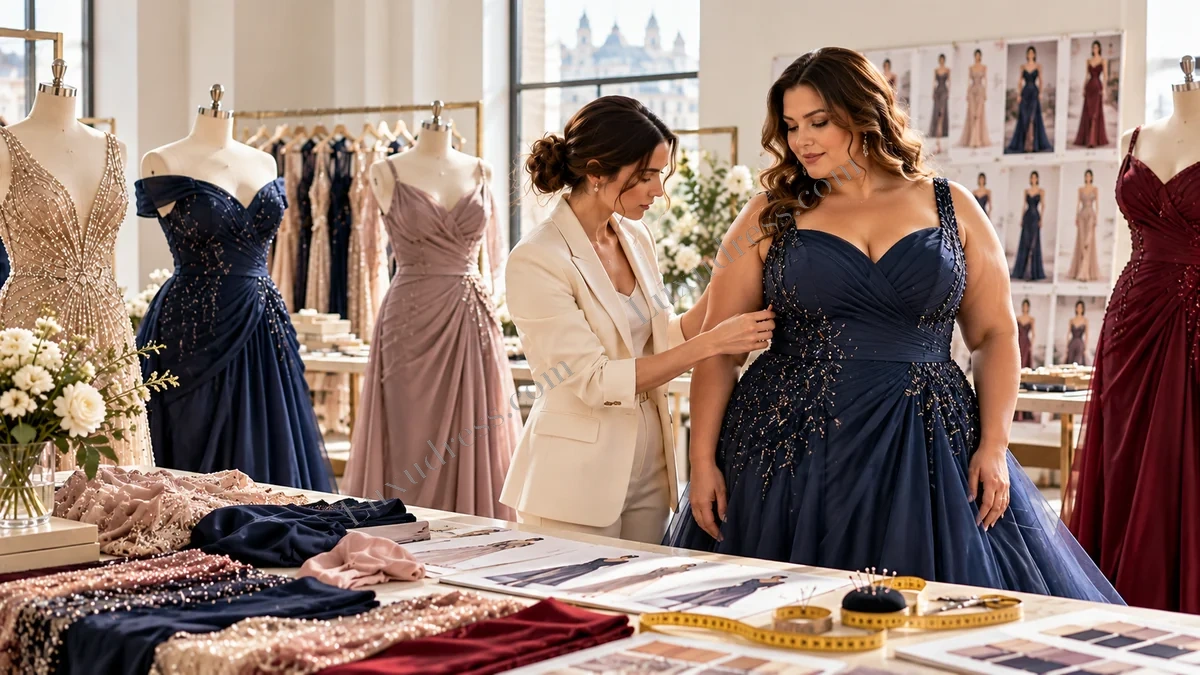
Formalwear is unforgiving here precisely because it is heavy, structured and public. A jersey dress can absorb a load problem in the fabric. A boned bodice in a lined crepe has nowhere to hide one. This guide follows that load through the garment: from the block that has to be drafted rather than derived, through the support architecture that carries it, the silhouette placements that must be re-decided, the fabrics that behave differently under tension, and finally the movement tests that prove the result before bulk.
If you need the arithmetic of grading — the increments, a rule set applied through a full size run, and the points of measure where a rule stops being true — that is covered in our prom dress size grading guide. This article deliberately does not repeat it. It starts further upstream, at the block, and stays on the physics of the garment.
Start with an appropriate block
A block is the pattern a size range is built from. A graded size is derived from a block by rule; a block is drafted to a body. That distinction is the whole of this section, because a range that has been extended by grading has no drafted block at the sizes that need one most.
What to read on the body
Five features decide the shape of an extended-size block. They have to be read together, because the interaction between them is the point: a change in bust projection moves the neckline, which changes where a strap anchors, which changes where the garment's weight finally lands.
| Feature | What it decides in the block | What happens if a straight-size proportion is kept |
|---|---|---|
| Shoulder width | Where the armhole sits and where a strap or stay anchors | A strap anchored too far inboard cuts in and drops the bodice |
| Bust projection | Depth, not width: dart intake, cup depth, front panel shaping | A panel drafted for less projection pulls forward and gaps at the neckline |
| Back length | Where the waist falls in the bodice, and vertical balance | A bodice that is short for the body sits above the waist and rides up |
| Waist position | The anchor for the skirt and for any internal waist stay | An error here propagates into every measurement below it |
| Hip shape | How the skirt hangs and where maximum circumference sits | A skirt drafted for another hip shape hangs from the wrong point |
Read them on a fit model whose measurements represent the target customer rather than the sample size that happens to be available. The reason is not representation; it is engineering. A block drafted to a body that does not exist in the customer base produces a garment that fits a model and generates returns, and the pattern record will not explain why.
Why a drafted block, and not a graded one
Grading is reliable over a short extension and unreliable over a long one, and the reason is the five features above: each of them behaves non-linearly away from the base. Bust projection does not grow at the same rate as circumference. Back length does not grow at all. Hip shape changes in a way no increment describes. A range extended by rule across a wide span therefore contains a run of sizes whose numbers are all defensible and whose block was never drafted for the bodies it is being sold to.
The practical consequence is a budget line rather than a technique. Budget for a second block instead of for more grades. It is a development cost paid once, and it converts the top of the range from a correction exercise into a design decision — the difference between a brand that sells the same dress to more customers and one that spends the season repairing the largest three sizes.
It also gives the extension somewhere to live. A second block has its own fit rounds, its own sealed sample and its own record, so the top of the range stops being corrected by whoever happens to be looking at it in a given week.
What to record, and what gets recorded uselessly
The record matters more than the fitting, and four figures are routinely recorded in a form that cannot be reused.
- Where a measurement was taken. A waist measurement is the natural waist, not wherever the waistband happens to sit on this garment.
- What was worn underneath. A waist measured over a smoothing slip is a different number from the same waist without one, and both are legitimate — but only if the record says which.
- The heel height, for anything measured to the floor.
- The correction as a pattern change in centimetres, rather than as a description of how it looked.
Build support where the design needs it
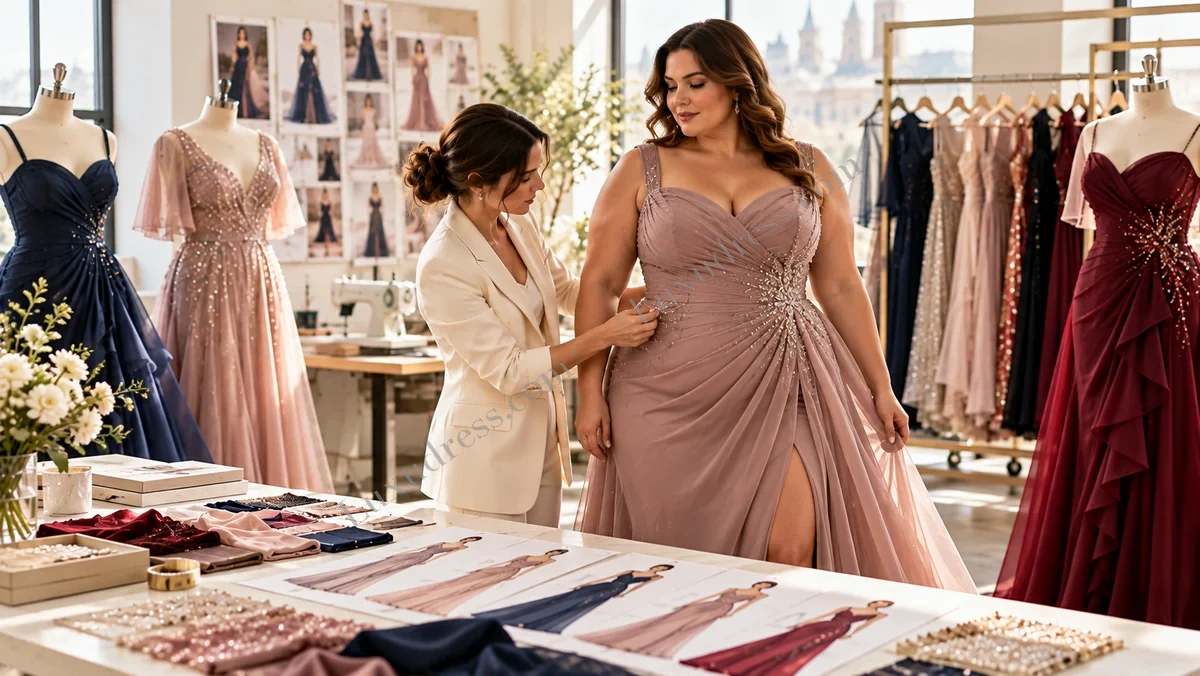
Support is where an extended-size evening dress is won or lost, and it is almost never specified. The brief says boned bodice; the sample has bones; the garment still fails, because the bones shape and the garment needs something to carry it. Shaping and load-bearing are two different jobs and they need two different elements.
The load map
Read this as a map of forces rather than a construction list. For each zone, what it carries, where that force is supposed to end up, and what happens when nothing terminates it.
| Zone | What it carries | Where it should terminate | What fails if nothing terminates it |
|---|---|---|---|
| Bodice front | The bust, plus the weight of the bodice above the waist | Shoulder via a strap or stay, or a boned front into a waist stay | Neckline gapes and the bodice edge lifts away from the body |
| Waist | The skirt's weight, plus the bodice's weight | An internal waist stay seated on the body's waist | The waistband rolls over and the whole garment migrates down |
| Shoulder and strap | The entire load, on a shoulder-supported style | A reinforced strap anchor with a wide footprint | Straps cut in, or the bodice drops over the evening |
| Back and closure | Lateral tension at the widest point of the body | Across the closure, in line with it | The zip strains and the placket gapes |
| Hip and skirt | The sweep's mass and its swing in movement | The waist stay, or a separate inner layer | The skirt drags the bodice sideways at the side seams |
| Hem and train | Mass multiplied by distance from the body | The waistband, through the skirt's own structure | The hem drops and the train distorts |
Two conclusions come out of that map. The first is that a boned bodice is not a support system. Bones shape the front panel; they do not carry the skirt. That job belongs to a stay, and a stay has to be specified. The second is that the load grows while the seam that receives it does not get any stronger, which is why the largest sizes in a range are where the same construction that worked at the base size stops working.
Thin straps without a heavy look
A designer asked to add support will hear the word as thickness, and thin straps are usually a deliberate part of the design. The answer is not to thicken the strap but to change what the strap sits on and how far the load spreads when it arrives.
- Widen the anchor, not the strap. A stay tape or an interfaced panel under the strap spreads the same load across a larger area.
- Put the anchor where the design already has a line, so the reinforcement reads as construction rather than as an addition.
- Carry part of the load at the waist, so the shoulder is not asked to take all of it.
- Specify the strap anchor in the tech pack, because a supplier making a strapless version will reuse the same anchor unless told otherwise.
Low backs, and where the support goes instead
An open back removes the most convenient place to terminate a load, and it is the single most common reason a plus-size evening dress fails structurally while passing every measurement check. There is no single answer; there are three, and the choice is a design decision that has to be made early.
The first is to keep the low back and move the support inside: an internal corselette or a fitted inner bodice that carries the load and stays hidden below the outer line. The second is to keep the visual low back and reinforce its edges with a clear or matched stay, accepting that the outer fabric will read slightly firmer. The third is to reach the shoulders, which requires the design to include something that does — a halter, a strap, or a covered shoulder.
Whichever you choose, it belongs in the tech pack as a support instruction with a name, not as an implicit expectation that the sample room will solve it. A supplier who is not told will make the garment in the picture, and the picture has no back.
Comfort is a specification, not a hope
Support that cannot be worn for four hours has failed, however well it holds. That is not a soft requirement; it is a testable one, and the failure modes are specific: a strap edge that leaves a mark, a stay that presses when seated, a boned channel that digs at the front of the ribcage, an underband that rolls. Test the sample for the length of a real event, seated for a substantial part of it, and note every pressure point while it is still a pattern change rather than a return.
Grade silhouette, not only measurements
Some things in a pattern are measurements and some are placements. Measurements are what the chart describes; placements are where a feature sits on the body, and they do not scale. A range can be numerically complete and visually wrong, and the four placements below are where that shows first.
The four placements that must be re-decided
| Placement | What scaling does to it | What it needs instead |
|---|---|---|
| Mermaid or trumpet knee break | Moves down proportionally and lands below the knee | Re-position on a body, at each size band |
| Slit height | Rises and widens at once, so the opening grows faster than the leg | Rebalance the opening rather than the measurement |
| Neckline width and armhole depth | Widens and deepens, and eventually reads as a different neckline | Visual review at the largest size, not only at the base |
| Skirt sweep and train | Grows in every direction, so mass grows faster than the pattern suggests | Hold the sweep and add length, or lighten the construction |
The mermaid knee break is worth singling out because it fails quietly. Scaled proportionally, it moves down the leg with the total length, and it arrives below the knee — where the flare no longer reads as a mermaid and the garment starts to look like an A-line with a late flare. Nothing in the measurements is wrong. The silhouette has simply stopped being the silhouette.
Why the skirt gets disproportionately heavy
A skirt's weight does not rise in step with its circumference, and this is the arithmetic reason the largest sizes in a range feel like a different garment. A full circle skirt's perimeter rises with the radius, so the fabric quantity rises with the square of the radius. Everything that hangs from the waist therefore grows faster than the body does, and the waist is where that growth is felt.
| Quantity | How it grows with the size | What it means at the waist |
|---|---|---|
| Waist circumference | Linearly | The anchor point itself does not grow much |
| Skirt length | Not at all, for a fixed length | Leverage grows with the distance from the waist |
| Skirt sweep | Faster than linearly at a constant flare angle | More fabric to carry, hanging from the same seam |
| Train | Its own mass, at the furthest point from the waist | The largest single load in the garment |
The practical response is a deliberate one rather than a proportional one. Hold the sweep and take the length, if the customer wants a longer dress. Reduce the underlayers rather than the outer fabric, so the drape survives. Where a train is essential, lighten its construction and weight its hem so it falls instead of pulling. All three are design decisions, and all three are cheaper at the pattern stage than at the fixing stage.
Balance is what you check
After the numbers, check balance: whether the hem sits level, whether the waist looks as though it is in the right place for the height, whether the shoulder line reads straight, and whether the skirt hangs from the waist or swings away from it. Balance is not measurable on a chart and it is visible in three seconds on a body, which is why the largest size in a range has to be fitted at least once.
Choose fabrics with body behaviour in mind
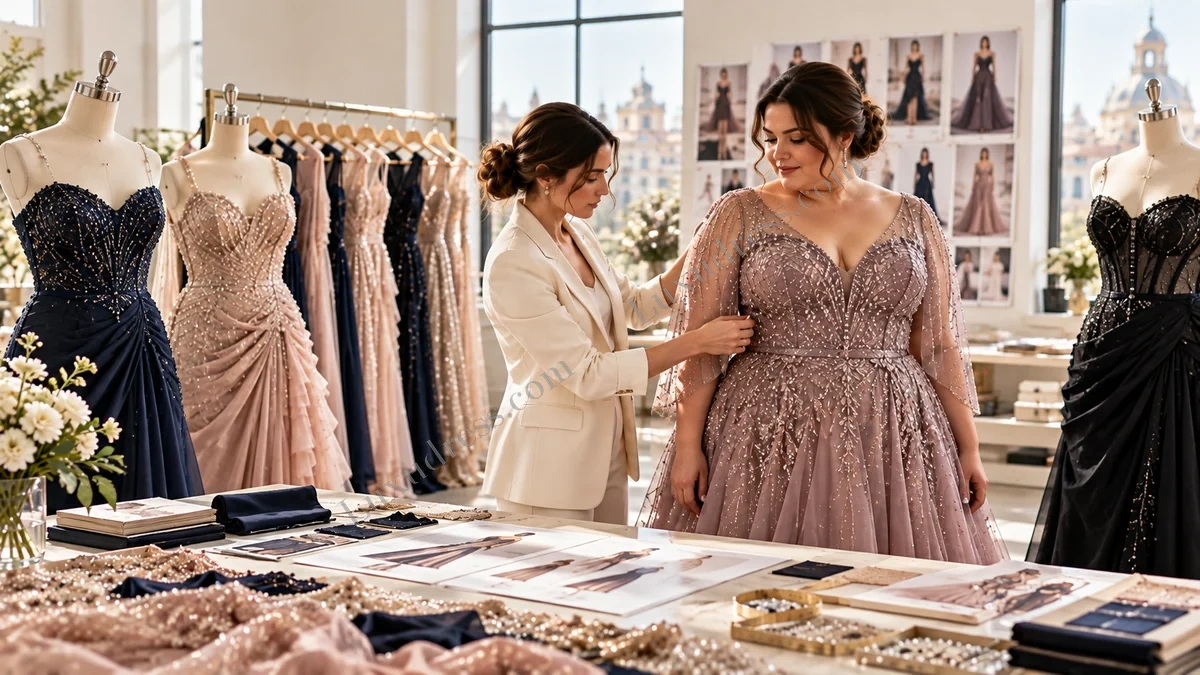
Fabric is usually chosen on how it looks on a hanger and a swatch. In extended sizes it has to be chosen on how it behaves under tension, because the same cloth is being asked to carry more and to stay smooth while doing it.
Tension rises, and recovery is what matters
A close-fitting garment in a larger size is under more tension at the same style of fit, and tension is what turns a good fabric into a bad one. The property that decides the outcome is not stretch but recovery — whether the cloth returns to its original dimension once the tension comes off. A fabric with generous stretch and poor recovery looks right on a form and bags by the end of the evening, which is exactly the failure customers describe as the dress losing its shape.
| Property | Why it matters more as sizes extend | What to ask for |
|---|---|---|
| Recovery | Tension is higher at the same fit, so poor recovery shows as bagging | A stated recovery figure, and a recovery test on the finished panel |
| Dimensional stability | A body-hugging garment has nowhere to hide growth | A shrink and relaxation figure for the batch you are buying |
| Face weight | A thin face under tension shows every internal line | Enough weight to hold a surface, or a bonded underlayer |
| Surface finish | Sheen amplifies every seam, fold and undergarment edge | A matte or low-lustre finish where the fit is close |
The test is simple and worth running before the range is committed. Cut a panel to the largest size in the intended cloth, hang it under load in the shape it will wear, leave it for a working day, then measure the growth and look at the surface. A panel that has grown by the time the office closes is a panel that will have grown by the time the photographs are taken.
The surface problem with thin satin
A thin satin worn close to the body has no surface in which to hide anything. Every internal seam allowance, every bone channel, every fold of a lining and every ridge of an undergarment reads straight through it, and the effect intensifies as the panel is stretched over a larger form. It is the most common reason a technically correct extended-size evening dress still looks unfinished.
- Move to a heavier face weight of the same quality, which hides more than any change of construction.
- Incorporate a bonded or fused underlayer so internal edges stop being visible as lines.
- Finish seam allowances flat and use a lining that does not create ridges of its own.
- Consider a low-lustre or matte finish, which suppresses the highlight that reveals every irregularity.
All four are decisions made at the fabric and pattern stage, and none of them can be corrected after the goods are sewn. If the design depends on a thin, reflective satin, the affordable answer is usually to change the fit tolerance rather than the fabric: a garment that skims instead of gripping has a surface that forgives. That is a fit decision expressed through fabric, and it is worth making explicitly rather than discovering at the fitting.
Lining and mesh must match the shell
A lining is not a neutral addition, and mismatching it to the shell is a common and expensive mistake in extended sizes because the two layers behave differently under the same load.
| Mismatch | What happens on the body | How to avoid it |
|---|---|---|
| Lining lighter than the shell | The shell holds and the lining stretches, so it hangs below the hem | Match recovery and stability, not just colour |
| Lining heavier than the shell | The lining drags the outer layer out of its drape | Keep the lining weight proportionate to the face |
| Stiff mesh against a soft shell | A visible ridge where the mesh ends | Grade the transition, or use a soft mesh of the same family |
| Different fibre in the two layers | The layers clean, shrink and relax differently | Keep at least the behaviour class the same |
The safe rule is that lining, mesh and shell should share a performance class, which is not the same as sharing a price band. Ask for the same four figures on all three fabrics — recovery, stability, weight and finish — and treat a gap in any of them as a specification question rather than a detail. Our guide to how fabric weight affects fit and drape covers the underlying behaviour, and the construction side is set out in how dress construction affects fit and cost.
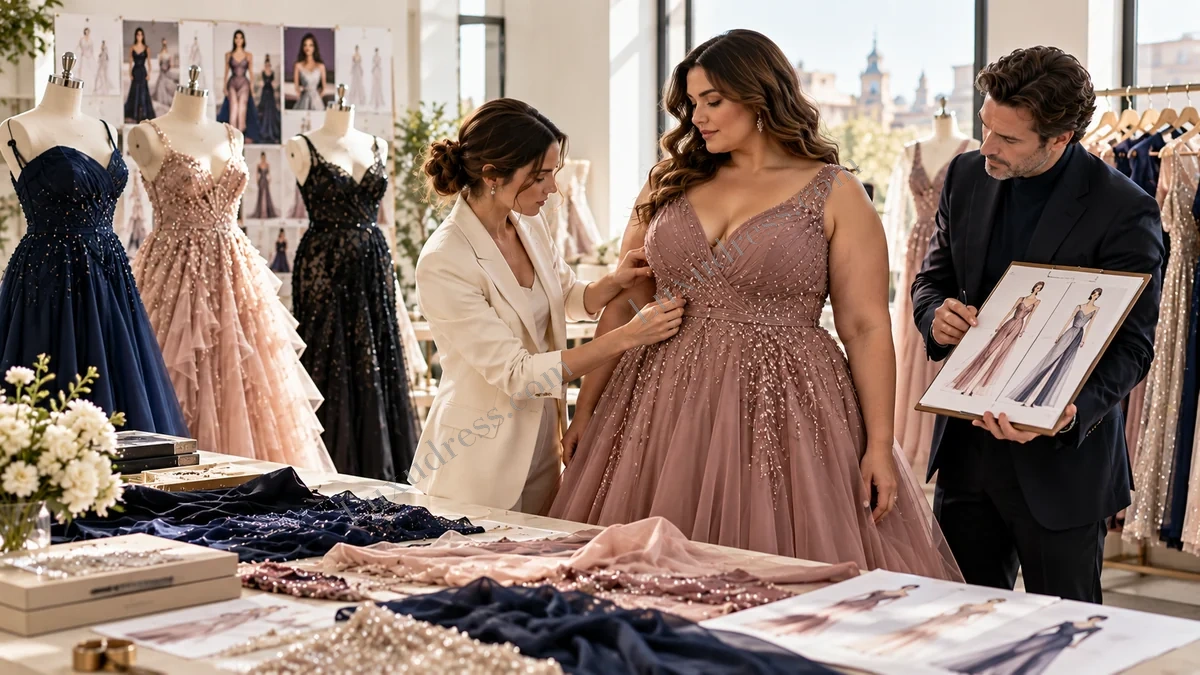
Fit test real movement
A dress that fits standing still has been checked for the position it will occupy in a mirror and none of the positions it will occupy at an event. The movement set below is the cheapest quality control available on an extended-size range, because the failures it finds are the ones customers cannot fix and fitters cannot repair.
What each test is actually checking
- Sit, and stay seated for two minutes. Checks whether the waistband rolls, whether the skirt has allowance over the thigh, and whether the bodice rides up once the spine straightens.
- Walk ten paces at a normal stride. Checks hem clearance at the front and whether the slit opens under load.
- Raise both arms twice. Checks the shoulder, the armhole and the cup, and whether the bodice edge lifts.
- Two stairs up and two down. Checks the hem at the back and how the train behaves when it is picked up.
- Close the closure after sitting down, arms forward. This is the position of maximum tension, not standing in a fitting room.
The last item is the one that catches strained zips, because a closure is measured at its worst position rather than its best. If the zip has to be coaxed in a seated position with the arms forward, it will fail in the same position in a restaurant, and it will fail more visibly.
Test in the right undergarments and the right heels
A fit approved over a smoothing slip and in flat shoes is a fit approved for a different garment. The undergarments change the body's surface by centimetres in exactly the places a structured evening dress is tightest, and the heel changes every floor-length measurement and the whole balance of the hem.
State both in the fit brief. If the design assumes a specific support garment, name it; if it does not, say so and fit to a natural shape. Either is workable, and the only unworkable answer is leaving it to whoever attends the fitting. The same applies to the hem: agree the heel height, write it down, and measure to the floor from there.
Record the force, not the symptom
Fit comments in extended sizes are dominated by descriptions of the symptom, and a symptom cannot be engineered. The waistband rolls is a description. The waist stay is not carrying the skirt is a cause with an answer. Sorting the comments into those two columns before acting is what turns a fitting into a pattern change.
| Symptom reported | The force behind it | What to change |
|---|---|---|
| Neckline gapes | Nothing terminating the bust load at the shoulder | Add or move the strap anchor and the internal stay |
| Waistband rolls over | The skirt's weight landing on the seam instead of a stay | Specify a waist stay and hang the skirt from it |
| Bodice rides up when seated | Back length short for the body | Draft the block again rather than grading the bodice |
| Zip pulls | Closure rated below the lateral tension | Re-rate the closure, or change its type above a size band |
| Skirt swings out in movement | Sweep mass with no inner layer to control it | Reduce the sweep or add a controlling underlayer |
| Hem drops at the back | Train mass carried by the waistband | Weight the hem or lighten the train construction |
Record the correction against a size or a size band, never across the whole range. A change made to fix the largest size and then applied everywhere alters eight sizes to repair one, and the sizes that were already correct will be wrong in a way that is much harder to detect, because nobody is looking at them.
Practical buyer worksheet
Take these ten items into the development conversation. The size range and base fit size line decides whether you need a second block, and the critical construction risks line is where the load map gets written down.
- Target customer and use occasion
- Target retail and wholesale price
- Target ex-factory or landed cost
- Core fabric and backup fabric
- Size range and base fit size
- Colour count and continuity colours
- Critical construction risks
- Approval sample required
- QC checkpoints
- Latest acceptable delivery date
FAQ
Can the same pattern simply be graded up?
Over a narrow extension, yes — one size, sometimes two, is usually within what grading handles well. Across a wide range, no, and the reason is physical rather than philosophical. Bust projection, back length and hip shape do not grow in the ratios a grade rule assumes, and the skirt's mass grows faster than its circumference. Where the extension is commercially important, the honest answer is a second block, drafted and fitted, with grades derived from it.
Which silhouettes work best?
Most silhouettes can work when the support and the placements are engineered; the constraint is balance and fabric behaviour rather than shape. Two practical rules narrow it down. Silhouettes whose flare starts near the waist are easier to keep in balance than those whose flare starts low, because the knee break has less distance to travel. And silhouettes with a defined internal layer — an inner bodice, a corselette, a fitted lining — carry load better than those that rely on the outer shell alone.
Do larger sizes use more fabric?
Yes, and by more than the circumference suggests. A skirt's fabric quantity rises with the square of its radius at a constant flare, so a wide skirt or a train costs disproportionately more at the top of a range. That is one of the reasons an inclusive range needs its own costing rather than a per-size multiplier, and it is why holding the sweep and taking the length is often the more sensible trade on a long dress.
Should plus-size samples be made before bulk?
Yes, wherever the size range matters commercially. The failures this article describes do not appear at the base size, and none of them can be corrected after the goods are cut: a back length that is short, a support that was never specified, a sweep that is too heavy and a fabric that does not recover are all pattern and sourcing decisions. One fitted sample at the largest size, tested in movement, is cheaper than a season of returns.
Next step
We develop and produce evening, prom and occasionwear in extended size ranges at our production facilities in Guangzhou and Dongguan, including block drafting, support and corselette development, fabric recovery testing and sampling. Send the size range you are selling into, a reference for the silhouettes in it, and where you expect the range to end, and we will come back with a block and fit plan rather than a price on an unspecified garment. Request a quote, or see the constructions we run on our evening dress manufacturing and prom dress manufacturing pages.
If you want a starting point before that, our style library and ready stock both show silhouettes already in production, and a small first order is usually the cheapest way to test an extended size range against real customers before committing a full block. The wider category we work across is on the women's dresses page.