On this page
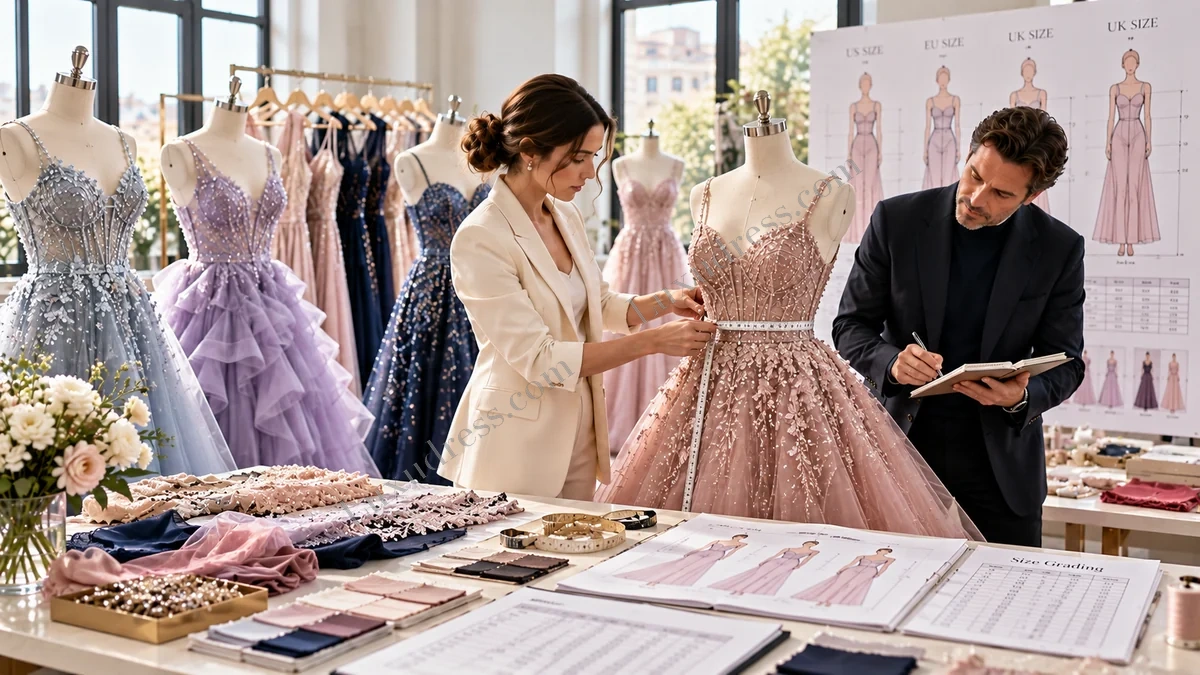
A prom dress is not a scaled-up blouse. A boned waist, a bought-in cup, a fitted hip, a long skirt and a slit interact with a body in ways that make proportional scaling unreliable, and the failures arrive as fit complaints rather than as pattern errors. That is what makes them expensive: by the time a customer says the waist is wrong, the pattern has been cut eight times and every size inherits the fault.
This guide assumes the mechanics of grading are already understood — where grade rules come from, what a grade break is, how pattern truing works, and which sizes to release. Those are covered in our guide to size grading from one approved sample. What follows is the prom-specific part: the points of measure where a rule stops being true, the arithmetic that shows why, and the protocol that proves the result before bulk.
Choose the correct base size
The base size is the one size a pattern is drafted to and every other size is derived from. It is the most consequential decision in a size set and it is usually made in the least deliberate way — often inherited from a previous range, or set at whatever size the fit model happens to be.
Two rules govern it. The base should sit near the commercial centre of the range, and it should be confirmed on a fit model before any other size is derived. Both rules exist for the same reason: grading error accumulates outward from the base, so the sizes furthest from it are the least accurate in the run, and you would rather those be the sizes you sell least.
The base is a commercial decision before it is a fit decision
If a range sells mostly at the middle of the run, drafting the base at the smallest size means every size that actually sells is derived, and derived again where a grade break intervenes. Each derivation is a chance for a tenth of a centimetre to move — invisible at the bust, and a fit complaint at the waist of a boned bodice.
Three measurement sets, kept apart
Most prom sizing failures are not grading failures. They are bookkeeping failures, and they come from three documents being treated as one. Body measurements describe a person. Garment measurements describe a dress lying flat. Ease describes the difference between them, and it is the number that gets lost.
| Document | What it contains | Who owns it | What goes wrong when it is merged |
|---|---|---|---|
| Body chart | The wearer, with no garment in the equation | Technical designer | Ease gets written into the body chart, and every size inherits the same error |
| Garment chart | The finished dress, measured flat | Pattern maker | Becomes the QC standard only if it is kept separate from the body chart |
| Ease schedule | The intended difference, point by point | Both, agreed in writing | The most commonly lost number in a range; without it the garment chart cannot be checked |
One piece of terminology worth separating out, because it does real damage in a brief: vanity sizing. The number on the label and the number on the pattern are two different things, and a brand may run them apart deliberately — a dress labelled 10 cut from a 12 pattern. What is not acceptable is doing it by accident, because a supplier reading a label as a pattern reference will grade from the wrong anchor. If your label and your pattern disagree, say so in one sentence: labelled 10, cut to a 12, grade from the 12.
What 'confirmed on a fit model' actually means
It does not mean the sample looked acceptable on somebody. It means the base size was fitted on a body that matches the body chart within a stated tolerance, wearing the undergarments the garment was designed around, at the heel height the length was drafted to, with corrections recorded as pattern changes in centimetres.

Grade bust, waist and hip with the silhouette in mind
A grade rule sheet is a short table and it decides the whole size set. It is also the document most often agreed verbally, which means the increment a supplier uses is the increment they remember rather than the one you intended.
The rule sheet
Here is a rule set for a structured prom range, in the form a pattern maker can work from. The third column is the part that matters most: it says whether a point is graded by rule, re-drafted, engineered or deliberately held fixed. A range with no 'fixed' rows in its rule sheet has almost certainly graded lengths it should have left alone.
| Point of measure | Increment per size step | Applied by | Note |
|---|---|---|---|
| Bust, finished garment | +4.0 cm | Grade rule | Ease held constant, so the garment follows the body |
| Underbust, finished garment | +3.0 cm | Grade rule, reduced | The ribcage flattens as the run goes up; see the worked run |
| Waist, finished garment | +4.0 cm | Grade rule | The structure shapes the waist, so the garment is cut close |
| Hip, finished garment | +4.0 cm | Grade rule | Skirt ease held constant |
| Shoulder width | +0.4 cm | Grade rule | A horizontal point; oversize it and the armhole drops |
| Neckline drop | +0.5 cm | Grade rule, then visual check | The number can be right while the line is wrong |
| Bodice length, HPS to waist | Held fixed | Fixed | Length is a proportion variable, not a size variable |
| Skirt length, waist to hem | Held fixed | Fixed | Sold as petite, regular or tall, not as a size |
| Train length | Held fixed | Fixed | It reads as scaled even when it is not |
| Slit height, waist to slit top | +1.0 cm, then re-drafted | Re-draft | Checked on a body, never on the chart alone |
| Boning channel count | +1 per two steps | Engineered | See the four zones a rule cannot grade |
| Boning length | Held fixed | Fixed | Follows the bodice length |
| Cup | One letter per two steps | Bought-in component | A rule cannot create a cup |
| Centre-back closure overlap | +0.25 cm, then re-engineered | Re-engineered | Above the mid-point, move to a lacing panel |
The increment column is the number to agree in writing. Everything else on the sheet is a note to a pattern maker; the increment is a specification, and it is the one line in the whole size set that a supplier can get wrong invisibly and that eight sizes will inherit.
The same rules applied through a full run
Take the rule set above and apply it to a base size of EU 38, with the garment cut 2 cm over the body at the bust and 4 cm over at the hip, and with the bodice cut close at the waist because the boning is doing the shaping. Two steps down and six steps up gives this run.
| Size | Bust | Underbust | Waist | Hip | Rib to waist |
|---|---|---|---|---|---|
| EU 34 | 82.0 | 70.0 | 62.0 | 90.0 | 8.0 |
| EU 36 | 86.0 | 73.0 | 66.0 | 94.0 | 7.0 |
| EU 38 (base) | 90.0 | 76.0 | 70.0 | 98.0 | 6.0 |
| EU 40 | 94.0 | 79.0 | 74.0 | 102.0 | 5.0 |
| EU 42 | 98.0 | 82.0 | 78.0 | 106.0 | 4.0 |
| EU 44 | 102.0 | 85.0 | 82.0 | 110.0 | 3.0 |
| EU 46 | 106.0 | 88.0 | 86.0 | 114.0 | 2.0 |
| EU 48 | 110.0 | 91.0 | 90.0 | 118.0 | 1.0 |
| EU 50 | 114.0 | 94.0 | 94.0 | 122.0 | 0.0 |
Read the last column, because it is the reason this article exists. The difference between the ribcage and the waist — the space a boning layout is designed to shape — falls from 8.0 cm at the bottom of the run to nothing at the top. At EU 38 the pattern maker has 6.0 cm of difference to work into a boned front panel. At EU 50 there is no difference left, because the two measurements have met.
That is not a fault in the arithmetic; it is what happens when a linear rule is applied to a body that does not behave linearly. It also explains a failure that otherwise looks mysterious. A bodice graded correctly by every number on the sheet arrives at the top of the run with a layout built for 6 cm of shaping that now has none: the channels are there, the bones are the right length, the waist measures exactly what the chart says, and the garment holds nothing.
One caveat: those figures are the arithmetic of the rule set applied to one base size, so they show how the rules behave rather than what any one market's chart should say. Your increments come from your fit model, your customer base and your fabric. What travels is the direction — if the waist increment is larger than the underbust increment, the rib-to-waist difference narrows as the run goes up, in any range.

Ease is not a grading decision, and it is where ranges break
Grading moves the body. Ease should stay constant unless a change is deliberate, and the ordinary failure is that ease is quietly absorbed into the body chart during development — so the smallest size in a range carries 2 cm at the bust and the largest carries 6, and the range gets progressively roomier without anyone deciding it should. The symptom is a designer saying the larger sizes look baggy, and the cause is a document, not a pattern.
| Silhouette | Ease at the hip | What the fabric must do |
|---|---|---|
| Mermaid or trumpet | Minimal, sometimes slightly negative | Recover, or the garment bags where it is tightest |
| A-line | Can grow with the flare without changing the look | Hold a press, because a graded flare shows every crease |
| Ball or full skirt | Generous in the skirt, close at the waist | Carry volume without adding weight at the waistband |
| Column or bias | Minimal | Not relax, because a bias garment keeps growing after it is cut |
Negative ease belongs on a structured garment in a fabric that can take it, and only where the structure is doing the work — the waist of a boned bodice, not the hip of a satin skirt. Calling a fit close and leaving the number to the supplier is how a range acquires four different definitions of close. The number belongs in the ease schedule, per silhouette, and it is the figure your fit model then confirms. Fabric and ease are linked more tightly than most buyers expect; the mechanics are in our guide to how fabric weight affects fit and drape.
Where the silhouette changes the rule itself
Three places in a prom pattern, and they are worth checking one by one before you sign the size set off.
- The waist. On a soft style the waist can be graded like any other circumference. On a boned style it cannot, because the shaping comes from the layout rather than from the measurement.
- The hip. A full skirt hides a grading error; a fitted one exposes it immediately. If a range contains both, the fitted version is the one to fit-test.
- The skirt sweep. Volume and length change how a graded error reads. A flare that looks correct drawn flat can read as a step when it is made up in a heavier fabric.
Princess seams and darts deserve their own sentence, because they are where a graded pattern most often stops being a pattern. A dart whose only change across the run is that it has moved further out has stopped shaping the garment — it is decoration on a wider panel. Lay the graded set out nested and check whether the dart still has an angle at the top of the run or has flattened into a straight line. A range can be arithmetically perfect and visually wrong, and full-size nested pattern pieces are the only way to find out.
Treat cups and corsetry as engineered zones
Everything above applies to the parts of a prom dress made of fabric and measured in centimetres. The bodice is not entirely made of those parts. A cup is a bought-in component with its own sizing convention, a boning layout is a shaping system, and a closure is a load path. None of the three responds to a circumference increment the way a pattern rule assumes.
The four zones a rule cannot grade
Take the base size and the top of the run from the table earlier and put the rule's answer next to what the garment actually needs at EU 50.
| Zone | At EU 38 (base) | The rule would give at EU 50 | What EU 50 needs | What to do |
|---|---|---|---|---|
| Rib-to-waist difference | 6.0 cm | 6.0 cm | 0.0 cm | Re-draft the boning layout per size band |
| Cup volume | B | B | DD | Step one cup letter per two sizes; cups are bought in, not graded |
| Centre-back closure overlap | 3.0 cm | 3.0 cm | 5.0 cm, or a lacing panel | Re-engineer the closure above the mid-point |
| Boning channels | 11 | 11 | 17 | Add channels; never widen the gaps |
The channel count is worth showing the working for, because it is the row suppliers most often disagree with. Eleven channels around a 76 cm underbust is roughly one channel per 7 cm of circumference. At EU 50 the same spacing on 94 cm calls for about fourteen; holding the front panel spacing at the base size's figure, because that is where the eye reads the shaping, takes the total to seventeen and puts the extra channels in the side and back panels where a wider gap is less visible.
The cup is simpler and easier to get wrong. Cups are components: they come in sizes, they are bought, and a cup letter is not a graded measurement. A range that runs B at every size, because the base was a B and nobody revisited it, will fit the small end and fail the top end in a way that looks like a fit problem and is a sourcing omission. Step the cup letter with the run, and specify the cup construction alongside it. The bodice this sits inside is covered in our guide to how corset dresses are manufactured.
Where the support should come from
A bodice carries weight, and at the top of a size run it carries more of it. The question that never gets asked until a fitting is where that load is going, and there are only two acceptable answers: into the shoulders through a strap, a halter or a stay, or into a waist stay anchored to a close-fitting waistband. What is not acceptable is letting the load land on the waist seam, because that seam also carries the skirt, and it is the joint most likely to fail first.
The closure is the third zone and the one with the clearest threshold. Three centimetres of overlap behind a centre-back zip is generous on a size 8 bodice and barely adequate on a size 20, because the same zip is under more tension and the placket has further to travel. Above the mid-point of a wide run the honest answer is a change of closure type — a lacing panel, or a zip with a modesty panel behind it. That change is a size-specific engineering decision, so it belongs in the spec with the size at which it happens.
What to write into the spec so it becomes repeatable
Seven lines, and they are the difference between an engineered zone and a lucky sample. Each one is a decision that was made once and will otherwise be remade differently on the next style.
- Boning channel count and spacing, stated at the base and at the top of the run rather than as a single figure.
- Boning type, width and where the channels stop.
- The rib-to-waist difference the layout was designed against, so a future pattern maker can see when it no longer applies.
- Cup size, cup construction, and how the cup is anchored to the shell and to the channel above it.
- Closure type, overlap, and the size at which the closure changes.
- Where the bodice load terminates: the shoulder, the waist stay, or both.
- The size at which the style stops being the same construction, because above that point the garment needs a separate development record rather than another row on a chart.
The last line is the one almost never written and the one that decides whether size 12 matches size 8. A range does not have to be one construction; it does have to be honest about where it stops being one. A supplier who knows that above EU 44 the bodice becomes a different layout will plan the sampling accordingly. A supplier who does not will make one sample and grade it, and you will find out at the fitting.
Control vertical proportions
Circumferences are size variables. Lengths are proportion variables and they belong to the body rather than to the size. A customer does not become 5 cm taller by moving up a dress size, and a range that grades lengths with the circumferences produces garments that are wrong in a way no measurement check will catch: every figure on the chart is correct and the bodice is in the wrong place.
Vertical points barely grade, and that is the point
| Point | Does it grade? | What actually changes it | What to do |
|---|---|---|---|
| Bodice length, HPS to waist | No | Torso proportion | Hold it fixed; offer petite and tall blocks instead |
| Waist position on the body | No | The body | Fit it on the body; never move it to correct a different measurement |
| Skirt length | No | Height and heel | Hold it fixed and state the heel assumption |
| Slit height | Partly | Leg length, and modesty at the top of the run | Re-draft it and check on a body, not on the chart |
| Train length | No | Deliberate design | Scale it deliberately or leave it entirely alone |
| Walking clearance at the hem | No | Length and heel | Check it in movement at every length offered |
The most common structural error in a prom range is treating length as a size variable, and its signature is a complaint that arrives in two forms from two directions. Petite customers say the bodice is too long and the waist sits low; tall customers say the same thing, and both are right, because a size 14 that is a size 8 stretched in every direction has a bodice 2 cm too long for anyone who is not also 2 cm taller.
The heel assumption
A floor-length measurement without a stated heel is not a measurement. It is a number that will be interpreted differently by the designer, the pattern maker, the fit model and the customer, and the interpretations will differ by more than the hem tolerance.
Write it down as a number on the chart you publish: hem to floor from a stated heel height. Then three things become possible. The supplier can check it. The customer can understand why a floor-length dress arrives with a hem that is not quite touching the floor. And the returns conversation has an answer, because a customer who chose a 12 cm heel for a garment drafted at 7 has moved the hem by 5 cm — more than any hem tolerance in the table further down this page.
Petite and tall are blocks, not size bands
If a brand offers lengths, it is not adding a measurement — it is adding a pattern block. A petite block is not a size 8 shortened: the bodice length, waist position, slit height and hem are all re-drafted, because a shorter torso is not a smaller one. That is a development cost to budget rather than a row to add to a chart, and on a prom range the case for it is stronger than elsewhere, because an alteration on a boned bodice is either expensive or impossible.
Validate more than one size
A size set validated only at the base size is a size set that has been checked for a tenth of its risk. The base is, by construction, the size with the fewest derived measurements and the least accumulated error. Everything interesting about a graded prom range happens away from it.
The fit set
Make these, and make them in the fabric you intend to ship rather than in a sampling substitute. A fit decision made in a stand-in cloth is a fit decision you will remake.
- The base size, fitted on a body that matches the body chart within the stated tolerance.
- One size either side of the base, fitted on the same model if the range between them is small, or on models whose measurements are recorded.
- One extended size wherever the range runs past roughly four steps from the base, because that is where accumulated grading error and the engineered zones both change behaviour.
- The changeover size, if the construction changes at any point in the run — the closure type, the boning layout, or the cup.
- One length variant, if lengths are offered, because a length block can be right numerically and wrong in proportion.
That is five to seven garments for a well-built range, and more than most first prom programmes plan for. It is also the difference between finding the rib-to-waist problem at a fitting and finding it nine months later in a complaint, when the top three sizes of a style are already in a warehouse.
The movement set
This is where prom differs from nearly every other category, and it is where a range can pass every measurement check and still fail. A prom dress is not worn standing still. It is worn sitting at a table, walking across a room, climbing into a car, standing for photographs, and then dancing — and each of those tests a different part of the garment.
- Sit down, and stay seated for two minutes. Tests the waist, the skirt allowance over the thigh, and whether the bodice rides up.
- Walk ten paces at a normal stride. Tests the hem allowance at the front and the knee break.
- Two stairs up and two down. Tests the hem at the back and the slit.
- Arms above the head, twice. Tests the shoulder, the armhole and the cup.
- A full turn in both directions. Tests the closure, the train and the bias of the skirt.
- A hug. Tests the back and whether the closure gapes.
- Two minutes of actual dancing. Tests everything at once, and is the only test that reproduces what the garment is for.
Run the whole set at every size you fit, not only at the base. A movement failure is size-specific more often than style-specific: the same garment can be perfect at EU 38 and unwearable at EU 46, because the skirt has less clearance over a thigh at a given length and the bodice has more weight to hold.
The verification protocol
Eight steps, in order, and the order matters because each step's output is the next step's input.
- Fit the base on a model whose measurements match the body chart within the stated tolerance, in the intended undergarments, at the intended heel.
- Fit the sizes either side, on the same model where the range allows or on models whose measurements are recorded against the chart.
- Run the movement set at every size fitted, and record what failed as well as what passed.
- Measure the corrections against the garment chart, in centimetres, rather than describing them.
- Record corrections per size. A correction that fixes EU 38 and is then applied across the run changes eight sizes to repair one.
- Amend the pattern for the affected size or size band and re-make only the affected pieces. Re-cutting the whole range to fix one size is how a schedule is lost.
- Seal a corrected sample per size band, and make those samples the QC reference rather than the original base sample.
- Inspect bulk against the sealed samples and the tolerance table below, not against a memory of how the base fitted.
Step five is the one that saves the most money and the one most often skipped, because the correction arrives as a single comment and a single reply. The waist is tight cannot be acted on. The waist is 1.2 cm small at EU 44 and correct at EU 40 is a pattern change with a target, an owner and a way to check that it was done.
Tolerances to agree before bulk
A tolerance is not a quality level; it is the range of variation you will accept without a conversation. Prom ranges commonly work to something like the table below, and publishing it stops the two arguments that come up on every bulk order: whether a measurement is a defect, and whether it is worth reworking.
| Point of measure | Working tolerance | Why this one |
|---|---|---|
| Bust, underbust, waist, hip | ±1.0 cm | A circumference can be absorbed by the closure, within limits |
| Structured waist, boned | ±0.5 cm | The structure cannot absorb error, so the tolerance has to be tighter than the fabric |
| Bodice length, HPS to waist | ±0.5 cm | Visible in the neckline and in where the waist sits |
| Skirt length | ±1.0 cm | Correctable at a hem, which is why it is looser |
| Slit height | ±1.0 cm | Correctable, but only before the slit is finished |
| Cup position | ±0.3 cm | A cup that is off by 5 mm reads in the neckline |
Agree the table at sample approval rather than at final inspection. A tolerance agreed after the goods are made is a negotiation about the goods; the same table agreed before bulk is a specification, and a supplier who has signed it will check against it in-line instead of hoping a small difference is not noticed.

One comment per size, and separate fit from design
The last discipline, and the cheapest. Sort the fit comments into two piles before acting. A design correction — the neckline should be 2 cm lower — is a decision about the product, applies to every size, and should be recorded as a design revision with a date. A fit correction — the bodice is 8 mm long at EU 42 — applies to that size or that band and should never be applied across the run. Recorded in the same field, the next season cannot tell which changes were intentional and re-litigates all of them. What each construction decision costs is set out in our guide to how dress construction affects fit and cost.
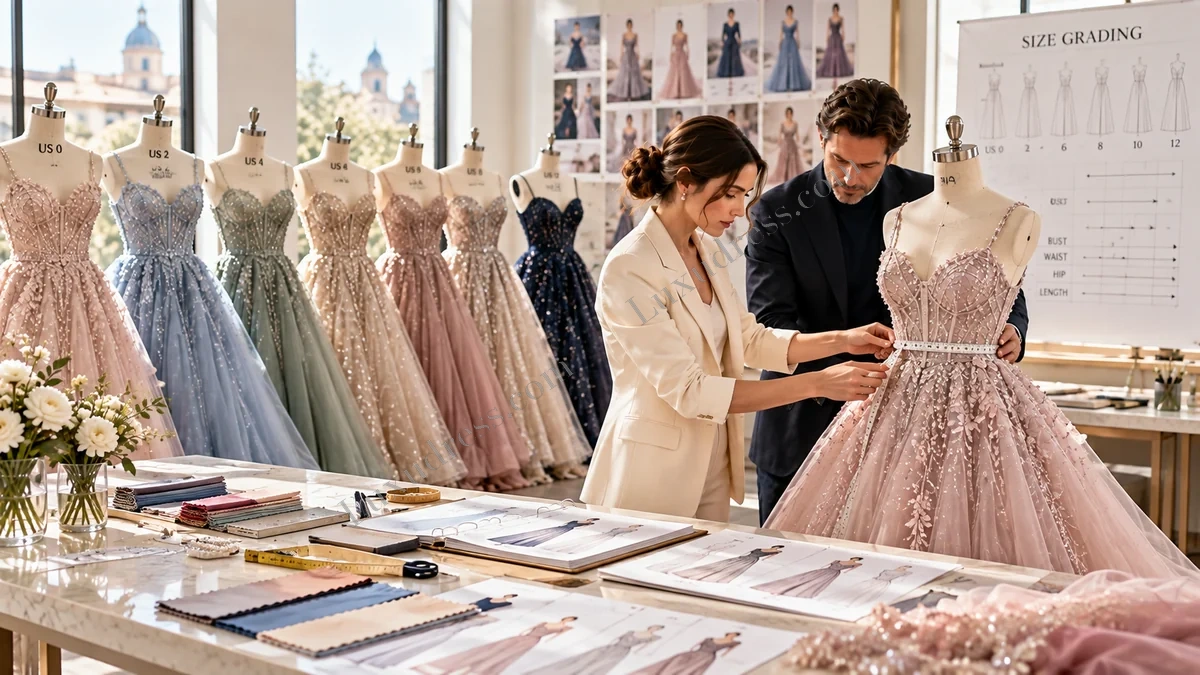
Practical buyer worksheet
Take these ten items to the grading conversation. The size range and base fit size line is the one that decides everything after it, and the approval sample line is the one that decides whether the decisions survive contact with bulk.
- Target customer and use occasion
- Target retail and wholesale price
- Target ex-factory or landed cost
- Core fabric and backup fabric
- Size range and base fit size
- Colour count and continuity colours
- Critical construction risks
- Approval sample required
- QC checkpoints
- Latest acceptable delivery date
FAQ
Can one grade rule work for every prom dress?
No, and the differences are structural rather than stylistic. Silhouette changes where ease can move, the fabric decides whether negative ease is possible, a boned bodice or a bought-in cup changes which points can be graded by rule at all, and the width of the run decides where the rules stop being true. One rule sheet across a prom range is a reasonable starting point and a poor finishing point.
Why do cup areas fail in larger sizes?
Because cup volume and support architecture are not functions of circumference. A grade rule moves a measurement outward; it does not create a cup, and it does not change how a cup is anchored. Where a range keeps the same cup letter across the run the larger sizes are asked to do with the same component what the smaller sizes do, and the failure shows as a gaping neckline, a digging underband, or a bodice edge that lifts away instead of lying flat.
Should brands offer petite and tall lengths?
If the customer base justifies the development cost, yes, and on a prom range the argument is stronger than in most categories, because an alteration on a structured gown is either expensive or impossible. A boned bodice cannot simply be shortened without moving the channels. The cost is a second pattern block rather than a second measurement, and it belongs in development.
How many fit models are needed?
At a minimum one, used to confirm the base size. A wider run benefits from a second, because the failures that matter in a graded prom range are away from the base — but a second model is only useful if her measurements are recorded against the body chart and the differences are documented. Fitting the same style on a model whose measurements nobody wrote down replaces one unverified assumption with another.
Next step
We develop and produce prom, evening and occasionwear at our production facilities in Guangzhou and Dongguan, including pattern development, grading, cup and boning sourcing, sampling and bulk. Send the size range you are selling into, the base size you want to build from, and a reference for the silhouettes in the range, and we will come back with a grade rule sheet and a fit plan rather than a price on an unspecified garment. Request a quote, or look at the constructions we run on our prom dress manufacturing page.
If you want a starting point before any of that, our style library and ready stock both show silhouettes in production, and a small first order is usually the cheapest way to test a size range against real customers before committing a full range to grading. The wider category we work across is on the women's dresses page.