On this page

That is why a corset dress is not a dress with a corset bodice attached. It is one garment with a load path running from the shoulder or the neckline down through the bodice, across the waist and into the skirt — and if the skirt is treated as a separate decision, the garment will pull, ride up or collapse at the point where the two meet. Most corset dresses that fail in wear fail there, not at the boning.
So this is written as a walk through the line. The dress below travels from the pattern room to the sealed sample, and at each station there is what happens, what reliably goes wrong, and what a buyer should check before letting it move on. If you want the bodice on its own terms, our guide to how structured bodices are made takes that view; if you want the whole floor, how evening dresses are made covers it. The commercial pages behind this article are our corset dress manufacturing and prom dress manufacturing ranges.
The route through the line
Nine stations, and the two that decide whether the garment works are the first and the seventh. Read the table as a map; the sections below are the stops.
| Station | What happens | The risk introduced here |
|---|---|---|
| 1. Block selection | Choosing or drafting the bodice block | A block that suits the design but not the target customer |
| 2. Panel lines | Placing seams that carry the shape | Nowhere stable to put the boning |
| 3. Cup system | Selecting cups, foam, underwire or soft shaping | Support that does not match the wearer |
| 4. Boning | Channels, bones, end finishing | Poking ends, twisted seams, a bodice that folds |
| 5. Underlining | Stabilising the shell | A shell that stretches where it must not |
| 6. Interfacing and lining | Building the hidden chassis | A cardboard hand or a collapsed waist |
| 7. Fit review | On a body, in movement | Everything above, discovered too late |
| 8. Correction | Transferring fixes to the pattern | A fix applied to the sample only |
| 9. Grading | Deriving the size run | A structure that only works in the base size |
The reason to name the stations is that each one constrains the next. A cup system chosen at station three determines how much boning station four needs to add. A block chosen at station one determines how much correction station eight will have to absorb. Reading the list backwards is how a quote for a corset dress is really built.
The pattern starts with the support zone
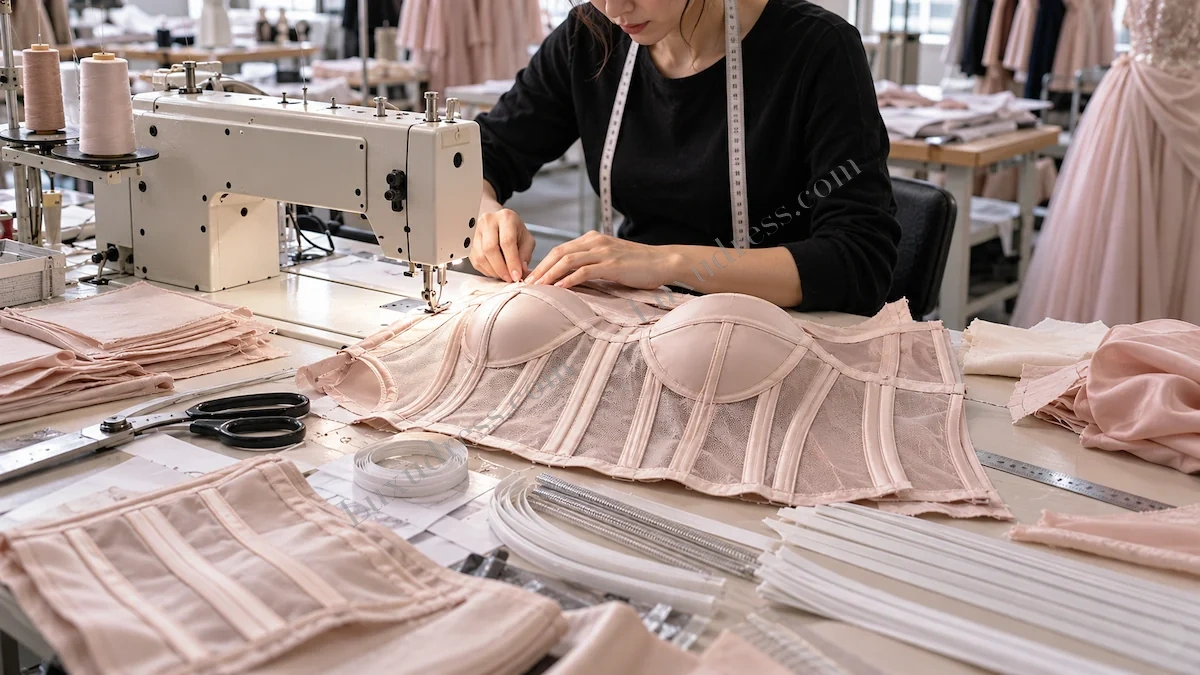
Stations one and two. The pattern maker does not begin with the outside of the dress; they begin with the zone that has to carry load. Neckline, cup position, underbust line, waist and back height get defined together, because each one moves the others — raise the back height and the underbust line has to follow, or the bodice starts levering away from the body.
The requirement at this station is to manage shape and breathing ease at the same time, and those two pull in opposite directions. A corset dress that shapes well and cannot be worn for four hours is a return; one that is comfortable and shapes nothing is not a corset dress. The resolution is almost always in the panel lines rather than in the circumference — the same body measurement, redistributed, holds better than a tighter measurement.
Panel lines control contour, and they also determine where boning can sit. A princess seam running from the armhole through the bust to the waist gives a continuous structure to bone along. A design with only a centre-back seam and a side seam does not, and the pattern maker has to either add a seam the designer did not ask for or accept a bodice that folds. This is why the outer design can look simple while the internal pattern is complex: the simplicity is bought with seams the customer never sees.
What the pattern room needs from you
Five inputs, and a brief that omits any of them will produce a first sample that has to be repeated. First, the base size and the size run, because the block is chosen against both. Second, the support level wanted — is the bodice holding weight, or is it decorative over a bra? Third, the intended wear duration and the event, which sets how much ease the shaping can take. Fourth, the skirt construction, because a heavy skirt pulls the waist down and the bodice has to be drafted against that load. Fifth, the fabric, because the internal recipe depends on what the shell will do.
The second and fourth are the ones most often missing, and the fourth is the one that causes the failure described at the start of this article. A boned bodice drafted for a light A-line skirt and then attached to a full tulle ball skirt will ride up at the waist, because nothing in the bodice was specified to resist a downward pull. Say what the skirt weighs, and say what it is made of, before the block is chosen.
- Define neckline, cup position, underbust line, waist and back height together.
- Manage both shape and breathing ease.
- Panel lines control contour and where boning can sit.
- The outer design can look simple while the internal pattern is complex.
Cups and understructure are selected for the target fit
Station three. Molded cups, foam, underwire and soft shaping create four different kinds of support, and they are not interchangeable. A molded cup gives a consistent shape and a consistent look; foam gives smoothness without rigidity; underwire gives lift with a defined underbust line; soft shaping gives comfort and forgives fit variation. Choosing between them is choosing what the bodice is allowed to get wrong.
Choosing the cup system
| Cup system | What it buys | Where it stops working |
|---|---|---|
| Molded cup | Consistent shape, clean neckline, repeatable look | Poor tolerance of size variation; needs a revised component as sizes grow |
| Foam shaping | Smooth surface, light support, comfortable | Insufficient containment in larger cup volumes |
| Underwire | Lift and a defined underbust line | Requires accurate wire sizing and a robust channel |
| Soft shaping | Forgiving fit, movement, comfort | Little containment; needs more boning to hold the bodice |
The critical point at this station is that cup components may need to change across a wide size range. A cup that works at the base size frequently stops working two sizes up, because cup volume does not scale with a circumference measurement. The industry answer is not to grade the cup but to change it — a different mould, a different wire, or a different construction above a defined size.
Then the unglamorous part that decides whether the wearer ever enjoys the dress: cup edges need clean internal finishing. A cup whose edge is not anchored and finished will roll, show through the shell on a fitted bodice, or press into the body after an hour. Ask how the cup edge is secured, not just what cup was chosen.
Finally, test neckline stability in movement rather than on a dress form. A form has no shoulders to move and no chest to breathe. Have a person raise both arms, reach forward and turn, and watch whether the neckline holds its position. Neckline gape is the most common visible fault in a corset dress and it is almost always a cup-and-neckline interaction rather than a boning problem.
- Molded cups, foam, underwire or soft shaping create different support.
- Cup components may need to change across a wide size range.
- Cup edges need clean internal finishing.
- Test neckline stability in movement, not only on a dress form.
Boning controls vertical stability
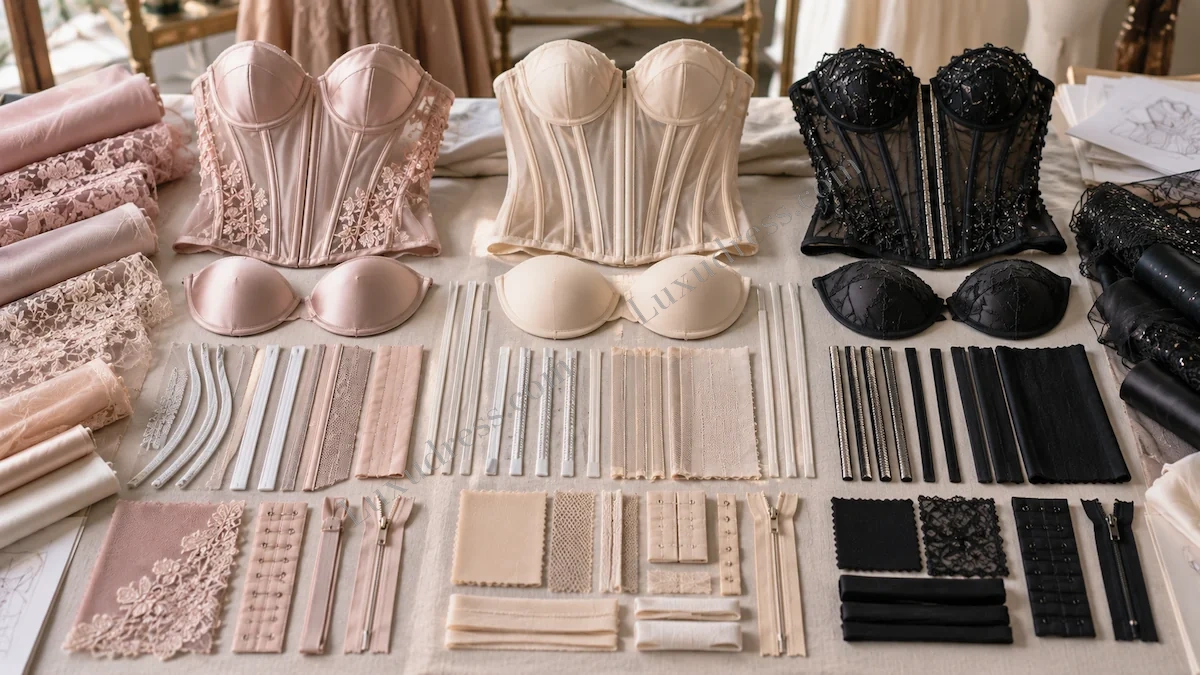
Station four. Plastic, spiral steel and other supports each create a different kind of flexibility, and the choice is a behaviour decision rather than a quality hierarchy. Spiral steel bends in more than one direction and follows a curved seam; a flat plastic bone is stiffer across its width and resists folding. A bodice that has to move with the wearer and a bodice that has to stand away from her need different bones in the same garment.
Boning: what each type does
| Type | Behaviour | Best placed |
|---|---|---|
| Spiral steel | Flexible in two directions, follows curves | Along princess seams and around the waist |
| Flat steel or plastic | Stiff across the width, resists folding | Centre front and centre back |
| Rigilene or light plastic | Soft, inexpensive, limited support | Upper bodice edges and light shaping |
| Synthetic whalebone | Firm with a little give | Side seams and mid-panel support |
Channels have to prevent two specific failures: ends poking through, and seams twisting. Poking is solved by finishing the bone end and by anchoring the channel top and bottom rather than letting it float. Twisting is solved by matching the channel to the seam direction — a channel sewn across the grain of a curved seam will twist the seam as the wearer moves, and the bodice will start to spiral.
More bones are not automatically better. Placement matters more than count, and a bodice with four well-placed bones along continuous seams will hold better than one with eight bones dropped into positions that fight the panel lines. When a supplier proposes additional boning, ask which structural problem each one is solving. If the answer is general reassurance, the boning is not the fix.
Back closures need reinforcement to handle tension, and this is where a corset dress is under the most load. A zip set into a boned bodice carries the entire closing tension; a lace-up distributes it. Whichever is used, the placket or facing behind it needs to be specified, because the failure mode is not the closure breaking — it is the fabric around it stretching and the bodice gapping above and below.
- Plastic, spiral steel or other supports create different flexibility.
- Channels must prevent ends from poking and seams from twisting.
- More bones are not automatically better; placement matters.
- Back closures need reinforcement to handle tension.
Lining and interfacing create the hidden chassis
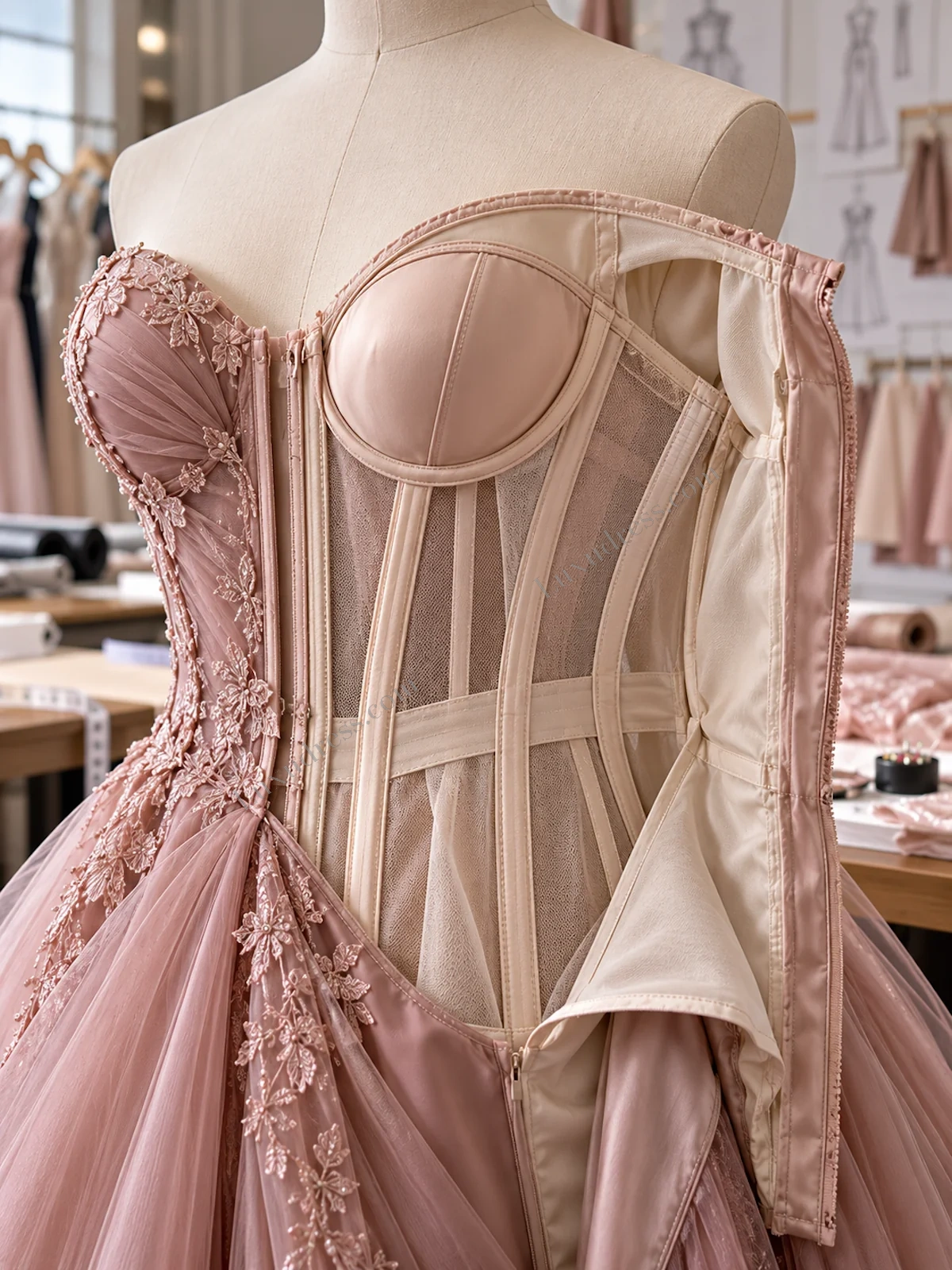
Stations five and six. Underlining stabilises the fashion fabric, and on a corset dress that stabilisation is structural rather than cosmetic: an underlining is what stops a satin shell from stretching where the boning pushes and compressing where it does not. Choose it by weight and by recovery, and match it to the shell rather than to the season.
The internal recipe changes with the shell
| Shell | Underlining | Interfacing | What changes |
|---|---|---|---|
| Heavy satin | Light stable woven | Fusible at the waist only | Shell carries shape; interfacing must not stiffen the bust |
| Light satin | Medium stable woven | Fusible through the bodice | Needs the most help; weight is the risk |
| Crepe | Light stable woven | Fusible at waist and closure | Recovery of the crepe decides how much help is needed |
| Stretch fabrics | Stable knit or woven | Non-fusible or low-temperature | Fusing can kill recovery; test before bulk |
Interfacing should support without creating a cardboard hand, and that is a narrow band. Too little and the waist collapses over an evening; too much and the bodice stops moving with the body, which the wearer notices immediately as discomfort in the ribs. The test is tactile: press the finished bodice between finger and thumb. If it cracks rather than flexing, it is over-fused.
Inside finishing should allow comfortable wear and practical QC, and those two requirements are usually satisfied by the same decisions. A boned bodice whose channels are anchored and whose seams are bound can be inspected by feel as well as by eye, which means a fault is caught in the line rather than at final inspection. A bodice finished with raw channels over loose seam allowances cannot be inspected reliably at all.
What to check at inline inspection
A corset dress cannot be inspected only at the end, because by then the structure is inside the garment and the only way to check it is to open it. Five checks belong inline, and four of them can be done by feel through the shell.
- Channel anchorage — run a hand down each channel and check the bone does not move inside it
- Bone ends — feel for any point that can work through the fabric
- Cup edge — check it is secured and lies flat against the shell, not lifting it
- Waist seam — check the interfaced zone sits where the skirt will load it
- Closure — close it, pull it, and check the placket behind it does not distort
Agree these five before bulk starts and name them in the written inspection standard. They are cheap checks, they take a couple of minutes per garment, and they catch the class of fault that is expensive at final inspection and unfixable after shipping.
Why a corset dress costs what it does
A corset dress quote surprises buyers because the visible garment looks simpler than the price implies. The reason is that most of the operations are inside it, and they do not reduce when the outside is minimal. A plain satin bodice with no surface decoration can cost more to make than a bodice with a print, because the print is on the fabric and the structure is not.
Where the money goes, in rough order of magnitude. Pattern development, which for a boned bodice is several rounds rather than one. Cup components, which are bought in and sized. Boning channels, which are cut, sewn, inserted and anchored — four operations per bone. Underlining and interfacing, which are two extra layers to cut, fuse and handle. Closure reinforcement. Fit rounds, which for a structured garment are the most expensive stage to repeat. And grading, which for a corset structure is not a scaling exercise but a re-engineering one.
All of that combines with the fact that a structured bodice cannot use the shortcuts a soft garment can. There is no drape to hide a seam, no softness to absorb a millimetre of error, and no way to press a fault out. A corset dress has to be right in the pattern, which means the money is spent earlier and more of it is spent before the first sellable unit exists.
That is a useful thing to say out loud in a costing meeting, because the comparison that gets made is always against a simple woven dress. It is not the same product and it does not have the same cost structure. When a corset dress quote comes in high, the productive question is which of the seven lines above to reduce — usually the embellishment or the number of fit rounds, and almost never the boning.
Different shell fabrics require different internal recipes, which is the reason a corset dress quoted in one fabric cannot be re-quoted in another by adjusting the fabric line alone. Changing the shell changes the underlining, the interfacing and sometimes the boning. Treat the internal recipe as part of the design and write it into the specification alongside the outer fabric.
The join between bodice and skirt
This is the place most corset dresses fail, and it is worth its own paragraph because it sits between two stations and is therefore nobody's job unless someone owns it. A bodice is drafted to a waistline and a skirt is drafted to the same waistline, and each is internally consistent. Put them together and the skirt's weight starts to act on a bodice that was never specified to resist it.
Four things go wrong. A full or heavy skirt pulls the waistline down, and because the bodice is rigid the fabric between the waist seam and the first bone stretches. A skirt with a wide sweep swings laterally and drags the bodice sideways at the side seams. A skirt attached to a bodice that ends above the natural waist creates a visible step when the wearer moves. And a skirt with a train adds rearward load that opens the back closure above the waist.
The fixes are all at the pattern stage and all cheap there. Interface the waist seam on the bodice side, so the area between the bones resists stretch. Anchor the skirt to the bodice through a waist stay rather than directly to the seam. Check the waistline position on a body in movement, not standing still. And where the skirt is genuinely heavy, redistribute some of its weight to the shoulders by treating the bodice and skirt as one hanging structure rather than as two joined pieces.
Ask your supplier how the skirt is attached and what carries its weight. A supplier who answers in terms of a waist stay and a load path has made this garment before. One who answers that it is stitched to the bodice seam has answered a different question.
- Underlining can stabilize fashion fabric.
- Interfacing should support without creating a cardboard hand.
- Inside finishing should allow comfortable wear and practical QC.
- Different shell fabrics require different internal recipes.
Fit review is non-negotiable
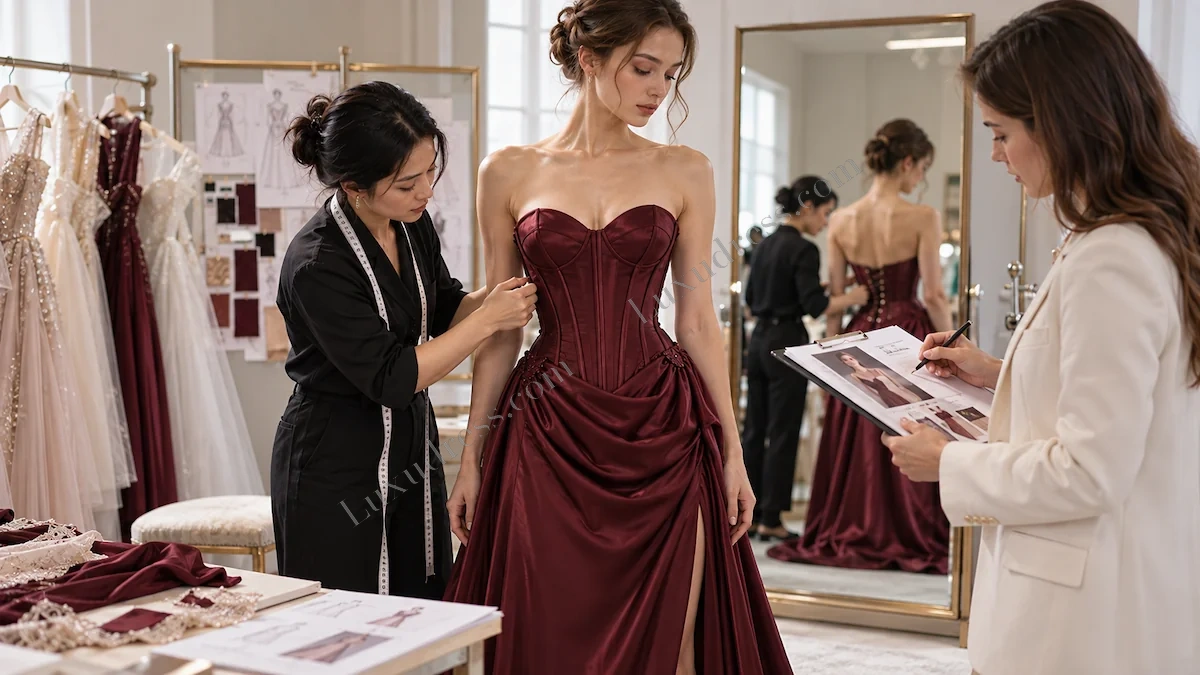
Stations seven to nine. This is the station where everything above is proved or disproved, and it cannot be done on a form. Check bust containment, neckline gap, waist pressure, back closure and sitting comfort — in that order, because each one depends on the one before it. A neckline gap that appears after the waist is correct may be a neckline problem; one that appears before is usually a waist problem showing up higher.
The seven-point fit review
Seven checks, in order, on a body. If you have a supplier who will run this and report it, you have most of what you need to know about whether they can make a corset dress.
- Bust containment, standing, with the intended underwear
- Neckline gap when the arms are raised and when the wearer reaches forward
- Underbust line position, and whether the wire (if used) sits on the ribs rather than on the breast
- Waist pressure on a deep breath and after ten minutes of wear
- Back closure: does it close without strain, and does the bodice gap above or below it
- Sitting comfort: does the bodice ride up, fold or dig when the wearer sits
- Movement: walk, turn, and watch whether the bodice and skirt separate at the waist
The seventh check is the one specific to a corset dress rather than a corset bodice, and it is the one most often omitted. A skirt that pulls the waist down, or a bodice that rides up, will show as a gap or a fold at the waistline within a few minutes of movement. Fixing it is a pattern correction at the waist or a change to the skirt's weight distribution — not a tighter bodice.
Then transfer the corrections to the pattern before grading. This sounds obvious and is frequently skipped: a sample is adjusted by hand, approved, and then graded from the unadjusted pattern, so the flaw is reproduced across every size in the run. Ask explicitly whether the corrections were transferred, and ask to see the amended pattern.
Extended sizes may require stronger support architecture rather than simple enlargement. That is a structural change — more boning, a different cup, a reinforced closure, sometimes a different block — and it is the reason a size range is worth validating at more than one point. Our guide to grading from an approved sample covers the derivation itself; the point here is that a corset structure does not survive grading unchanged.
- Check bust containment, neckline gap, waist pressure, back closure and sitting comfort.
- Observe whether the bodice rides up or collapses in movement.
- Transfer corrections to the pattern before grading.
- Extended sizes may require stronger support architecture rather than simple enlargement.
Practical buyer worksheet
Ten fields. For a corset dress the first four are the ones that change the garment most, and they are the four most often left blank:
- Target customer and use occasion
- Target retail and wholesale price
- Target ex-factory or landed cost
- Core fabric and backup fabric
- Size range and base fit size
- Colour count and continuity colours
- Critical construction risks
- Approval sample required
- QC checkpoints
- Latest acceptable delivery date
FAQ
Is more boning always better?
No. Correct placement and the overall pattern matter more, and extra bones placed without a structural reason add weight, restrict movement and make the bodice stiffer without making it more supportive. The useful question is which specific problem each bone solves.
Can corset dresses use stretch fabric?
Yes, but the shell stretch and the internal structure have to be engineered together. A stretch shell and a rigid boning package fight each other: the shell relaxes while the structure does not, so the bodice loses its line. Where stretch is used, the interfacing must be non-fusible or low-temperature, and recovery must be tested on a finished garment rather than on a swatch.
Why do corset necklines gape?
Four contributors, and they are usually present together: cup shape, neckline length, bust volume, and support or back tension. Because the causes overlap, the fix is rarely at the neckline. Ask the pattern maker which of the four the correction addresses; if the answer covers only one, the gape will return in the next sample.
Do plus sizes need a different approach?
Often yes, particularly in cup volume, support, panel shaping and closure strength. The circumference grows predictably; the load does not, and it is the load that decides how much structure the bodice needs. Treat the top of the size run as its own development rather than as the base size plus centimetres.
Next step
We build corset dresses and structured prom and evening styles at our production facilities in Guangzhou and Dongguan, including the internal recipe, the cup system and the size validation. Send the silhouette, the skirt construction and the size range and we will come back within twenty-four hours with a construction view and an itemised quotation. See corset dress manufacturing for the constructions we run repeatedly, and the style library for finished examples.