On this page
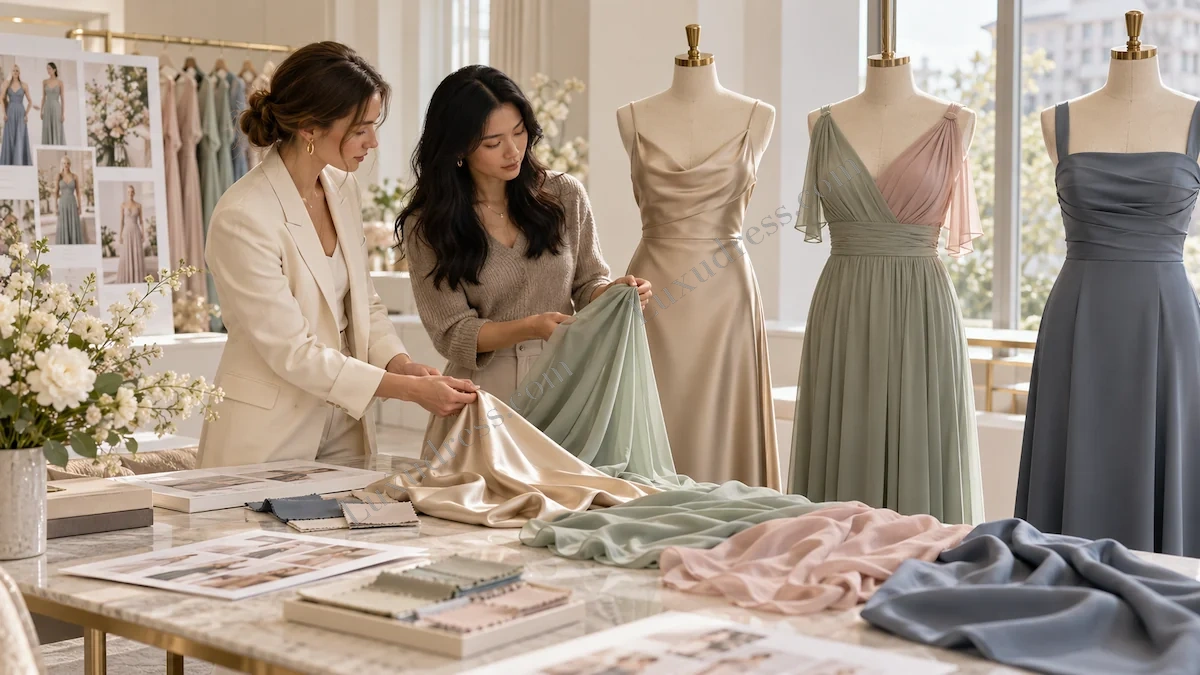
Most comparisons of these three fabrics are written as if the question were aesthetic. It is not, or not only. In bridesmaid the fabric decides three operational things before it decides anything visual: how hard the colour is to keep consistent across a group, how much alteration the style will generate, and how many metres of cloth each dress consumes. Those three determine whether the programme is repeatable.
So this is written as a set of verdicts rather than a set of descriptions. Each fabric is scored on the same six dimensions, then judged against the specific situations bridesmaid buyers actually face. At the end there is a single-pick recommendation for the common case, because most buyers do have to choose one. The commercial page behind this article is our bridesmaid dress manufacturing range.
The scorecard
Six dimensions, and they are not equally weighted. Shade control and alteration burden matter more than photographic elegance, because a bridesmaid order is a group order with a date attached. Read the table as a starting position, not a verdict — the sections below are where the verdicts are.
| Dimension | Satin | Chiffon | Crepe |
|---|---|---|---|
| Shade control across a group | Hardest — reflection exposes variation | Moderate — layering shifts tone | Most forgiving — matte and even |
| Alteration burden | High — reflects every fit change | Low — movement hides fit | Moderate — clean lines show imbalances |
| Fabric consumption | Moderate | High — layers and hems | Lowest of the three |
| Photographs under flash | Strongest, if construction is clean | Soft and forgiving | Consistent, less dramatic |
| Labour per garment | Moderate, pressing-critical | High — cutting, layers, narrow hems | Lowest |
| Rewear value to the wearer | High in the right shape | Moderate | Highest |
Satin when polish and photography lead
High reflection makes colour and drape prominent, and it works for slip, bias, cowl and structured silhouettes. If your brand promise is a group that looks deliberately dressed, satin delivers that more reliably than the other two.
Where satin wins, and where it loses
It wins for group photography, for the sense of occasion and for a colour the customer can see from across a room. It loses on shade discipline and on alteration tolerance, because a reflective surface turns both into visible events. A group of five satin dresses from two dye lots will show it; a group of five crepe dresses from two dye lots usually will not.
The lining decides more than the shell
Bridesmaid buyers spend their fabric conversation on the face cloth and their money on the lining, and the lining is what the wearer notices. It decides whether the dress feels like a dress or like a costume, how warm it is at a summer wedding, and whether the colour reads true or grey.
Three lining decisions matter more than the fabric brand. First, coverage: a half lining is cooler and shows more, a full lining is hotter and reads more expensive. Second, colour: a lining a shade warmer or cooler than the shell changes how the whole dress reads in a photograph, which is why they should be approved together. Third, weight relative to the shell, because a heavy lining under a light chiffon pulls the drape out of the garment entirely.
Ask for the lining to be specified with the same six fields as the shell — composition, weight, width, finish, stretch and recovery — and approve the two together. The most expensive mistake in this category is not a cheap shell; it is a mismatched pairing.
The verdict on satin therefore depends on your operating system rather than on taste. If you can hold continuity fabric, control dye batches and compare finished garments side by side before packing, satin is the strongest choice available. If you cannot, you are buying a liability with a beautiful surface.
It also requires disciplined cutting, correct seam tension and proper pressing. Press marks on satin are not a minor defect; they are the most visible thing on the garment. Specify pressing as part of the order, not as an assumption.
- High reflection makes colour and drape prominent.
- Works for slip, bias, cowl and structured silhouettes.
- Shade variation and press marks are visible.
- Requires disciplined cutting, seam tension and pressing.
Chiffon when movement and mix-and-match matter
Chiffon is useful for romantic and soft styling, and it is the fabric that flatters the widest range of bodies without alteration. Multiple layers build opacity and colour depth, which gives you a colour story rather than a colour.
Why mix-and-match really works in chiffon
The commercial promise of mix-and-match is that five wearers choose five necklines and the group still reads as a group. That promise holds only when the fabric softens the differences between the silhouettes, and chiffon is the fabric that does it. On a clean matte crepe the eye reads structure, so difference reads as difference; on chiffon the eye reads movement, and difference reads as variety.
This is worth knowing because it changes what you have to design. A chiffon mix-and-match range can carry more neckline variation than a crepe one before it looks uncoordinated, which means the same fabric budget buys more customer choice. That is a real commercial advantage and it is not visible on a swatch.
It also sets the limit. Where the fabric is heavy or highly reflective, keep the neckline variation tighter and put the variety in colour instead. And check the group as a group — five garments on one rail, photographed together — before you lock the range, because that is how the customer will first see it.
The one question that settles a collection
If a range has to mix fabric families, the question that resolves the argument is simple: which single dress does the customer remember, and what is it made of? That dress sets the family the rest of the range supports. Everything else can be secondary, but it cannot be random, because secondary fabrics are still separate minimums, separate colour standards and separate sourcing conversations.
The brands that run this well choose one primary family for the commercial core and one contrast story for a small number of styles — the statement piece and perhaps a skirt or a sleeve detail. That structure gives the range a coherent hand and keeps the sourcing problem the size of one and a half fabrics rather than four.
Write it down before sourcing, not after. A decision recorded as a fabric platform with named colours is a decision a new buyer can inherit in eighteen months; a decision made in a conversation is one that gets re-litigated every season and rarely the same way twice.
Where chiffon wins, and where it loses
It wins on forgiveness and on mix-and-match. A chiffon range can carry several silhouettes in one colour and still look coherent, because the fabric softens the differences between them — which is the whole premise of the mix-and-match model. It wins again on rewear, because a soft dress is easier to wear elsewhere than a structured one.
It loses on labour and on consumption. Layers, narrow hems, careful cutting and snag management are all hours, and a three-layer skirt is three times the metres. A chiffon programme that looks cheaper on the swatch price is frequently the most expensive of the three to produce.
The practical controls are specific: stable cutting on a paper underlay or a vacuum table, a rolled narrow hem rather than a folded one if the quality needs to read, and a snag test on the finished garment rather than on the swatch. Snag is a construction-and-handling property, so testing the cloth alone tells you very little.
- Useful for romantic and soft styling.
- Multiple layers build opacity and colour depth.
- Works well for sleeves, overlays and gathered skirts.
- Requires careful narrow hems and snag management.
Crepe when fit and modern simplicity lead
The matte surface gives a contemporary look and supports column, fitted and tailored silhouettes. Crepe is the fabric that lets a bridesmaid dress survive the wedding and be worn again, which is increasingly what the wearer is buying.
Where crepe wins, and where it loses
It wins on shade control, on labour and on consumption: a matte surface does not amplify a dye-lot difference, it does not require the pressing discipline satin does, and a column silhouette uses the least cloth of the three. On a programme where margin is thin and reorders matter, those three advantages compound.
It loses on drama and on forgiveness. A clean line shows a fit imbalance that chiffon would hide, and a crepe that bags at the seat has nowhere to hide either. That makes recovery the specification that matters: ask for recovery figures, and test a close-fitting sample on a body for a full evening rather than for ten minutes.
The fabric that survives a reorder
Bridesmaid programmes live or die on the second year. The first order proves the design; the second proves the operating system, and the fabric is where an operating system is most easily broken. A quality that has been discontinued, a dye reference that was not retained, a minimum that only worked at launch volume — any one of them ends the programme quietly.
The test to apply before committing is simple. Can I buy this fabric again in the same quality, in the same colours, at a quantity I can afford, without re-approving anything? If the answer requires a caveat, that caveat is the risk you are accepting. Ask the question at the sourcing stage rather than at the reorder stage, because by the reorder stage the answer is fixed.
And write down what you approved. Weight, width, finish, stretch, recovery, dye reference, mill. Six months later nobody remembers which of three similar satins was the one the range was built on, and a reorder built on the wrong one is a group of dresses that no longer match the ones already sold.
The one discipline crepe demands is pattern balance. Because the surface is calm, the silhouette is doing all the work, and a poorly balanced column looks ordinary rather than hidden. Crepe simplifies styling and demands good pattern making in exchange.
One last thing on crepe, because it is the fabric buyers most often under-specify out of familiarity. Because the word covers such a range, a brief that says crepe has said almost nothing: a light stretch crepe and a heavy structured crepe will produce different garments from the same pattern. Ask for composition, weight, stretch direction and stretch recovery, and ask what the sample was actually cut in. That single question prevents more re-cut samples than any other in this category.
How to run a side-by-side fabric test
If you are deciding between two of the three, make both up. Not swatches, not photographs — one garment of the same silhouette in each fabric, cut from the same pattern, finished to the same standard, and photographed together. It costs two samples and it settles the question permanently.
| Compare | How to judge it | What it tells you |
|---|---|---|
| Photograph under flash | Look for shine, show-through, shade banding | Which fabric survives the customer's camera |
| Six hours on a body | Wear it, sit in it, watch for bagging | Which fabric survives an evening |
| Fold and pack it | Unpack after 48 hours and look | Which fabric survives distribution |
| Cost it finished | Full metres, lining, labour, pressing | Which fabric survives the margin |
| Re-shade it | Compare against the retained standard | Which fabric survives a reorder |
Five tests, all of which can be run on a single sample set. Buyers who run them stop arguing about fabric on aesthetic grounds, because the comparison produces a defensible answer that everyone in the room can look at.
The sixth test is the one most programmes skip: repeat it next year, with the fabric you actually reordered. Sample-room behaviour in a first batch is not a guarantee for a second one.
- Matte surface gives a contemporary look.
- Supports column, fitted and tailored silhouettes.
- Can be more forgiving in photography than high-shine satin.
- Stretch and recovery must be specified for close-fitting styles.
Compare the commercial variables
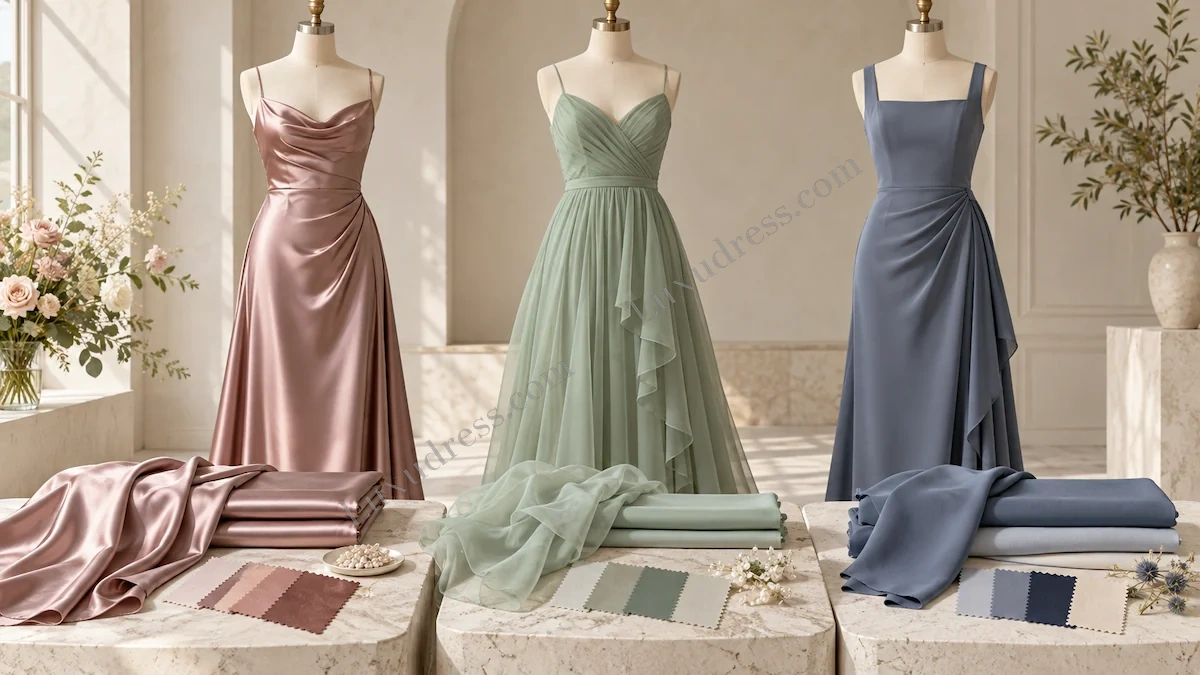
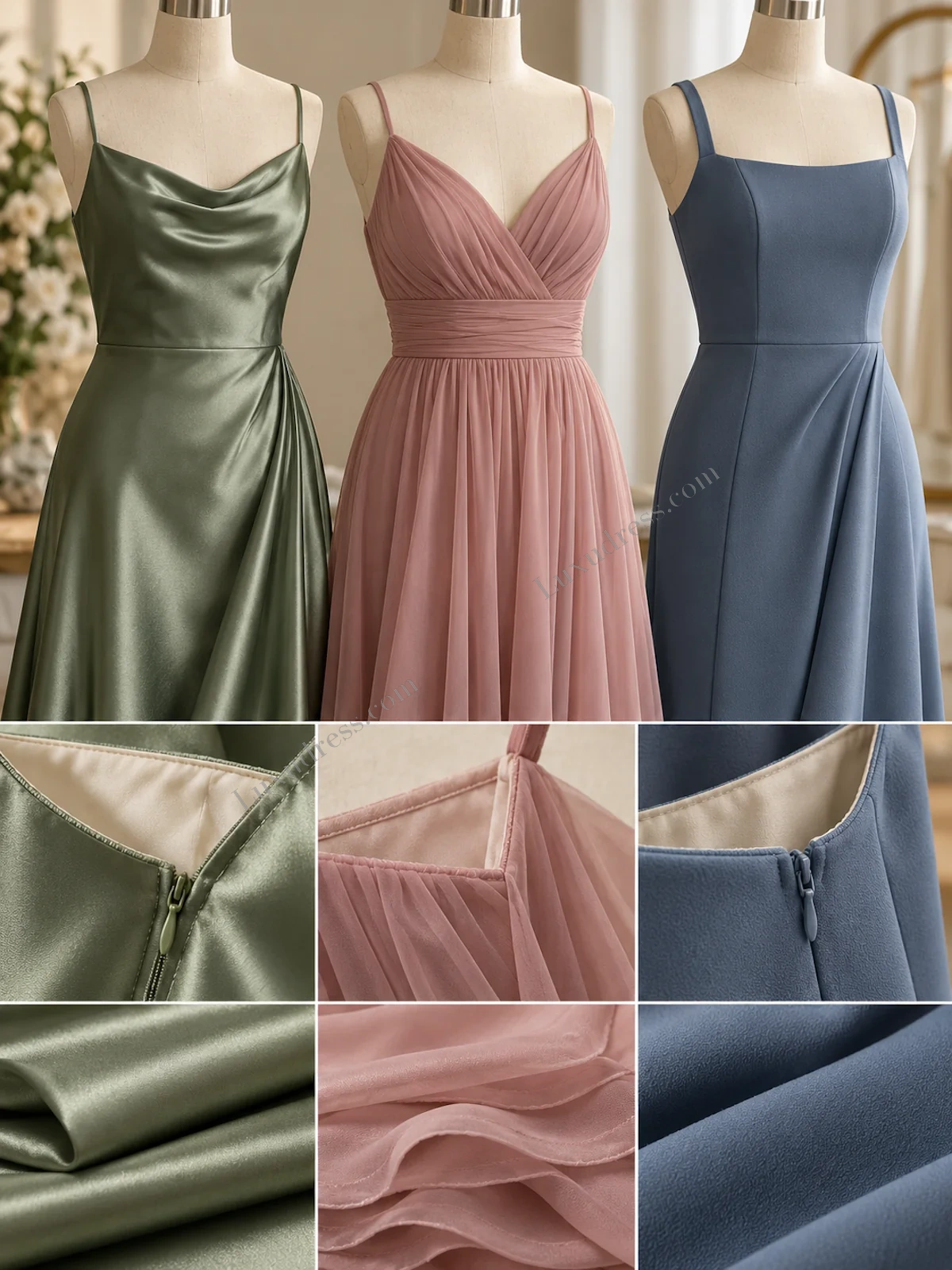
Satin gives image impact but exposes finishing defects. Chiffon can increase labour through layers and hems. Crepe may simplify styling but demands good pattern balance. Those three sentences are the honest summary; the table below is what they cost in practice.
Scenario verdicts
Read down the scenario column and find the one that describes your programme. If two apply and they disagree, the one tied to your largest order wins.
| Scenario | Verdict | Why |
|---|---|---|
| Group photography is the sales argument | Satin | Reflection is the look; nothing else reads as deliberately dressed |
| Shade consistency is your biggest risk | Crepe | Matte surface absorbs dye-lot variation |
| Wearer will rewear it | Crepe, then chiffon | Contemporary shapes and matte surfaces travel outside a wedding |
| Warm-weather weddings | Chiffon, lightly lined | Lower mass and more movement |
| Thin margin, high reorder volume | Crepe | Lowest labour and consumption of the three |
| Widest body-type coverage without alteration | Chiffon | Movement and layering forgive what a clean line exposes |
| Statement colour as the hero | Satin | Saturated colour is most visible on a reflective surface |
What actually decides it
Colour availability, minimums and continuity can decide the final choice regardless of everything above. A fabric that matches your brand but cannot be re-bought in eight months is a programme that ends after one season, and a fabric that only exists in three colours is a range with three colours.
What to buy now for next year
If a bridesmaid programme is going to run for more than one season, the sourcing decision includes reserving the means to repeat it. That means continuity fabric on the anchor colours, the dye reference retained against each style, and a written note of what was approved so a reorder does not depend on anyone's memory.
Reserving fabric costs a carrying charge on a few hundred metres, and it converts a reorder from a six-week sourcing exercise into a two-week production booking. In a category with a hard event calendar attached, that difference is the entire margin on the reorder — and it is also the difference between a boutique trusting your lead time and not.
The alternative is to accept that a colour will not recur and to say so at the point of sale. That is a legitimate strategy, and it is much better than promising continuity and then discovering that the mill has moved on.
So ask the sourcing question before the aesthetic one: which of these three can I buy in the colours I need, at the minimum I can afford, and again next year? In practice that answer eliminates one of the three about half the time, and the comparison gets much shorter.
A worked margin comparison
Take one silhouette — a lined column, midi length, no train — and cost it three ways at the same target retail. The absolute numbers matter less than the shape of the comparison, because the shape is what repeats across styles and seasons.
| Line | Satin | Chiffon | Crepe |
|---|---|---|---|
| Shell consumption | Baseline | Higher with layers | Baseline or lower |
| Lining | Full, structural | Full plus opacity layer | Often partial |
| Cutting and sewing ops | Baseline | Baseline plus hem and layer handling | Fewest |
| Pressing | A quality gate, budgeted | Routine | Routine |
| Expected rework | Highest of the three | Moderate | Lowest |
| Contribution at equal retail | Lowest | Varies with layer count | Highest |
The conclusion is not that crepe is better. It is that chiffon and satin have to be justified, and they usually can be — on brand, on photography, on the customer who specifically wants that look. What they cannot do is be chosen by default and costed as if they were crepe.
If your margin is thin, choose crepe and spend the difference on a better fit block. If your brand is built on the way the group looks in photographs, choose satin and fund the dye-batch discipline. If your market is warm-weather or mixed-body-type, choose chiffon and cost the layers honestly. Each of the three is the right answer to a different question.

- Satin gives image impact but exposes finishing defects.
- Chiffon can increase labour through layers and hems.
- Crepe may simplify styling but demands good pattern balance.
- Colour availability, minimums and continuity can decide the final choice.

Use one fabric family strategically
A shared base fabric across several silhouettes simplifies swatches and reorders, and it is the single decision that makes a bridesmaid programme repeatable. Newness can come from neckline, sleeve and drape rather than from a different fabric for every style.
The single pick
If you must choose one and you are running a programme rather than a single season, choose crepe. It gives the best margin, the best shade control, the least alteration burden, and the most rewear value of the three — and while it is the least dramatic, a group of five well-fitted crepe dresses in a strong colour photographs better than five satin dresses with visible shade differences.
Choose satin instead when the brand promise is explicitly luxurious and you are prepared to run the dye-batch discipline that satin demands. Choose chiffon when the market is warm-weather, mixed-body-type or mix-and-match. Both are legitimate; neither is automatic.
Adding a second story
Add alternate fabric stories only for a clear aesthetic or a clear price reason, and add them as a second family rather than as a second of everything. One base fabric for the core range plus one contrast story on a small number of styles gives you breadth without multiplying the sourcing problem.
Keep colour standards physical and repeatable whichever family you run. A signed swatch, retained and referenced by batch, is what lets a dress ordered in March match one ordered in June — and that is true of all three fabrics.
How to hand over the standard to a boutique
A colour standard that lives in your office is a colour standard the boutique cannot sell with. Three artefacts need to leave with the account: a cut swatch from production fabric, a written lead time per colour, and a named contact who can answer a question about either.
The swatch matters more than it sounds. A printed card is a picture of a colour; a fabric swatch is the colour. Boutiques that sell from printed cards generate swatch requests, and a swatch request is the moment a sale slows down. Cut the swatches from the cloth you are actually shipping, label them with the colour name and the fabric name, and replace them when the dye reference changes.
The written lead time per colour is the second. One honest number for a stocked colour and a different honest number for a special order is more useful than a single optimistic figure, because the boutique can then sell both with confidence. In this category the lead time is part of the product, not an administrative detail.
- A shared base fabric across several silhouettes simplifies swatches and reorders.
- Newness can come from neckline, sleeve and drape rather than a different fabric for every style.
- Add alternate fabric stories only for a clear aesthetic or price reason.
- Keep colour standards physical and repeatable.
Practical buyer worksheet
Complete this per fabric story rather than per style, because the fabric decision is made once and applied across the range:
- Target customer and use occasion
- Target retail and wholesale price
- Target ex-factory or landed cost
- Core fabric and backup fabric
- Size range and base fit size
- Colour count and continuity colours
- Critical construction risks
- Approval sample required
- QC checkpoints
- Latest acceptable delivery date
FAQ
Which is most flattering?
There is no universal winner. Silhouette, fit block and wearer preference matter more than the fabric name, and the same woman who looks best in a chiffon wrap can look best in a crepe column. Where the fabrics genuinely differ is in how much they forgive — and chiffon forgives most.
Which is easiest to colour match?
Any of them can vary by dye lot. Satin reveals differences most strongly, chiffon changes with layering because the tone deepens as layers are added, and crepe is the visually calmest — but all three still require batch control and a retained physical standard.
Which is best for summer weddings?
Light chiffon and lighter satins can both work, but the lining, the climate and the construction matter as much as the shell. In practice the weight of the lining decides comfort more often than the choice of face fabric does.
Can one collection mix all three?
Yes, if the brand intentionally coordinates colour, texture and merchandising. It has to be a decision rather than drift: three fabric families in one range means three sets of minimums, three sourcing conversations and three sets of colour standards.
Next step
Send us the colour story and the silhouettes, and we will tell you which of the three fabrics carries it best at your price and volume. Request a quote with your size range and event calendar and we will confirm fabric availability, minimums and continuity within twenty-four hours. The bridesmaid dress manufacturing page lists the constructions we run, and the evening fabric guide covers the materials that sit alongside these three.