On this page
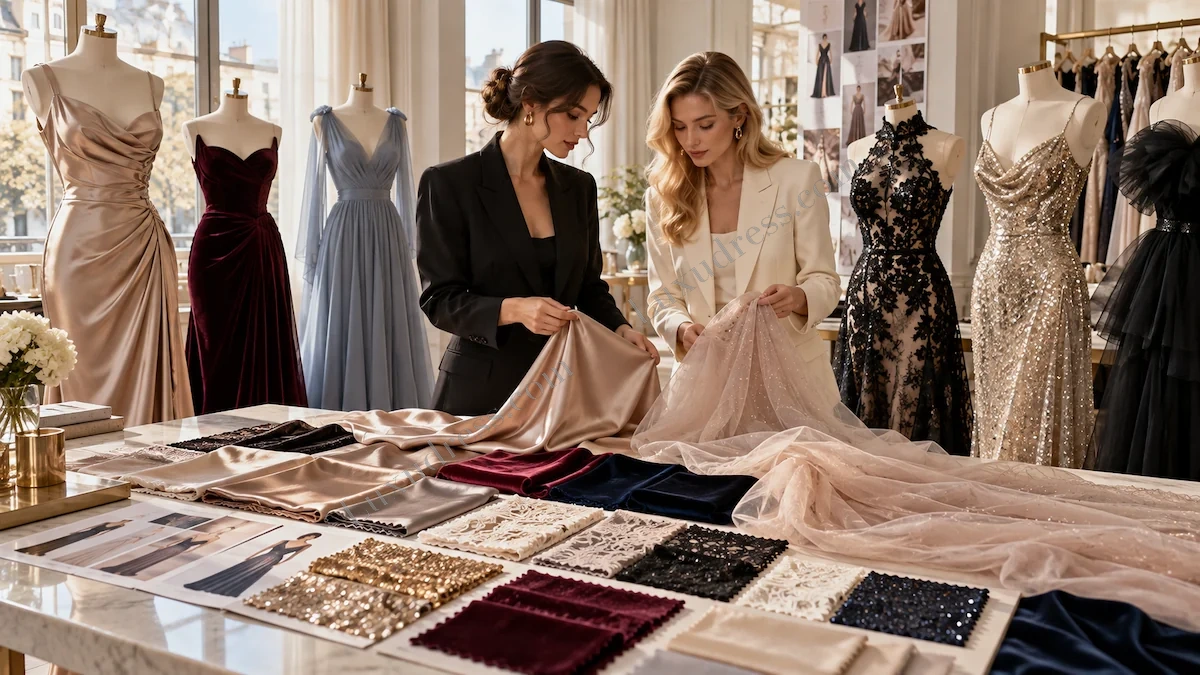
That is why the question "what is the best fabric for an evening dress" has no useful answer on its own. A heavy silk-faced satin is magnificent in a bias column and a liability in a gathered ball skirt, where its weight fights the volume and its lustre turns every fold into a hard-edged highlight. The same cloth can be the right decision and the wrong decision in the same collection.
So this is organised the way the decision is actually made: start from the requirement, then read the fabric through the one property that decides whether it works for you — and finish each section on the failure that fabric reliably produces, because knowing the failure is what lets you specify around it. The commercial page behind this article is our evening dress manufacturing range.
Start from the requirement
Before comparing fabrics, name the requirement. Most eveningwear briefs come down to one dominant demand, and the dominant demand eliminates most of the options immediately.
| If the dominant requirement is | Start with | Because |
|---|---|---|
| Sculpted shape that holds | Structured crepe, taffeta, supported tulle | Body in the cloth does the work the pattern would otherwise do |
| Fluid drape and movement | Light satin, crepe, chiffon | Drape follows the body rather than standing away from it |
| Photographic shine | Satin, silk-faced satin | Reflectance reads as luxury under flash |
| Volume without weight | Soft tulle, mesh, chiffon layers | Air, not mass, creates the silhouette |
| Surface impact | Velvet, lace, sequins, beading | The fabric is the design |
Then add the two constraints that override everything above: the retail price the style has to hit, and how the fabric behaves on a sewing floor. A fabric that satisfies the design and fails either constraint is not a candidate, however beautiful the swatch.
The six things a fabric specification must state
A fibre name and a weight are not a specification. They describe roughly a third of the material a pattern was drafted against, and the missing two thirds are where production surprises live. Six fields, and all six are cheap to obtain from a mill or a supplier.
| Field | Why it matters | What goes wrong without it |
|---|---|---|
| Composition | Fibre blend decides drape, lustre and recovery | A viscose and a silk blend behave differently at the same weight |
| Weight in gsm | Sets the hand and the fall | A sample cut in one weight approved for another |
| Usable width | Drives consumption and therefore cost | Two honest quotes differ by metres per garment |
| Finish | Decides surface and, on satin, how merciless it is | Press marks and seam grin appear only after approval |
| Stretch direction | Lengthwise, crosswise or both changes the block | A fitted style bags in one direction only |
| Stretch recovery | The property fitted eveningwear lives or dies on | Garments that fit in the morning and not by evening |
Ask for all six before a quote, not before a sample. The difference matters because consumption and therefore price depend on width and recovery, and a quote built on a guessed width is a quote that will move.
One practical note on compliance and testing. Our facilities operate to ISO 9001 with OEKO-TEX STANDARD 100, amfori BSCI-audited and SGS-inspected status, and the fabric itself should arrive with the mill's own documentation for the batch you are buying. If a supplier cannot produce documentation for the cloth they are cutting, that is worth knowing before bulk rather than after.

One more thing worth saying before the fabric-by-fabric sections. Two parallel fabrics behave differently even when they look similar, and a specification that lists only a fibre name and a weight has described perhaps a third of the material a pattern was drafted against. Ask for composition, weight, width, finish, stretch direction and stretch recovery — all six, not just the first two.
Satin: visual luxury with technical consequences
Satin is the fabric buyers reach for first and the one that punishes carelessness hardest. It works for bias, column, draped and structured looks depending on weight: a light satin in a bias slip is fluid and forgiving, a heavy one in a structured bodice gives shape, and a heavy one in a gathered skirt is a problem.
The property that decides satin
Reflectance. Satin does not diffuse light, it returns it, and that turns every surface irregularity into a visible event. Seam tension, a slightly stretched stitch, a press mark, a fold that was set in packing — all of them read as flaws on a reflective surface and disappear on a matte one. Satin therefore raises the standard of everything done behind it, not just the fabric choice.
The second property is weight, and it is the one buyers under-specify. Satin ranges from light and fluid to heavy and sculptural, and the two behave as different fabrics. Ask for grams per square metre and ask what the sample was cut in; a sample approved in a light satin tells you nothing about how a heavy one will fall.
The fabric that photographs under flash
Almost every evening dress is bought from a photograph taken at night, so flash behaviour is not a footnote to the fabric decision — it is a requirement. Three failures are produced by flash and not by daylight: pale shells go transparent, shiny surfaces blow out and lose their colour, and any shade difference between the shell and the lining becomes obvious.
The test is cheap and most buyers skip it. Take the finished sample somewhere dark, use a phone flash, and photograph it exactly as a customer would. What survives is your fabric choice; what does not is something to fix before bulk. A garment that passes a daylight check and fails a flash check has revealed a real specification gap, every time.
Where the flash is going to be harsh, the mitigation is construction rather than a different fabric: a fuller lining, a slightly deeper colour, and a matte lining behind a shiny shell. All three are additive costs and all three are cheaper than a customer complaint.
The third is the lining. On satin, the lining and the seam finish are what separate a garment that feels premium from one that feels flimsy, because the hand of a lined satin is partly the hand of its lining. A cheap lining under a good satin is the most common way to waste the satin.
The failure satin produces
Puckered seams and press marks. Not occasionally — reliably, on any run where the needle, the tension and the pressing were not specified. The mitigation is specific rather than general: a fine needle, a matched thread, seam allowance tested on the actual cloth before bulk, and pressing on a surface that will not flatten the weave. Satin is the fabric where the sample room earns its keep.
The second failure is shade. Pale and jewel colours need careful approval, and satin shows a dye-lot difference more sharply than any other evening fabric because it reflects rather than absorbs. Photograph approvals under flash before locking the colour — the customer's photograph is taken under flash.
- Works for bias, column, draped and structured looks depending on weight.
- Reflective surfaces reveal seam tension, press marks and puckering.
- Pale and jewel colours need careful approval.
- Lining and seam finish determine whether satin feels premium or flimsy.
Crepe: controlled drape and a calmer surface
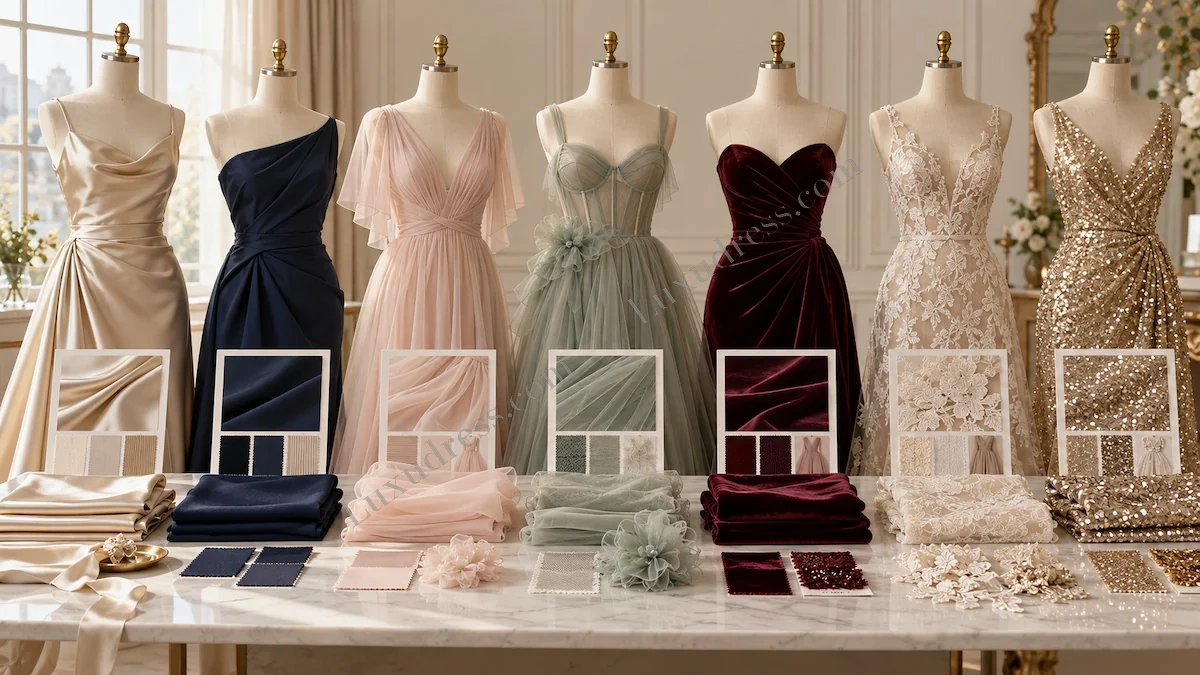
Crepe is the quiet workhorse of eveningwear and the fabric most likely to still look right in three seasons. Its matte surface reads contemporary rather than opulent, which is a commercial advantage in a category that skews towards shine, and it hides minor seam impressions better than glossy satin.
The property that decides crepe
Recovery — how completely the cloth returns to its original dimensions after being stretched. In a fitted, column or tailored silhouette the fabric is under tension across the seat, the bust and the upper arm, and a crepe with poor recovery will bag at exactly those points by the end of an evening. This is the single most under-specified property in fitted eveningwear.
The second property is weight and stretch, which vary so widely under the name "crepe" that the word alone is not a specification. A lightweight stretch crepe and a heavy structured crepe share a name and nothing else. Specify weight, stretch percentage and stretch direction, and say plainly whether the style needs the fabric to hold or to follow.
The third is the seam. Crepe is more forgiving than satin but not forgiving enough to survive a standard stitch on a close-fitting style, where seam grin — the weave opening along the stitch line and showing the thread — is the visible failure. Test it on the actual cloth in the actual tension.
The failure crepe produces
Seam grin and bagging, and both are forgiving of everything except haste. They appear in the fitting rather than on the hanger, which means they are usually discovered by the customer rather than by the QC table. Test recovery and seam grin on a close-fitting sample before you commit the style, not after.
The compensating strength is that crepe photographs consistently. It does not flare under flash, it does not show a hard highlight at every fold, and it reads the same on a phone camera as it does on a professional one — which matters in a category where most of the buying decision happens on a screen.
A simple approval protocol
Whatever the fabric, the failure you will actually receive is a garment that no longer matches what was approved. That happens because approval was given against the wrong object: a swatch instead of a garment, a garment in daylight instead of under flash, a single unit instead of a comparison.
Four steps prevent nearly all of it. Approve the finished garment, not the swatch. Approve under both daylight and flash. Compare side by side against the retained standard rather than against the previous batch. And record the dye reference against the style so the next run has something to match.
All four take an hour per colour. Against the cost of re-cutting a shade that was approved wrongly, that hour is the best-value time in the whole development calendar. It is also the step that most often gets skipped when a delivery date is tight — which is precisely when it matters.
- Useful for fitted, column and tailored evening silhouettes.
- Often hides minor seam impressions better than glossy satin.
- Weight and stretch vary widely, so crepe must be specified precisely.
- Test recovery and seam grin in close-fitting styles.
Chiffon: movement without visual weight
Chiffon is the fabric that makes a gown look as though it is in motion even when it is standing still, and it is excellent for soft skirts, overlays and sleeves. It is also the fabric that generates the most hidden labour, because it is rarely one layer.
The property that decides chiffon
Opacity per layer, and therefore the layer count. A single layer of chiffon over a lining gives one colour depth; three layers over the same lining give a visibly deeper, richer colour from the same dye lot. Layer count is therefore a design tool and a cost line at the same time, and a change of one layer is a change of the garment.
The second property is stability on the cutting table. Chiffon shifts, so it requires stable cutting — a paper underlay, a single-layer spread or a vacuum table — and it requires narrow hems that are clean rather than merely finished. A rolled hem on chiffon is a visible quality signal; a folded hem is a visible cost decision.
The third is static and snag. Both are properties of the fibre and the finish rather than of the design, and both are testable before bulk. Ask for the material to be tested in the condition it will be worn — over the lining, over the underwear — because a chiffon that behaves on its own can misbehave in an assembled garment.
The failure chiffon produces
Transparency where the brief did not expect it. Seam allowances showing through the face, an unfinished edge reading as a shadow, a panel join visible as a line down a soft skirt. All three are construction problems rather than fabric problems, and all three are invisible on a swatch and obvious on a dress.
The second failure is labour drift. Layers, hem treatments and careful cutting are all hours, and a chiffon style that was costed as a single-layer garment becomes unprofitable quietly. Cost it on the construction you intend to make, not on the one in the sketch.
The checklist before you commit a fabric
Seven questions, and if any of them cannot be answered then the fabric is not ready to be committed to a range. Which colour roles does it serve — anchor, accent, or statement? Can it be bought again in the same quality and colour? How many metres does the silhouette actually consume, including the lining? What does it do under flash? What does it do after six hours on a body? What does it cost fully finished, not at the metre? And who signs off the shade, against what standard?
The point of writing them down is that they get asked at different times by different people. The sourcing question is asked by the buyer, the flash question by the designer, the consumption question by costing, and the shade question by nobody unless someone remembers. One sheet with all seven forces the decision to be made once and made together.
Answer all seven and the fabric decision stops being a matter of taste. It becomes a decision with a paper trail, which is what makes a second season possible.
- Excellent for soft skirts, overlays and sleeves.
- Requires stable cutting, opacity planning and clean narrow hems.
- Layer count affects colour depth and cost.
- Static, snagging and seam transparency should be tested.
Tulle and mesh: volume and invisible support
Tulle and mesh are rarely the fabric a customer names and often the reason the dress works. Tulle builds volume out of air rather than mass, and mesh does structural work that the outside of the garment never shows.
The property that decides tulle
Stiffness. Soft tulle creates air and movement; stiffer tulle holds a shape and can defeat gravity for a skirt that would otherwise collapse. Choosing between them is choosing between a silhouette that breathes and a silhouette that stands, and the same style can require both in different layers.
The second property is the gathering ratio — how much tulle goes into how much finished width. Ratio controls the silhouette more than the pattern does, and it is also a direct cost driver, because a high ratio multiplies metres. A change of ratio is a change of shape and a change of price at once.
The third is edge treatment. A raw edge, a rolled edge and a horsehair edge produce three different hems and three different readings. Horsehair in particular is what holds a hem line clean across a full circle, and specifying it changes the way the entire skirt sits.
The failure tulle and mesh produce
Colour that does not match what was approved. Shell, mesh, lining and cups are sourced separately, and on a garment where two of them sit against each other — an illusion neckline, a sheer panel over a cup — a small mismatch is a large visual defect. Approve them as one assembly, under both daylight and flash.
The second failure is a skirt that loses its shape after packing. Tulle takes a compression set; a gown that was perfect on the form can arrive with a permanently creased underskirt. Specify the packing and say what the garment must look like on arrival, not only what it looked like when it left.
- Soft tulle creates air and movement; stiffer tulle holds shape.
- Mesh can stabilize necklines and illusion panels.
- Gathering ratio and edge treatment change the silhouette.
- Colour matching among shell, mesh, lining and cups needs deliberate approval.
Velvet, lace and sequins: high impact, higher control
These three share a commercial characteristic: they are priced by how they are handled rather than by what they cost per metre. Each of them can be the reason a gown is memorable, and each of them can be the reason a production run loses money.
The properties that decide these three
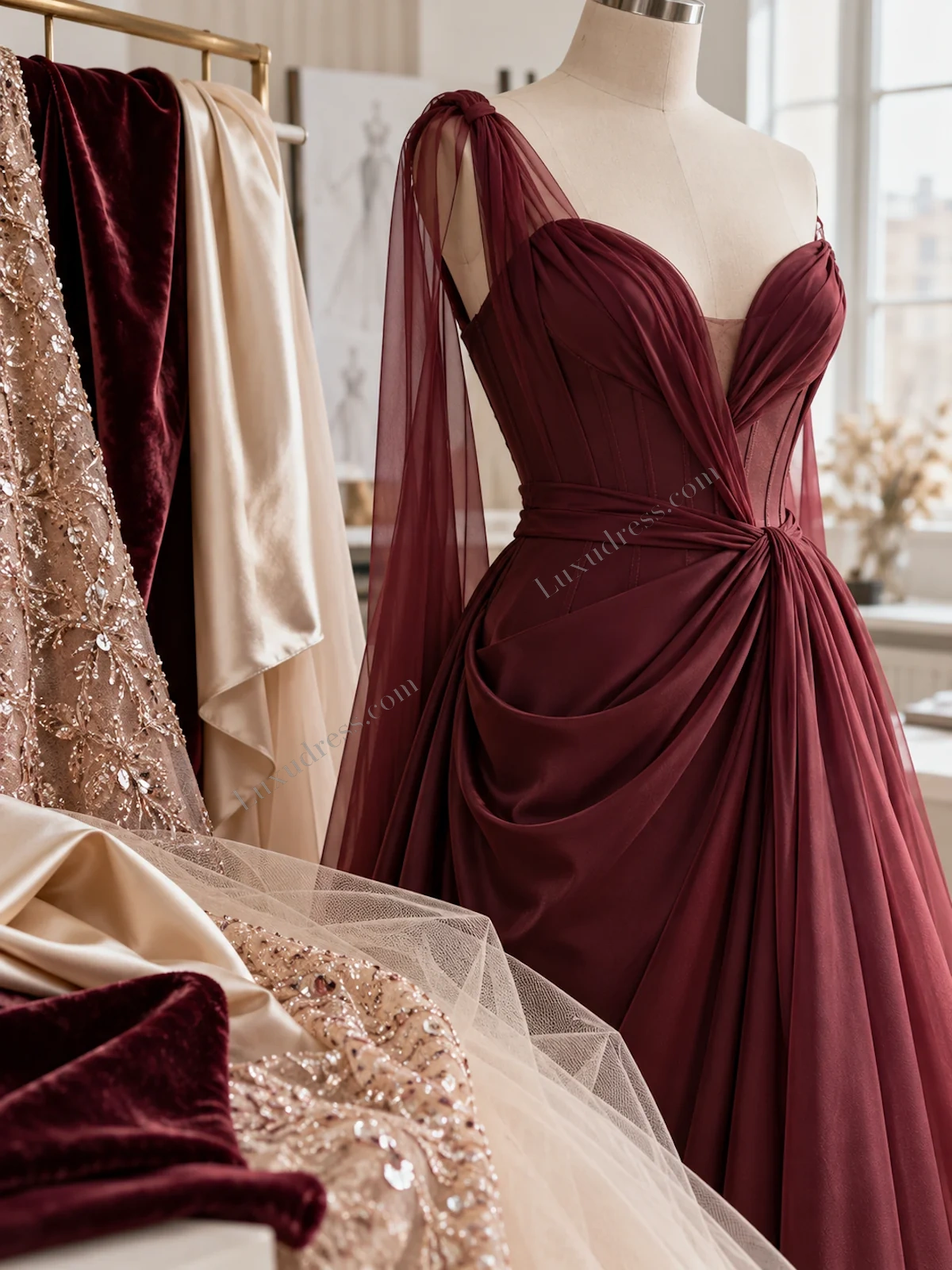
Velvet is decided by nap direction. Cut the panels the wrong way and the garment changes colour piece by piece under moving light; press it like a woven and you flatten a pile that cannot be restored. Both are decisions made once, at cutting and finishing, and neither is recoverable later.
Lace is decided by motif scale and placement. If the motif has to be matched across a seam, that is hours of labour per garment and it must be costed as such. If it can run continuous, it is a different and much cheaper garment. The decision sits in the design and it has to be made before pricing, not after.
Sequins are decided by direction, seam bulk and needle choice. Sequins have a direction; cut two panels against each other and the surface catches light unevenly. They also add bulk at every seam and they break needles, both of which are predictable costs that should be quoted rather than discovered.
The failure these three produce
Cost that arrives after the design is approved. A velvet range priced on a plain-woven assumption, a lace range priced without the matching, a sequin range priced without the extra handling — all three are the same mistake in different fabric. Cost these fabrics by the actual construction method, not by the metre price alone.
The second failure is repair. All three are difficult to mend invisibly, and all three generate post-delivery work when a trim is dislodged in packing or wear. Where a customer will handle the garment repeatedly, plan on spares and say so in the specification.
How to cost a fabric decision properly
The most common costing error in eveningwear is comparing fabrics at the metre and stopping there. Fabric price is one line of six, and the other five frequently reverse the ranking. Two qualities can differ by a third at the metre and the cheaper one can cost more per garment.
| Cost line | Satin | Chiffon | Crepe |
|---|---|---|---|
| Metres per garment | Moderate | Highest — layers and hems | Lowest |
| Lining required | Yes, visible and structural | Usually, plus opacity planning | Often partial |
| Cutting labour | Moderate | High — stable cutting | Low |
| Sewing labour | Moderate | High on narrow hems | Low |
| Pressing | High — a quality gate | Moderate | Low |
| Repair and rework risk | Shade and press marks | Snag and seam show-through | Seam grin if recovery is poor |
Read the table as a checklist rather than a verdict: the point is that the metre price is the smallest of the six lines for the two difficult fabrics. A chiffon style is rarely cheaper than a crepe style of the same silhouette once both are fully costed, even when the chiffon is cheaper by the metre.
Ask for this comparison before you commit a style to the range, not after the quote arrives. We will produce it for any silhouette on request as part of a quotation, and it is usually the fastest way to settle an internal argument about which fabric to use.
- Velvet needs nap direction and careful pressing.
- Lace may require motif matching.
- Sequins change needle choice, seam bulk, lining and repair work.
- Cost these fabrics by actual construction method, not by meter price alone.

Practical buyer worksheet
Ten fields. Fabric is the one where the least information is usually supplied and the most money is committed, so fill this in before sourcing rather than after:
- Target customer and use occasion
- Target retail and wholesale price
- Target ex-factory or landed cost
- Core fabric and backup fabric
- Size range and base fit size
- Colour count and continuity colours
- Critical construction risks
- Approval sample required
- QC checkpoints
- Latest acceptable delivery date
FAQ
Is satin always the most premium?
No. Premium perception depends on weight, finish, cut and construction, and a heavy crepe with a clean inside will read as more expensive than a thin satin with a puckered seam. The most common mistake in this category is buying shine and calling it quality.
Which fabric is easiest for fitted dresses?
Stable crepes and selected stretch wovens can be forgiving, depending on the block and the compression you want. The determining question is recovery rather than softness: a fabric that returns to shape after being stretched across a body for six hours is easier than one that feels nicer on the hanger.
Why do pale dresses look transparent?
Four causes, and they are usually present together: low shell opacity, insufficient lining, stretch under tension, and flash photography. Flash is the one that exposes all three at once, which is why a dress can be acceptable in the fitting room and unusable in a photograph.
Should fabric be approved before sampling?
For critical styles, yes — a sample made in the wrong weight is a sample that has to be repeated. Where the fabric is still being decided, separate construction sampling from final material approval so the fit work is not held up by the sourcing work.
Next step
Send us the requirement rather than the fabric name, and we will tell you which qualities meet it and what each one costs to make. Request a quote or a fabric review with your silhouette, target price and delivery window, and you will have an itemised answer within twenty-four hours. Our fabric sourcing service covers the search itself, and the evening dress manufacturing page shows the constructions we run.