On this page

Rental buyers should think like asset managers. The garment is not sold once; it is hired repeatedly, cleaned repeatedly, repaired occasionally and eventually retired. Every decision below follows from that: the product has to create demand over and over while remaining serviceable, repairable and replaceable.
The mental shift is worth stating plainly, because it reverses a few instincts that are correct in wholesale. In wholesale you buy what looks best on the rail. In rental you buy what will survive forty bookings, and the piece that photographs best is often the piece that survives worst — heavily beaded open tulle is the classic example.
A worked revenue-per-wear sum
Take two dresses at the same purchase price. The first is a heavily beaded column: high rental price, low booking frequency because it suits a narrow set of events, and three hours of specialist attention after every booking. The second is a crepe column: lower rental price, booked most weekends, cleaned in-house in forty minutes.
| Line | Beaded column | Crepe column |
|---|---|---|
| Purchase price | High | The same |
| Rental price | High | Moderate |
| Bookings per year | Low | High |
| Cleaning per booking | Specialist, slow | In-house, fast |
| Days out of service | Many | Few |
| Contribution after a year | Often lower | Usually higher |
The table is not an argument against buying the beaded dress — the statement piece earns its place by getting customers through the door. It is an argument for knowing which dress is the statement and which is the asset, and for not building the wardrobe out of statements because they photograph better.
Buy for revenue per wear
Estimate three numbers before you buy: rental price, realistic booking frequency and usable service life. Multiply them and you have revenue per wear; subtract the purchase price, cleaning, repairs and downtime and you have the actual contribution. A dress that rents for more but sits idle for six weeks can lose to one that rents for less and goes out every weekend.
The three numbers that decide a rental buy
Strip it to the minimum and the decision rests on three numbers: what you pay, how many times it goes out, and what it costs each time it comes back. Everything else — the photography, the trend, the brand — is how you get the first two numbers to be favourable, and none of it changes the arithmetic.
The third number is the one that separates experienced rental buyers from new ones, because it is invisible on the day of purchase. A dress that costs less and needs two hours of specialist attention after every booking is more expensive than a dress that costs more and goes straight back on the rail.
Work the sum per style, not per wardrobe. Averages hide the problem: the wardrobe can look healthy while three specific styles lose money every time they are booked, and those three are usually the ones everyone assumed were the best sellers.
| Input | How to estimate it | Common error |
|---|---|---|
| Rental price | Your actual booked rate, not the list rate | Using list price instead of the discounted realised rate |
| Booking frequency | Weeks booked per quarter for comparable styles | Assuming the best month is typical |
| Service life | Until repairs exceed the margin or it looks tired | Ignoring the point where it stops being bookable |
| Cleaning cost | Per clean, including specialist care | Treating cleaning as overhead rather than per-wear cost |
| Downtime | Days out of service for cleaning and repair | Forgetting that a day out is a booking lost |
Treat repair and cleaning as part of the economics
Repair time, cleaning cost and downtime are part of garment economics, not overhead. A heavily beaded gown that needs three hours of specialist attention after every booking is not a premium asset; it is a low-yield asset with a high headline price. Work the sum per garment and you will often find the mid-price column is the most profitable thing you own.
Use statements to drive discovery
Use statement pieces to drive discovery, but build the wardrobe around reliable repeat-renters. And track which sizes create the most lost bookings — that data is the cheapest capacity increase available to a rental business, because the size you cannot supply is demand you are turning away and it is demand you have already paid to attract.
- Estimate rental price, booking frequency and usable service life.
- Treat repair time, cleaning cost and downtime as part of garment economics.
- Use statement pieces to drive discovery but build the wardrobe around reliable repeat-renters.
- Track which sizes create the most lost bookings.
Choose constructions that survive handling
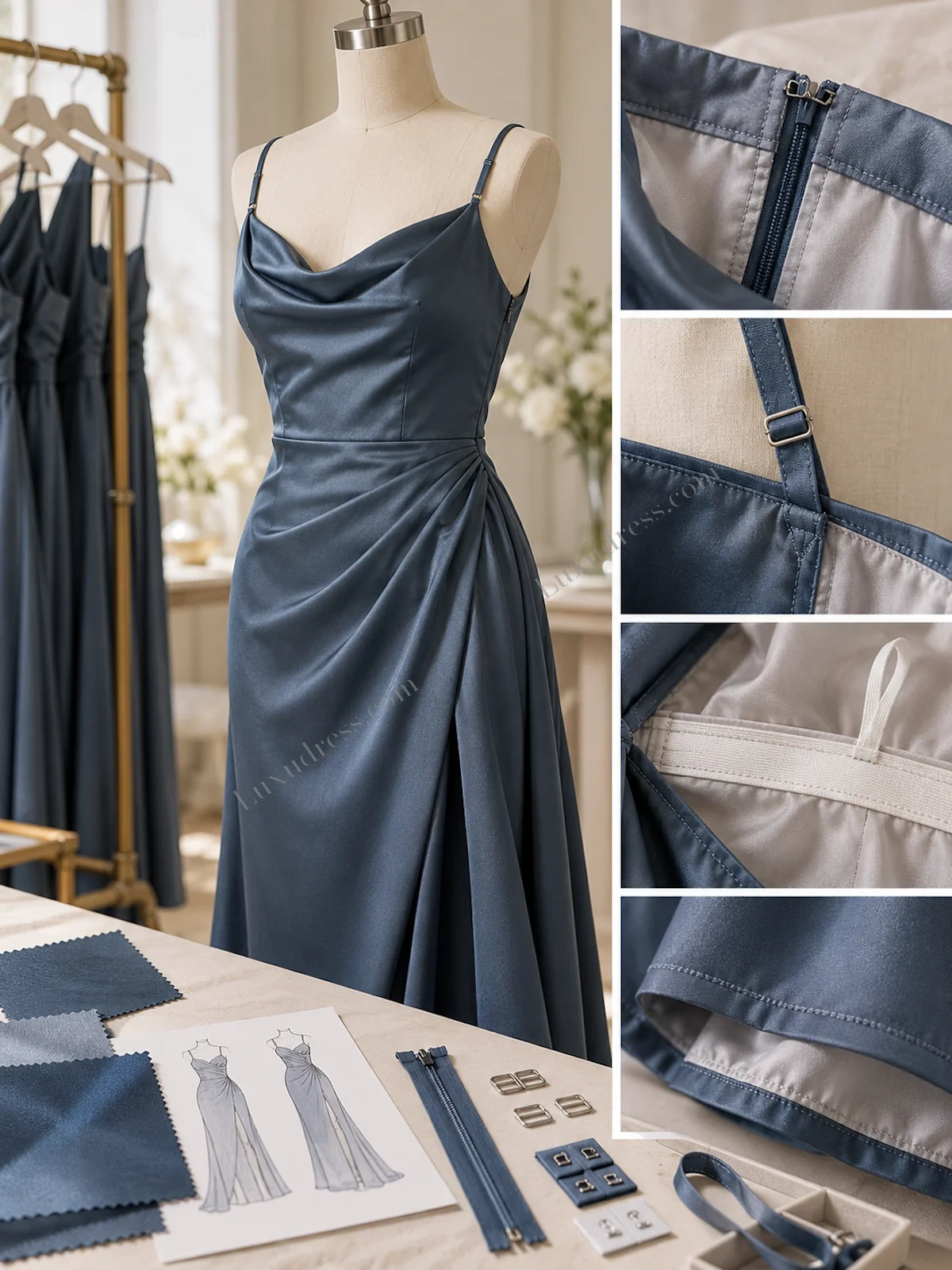
Reinforce the high-stress points: straps, zippers, slits and hook-and-eye areas. These are the four places rental garments fail, and all four can be specified at sample stage for a small cost — far smaller than the cost of a garment that is out of service for a fortnight.
The first thirty days of a new style
Treat the first month of a new style as a test rather than as trading. Three measurements tell you what you have: how many inquiries it generated, how many of those converted, and what condition it came back in. The first two tell you about demand; the third tells you about the asset, and it is the one most rental businesses do not record.
Log the condition on return every time — any repair needed, any cleaning problem, any fit complaint. After ten bookings you will know whether the style is a keeper, a repair liability, or a one-season piece, and you will know it before you have bought six more of it.
The styles that survive that test are the ones to develop into private label. The brief writes itself: take the construction you have proven, change what customers complained about, and add your branding. That is a much cheaper development than starting from a reference photograph.
| Stress point | What fails | The specification to ask for |
|---|---|---|
| Straps | Stretch and seam pull at the join | Reinforced join, stronger strap tape |
| Zippers | Teeth and tape failure under repeated use | A heavier gauge and a clean zip guard |
| Slits | Tearing up from the hem | Reinforced bar tack at the top of the slit |
| Hook and eye | Bending and pulling out | Reinforced placket behind the closure |
Avoid fragile trims in high-contact zones
A delicate trim at the underarm or across the seat of a garment will be repaired repeatedly. Put the same trim somewhere it is not touched and it is never a problem. This is a design decision, not a quality one: the trim is not faulty, it is in the wrong place.
Specifying for cleaning
Your cleaning process is a design constraint and it should appear in the specification. Tell the supplier what the garment will be subjected to — solvent or wet cleaning, how often, and what temperature — and ask whether the lining, the interfacing, the trim and any adhesive will survive it. Most rental failures are not tears; they are delamination, shrinkage and trim that goes dull after the third clean.
The repair kit
Build one per style family rather than per garment: spare trim, spare closures, matching thread, and a written note of what can be repaired in-house and what has to go out. It is a small capital cost and it converts a class of lost bookings into a fifteen-minute job.
The note matters as much as the parts. Whoever is doing the repair at eight in the evening before a Saturday pickup needs to know whether the seam can be opened without damaging the lining, and whether that particular trim can be replaced without unpicking the whole panel. Write it down once, per family.
Ask your supplier for the spare parts when you order rather than when you need them. Trims are made in batches, and a trim ordered in isolation a year later often cannot be matched.
Two specifications matter most. Ask for linings and seam finishes rated for repeated cleaning rather than for a single wear, and ask for any fusible interfacing to be one that will not bubble. Both are cheap to specify at sample stage and impossible to correct afterwards, because by then every garment in the wardrobe has the same problem.
Linings that tolerate cleaning, and spare trims
Prefer linings and seam finishes that tolerate repeated cleaning, and keep spare trims for premium embellished styles. A missing bead is a five-minute repair if you have the bead, and a lost booking if you do not — which makes a small bag of spare trims one of the highest-return purchases a rental business can make.
- Reinforce high-stress straps, zippers, slits and hook-and-eye areas.
- Avoid fragile trims in high-contact zones unless the rental rate justifies repairs.
- Prefer linings and seam finishes that tolerate repeated cleaning.
- Keep spare trims for premium embellished styles.
Build a wardrobe with fit coverage
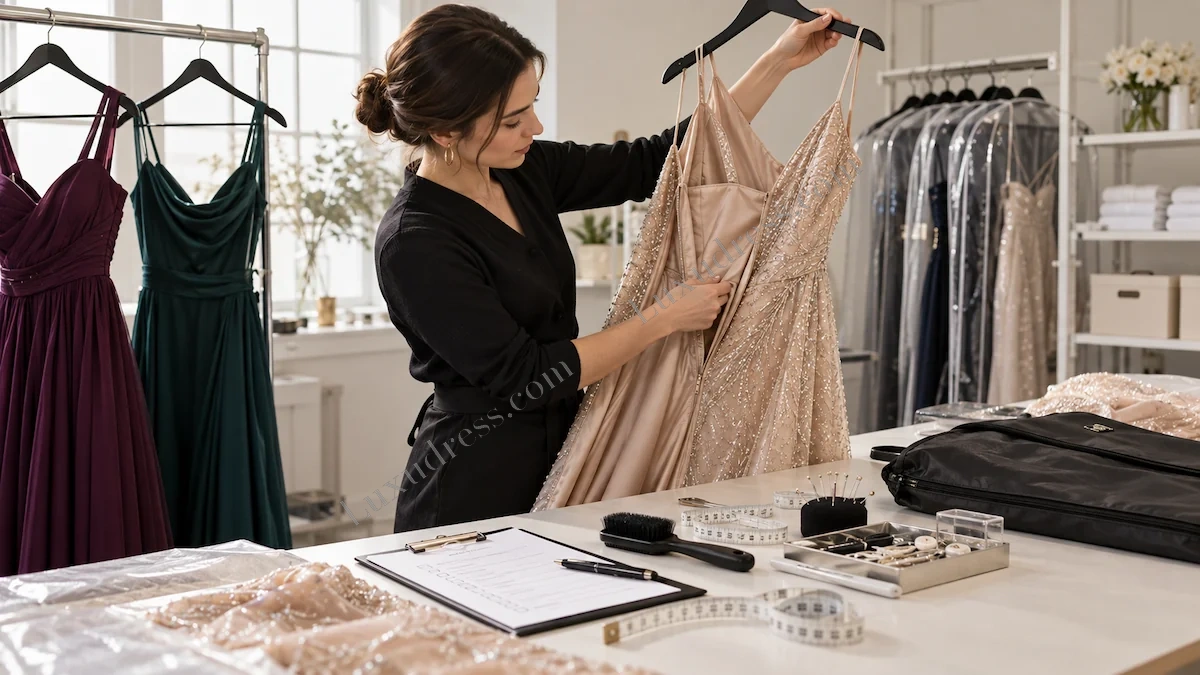
Use adjustable elements where appropriate: lace-up backs, stretch panels, wrap fronts and adjustable straps. Each one lets a single garment serve a wider range of bodies, which is worth more to a rental business than a perfect fit on one body — you are not selling the fit, you are selling availability.
Why availability beats fit in rental
A wholesale brand optimises fit, because a well-fitting garment is what makes a customer buy it and come back. A rental business optimises availability, because the transaction is not whether the dress fits perfectly but whether there is something for the customer on that date. A dress that fits well on one body and cannot be adjusted generates an inquiry you cannot fulfil; a dress that fits adequately across four bodies generates four bookings.
That is why adjustable elements are worth more in rental than in any other channel, and why a slightly less flattering but more adjustable style will often outperform a more beautiful one. It is also why the size curve matters more than the style count — the constraint on a rental business is almost never what it owns and almost always which sizes of what it owns.
The commercial consequence is that buying the missing size is nearly always a better decision than buying another style. A new style competes with your existing wardrobe; a missing size fulfils demand you are currently refusing.
| Adjustable element | What it buys you | Watch out for |
|---|---|---|
| Lace-up back | Several inches of tolerance at the waist and bust | Lacing wears; keep spare cords |
| Stretch panel | Comfort across sizes without visible adjustment | Recovery — cheap stretch stops recovering |
| Wrap front | Adjustable coverage and bust fit | Needs a secure inner tie |
| Adjustable strap | Torso length tolerance | Hardware is a failure point; specify quality |
Do not depend on one fit block
A wardrobe built on a single block concentrates your risk and your lost bookings in the same place. Collect fit notes after every rental; within a season that log is the most valuable merchandising document you own, because it tells you which block to add next with evidence rather than guesswork.
Building the size curve
A rental wardrobe is a size curve before it is a collection of dresses. Start from your own booking data: which sizes generate the most inquiries, and more importantly which sizes you turn away. The turned-away sizes are the ones to buy next, because the demand is proven and the loss is measurable.
What to do with the styles that do not work
Some purchases will not work, and the cost of that is set by how quickly you admit it. A style that has been booked once in a season is not a slow burner; it is a mistake, and holding it for another year costs you the capital and the rail space, both of which could be funding a size you are turning away.
Set a review point per style — after a defined number of months or bookings — and act on it. Sell it, retire it, or repurpose it for styled shoots where it can still earn attention even if it cannot earn bookings. What you should not do is leave it on the rail indefinitely because it was expensive.
When to stop renting a dress
Three signals, and any one of them is enough. The garment no longer photographs well even when it is clean — fabric has gone tired, or a trim has dulled, or the shape has stopped holding. Repairs are becoming routine rather than occasional, which means the construction has reached the end of its life rather than suffering a one-off accident. Or the bookings have simply stopped, which usually means the style has dated rather than that the garment has failed.
The first two are retirement. The third is a merchandising decision and a different one: the dress may still be perfectly serviceable and simply no longer wanted, in which case it can be sold rather than retired, and often to a customer who has already rented it.
Log which of the three it was. Retirement for condition tells you to specify better next time; retirement for demand tells you to buy differently. Treating them as the same thing is how a wardrobe gets rebuilt twice for the same reason.
Log why it did not work. The reason is usually structural — wrong size, wrong block, too fragile — and that note is what stops you buying the same mistake again in a different colour next season.
| Step | What to do | What it tells you |
|---|---|---|
| Log inquiries by size | One line per inquiry, including declined | Where demand actually sits |
| Compare to holdings | Holdings per size against inquiries | The gap you are funding |
| Buy the gap first | Fill the missing sizes before new styles | Highest-return purchase available |
| Re-check each season | Repeat the comparison | Whether the curve has moved |
Buying the gap before buying new styles feels unexciting and is usually the single highest-return decision a rental business makes. A new dress competes with the dresses you already own; a missing size fulfils demand you are currently refusing.
Balance trends with shapes that photograph
Balance extreme trends with shapes that photograph well across multiple clients. The most directional piece in the wardrobe will rent twice; the column that suits everyone will rent repeatedly, and it is the second one that pays the rent. Buy the directional piece anyway — just do not build the business on it.
- Use adjustable elements where appropriate: lace-up backs, stretch panels, wraps or adjustable straps.
- Do not depend on one fit block for every body type.
- Collect fit notes after each rental.
- Balance extreme trends with shapes that photograph well across multiple clients.
Test ready stock before private label
Buy small quantities of existing styles first. This is the fastest way to learn what your customers actually book rather than what they say they like — and for rental it is also the cheapest, because you are buying assets you can rent while you learn.
| Signal to track | What it tells you | What to do with it |
|---|---|---|
| Booking inquiries | Real demand versus stated preference | Buy more of what is asked for by name |
| Return reasons | Fit, comfort or condition problems | Fix it in the private-label version |
| Alteration needs | Where the block does not fit | Change the block, not the style |
| Cleaning performance | Which fabrics survive your process | Drop what cannot be cleaned economically |
Use the data to brief private label
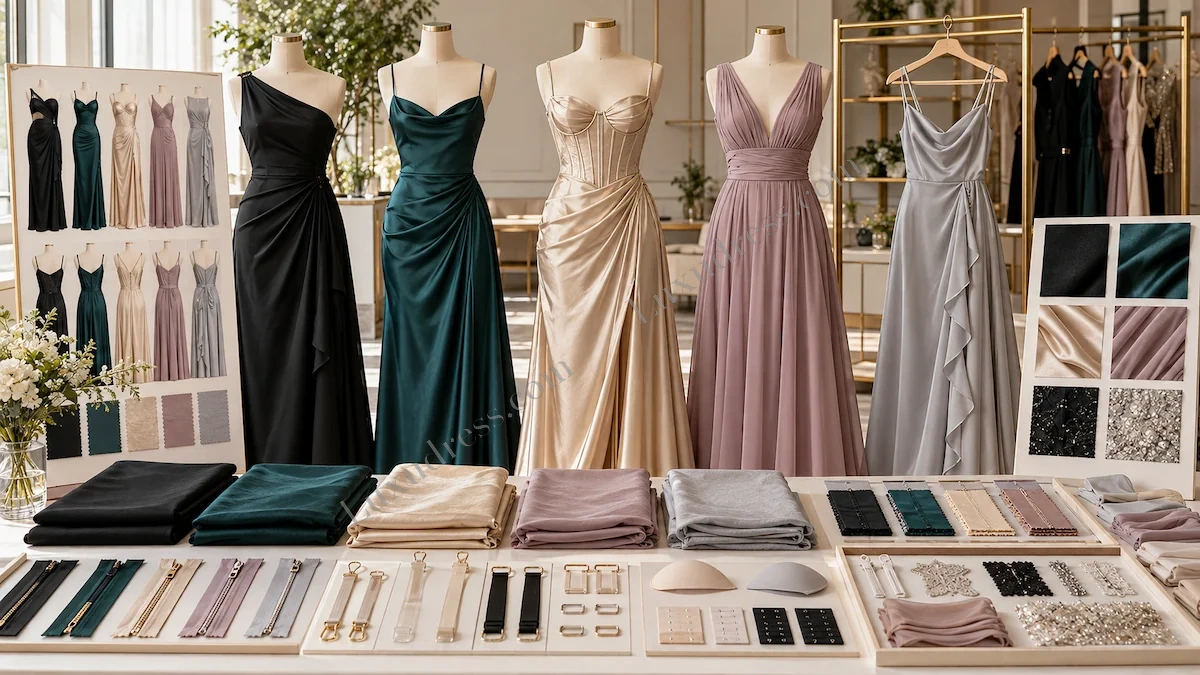
Then use that data to brief private-label versions. We hold 260 ready-to-ship styles available from one piece, which makes this test cheap to run; the ready-stock hub is where most rental buyers we work with start. Move into custom development when a repeated commercial pattern is visible — by then the brief writes itself, and you are developing something already proven rather than something you hope will be.
- Buy small quantities of existing styles to reveal real demand.
- Track booking inquiries, return reasons, alteration needs and cleaning performance.
- Use that data to brief private-label versions.
- Move into custom development when a repeated commercial pattern is visible.
Negotiate replenishment and continuity
Ask whether core fabrics and trims can be reordered before you commit to a style. A rental wardrobe built on styles that cannot be replaced is a wardrobe that shrinks every time something is retired, and eventually it has to be rebuilt from scratch — which is a capital event, not a purchasing decision.
What continuity means from a supplier
Continuity is a specific commitment, not a general willingness. Ask three things: can this fabric be reordered in twelve months, will the dye reference be retained against my style, and what quantity do I need to commit to for that to be guaranteed?
A supplier who answers all three concretely is offering continuity. One who says the fabric will probably be available is not — fabric mills discontinue qualities, dye houses change formulations, and a probably becomes a no at exactly the moment you need it.
Where continuity cannot be guaranteed, buy the replacement up front. Two units of a style you know you will wear out is cheaper than one unit plus a failed reorder in eighteen months, and it is the only reliable answer when the fabric genuinely will not recur.
Keep style IDs and specifications organised
When a dress is damaged beyond repair, the ability to reorder exactly the same garment — same fabric, same shade, same trims — is the difference between a small loss and a permanent gap in the wardrobe. Keep the specification on file per style ID, and make sure the supplier can still read it in two years.
What to put in the style record
Nine fields per style, kept somewhere that survives staff changes: the supplier style ID, the shell fabric and its mill reference, the lining, the trims with their own references, the colour standard and dye reference, the construction notes, the size run held, the cleaning method, and the repair history. That record is what lets you reorder the same garment in two years and what lets a new staff member answer a customer question accurately.
The two that get skipped are the trim references and the cleaning method. Trim references matter because a replacement bead or hook is a five-minute repair with them and a lost booking without them. The cleaning method matters because a garment cleaned wrongly is damaged permanently, and the person doing the cleaning in two years will not be the person who worked it out.
Keep it as a simple per-style file rather than a spreadsheet of garments. The record is about the specification, not the individual unit, and it should be the thing you send a supplier when you reorder.
Controlled colour stories, and deliberate scarcity
Use controlled colour stories that support styled shoots or group bookings, and avoid building the business around products that cannot be replaced unless scarcity is deliberate and part of the offer. Scarcity is a legitimate strategy, but it has to be a choice — accidental scarcity is just a shrinking wardrobe.
- Ask whether core fabrics and trims can be reordered.
- Keep style IDs and specifications organised.
- Use controlled colour stories that support styled shoots or group bookings.
- Avoid building the business around products that cannot be replaced unless scarcity is deliberate.

Practical buyer worksheet
Ten fields per style, completed before you buy rather than after the first booking. The last four are the ones wholesale buyers never fill in and rental buyers cannot afford to skip:
- Target customer and use occasion
- Target rental price and booking frequency
- Target purchase cost per wear
- Core fabric and backup fabric
- Size range and fit adjustability
- Colour count and continuity colours
- Critical durability risks
- Spare trims and repair plan
- Cleaning method and downtime
- Replacement availability
FAQ
What materials work well for rental?
Durability depends on construction as much as on fibre. Crepe, selected satins, stretch wovens and supported tulle can all work when they are engineered for repeat use — and all can fail when they are not. Ask what the seam allowance is, how the closure is reinforced and whether the lining tolerates your cleaning process, rather than asking what the fabric is called.
Wholesale or private label?
Wholesale supports fast testing; private label becomes attractive once repeated booking patterns are clear. Most rental businesses are best served by testing wholesale and then developing the proven styles, because the test costs less than the mistake it prevents.
How many wears should a dress last?
There is no universal number. Use contribution margin across the garment's usable life, including cleaning and repair, rather than a wear count — a dress that rents cheaply and never needs repair can comfortably outperform one that rents high and spends half its life at the cleaner.
What is the most common mistake?
Buying only for visual impact and ignoring cleaning, repairability, fit flexibility and replacement availability. The photograph gets the booking; the construction decides whether you make money on it, and those are two different decisions made months apart.
Next step
If you run a rental wardrobe, start with small quantities and real booking data. Browse the 260 ready-to-ship styles available from one piece, then send us your best-performing styles with the construction changes you want and we will quote the private-label version. Our dress rental supply page covers the programme in full.