On this page
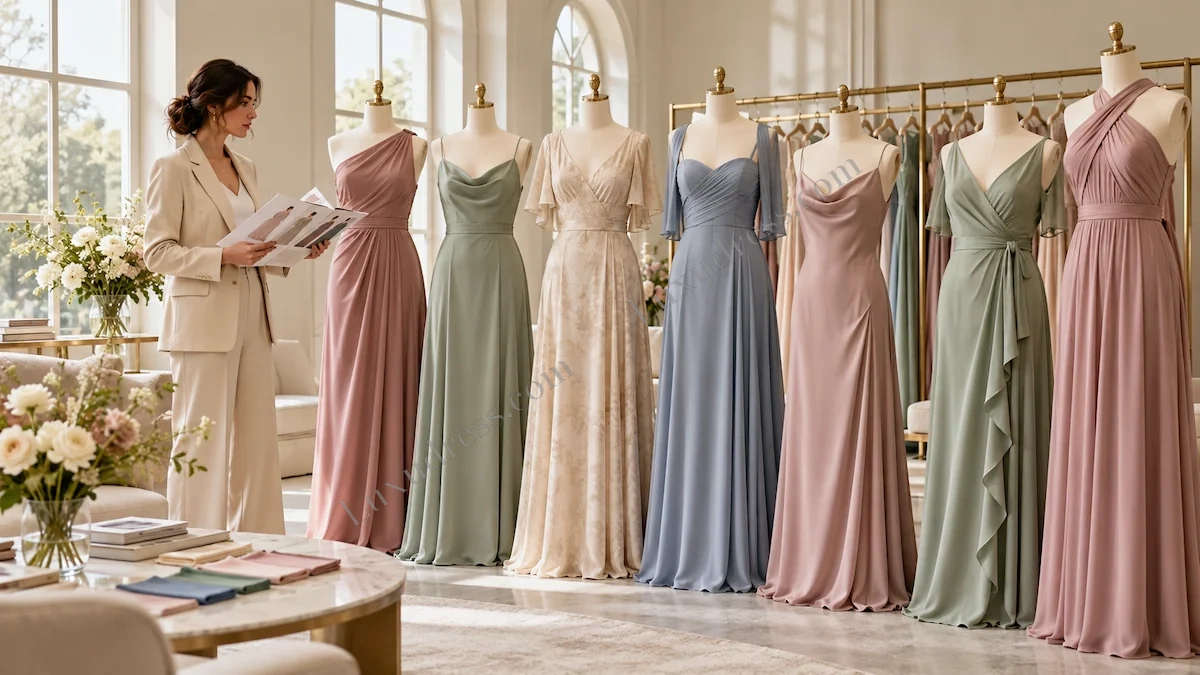
A bridesmaid launch succeeds when design, colour continuity, sizing and replenishment are treated as one commercial system rather than as four separate problems. The extra difficulty is real: purchase windows are long, group members order at different times, and the product is judged in a single photograph alongside four other dresses.
That last point is the one worth internalising. In most categories a defect is discovered by one wearer. In bridesmaid it is discovered by five people standing next to each other, in daylight and under flash, with a photographer directing them — which is why the controls in this article are heavier on consistency than on design.
Define the coordination system
Decide which of three models you are running, because each has different production consequences. Same-fabric mix-and-match lets each wearer choose a neckline while the colour is guaranteed identical. Same-colour mixed fabric is riskier — colour matching across satin and chiffon is a genuine technical problem, not a styling one. Tightly matched uniform styling is the simplest to produce and the least forgiving commercially.
Who actually buys a bridesmaid range
Three buyers, with different needs. The bride, who is choosing a colour and a look and cares about how the group photographs. The bridesmaid, who is paying for it and cares about whether she will wear it again. And the boutique, who is stocking it and cares about whether it will sell in March as well as in June.
Most ranges are designed for the first and bought by the second, which is why conversion stalls at the fitting room. Designing for the second means rewear value: a silhouette and a fabric that work outside a wedding, and a colour that does not announce the occasion. That is the commercial argument for the mix-and-match model — it lets each wearer solve her own problem while the bride still gets a coherent group.
The boutique is the one who decides whether you get a second season. Give her a colour card, an honest lead time, and a style she can reorder in a size she is missing, and she will sell your range ahead of a prettier one that cannot do any of those things.
| Model | What the customer chooses | Production consequence | Risk |
|---|---|---|---|
| Same fabric, mix and match | Neckline and silhouette | One fabric, one dye standard | Low — the safest model |
| Same colour, mixed fabric | Fabric and silhouette | Colour must match across substrates | High — metamerism between fabrics |
| Uniform styling | Size only | Simplest to run | Commercial — limits who buys |
Metamerism is worth understanding before you commit to the second model: two fabrics can match under shop lighting and diverge under daylight, because the colour is produced by different dye chemistry on different fibre. If you run mixed fabrics, approve them together under both conditions, and accept that a perfect match may not be achievable.
How many colours a bridesmaid range needs
Fewer than most first ranges carry. A working programme is two or three anchor colours carried across the whole range, plus one or two seasonals that appear on a small number of styles. That keeps the dye-lot count low, makes continuity fabric affordable to hold, and — commercially — makes the range easier for a boutique to buy into without committing to a colour it cannot sell.
The counter-pressure is real: brides shop by colour, and a range with three colours will lose the customer who wants the fourth. The answer is a swatch programme rather than more stock — sell the colour story on a card, and make the extended palette available as a special order with an honest lead time. You get the breadth on the swatch card without carrying it in inventory.
Use repeatable physical colour standards
A screen approval is not a standard; it is a picture of one. A signed-off swatch, retained and referenced by batch, is what allows a dress ordered in March to match one ordered in June. Keep the swatch, label it with the dye reference, and require every batch to be compared against it — not against the previous batch, because that is how drift accumulates unnoticed.
The alteration allowance
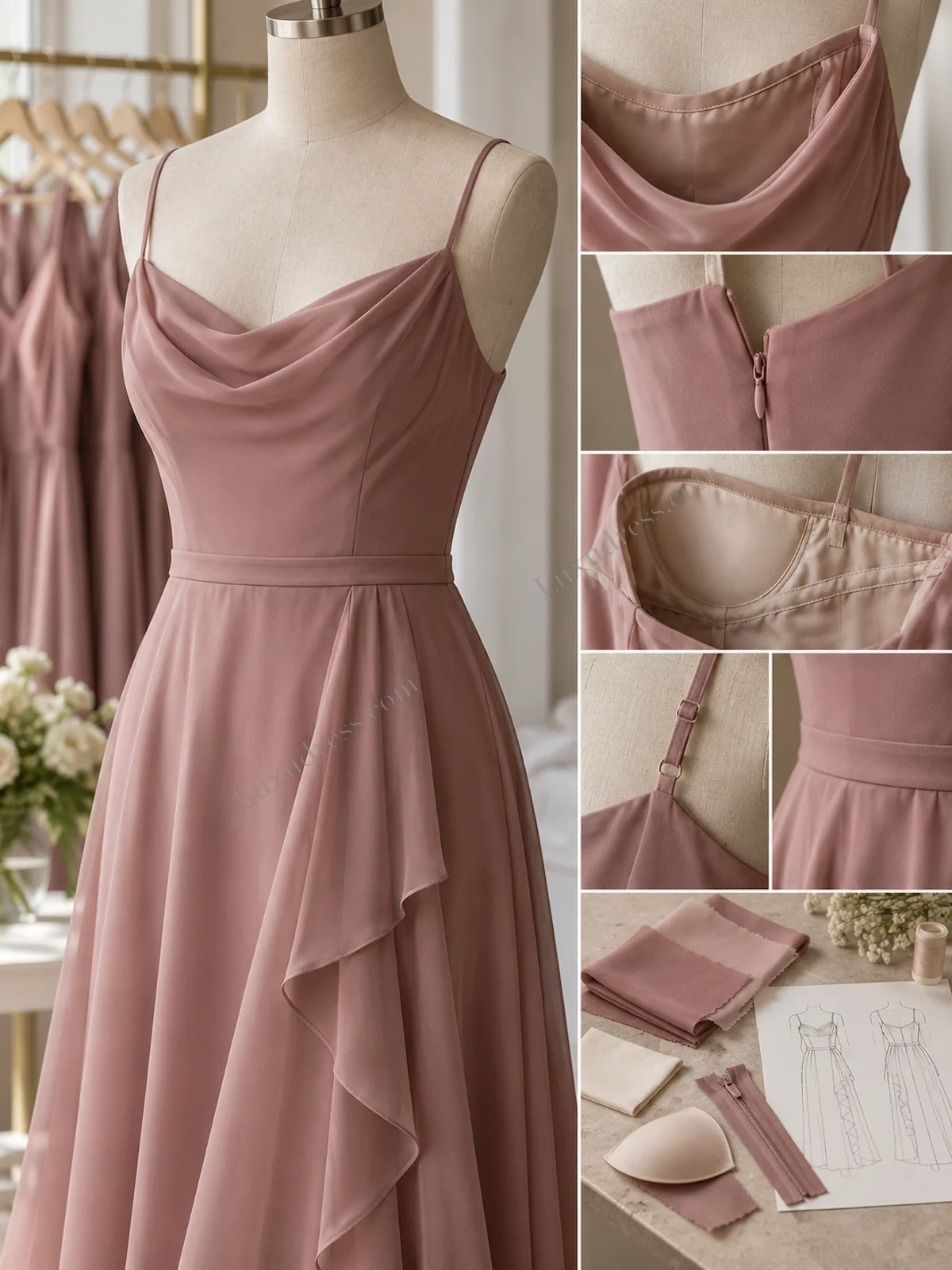
Bridesmaid dresses are altered more than any other occasionwear, and an alteration that cannot be made is a lost sale. Three allowances make the difference: a hem that can be taken up without reshaping the skirt, seams that can be let out or taken in by a defined amount, and straps that can be shortened without rebuilding the bodice.
All three are decisions made at the pattern stage, and none of them cost anything to include. Ask your supplier what alteration allowance is built into each style, and ask the boutique what alterations she actually performs — those two answers together tell you which styles will sell through and which will come back.
Where the bodice is structured, be honest about the limit. A boned bodice cannot be let out by three centimetres without changing the fit, and it is better to say so on the hangtag than to have a fitter discover it a week before the wedding.
Plan the extended sizes deliberately
Keep core styles available long enough for group purchases that happen at different times, and plan petite, tall, maternity or extended-size needs deliberately rather than on request. A bridal party is a cross-section of the population, not a sample size, and the order you lose is usually the one you could not supply.
- Decide whether the range is same-fabric mix-and-match, same-colour mixed fabric or tightly matched uniform styling.
- Use repeatable physical colour standards.
- Keep core styles available long enough for group purchases that happen at different times.
- Plan petite, tall, maternity or extended-size needs deliberately.
Choose fabrics for group photography
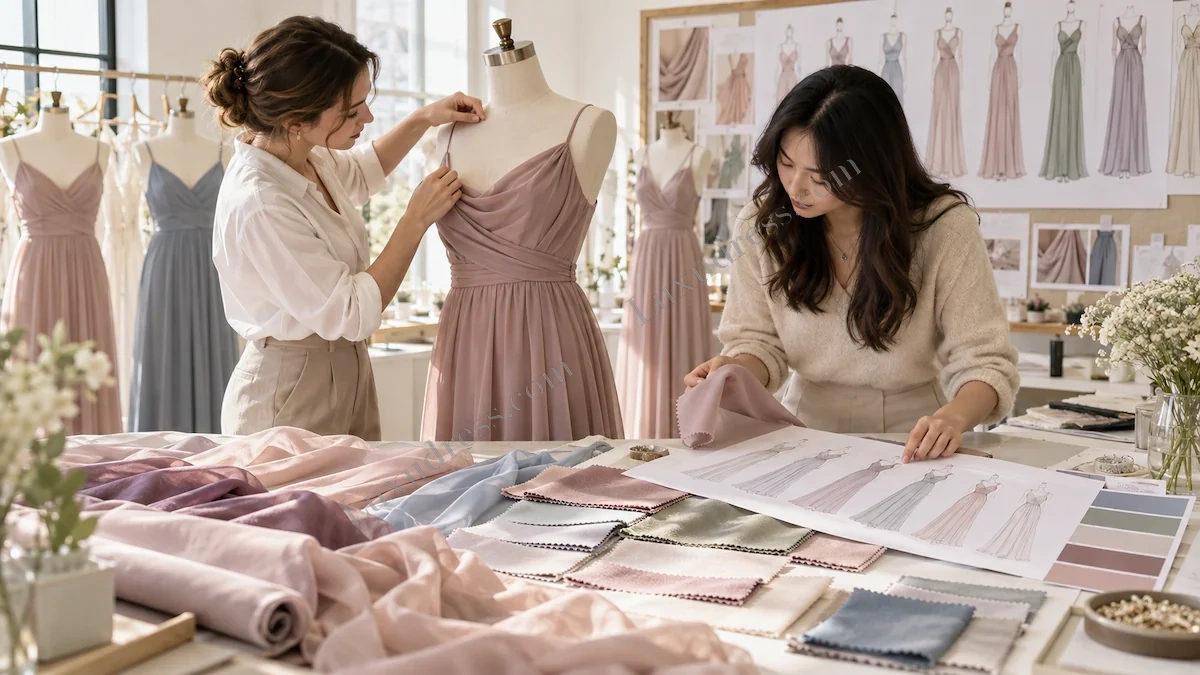
Fabric choice in this category is a photographic decision before it is a tactile one. Satin reflects light and exposes shade differences — two dresses from different dye lots will show it immediately in a group photograph. Chiffon diffuses light and moves, which flatters and forgives. Crepe gives cleaner body lines and a matte surface that reads consistently.
What chiffon costs you in production
Chiffon is the fabric customers like and production teams watch. It is slippery to cut, it moves on the table, it needs careful handling at every operation, and it almost always needs a lining — which adds a second fabric, a second minimum and a second shade-matching problem. None of that is a reason to avoid it; all of it is a reason to cost it properly.
What makes a bridesmaid style reorderable
Three properties, and they are what separate a style that sells for five years from one that sells for a season. A fabric that can be re-bought — preferably a stock quality rather than a custom weave. A colour with a retained dye reference rather than a one-off match. And a construction simple enough that a re-run does not need a new fit approval.
Check all three at the point you approve the style, not when the reorder arrives. If the fabric is a mill special, the colour was matched by eye, or the bodice needed three rounds to fit, the style will not reorder cleanly however well it sells — and in this category the reorder is where the margin is.
The two costs that get missed are the lining and the handling time. A chiffon style is rarely cheaper than a crepe style of the same shape once both are fully costed, even when the shell fabric is cheaper by the metre. Ask for the comparison before you commit the style to the range rather than discovering it in the quote.
The compensating factor is that chiffon forgives. It diffuses light, moves well in photographs, and is more tolerant of fit variation across a group than satin — which is exactly why it earns its place despite the handling cost.
| Fabric | How it behaves in a group photograph | Production consequence |
|---|---|---|
| Satin | Reflective; shows every shade difference and every seam | Strict batch control; careful pressing |
| Chiffon | Diffuse and moving; forgiving of fit and shade | Needs lining and careful layer handling |
| Crepe | Matte and consistent; clean body lines | Shows pressing faults if finished badly |
Satin is the most demanding choice
That is why satin is the most commercially attractive bridesmaid fabric and the most demanding to produce consistently. If you run satin, treat shade control as a production discipline with batch comparison, not as an inspection step at the end — by the time final inspection finds a shade difference, the whole group order is wrong.
Lining, opacity and flash
Opacity is the failure customers notice first and buyers specify last. A pale satin or a light chiffon can be perfectly acceptable in daylight and transparent under flash, which is precisely the condition a wedding photographer creates. Specify opacity as a requirement, not as a hope: name the lining, its coverage, and the colour — a lining a shade warmer than the shell will change how the dress reads in a photograph.
| Check | Under daylight | Under flash |
|---|---|---|
| Shell opacity | Usually adequate | Often the failure point |
| Lining colour | Reads true | Can shift the whole garment |
| Seam show-through | Invisible | Frequently visible |
| Pressing marks | Minor | Highly visible on satin |
Test all four before you approve the colour, and test them on a finished garment rather than on a swatch — a swatch tells you about the fabric and a garment tells you about the construction.
Approve under the light it will be worn in
Photograph approved swatches and finished garments under daylight and warm indoor light before you lock the colour. Most bridesmaid purchases are judged in photographs taken at a wedding, under mixed lighting, and the approval that matters is the one made under those conditions. A colour approved only under a sample-room light is a guess.
- Satin reflects light and exposes shade differences.
- Chiffon diffuses and moves.
- Crepe gives cleaner body lines and a matte surface.
- Photograph approved swatches and finished garments under daylight and warm indoor light.
Build silhouettes around a shared fit philosophy
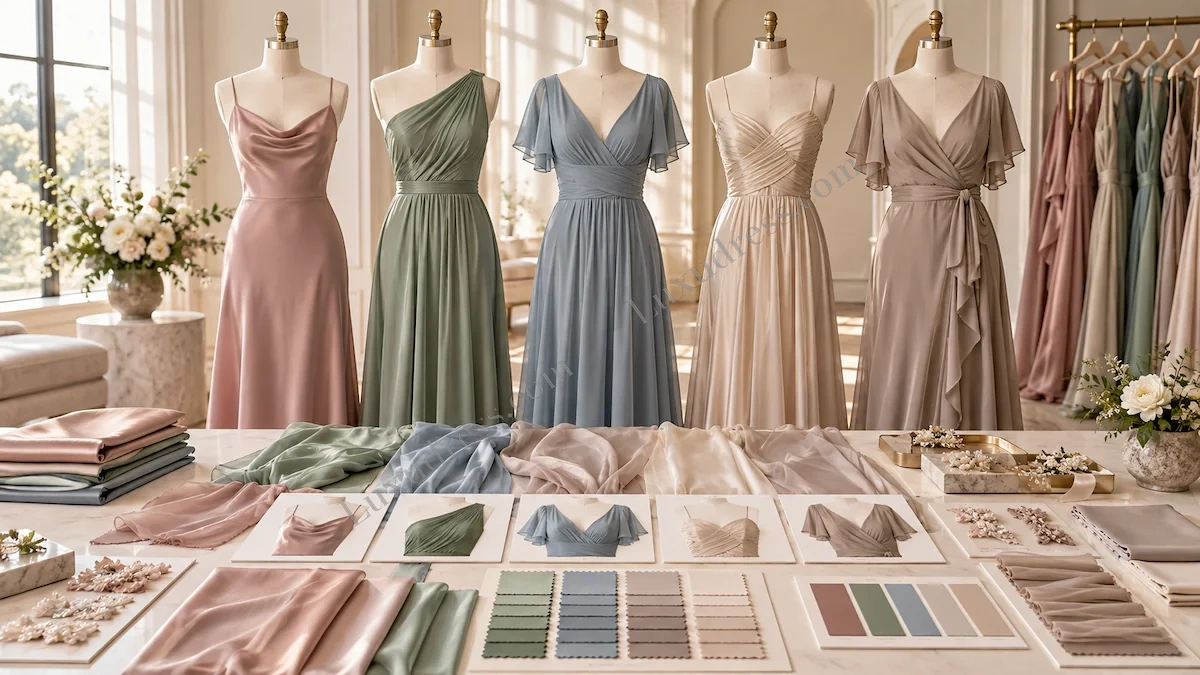
Create multiple neckline options without changing every structural variable. If the waist placement, the skirt proportion and the internal support stay constant across the range, the wearer can choose a neckline that suits her and the group still looks coherent — and you have not created six separate fit problems.
How many necklines a bridesmaid range needs
Four is usually enough and six is usually too many. The point of neckline variety is to let each wearer choose something that suits her, not to offer unlimited choice — unlimited choice produces a group that looks uncoordinated and a boutique that cannot hold the stock.
A working set covers the main coverage preferences: a higher neckline, a V or sweetheart, a strapless or off-shoulder option, and one with sleeves or a strap that works for someone who wants more coverage. Four options, one fabric, one colour standard, and the group still reads as a group.
Test each one for bra compatibility and for movement before it goes in the range. A neckline that cannot be worn with a normal bra generates an alteration request every time, and in a category where five people are ordering together, that is five complaints from one dress.
| Keep constant | Vary freely | Do not vary without testing |
|---|---|---|
| Waist placement | Neckline shape | Internal support level |
| Skirt proportion | Strap treatment | Cup specification |
| Hem length logic | Back detail | Closure type |
Test the three details that generate alterations
Test straps, low backs and wrap fronts for movement and bra compatibility. These are the three details that generate the most alterations and the most complaints, and all three are fixable at sample stage and expensive at bulk stage. A strap that slips when the wearer raises her arms will slip at the wedding, and every alteration is a cost you absorb.
Grade for the whole party
Grade with the full bridal party in mind, not only the base model. A range that fits a size 8 sample perfectly and pulls across the back at a size 18 will generate returns and alterations that cost more than the margin on the order. Ask your supplier which sizes they fit-test, and ask to see the extended sizes rather than only the sample size; the constructions we run across a full size range are listed on our bridesmaid dress manufacturing page.
- Create multiple neckline options without changing every structural variable.
- Keep waist placement and skirt proportion coherent.
- Test straps, low backs and wrap fronts for movement and bra compatibility.
- Grade with the full bridal party in mind, not only the base model.
Merchandise for real bridal buying behaviour
Offer colour swatches and clear lead-time expectations. Bridesmaid customers order against a fixed date and they will ask two questions before anything else: what colour is it, and will it arrive. Both need accurate answers at the point of sale, not after the order is placed.
Explain special-order terms accurately
State what happens if a group member orders late, whether a discontinued colour can be matched, and how long a reorder takes. Inaccurate answers here generate the category's most expensive failure: a dress that arrives after the wedding. That is not a return, it is a refund plus a complaint that will be posted publicly.
Swatch programmes that work
A swatch programme is a small operational system: a physical card, a named colour reference, a stated lead time per colour, and a clear statement of which colours are stocked and which are special order. The card is the sales tool; the reference is what makes a reorder match; the lead time is what stops a customer ordering a dress that cannot arrive.
Two details make the difference between a programme that works and one that generates complaints. First, the swatch must be cut from production fabric, not from a mill card that has since been superseded. Second, the lead time must be stated per colour rather than as a blanket promise, because continuity colours and special-order colours genuinely have different answers.
Keep replenishment visible to accounts
Let customers compare styles within one fabric or colour story, and keep replenishment logic visible to wholesale accounts. A boutique that knows a core style can be reordered in a defined number of weeks will sell it differently from one that believes it is a one-off — and will order more confidently at the start of the season.
- Offer colour swatches and clear lead-time expectations.
- Explain special-order terms accurately.
- Let customers compare styles within one fabric or colour story.
- Keep replenishment logic visible to wholesale accounts.
Plan production around event deadlines
Track four dates separately: the wedding date, the customer order date, the production completion date and the alteration buffer. Conflating them is the single most common cause of a bridesmaid order arriving too late to be altered, which in this category is the same as arriving too late.
What a realistic bridesmaid lead time looks like
A bridesmaid lead time has more parts than most buyers expect, because the order is assembled rather than taken. There is the time to collect the group's sizes and payment, the time to confirm material, the production time, the inspection and packing time, the freight, and then the alteration buffer at the customer's end.
Publish the whole sequence rather than the production time. A boutique that tells a customer six weeks when the real answer is eight has created a problem that will land on you, and it will land in the week before the wedding when nothing can be done about it.
What to charge for, and what not to
Three things in a bridesmaid programme justify a charge: a rush order, a special-order colour, and an extended size. Three things do not: a swatch card, a size set for the boutique, and an honest answer about a date. Charging for the first group is normal; charging for the second turns the tools that sell the range into friction.
The swatch card is the clearest case. It costs little, it prevents the most expensive category of return — a colour that was not what the customer imagined — and it is the thing that lets a boutique sell a colour she does not hold in stock. Give it away.
Rush orders are the opposite case. A rush genuinely costs money: it displaces other work and it usually means air freight. Charge for it, state the price in advance, and let the customer decide. Both of those are better than absorbing it quietly and resenting the order.
Then hold the one part you control: confirm material availability before you promise the date. A date promised before fabric is confirmed is a guess, and in this category a wrong guess is not a late delivery — it is a dress that arrives after the event it was bought for.
What a realistic bridesmaid lead time looks like
A bridesmaid lead time has more parts than most buyers expect, because the order is assembled rather than taken. There is the time to collect the group's sizes and payment, the time to confirm material, the production time, the inspection and packing time, the freight, and then the alteration buffer at the customer's end.
Publish the whole sequence rather than the production time. A boutique that tells a customer six weeks when the real answer is eight has created a problem that will land on you, and it will land in the week before the wedding when nothing can be done about it.
Then hold the one part you control: confirm material availability before you promise the date. A date promised before fabric is confirmed is a guess, and in this category a wrong guess is not a late delivery — it is a dress that arrives after the event it was bought for.
| Date | Who owns it | What it protects |
|---|---|---|
| Wedding date | The customer | The hard deadline nothing can move |
| Customer order date | The retailer | Determines whether the slot exists |
| Production completion | The supplier | Must precede shipping and clearance |
| Alteration buffer | The customer's fitter | Protects against fit and hem changes |
Do not promise rush before material is confirmed
A rush slot is worthless if the fabric is not in the building. Confirm material availability before committing to a date you cannot move — and if a rush is genuinely needed, ask what it costs in air freight rather than assuming the production slot is the constraint.
Batch control and continuity fabric
Where a core colour is likely to recur, reserve continuity fabric; the cost of holding it is almost always lower than the cost of a failed re-dye. Then use batch control for group orders: dresses for one group should come from the same dye batch wherever possible, and should be compared side by side under the lighting they will be worn in before they are packed.
- Track wedding date, customer order date, production completion and alteration buffer separately.
- Do not promise rush production before material availability is confirmed.
- Reserve continuity fabric for key colours when justified.
- Use batch control and shade comparison for group orders.
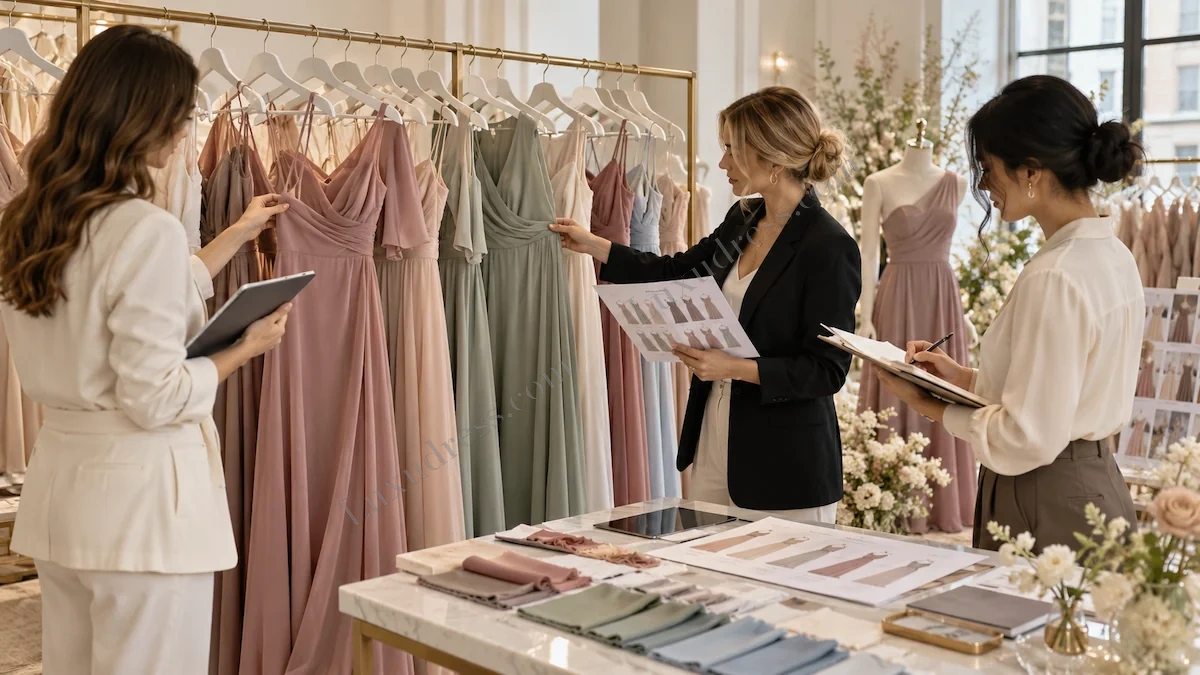
Practical buyer worksheet
Ten fields per colour story — this is what turns a bridesmaid concept into a quotable programme. Complete it per colour story, not per style, because colour is what drives the production risk:
- Target customer and use occasion
- Target retail and wholesale price
- Target ex-factory or landed cost
- Core fabric and backup fabric
- Size range and base fit size
- Colour count and continuity colours
- Critical construction risks
- Approval sample required
- QC checkpoints
- Latest acceptable delivery date
FAQ
Which fabrics are common for bridesmaid lines?
Satin, chiffon and crepe are common because they support different aesthetics and price points, and because each behaves differently in group photographs. The choice should follow the look you are selling and the shade control you can sustain — a fabric you cannot reproduce consistently is a liability in this category however good it looks.
How important is colour matching?
Very important, because several dresses are photographed together and any shade difference is visible in the same image. Physical swatch standards and batch control are the two controls that make it work; a screen approval is not a standard.
Should every style be in every colour?
Not necessarily. A controlled matrix — core styles in the full colour range, fashion styles in two or three — reduces inventory and fabric complexity without limiting what the customer can put together, and it keeps the dye-lot count manageable.
What makes bridesmaid production different?
Group coordination, long purchase windows, colour continuity and broad size needs create extra operational demands. The product is often simple; the logistics are what makes the category hard, and they are what a supplier should be audited on.
Next step
We produce bridesmaid programmes with matched dye lots, mixed-size runs and continuity fabric held for core colours, at our production facilities in Guangzhou and Dongguan. Send your colour story and silhouettes with quantities and the event calendar, and we will confirm what is achievable and what is not. See our bridesmaid dress manufacturing range for the constructions we run, and the occasionwear cluster for the rest of the programme.