On this page

This is written for fashion brands, retailers and product developers grading a bridesmaid or matched-group range. It assumes the general mechanics, which our guides to size grading from one approved sample and prom dress grading cover. What follows assumes those and adds the problem those two do not have: several dresses of the same style worn at once, where consistency is a merchandising requirement as well as a fit one. The category is on our bridesmaid dress manufacturing page.
The group is the constraint
In most categories the fit target is a body. In bridesmaid it is a group of bodies of different sizes standing in one line, in the same colour, in the same fabric, in photographs that will be looked at for years. That changes what the grade is for.
Two failure modes, not one
| Failure | What it looks like | Why a per-size fit check misses it |
|---|---|---|
| A size does not fit its wearer | The dress pulls, gaps or hangs badly on one person | Nothing — this is what a normal fit session catches |
| The range stops looking like one dress | The neckline looks wider, the straps thinner, the skirt fuller or the waist higher at one end of the range | Each size passes its own measurements; only the group reveals the drift |
The second failure is the reason bridesmaid grading has its own method. It is produced by grade rules that are individually reasonable — a proportional increase here, a proportional increase there — and cumulatively transform the garment. Grade rules that are arithmetically consistent produce a set of sizes that are geometrically inconsistent, and the divergence is usually largest at the ends.
The group photograph is the real test
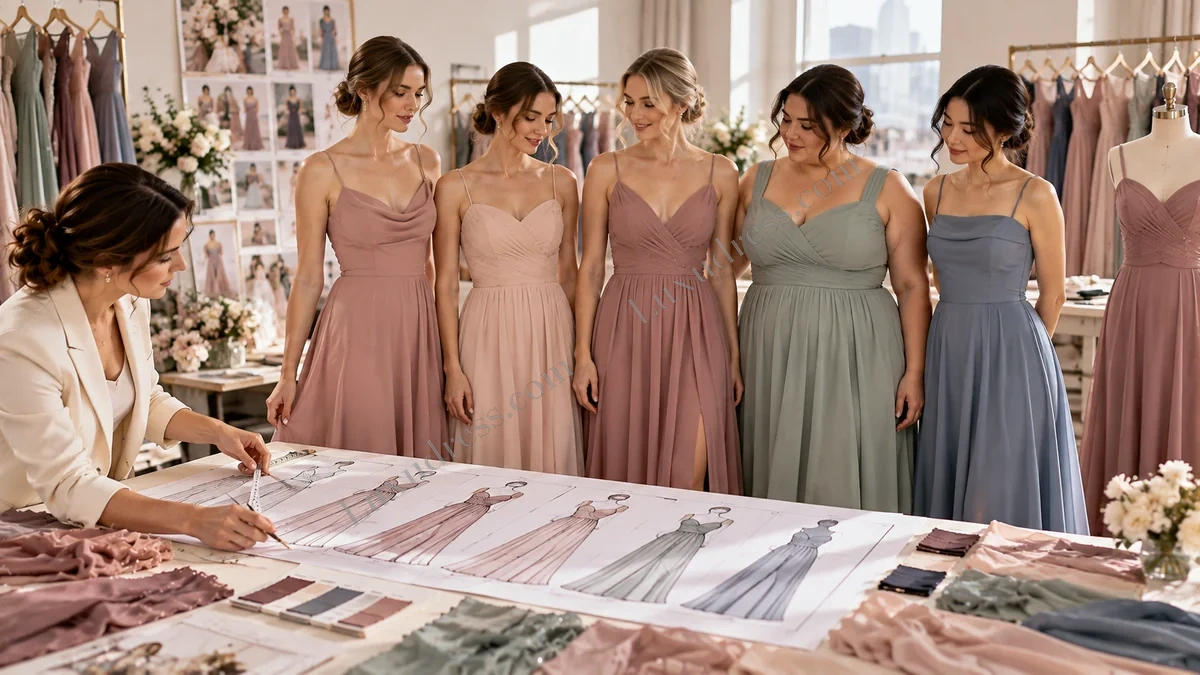
The outcome this method is built towards is a single image: several wearers of several sizes, in the same dress, standing in a line. That image is worth arranging before bulk, because it shows at a glance what a size-by-size fit session cannot. Place the extreme sizes at opposite ends and look along the line: the eye finds a neckline that has widened, a strap that has thinned, a waist that has climbed, or a skirt that has become visibly fuller without anyone having decided anything.
Photograph it front-on and from a slight angle, in one light, with the hem relationship visible. The hem and floor line is the anchor the camera reads first, so a group that fails on floor clearance looks wrong for reasons the viewer cannot name — which is exactly the reaction a real customer has when the photographs come back. Testing it at the sample stage converts that reaction into a grade rule change.
The target is a ratio, not a number
The practical way to state the goal is as a set of ratios that must hold across the range: the neckline's width relative to the shoulder, the waist's position relative to the body's total length, the skirt's sweep relative to the bodice's width, the strap's width relative to the shoulder. Numbers move as sizes grow; ratios are what the eye reads. A grade that holds the ratios keeps the dress recognisable, and a grade that holds only the increments does not.
Protect the visual anchors
The anchors are the features that identify the dress. Each one needs a rule, a tolerance and a known breaking point, and together they are the specification the grade is measured against.
Waist position
The waist seam's position on the body should stay recognisable across the range, because a waist that climbs at the small end and drops at the large end changes the dress's proportion entirely. The control is to grade the bodice length in a way that tracks the body rather than a fixed increment, and to state where the waist should sit as a proportion of the wearer's height rather than as an absolute distance from the shoulder.
Neckline character
A neckline that is a defined V, a square or a high round should still read as that shape at both ends of the range, which means its width cannot be scaled in proportion to the bust without checking the shoulder. A neckline that widens faster than the shoulder becomes a different neckline; a strap that narrows as the bust grows stops being a strap. Both are visible in a group photograph and neither is visible in a measurement chart.
Skirt proportion
Skirt sweep is the anchor most likely to be corrupted, because a mechanical increase in circumference produces a skirt that looks progressively fuller. On a gathered or A-line skirt in a light fabric, the same sweep that reads as elegant at a small size reads as heavy at a large one. The correction is to decouple the hem sweep from the body's circumference increase and to set it against the bodice's width, so the dress keeps its silhouette proportion rather than its measuring-tape proportion.
Hem and floor clearance
One rule has to apply to the whole group or the line will read unevenly: whether hems are intended to clear the floor, touch it, or sit at a defined distance, and at what footwear. Because the group is photographed standing together, the relationship between the hem and the floor is as visible as the colour. This rule belongs in the size chart as a stated standard, not as a per-style decision.
Grade fitted and flowing zones differently
A bridesmaid dress usually has both a fitted zone and a flowing one, and they should not be graded by the same logic. The fitted zone has to track the body; the flowing zone has to track the intended silhouette.
The fitted zone
Bust, waist and hip in a fitted bodice need controlled increases that follow the body's proportions, with the relationship between them checked as a set rather than individually. The reason is that the differences between bust, waist and hip do not grow at the same rate across a size range, so a rule set that is right in the middle is not right at the ends. Where the back width or the bust increase outruns the waist, the garment loses the shape it was drawn with.
The flowing zone
An A-line, a gathered or a bias skirt does not need the same proportional increase as a fitted hip, and applying one produces exactly the drift described above. In a light fabric the volume of a gathered skirt grows visually faster than its measurement, so a sweep that increases at the body's rate looks progressively fuller at the top of the range. Setting the sweep against the bodice width rather than the hip circumference keeps the silhouette stable while the fit still tracks the body.
Wrap and tie details
A wrap front has to remain functional across the range, which is a different requirement from remaining visually similar. The overlap has to be sufficient that the garment cannot open when the wearer moves, the tie has to reach and hold, and the neckline coverage has to stay within the brand's standard at the largest size. Where a wrap is graded only on its outer dimensions, the overlap often becomes the component that fails — and a garment that opens is a coverage failure rather than a fit one.
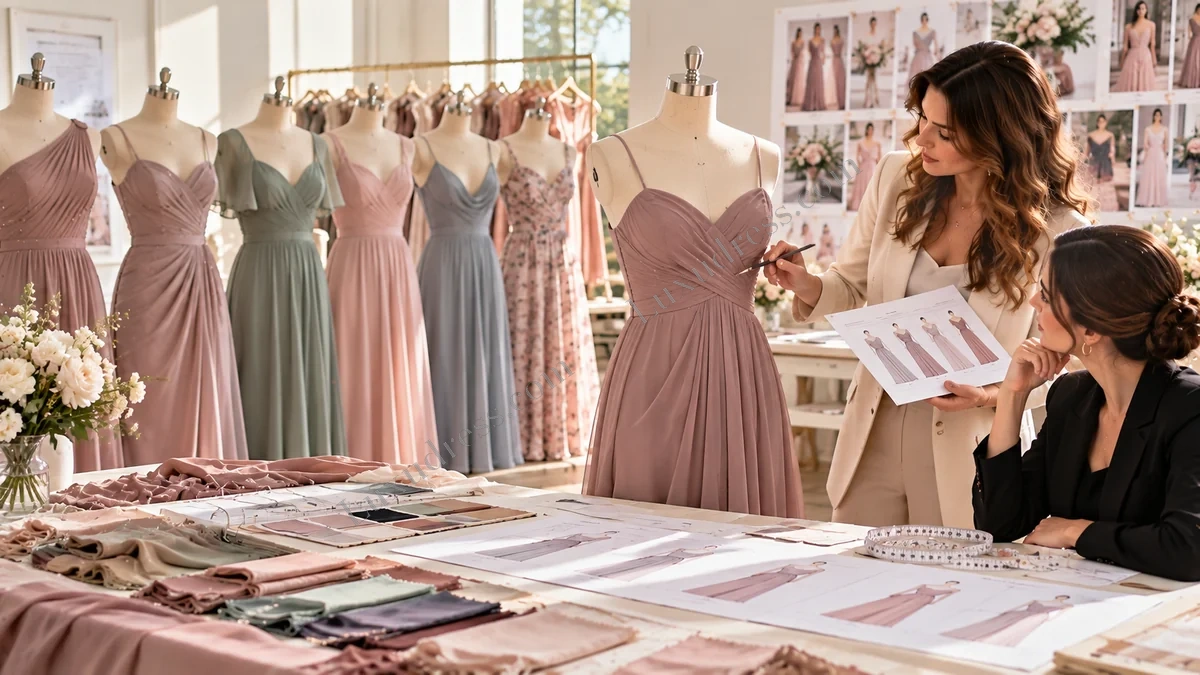
Review strap and armhole behaviour
Straps and armholes are where a grade that looks correct on paper produces a garment that is unwearable, because both are governed by relationships rather than by dimensions.
Why straps are hard to grade
A strap's correct position depends on shoulder width, the distance from shoulder to bust, and the armhole's shape — three things that do not grow at the same rate. A strap graded only on its length will sit too far inboard or too far outboard as sizes change. Straps usually need their own rule line: a stated attachment point relative to the shoulder, a stated width, and a stated position relative to the bust apex, with the attachment point checked at both ends of the range.
Armhole depth
The armhole has to deepen enough to be comfortable without opening so far that it exposes the undergarment or cuts into the underarm. Those two limits meet somewhere in the range, and where they meet depends on the style: a wide armhole on a fitted bodice reaches the lower of the two limits sooner than a loose one. The control is to check the armhole on a body at the largest size the style is offered in, and to note in the specification whether the style is intended to be worn with a particular undergarment.
One-shoulder and halter styles
These styles carry load through one attachment rather than two, so they need separate balance checks rather than a rule derived from a two-strap standard. A halter's tension runs through the neck, which changes what the neckline can be asked to do; a one-shoulder style's tension is resolved asymmetrically, so the side seam and the bodice's internal structure have to be checked on both sides. Neither is a grading rule so much as a structural requirement that the grade has to respect.
Adjustable straps are not a substitute
An adjustable strap buys tolerance and it does not fix a grade. Where the attachment point is wrong, adjustment moves the problem rather than solving it: the strap can be lengthened to reach a comfortable position, but the point at which it joins the bodice is still in the wrong place, so the neckline and the armhole remain wrong with it. Adjustability is worth having, and it should be treated as a refinement on a correct grade rather than as cover for an unchecked one.
Build an extended-size validation step
Every grade is a hypothesis until a garment is made at a size other than the base and tried on. That step is the one most often skipped, because the base size is where the style was developed and where all the attention has been.
Fit one size beyond the base
At minimum, one size other than the base is made and tried on a person. Which one is a decision, and it should be chosen for information value: a size where the bust, waist and hip relationships have moved furthest from the base gives more than a size adjacent to it. For a range that runs into extended sizes, the validation size should be at the top end, because that is where the grade is least tested and where the fit philosophy is most likely to need a different construction.
What to check on the validation size
- Bust support, and whether the internal structure still does its job at the larger volume.
- Back width, and whether the bodice still closes without strain.
- Waist placement against the anchor rule rather than against the base size.
- Armhole and strap behaviour on a body, standing and with the arms raised.
- Skirt proportion against the bodice, to confirm the silhouette still reads as the same dress.
- Coverage at the neckline and the armhole against the brand's stated standard.
Correct the rule, not the garment
A validation finding should change the grade rule and the pattern, not produce an individually fitted garment. Altering the sample to fit the wearer in front of you resolves that one garment and leaves the rule unchanged, so the fault reappears at every size it touches in production. The validation step is valuable precisely because it is the last point at which a rule change is free, and it only delivers that value if the finding is written back into the rule set before bulk.

Coordinate measurements across the collection
A bridesmaid range is usually several styles rather than one, and the group that has to be consistent is not only the sizes of a dress but the dresses in the range. Wholesale buyers notice immediately when two styles in the same size do not fit the same.
One body standard
Every style in the range should be graded from the same body standard, with the same naming convention for sizes, the same reference points and the same measurement definitions. Where styles are developed separately, this is the discipline that keeps them interchangeable to a buyer — and its absence is what produces the note that a brand's sizing is inconsistent, which is expensive to correct once a wholesale customer has built a size chart around it.
What a shared standard looks like in a chart
Consistency across a collection is not a statement of intent; it is a set of visible properties of the measurement charts. Every style should carry the same size names for the same body, the same named reference points, the same definition behind each measurement, and a stated fit intention. Where one chart measures a length from the shoulder and another from the waist seam, a buyer comparing two styles is comparing two systems rather than two dresses.
| Property | When it is shared | When it is not |
|---|---|---|
| Size naming | A size means the same body in every style | A size that fits differently between two dresses in one range |
| Reference points | Each measurement is taken from a named point, defined once | Two correct measurements that disagree, and no way to arbitrate |
| Tolerance set | Consistent, with documented per-construction exceptions | An inconsistency that reads as a defect at inspection |
| Fit intention | Each style states close, standard or relaxed | A designed difference mistaken for a grading error |
| Grade rules | Derived from one body standard, even where the blocks differ | Two ranges of sizes living inside one range of dresses |
Consistent tolerances with documented exceptions
Tolerances should be consistent across the range unless a construction genuinely requires otherwise, and where it does, the exception should be documented rather than applied silently. A knit style may legitimately need a different tolerance from a woven one; a bias skirt may need a different length tolerance from a straight one. Writing those exceptions down means the inspection standard can differ between styles without the difference reading as a defect.
Document intentional fit differences
A fitted style and a relaxed style in the same range are meant to fit differently, and that difference has to be documented or it becomes an inconsistency. The useful form is a note per style stating its intended relationship to the body — close, standard or relaxed — and how that intention is expressed in the measurement chart. Without it, a buyer comparing two styles in the same size has no way to know which differences were designed.
The anchor table
This is the working version of the anchors described above: what to hold, how to hold it, and the size at which it usually breaks. The breaking-size column is the one that turns a rule into a check.
| Anchor | The rule | Where it usually breaks |
|---|---|---|
| Waist position | Held as a proportion of wearer height, not a fixed distance from the shoulder | At the top of an extended range, where bodice length changes faster than the waist relationship |
| Neckline character | Shape preserved; width increase checked against the shoulder increase | At the largest size, where a proportional increase turns a V into a wide scoop |
| Skirt proportion | Hem sweep set against bodice width rather than hip circumference | On gathered and A-line skirts in light fabrics, where volume grows faster than measurement |
| Strap attachment | Stated relative to the shoulder and the bust apex, with its own rule line | At both ends of the range, and worst on one-shoulder and halter styles |
| Armhole depth | Deepens for comfort without reaching the undergarment | At the largest size, on fitted bodices |
| Hem and floor clearance | One standard for the whole group, stated with a footwear assumption | Any style whose length was set per style rather than per range |
| Wrap overlap | Sufficient at the largest size to remain closed in movement | Where the wrap was graded on outer dimensions only |
| Closure strain | Bodice closes without visible pull at the largest size | Where the closure has no adjustability and the grade assumes one |
Which sizes to fit
A full size set is not necessary and is usually not affordable. What matters is that the sizes fitted are chosen for information, and that the set covers the ends of the range where the grade is least reliable.
| What is fitted | What it confirms | What it cannot confirm |
|---|---|---|
| Base size only | The intended fit, and the construction and proportion of the style | Any drift at the ends of the range |
| Base plus one adjacent size | That the rule set works in the direction it was developed in | Whether the rule still holds at the extremes |
| Base plus one validation size at the top of the range | That the grade, the support and the coverage survive the largest size offered | The behaviour at the smallest size |
| Base plus both ends | The whole range on the body, which is what the group photograph will show | Nothing that the range contains — this is the complete option and the most expensive |
The cheapest sufficient set
For most bridesmaid ranges, the base plus one size at the top of the offered range is the smallest set that answers the two questions that matter: does the rule set work, and does the dress still read as itself when it is large. Where a range is offered in extended sizes, that combination is not optional — the top-of-range garment is a different construction problem and it cannot be assessed from the base.
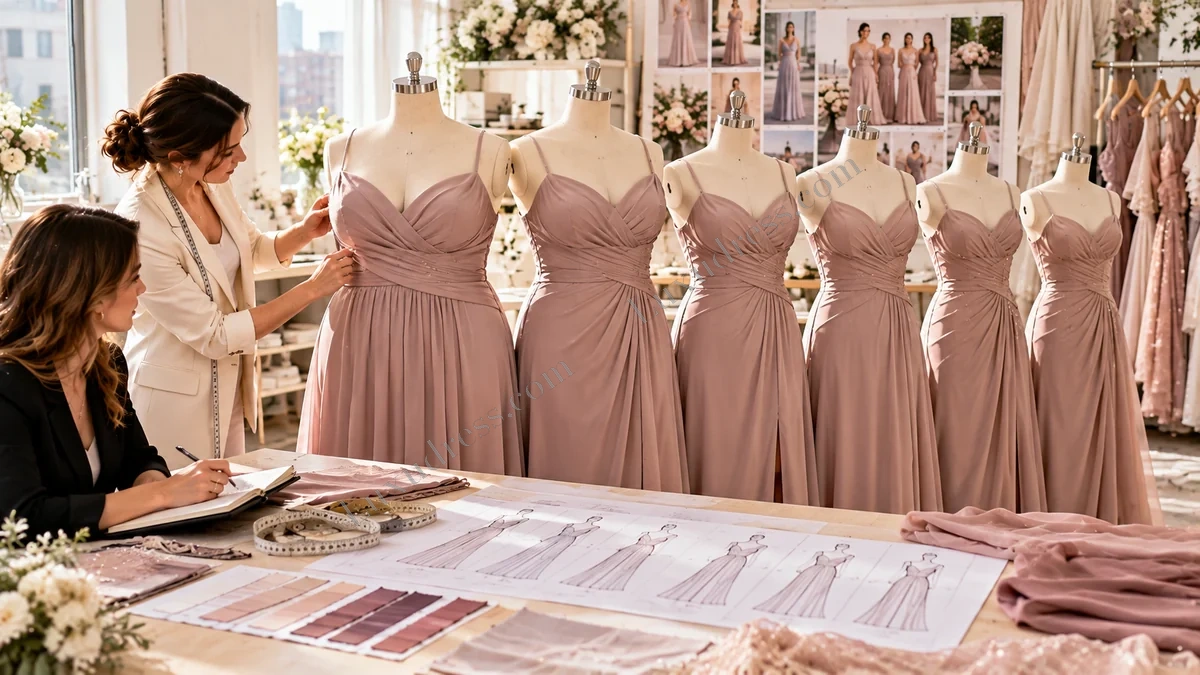
Practical buyer worksheet
Fill this in before the grade is released. For a matched range the fifth and sixth lines do the most work: a named size range and a stated colour count are what decide whether the group can be consistent at all.
- Target customer and use occasion
- Target retail and wholesale price
- Target ex-factory or landed cost
- Core fabric and backup fabric
- Size range and base fit size
- Colour count and continuity colours
- Critical construction risks
- Approval sample required
- Inspection checkpoints
- Latest acceptable delivery date
FAQ
Should every bridesmaid style use the same block?
Not necessarily, and the useful requirement is a shared body standard and a shared fit philosophy rather than a single block. Styles with genuinely different constructions — a fitted bodice, a relaxed slip, a wrap — need patterns that suit them, and forcing them onto one block produces compromises at both ends. What has to be shared is the measurement standard, the reference points, the size naming and the intended relationship to the body, because those are what a wholesale buyer experiences as consistency. Two styles can be cut from different blocks and still be interchangeable to the customer.
Why are straps difficult to grade?
Because the correct strap position depends on three relationships that do not grow at the same rate: shoulder width, the distance from shoulder to bust, and the shape of the armhole. A strap graded on length alone will move inward or outward as sizes change, and the change is small enough to pass a measurement check and large enough to be visible on a body. Straps therefore need their own rule line rather than an increment derived from the bodice, and the attachment point should be checked at both ends of the range rather than at the base size.
How are wrap dresses graded?
With four things controlled together: the overlap, the tie position, the neckline coverage and the waist placement. Overlap is the functional requirement — it has to be enough at the largest size that the dress cannot open in movement, which is a coverage question rather than a fit one. The tie has to reach and hold at both ends. The neckline coverage has to stay inside the brand's stated standard, which sometimes means the neckline cannot be graded proportionally at all. And the waist has to sit where the anchor rule says it should, because the wrap's whole proportion depends on it.
What matters most in extended sizes?
Physical validation on the intended body range, and the willingness to change a construction rather than a measurement when the validation says so. Extending a size range is not a matter of adding increments: at larger volumes the load on the bodice grows faster than its surface, the armhole limits are reached sooner, the skirt's volume reads differently from the same sweep, and a closure with no adjustability may stop closing. The specific sizes offered, the construction at the top of the range and the coverage standard all have to be decided rather than assumed — and none of those decisions can be checked from a measurement chart.
Next step
We develop and produce bridesmaid and matched-group ranges at our production facilities in Guangzhou and Dongguan, including shared body standards across styles, anchor-based grade rules for fitted and flowing zones, separate strap and armhole rules, validation garments at the top of the range, and a documented tolerance set per construction. Send the size range you intend to offer and the styles it has to hold together, and we will come back with a grade plan and a validation set rather than a set of increments. Request a quote, or see the constructions we run on our bridesmaid dress manufacturing page.
Our prom dress grading guide covers what a boned waist and a bought-in cup do to a grade, and how to launch a bridesmaid dress collection covers the range decisions upstream of this. Silhouettes already in production are on our style library and ready stock pages, and the wider category is on the women's dresses page.