On this page
- Most corset failures are relationships, not missing bones
- Read the bodice as a load path
- Position cups around the wearer
- Choose boning for function
- Control neckline and top edge
- Engineer the back closure
- The five symptoms and what each one means
- What the bodice specification has to carry
- Practical buyer worksheet
- FAQ
- Next step

This is written for fashion brands, retailers and product developers fitting corset and structured occasionwear. It assumes how a corset dress is built, which our corset manufacturing guide walks station by station, and it links to the load-side reading in our quality control checklist. What follows assumes those and covers the diagnostic: what the garment is telling you, and what to change. The category is on our corset dress manufacturing page and the wider one on occasionwear.
Most corset failures are relationships, not missing bones
The instinct when a bodice misbehaves is to add structure: another bone, a heavier interfacing, a stronger stay. That instinct is wrong often enough to be expensive, because a bodice that is over-structured in the wrong place fails more visibly than one that is under-structured in the right one. The failures worth diagnosing first are relationships.
The five relationships
| Relationship | What it decides | What it looks like when it is wrong |
|---|---|---|
| Pattern shape to body block | Where the volume sits and where the garment grips | Vertical wrinkles over the bust or diagonal drag lines toward the waist |
| Cup position to the wearer | Whether support comes from below or from pressure | A neckline that gapes, or a bodice that presses at the upper bust |
| Bone layout to seam and channel lines | Whether the bones stay where they were placed | A bone that bends outward or a channel that twists in wear |
| Top edge to the body | Whether the edge lies flat or cuts in | Gaping at the neckline, or an edge that marks the skin after an hour |
| Closure to the tension it carries | Whether the back stays closed and stable | A zip that ripples, a lace-up that distorts, hooks that release |
Every one of those is decided by a pattern or a component choice, and none of them is fixed by adding bones. That is why the diagnostic order matters: read the garment first, then decide whether the answer is pattern, cup, bone, edge or closure.
Read the bodice as a load path
Start by identifying where the garment is carrying weight: the bust, the waist, or the skirt hanging below a waist seam. Then trace where that load goes, and whether anything in the bodice is being asked to do a job it cannot do.
Where the load actually goes
In a strapless or low-backed bodice, the load has to reach the waist and the body rather than the top edge, and the garment's ability to stay up depends on how well it grips below the ribs. In a bodice with straps or a halter, part of the load travels through the strap, which means the strap's position and its attachment are structural rather than decorative. Where a skirt hangs from the bodice, the waist seam carries that weight into whatever is beneath it. Reading these three paths on the garment tells you which element is over-worked.
The neckline cannot provide support
This is the single most common mis-engineering in structured occasionwear. A neckline that has been drawn low and wide is being asked to hold the garment up, and fabric cannot do that without tension that shows. The garment stays only if the support has been moved somewhere it can work: a wider back, a waist stay, side anchoring, or a cup system that carries load from beneath. Where none of those is present, the correction is a pattern and structure change, not a tighter fit.
Use front, side and back fitting photos
A bodice read from the front alone hides most of what matters. The side view shows whether the volume projects or collapses at the bust, whether the waist is being compressed, and how the skirt's weight is loading the seam. The back shows whether the closure is under tension and whether the top edge is lying flat across the shoulder blades. Three views, same garment, same light, taken before any comment is written, and they will resolve most disagreements about what the bodice is doing.
Position cups around the wearer
Cups are the component most often specified by their size and least often by their position, and position is what the wearer experiences.
What a fitting photo set has to contain
A bodice cannot be diagnosed from images taken casually, and the difference between a useful set and a decorative one is standardisation: same garment, same wearer, same light, same distance, and a stated stance for each frame. The set that answers the questions in this article is six images — front relaxed, front with the arms raised, side relaxed, side with the arms forward, back relaxed, and the garment seated. Anything less leaves one of the five relationships unverified, and the missing frame is invariably the one that would have shown the fault.
The images also need a marker. A tape or a light mark at the natural waist and at the bust apex makes the placement questions answerable from a photograph rather than only in person, and it makes a comparison between two sample rounds meaningful. Without a marker, two rounds of photography show two garments; with one, they show a change.
Apex and underbust must match the block
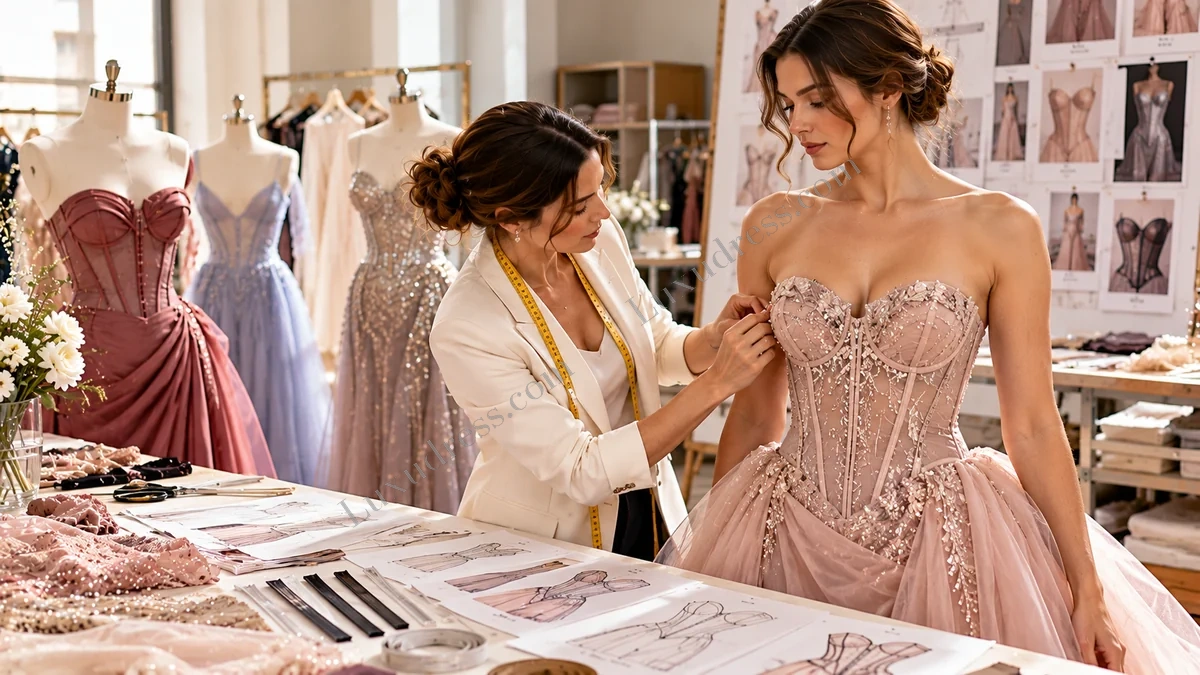
The cup's apex has to sit at the body's apex and the underbust line has to sit on the underbust, and both are properties of the block the pattern was built from rather than of the cup itself. A cup set too high presses at the upper bust and creates a hard line under the neckline; set too low, it stops supporting and the bust sits in the lower part of the cup. Both faults look like a fit problem to the wearer and are actually a placement problem in the pattern.
Cup shape changes the neckline
The cup's shape decides where the bodice's upper edge can be drawn and how high the centre-front can sit. A cup with a deep curve requires more fabric above it, while a shallow cup leaves a longer flat run to the neckline. This is why redrawing a neckline without revisiting the cup produces a garment whose edge either gapes or bears down on the bust. Where a brand wants a specific neckline across a range, the cup system is part of that neckline's specification.
Extended sizes may need different cup components
A single cup component scaled up does not produce a proportional increase in support, because the load grows faster than the surface area that carries it. At the top of a size range the cup often has to change type rather than size, and the bodice block beneath it has to change with it. That is a development decision taken at the base size and applied deliberately at the top, not a grading outcome — and it is why a range built from one cup will often need a second block for its extended sizes.
Choose boning for function
Boning is usually briefed as a quantity and a material, and the two things that decide whether it works are where it sits and what it is being asked to do.
Flexible versus spiral
Flexible plastic boning and spiral steel differ in stiffness, memory and the way they recover after the wearer sits down. Plastic is lighter, easier to work and adequate where the job is preventing a seam from collapsing; spiral steel holds a curve under load and returns to it, which is what a bodice that has to stay shaped through an evening requires. Choosing between them is a decision about the garment's behaviour in hour three, not about its appearance in the fitting room.
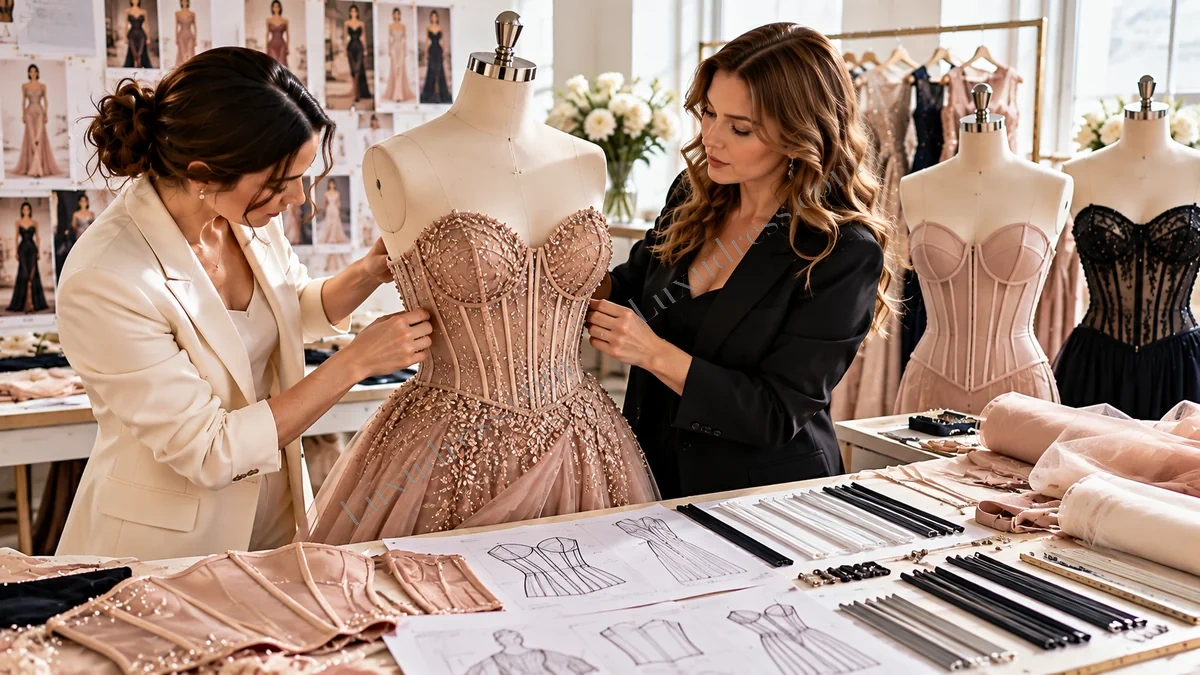
Bones follow lines, not spaces
A bone has to sit on a seam, a channel or a designed support line, because that is where the garment can carry it without the channel distorting. A bone placed where there is no line underneath pushes at the fabric and eventually prints through the shell or bends outward. The layout is therefore derived from the panel structure rather than added to it — which is why a bodice commissioned with a bone count rather than a bone layout tends to come back with the count satisfied and the behaviour wrong.
Ends and edge clearance
Bone ends need finishing and enough clearance from the seam they run alongside. A tip that sits too close to the edge will eventually work through it, and a tip that is left exposed inside the garment will mark the wearer. This is one of the few bodice decisions that is purely a construction standard and has no design dimension at all: it is either done or it is a latent defect, and it belongs in the specification as an explicit line rather than as expected good practice.
More bones cannot fix a pattern
This is the correction most often attempted and least often successful. Adding bones to a bodice whose pattern shape does not match the block adds stiffness to a shape that is already wrong, and the result is a garment that holds its incorrect line more firmly. Where the evidence is vertical wrinkles over the bust or diagonal drag lines toward the waist, the fault is pattern, and the answer is a pattern correction with the boning layout redrawn to suit it.
Control neckline and top edge
The top edge is where a structured bodice most often fails visibly, because it is the part of the garment closest to the wearer's skin and to the customer's eye.
Stabilising the edge
Stay tape, underlining, a facing or a discreet internal elastic can each stabilise a neckline, and the right choice depends on how much support the edge is being asked to give and how much it is allowed to show. An edge that only needs to keep its line needs very little; an edge that is absorbing load needs a stay and a structure behind it. Fashion tape is a styling aid and cannot be the answer to a production problem, because the customer will not have any.
The edge should lie close without cutting
The target is an edge that follows the body without pressing into it, and the test is time rather than appearance. An edge that looks correct on a form and marks the skin after an hour of wear is a construction problem that will be reported as a comfort complaint. Testing on a body for the length of a real event, seated for part of it, is the only way to find it — and where a brand has no fitter, the next best test is a form left loaded past the point where the skirt's weight has settled.
How a structured bodice behaves over an evening
A bodice is usually approved in the first five minutes of wear and judged by the wearer in the third hour. Three things change over that period and none of them is visible in a quick try-on. The skirt settles, which moves load from the waist seam into whatever structure is carrying it. The wearer relaxes her posture, which changes the tension at the top edge and at the closure. And the garment takes up moisture and warmth from the body, which slightly changes the friction between the lining and the skin.
The test that follows is a duration test: the sample worn for the length of a real event, seated for a substantial part of it, with every pressure point logged while it is still a pattern change rather than an alteration. A bodice that passes is one whose support path reaches the waist, whose closure has secondary support, and whose top edge is stabilised rather than tensioned. Those three are the difference between a structured bodice that can be sold across a size range and one that only works for the person it was fitted on.
Strapless needs lower anchoring
A strapless bodice has no upper path for load, so everything depends on how it grips below the ribs and at the waist. That grip comes from the pattern's relationship to the block, an internal support that reaches the waist, and a closure that can be adjusted. Where a strapless bodice is expected to stay up on the strength of the top edge alone, the top edge will be over-tensioned and will either cut in or slip — and both outcomes are visible within minutes of the wearer moving.
Engineer the back closure
The closure carries the tension the bodice needs in order to hold its shape, and it is the component most likely to be specified by its appearance.
Zippers need reinforced allowances
A zip set into a bodice under tension will ripple unless the seam allowance and the fabric around it can take that load. On a structured bodice the reinforcement is part of the pattern — a stay, an interfaced allowance, or a facing that distributes the pull — rather than something added at the machine. Where a zip ripples on the sample, the correction is usually the support behind it rather than a different zip.
Lace-up backs
A lace-up back is the most forgiving closure in terms of adjustability and the least forgiving in terms of construction. The eyelets or loops have to be set into a panel that can carry the tension of the lacing without deforming, and the cord has to be durable enough to be pulled repeatedly. The reward is real: a laced back allows a bodice to be adjusted to the wearer, which reduces the pressure on the fit of the pattern. The risk is that the adjustability becomes an excuse for a pattern that does not grip, and the garment then depends on the customer lacing it correctly.
Hooks and secondary support
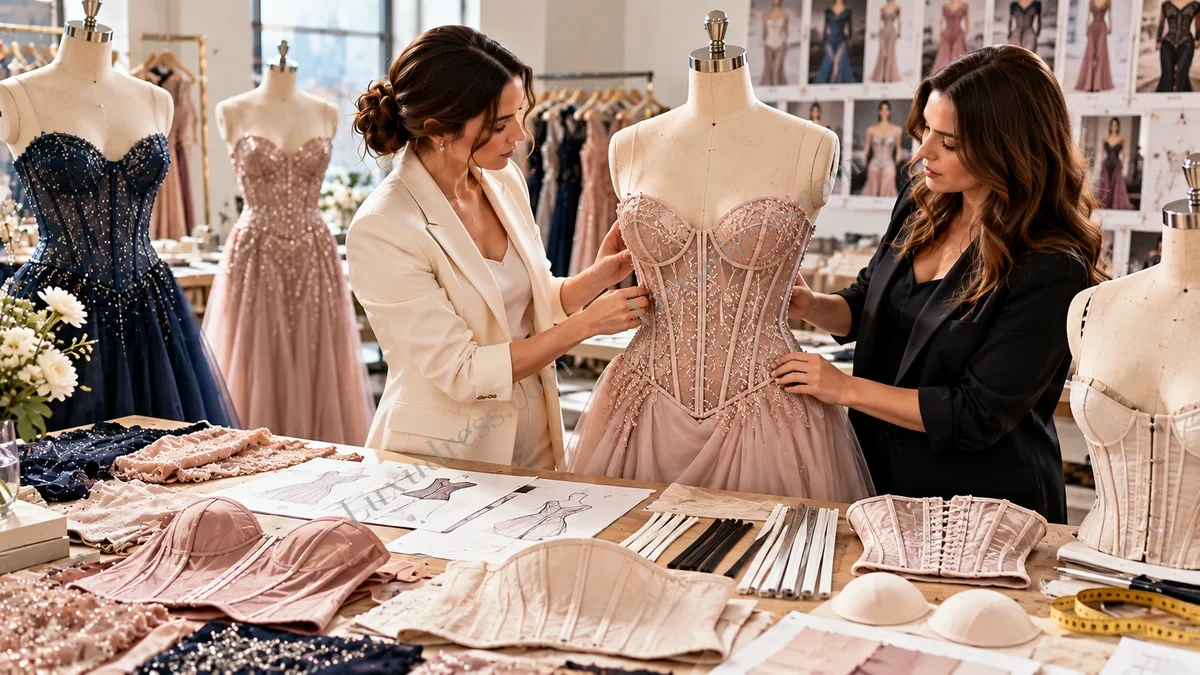
A hook and eye above a zip, or a pair of hooks at the top of a laced panel, takes peak tension off the closure that carries the rest of the load. It is a small component with a large effect on whether a bodice stays closed through an evening, and it is invisible in the design. On a bodice with a heavy skirt or a strong waist compression, the secondary support is what keeps the closure from being the first thing to fail.
Closure choice changes the size strategy
A closure with adjustment built in — lacing, or a zip combined with hooks — buys tolerance in a size run, which is a merchandising decision as much as a technical one. A fixed closure demands that the pattern be right across the range, and it makes any mid-range fit compromise visible at the point of sale. Where a brand plans a wide size range from one bodice block, the closure is one of the tools available to make that range work, and it is worth deciding deliberately rather than by styling.
The five symptoms and what each one means
This is the table worth keeping beside the fitting photos. It is not exhaustive, and its purpose is to point at the class of correction rather than to be a diagnosis on its own.
| What you see | What it usually means | Where the correction belongs |
|---|---|---|
| Vertical wrinkles over the bust | The pattern is too long or too narrow through the upper bodice for this block | Pattern — bust length and width at the apex line |
| Diagonal drag lines from the bust to the waist | The garment is being pulled off the intended line, often by a cup set too low or a waist that is too tight | Pattern and cup placement together |
| The neckline gapes when the wearer moves | The top edge is being asked to hold shape it has no structure for | Edge stabilisation, a stay, or a redrawn neckline with less upper edge |
| A bone bends outward or prints through the shell | The bone is off a seam or channel line, or the channel is being pulled by tension elsewhere | Boning layout, and the support beneath it |
| The bodice slides down in wear | The load is reaching the top edge or the closure rather than the waist and body | Internal support, waist anchoring, and the closure's secondary hook |
Read two symptoms together
A single symptom can have more than one cause, and the reading becomes reliable when two appear together. Vertical wrinkles at the bust and a bodice that slides down usually mean the pattern is not gripping below the ribs and the cup is not carrying load, which is one correction rather than two. A gaping neckline and a bone printing through the shell suggest tension being resolved through the top edge rather than through structure. Diagnosing in pairs is faster than chasing each fault separately.
What the bodice specification has to carry
The output of the diagnostic is a specification that makes the correct bodice repeatable. Each line below exists because its absence produced one of the symptoms above.
| Line | What it fixes | What its absence produces |
|---|---|---|
| The block the bodice is cut from | Where volume and grip sit | A bodice that is correct on one block and wrong on another |
| Cup type, size and apex position | Where support comes from and what the neckline can do | Pressure at the upper bust, or an unsupported garment |
| Bone type, layout and count | How the bodice holds its curve under load | Bones off-line, printing through, or bending outward |
| Channel construction and bone end finishing | Whether the bones stay where they were placed | Latent defects that appear after several wears |
| Top edge treatment and any stay | Whether the edge lies flat without cutting | A neckline that gapes or marks the skin |
| Closure type, reinforcement and secondary hook | Whether the bodice stays closed and stable | A rippling zip, or a closure that fails under tension |
| Intentional compression or ease, stated | Whether the fit is a decision or an error | The garment read as too tight or too loose against no standard |
State the intention
The last line in that table is the one most often missing, and it is the cheapest to add. A structured bodice deliberately compresses at the waist and deliberately leaves ease at the bust, and both of those read as defects to anyone who does not know they were intended. Writing them down converts them from faults into specifications — and it is the difference between a fitting comment that gets actioned and one that gets argued about.
Practical buyer worksheet
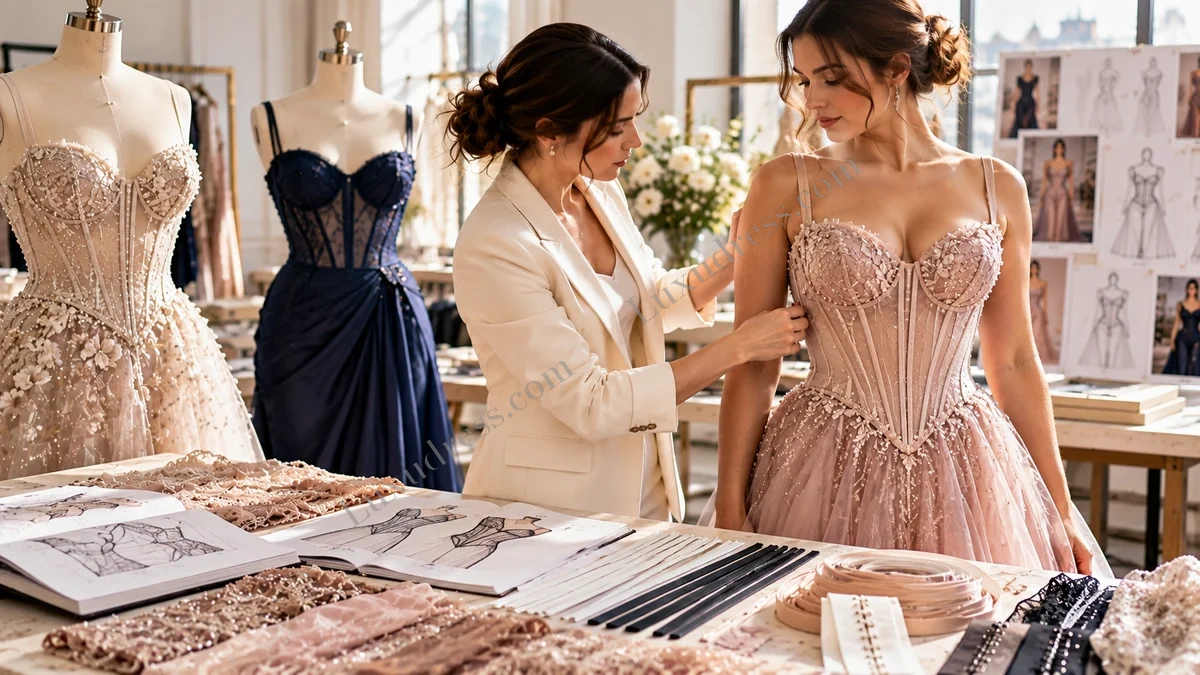
Fill this in before the bodice is sampled. For a structured bodice the seventh line is the load-bearing one: a named construction-risk list is what turns a fitting session into a set of corrections rather than a conversation.
- Target customer and use occasion
- Target retail and wholesale price
- Target ex-factory or landed cost
- Core fabric and backup fabric
- Size range and base fit size
- Colour count and continuity colours
- Critical construction risks
- Approval sample required
- Inspection checkpoints
- Latest acceptable delivery date
FAQ
Why does a corset dress slide down?
Usually because the load has nowhere to go except the top edge. A bodice that is gripping only at the chest and at the closure is relying on tension in the fabric rather than on structure reaching the waist, and once the wearer moves, that tension resolves downward. The contributing causes are commonly a pattern that does not follow the ribs and waist, a cup that is not supporting from beneath, an internal structure that stops above the waist, or a closure that cannot be adjusted. The correction is almost always structural rather than a matter of taking the bodice in.
What makes boning bend outward?
Three causes, usually in combination. The bone is not sitting on a seam or a designed support line, so there is nothing holding it in plane. The channel is being pulled by tension elsewhere in the bodice, which twists it. Or the bone type is too stiff for the curve it has been given, so it resolves the difference by bowing away from the body. Because the causes are different, the corrections differ: redraw the layout, remove the tension that is pulling the channel, or change the bone. Adding more bones addresses none of the three.
Is a lace-up back more forgiving?
It offers adjustability, which genuinely helps with a wide size range and with the small variation between wearers in the same size. It is not a substitute for a bodice that grips: a laced panel over a pattern that does not follow the body still slides, and the customer is then adjusting a garment that has no correct position for her to adjust it to. It also needs stronger construction than a zip, because the lacing tension is applied by the wearer every time the dress is put on, at eyelets or loops set into a panel that has to stay flat under repeated pulling.
Should boning be visible?
That is a design decision and both answers are legitimate. What is not a design decision is what hidden boning does: it has to support the bodice without printing through the shell or marking the wearer, which places limits on its stiffness, its channel construction and its proximity to the surface. Where a design intends the boning to be seen, the channels become visible construction and their finish, alignment and consistency across the garment become part of the design rather than an internal detail — which is a higher standard, not a lower one, and it should be specified accordingly.
Next step
We develop and produce corsetry and structured occasionwear at our production facilities in Guangzhou and Dongguan, including block-matched bodices, cup systems selected per size band, spiral and flexible boning layouts drawn from the panel structure, edge stabilisation, and closures with the reinforcement their tension requires. Send your fitting photos and the symptoms you are seeing, and we will come back with a reading of the bodice and the corrections that follow rather than a suggestion to add structure. Request a quote, or see the constructions we run on our corset dress manufacturing page.
Our corset dress manufacturing guide walks the same garment through the stations that build it, and our prom dress grading guide covers what happens to a boned waist as it is graded across a size run. Silhouettes already in production are on our style library and ready stock pages, and the wider category is on the women's dresses page.