On this page
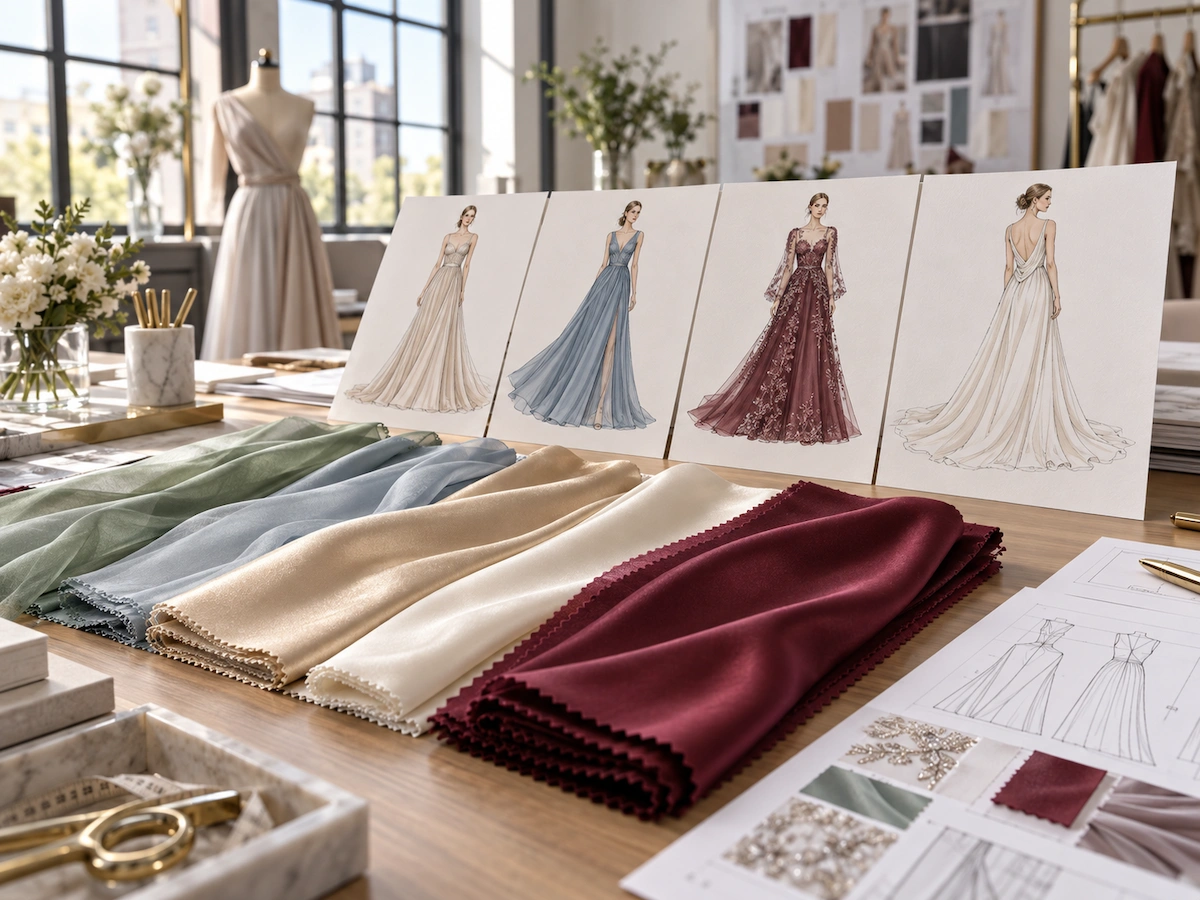
This guide is written as an operating system rather than a checklist. Positioning, assortment, development, costing and timing have to support one another. Get one wrong and the others quietly stop working — a beautiful range that cannot be reordered is a photography project, not a business.
It is written for the person building the first range: the founder pricing their first run, the buyer moving from general womenswear into occasion, the brand manager who has to explain why a launch slipped. The commercial pages behind this article are our occasionwear manufacturing range and our private label occasionwear service. Everything below is written in the order you should decide it.
Choose the market before the dresses
The first decision is not a silhouette. It is which buying occasion you are serving, because prom, bridesmaid, gala, cocktail, wedding guest and rental each impose a different calendar, a different price architecture and a different tolerance for construction risk. A prom buyer and a bridesmaid buyer are not the same customer wearing the same dress; they buy at different times of year, in different size distributions, and with different expectations about how long a style stays available.
Why occasionwear punishes generalists
A general womenswear brand can be mediocre at several things and still trade, because its customers buy on price, habit and convenience. Occasionwear does not work that way. The purchase is infrequent, emotionally loaded, photographed, and usually tied to a date that cannot move. The customer is not comparing you to another dress at the same price; she is comparing you to how she wants to look on that day, and she will forgive a higher price far more readily than a fit problem or a late delivery.
That is why the category rewards narrow focus at the start. A brand that is genuinely excellent at bridesmaid will outsell a brand that is adequate at bridesmaid, prom and gala, because the recommendation that matters in this category is word of mouth from someone who already had a good experience, and that recommendation is specific. Being the name someone mentions for one occasion is worth more than being on a shortlist for three.
The practical consequence is that you should be willing to say no to an order that is outside your occasion. A first-year brand that takes every enquiry ends up with a sample room full of one-off developments, no repeatable blocks, and no reputation for anything.
What each occasion actually demands
The table is a planning tool, not a market report. Read it as: if you serve this occasion, these are the constraints you are accepting.
| Occasion | Selling window | What the range needs | What kills it |
|---|---|---|---|
| Prom | Short, hard-edged season | Bold silhouettes, wide size run, colour breadth | Missing the season |
| Bridesmaid | Year-round, long order windows | Colour continuity, mix-and-match, extended sizes | Shade drift between batches |
| Gala / black tie | Year-round, event-driven | Structure, corsetry, higher price points | Fit failure at the bodice |
| Cocktail | Year-round, repeat purchase | Comfortable fit, versatile lengths | Weak differentiation |
| Wedding guest | Seasonal peaks | Dress-code coverage, photograph-friendly colour | Narrow assortment |
| Rental | Year-round, asset-managed | Durability, adjustability, replaceability | Cleaning and repair cost |
Two things follow from that table. First, a range cannot serve all six at once: the calendar alone makes it impossible. Second, the failure mode is specific to the occasion, so the controls you need are specific too. A bridesmaid business lives or dies on dye-lot control; a prom business lives or dies on the delivery date.
Write the three answers down
Define three things before any factory is briefed: the end customer, the price band and the selling channel. Those three answers determine the fabric you can afford, the construction you can specify and the quantity you can realistically buy — and they are the answers a manufacturer needs before a quote means anything.
The price band is the least glamorous and the most load-bearing of the three. A target retail of USD 180 and a target retail of USD 480 are not the same business: the first cannot carry hand-applied beading, and the second should not be made in a cheap crepe. Write the number down and design inside it, rather than designing and then discovering the number.
Trend-led, evergreen or a controlled mix
Trend-led ranges sell on imagery and die quickly; evergreen ranges sell on fit and reorder for years. A first collection is usually better served by a controlled mix: one or two image-driving statement pieces carried on top of a dependable commercial core, rather than a full line of statements. The statement pieces get you the first order. The core gets you the second one.
- Pick one primary buying occasion: prom, bridesmaid, gala, cocktail, wedding guest or rental.
- Define end customer, price band and selling channel before briefing a factory.
- Decide whether the first range is trend-led, evergreen or a controlled mix.
- Limit the first collection to a few strong silhouette families rather than many unrelated ideas.
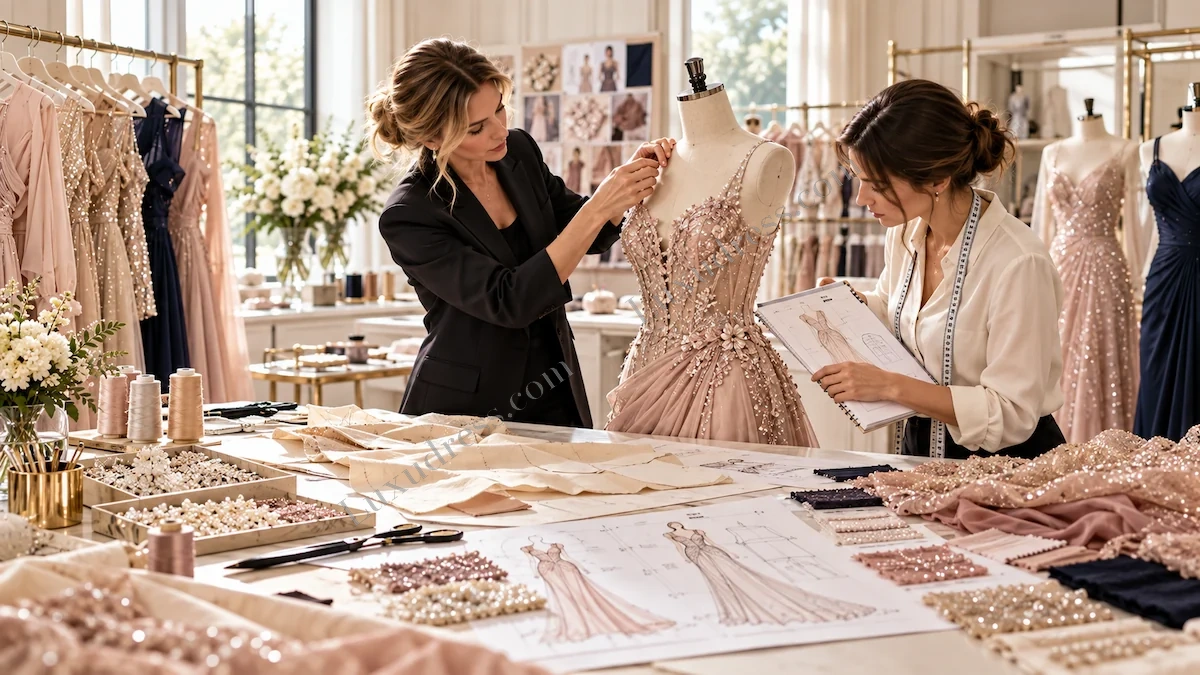
Build a commercially coherent first range
A first collection of six to twelve well-differentiated styles is normally easier to fit, merchandise and reorder than twenty. The reason is not austerity; it is that every additional unrelated silhouette adds a new pattern, a new fit risk and usually a new fabric — and each of those carries its own minimum.
The three-tier structure
Structure the range in three tiers and allocate budget deliberately rather than evenly. The tiers do different jobs and they should be judged on different measures.
| Tier | Share of the range | Job | How it is judged |
|---|---|---|---|
| Hero | One or two styles | Carry the imagery and the press | Does it get the brand noticed |
| Commercial core | Roughly half the range | Sell through and reorder | Sell-through rate and reorder volume |
| Image statements | One or two styles | Make the line look directional | Does it lift the whole range |
That structure gives you somewhere to put budget and somewhere to cut it. When the costing comes back high, the cut comes out of the statements, never out of the core — the core is what makes the second season possible.
What a first range costs to develop
Development cost is not the same as production cost, and confusing the two is why first-season budgets collapse. Development is the fixed cost of getting a style to an approved, graded, bulk-ready specification: pattern, fit rounds, sample materials, grading and the labour of a sample room. Production is the variable cost of making it again. The first is spent once; the second is spent every time you reorder.
Plan them as separate lines. A range of eight styles carries eight development costs regardless of how many units you eventually buy, which is exactly why a smaller, better-developed range usually beats a larger one at the same budget. If the development line is eating the production budget, the answer is fewer styles, not cheaper fabric.
| Cost line | Spent once or per order | What drives it |
|---|---|---|
| Pattern and fit rounds | Once per style | Construction complexity |
| Sample materials | Once per style | Fabric price and number of rounds |
| Grading | Once per style | Size range width |
| Bulk production | Per order | Quantity, fabric, operation count |
| Freight and duty | Per order | Volume, method, incoterm |
A useful discipline is to cost the development of the range before you approve the range. If the development line does not fit, the range is too big — and it is much better to discover that on paper than halfway through sampling, when half the money is already committed.
Share platforms across the range
Sharing is the single most effective lever a small brand has on both cost and consistency. If four styles run on the same shell fabric and two of them share a lining, the fabric minimum is met once instead of four times, and shade matching becomes one problem rather than four separate ones.
| Share this | Why | Watch out for |
|---|---|---|
| Shell fabric | One minimum instead of several; one shade approval | Do not share across price tiers that look different |
| Lining | Same logic, and lining drives comfort | Different opacity needs in pale colours |
| Colour story | Group orders and continuity reorders | Too many colourways still splits the dye lots |
| Closure and trims | Fewer trim minimums, faster repairs | A shared closure must suit every silhouette |
| Fit block | One fit approval covers several styles | Do not share a block across structured and fluid styles |
What actually sets the minimum
Do not plan against a single published number. For occasionwear the real minimum is set by four things, and which of them dominates depends on the design.
| Driver | When it dominates | What you can change |
|---|---|---|
| Fabric | Custom weave, custom dye, or a mill minimum | Move to a stock colour or a stock quality |
| Colour count | Every colourway is a separate dye lot | Fewer colourways, more styles per colour |
| Trims and embellishment | Buckles, moulded cups, bespoke buttons | Use a stock trim in a shared finish |
| Construction | Corsetry, boning, hand beading, specialist pressing | Reduce operation count before reducing quality |
That is why minimums on occasionwear are confirmed per style, colour, fabric and construction rather than quoted as one blanket figure. Ask your supplier which of the four is driving the number for your order; the answer tells you exactly which lever to pull if the number is too high. A simple satin column and a boned, beaded corset gown sit at opposite ends of that range even at identical piece counts.
Map target retail, landed cost and expected margin before final design approval, and protect cash for reorders instead of spending the entire budget on launch breadth. The most common first-season failure is a range that sold well and could not be repeated because the money was gone.
- Use a hero style, a dependable commercial core and a small number of image-led statements.
- Share fabric and colour platforms across multiple styles to reduce minimum pressure.
- Map target retail, landed cost and expected margin before final design approval.
- Protect cash for reorders instead of spending the entire budget on launch breadth.
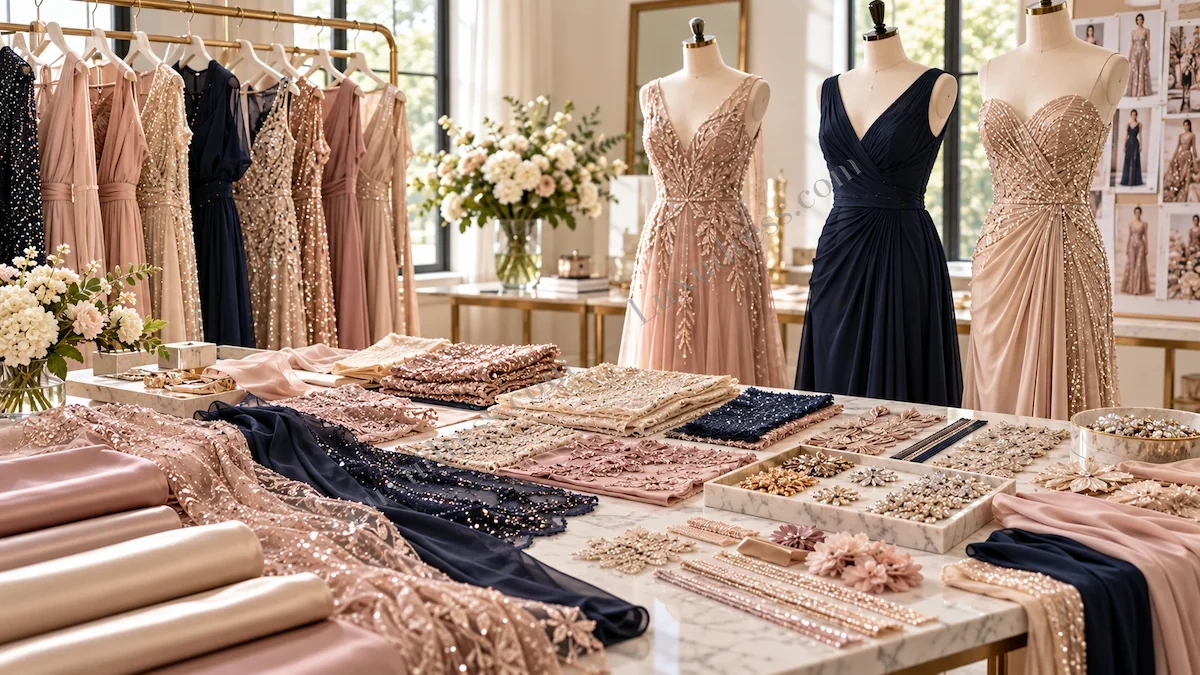
Turn ideas into factory-ready information
A mood board is not a brief. What a factory can act on is a sketch or reference photographs plus construction notes: shell fabric, lining, stretch, opacity, closure type, cups, boning, trims and hem treatment. The gap between a mood board and that list is where most first samples go wrong, because the factory fills it with assumptions and the buyer only discovers them when the sample arrives.
Specify in the order a technician reads
Write the brief in the order a garment is built. This is also the order in which a supplier will ask follow-up questions, so answering it upfront removes a round of correspondence.
| Order | Specify | Why it comes here |
|---|---|---|
| 1 | Shell: fibre, weight, stretch, opacity | Everything downstream depends on it |
| 2 | Hidden structure: lining, underlining, interfacing, boning, cups | Decides whether the garment holds its shape |
| 3 | Closure: zip, lace-up, hook-and-eye, buttons | Stress point and a common return cause |
| 4 | Hem, slit, train, and any length specification | Balance and floor clearance |
| 5 | Trims, labels, branding and packing | Commercial detail, separable from construction |
Skipping the hidden structure is the most common omission, and it is the part that determines whether the dress holds its shape after the third wear. A bodice listed as "boned" without saying what boning, in how many channels, over what underlining, is a specification that will be interpreted rather than followed.
What a technician will ask you next
Expect four follow-up questions on any first brief, and have the answers ready, because each one delays the quote by a day if it has to be asked. What is the base size and how should it be graded? What is the closure and where does it sit? How much support does the bodice need to carry — is it holding weight, or is it decorative? And what is the lining doing: opacity, comfort, or structure?
None of these are trick questions and none of them have a single right answer. What matters is that they are answered in the brief rather than discovered in the sample. A brief that answers all four typically produces a quote and a first sample on the first pass; a brief that answers none usually produces two rounds of clarification and a sample built on assumptions.
If you do not know an answer, say so and ask for a recommendation. A supplier who is asked for an opinion will usually give a good one, and it costs nothing — whereas a guess that you wrote into a specification becomes a specification you have to defend later.
Non-negotiables versus variables
Separate the two before you send anything. Write down which details you will not change and which you will trade away if the costing comes back high. When a quote needs to move, that list is the difference between a controlled negotiation and a redesign under time pressure.
As a working rule, treat fit and internal structure as non-negotiable and surface decoration as variable. A diamanté trim can be reduced without changing what the garment is. A bodice that does not support cannot be fixed later without redrafting the pattern.
What to send first
Eight items are enough for a meaningful first quotation: category, reference images, fabric direction, quantity per colour, size range, target price, branding needs and delivery window. Everything else can follow. What slows a quote down is not too little detail — it is the wrong detail, or an unstated assumption about one of those eight.
- Provide sketches, reference photos and construction notes, not mood boards alone.
- Specify shell, lining, stretch, opacity, closures, cups, boning, trims and hem.
- Define size range and base fit size early.
- Separate non-negotiable design details from features that can change after costing.
Use sampling as a decision process
Treat the first sample as a construction test, not a preview of the marketing shot. It exists to answer questions: does the bodice stay up, does the neckline gap when the wearer moves, is the waist where the sketch placed it, does the hem sit level, can the wearer sit down. Those are engineering questions, and they are much cheaper to answer in the sample room than in bulk.
The sample rounds and what each is for
| Round | Purpose | What you should decide at the end |
|---|---|---|
| First sample | Construction test on the base size | Does the structure work at all |
| Fit revision | Correct what the first round exposed | Is the fit approved for grading |
| Salesman or photo sample | Imagery and showroom, if needed early | Is the style presentable |
| Pre-production sample | Bulk reference, in bulk fabric and trims | Is this the standard bulk must match |
Keep the rounds separate in your own planning. The most expensive mistake in sampling is asking one sample to do all four jobs, because it then gets photographed before the fit is right and approved before the bulk fabric exists.
Review on a body, in this order
Review balance, neckline security, cup position, waist level, slit height, hem and movement — in that order, on a body, not on a hanger. Order matters: a bodice that does not sit correctly makes every judgement below it unreliable, so fixing the neckline before the waist is wasted effort.
Then have the wearer sit down, raise her arms and walk. Occasionwear is bought for events where people sit, dance and climb stairs, and a garment that only works standing still has not been tested.
The flash test and the comment log
Photograph the sample under direct flash. Flash is what exposes sheerness and shade differences, and it is the condition the garment will actually be photographed in by the customer. This is the cheapest test available and the one buyers skip most often.
Keep one controlled comment log. Splintering instructions across chat threads, emails and phone calls is how a second sample comes back with the first sample's problems plus new ones. Approve materials and colour separately from construction where it helps: signing off a satin shade does not have to wait for the boning to be right.
How long sampling takes
Our verified sample lead time is 7–10 days from tech pack approval for standard constructions. For corsetry, hand beading, sequins or special dyeing the sequence is longer, and it is confirmed after sample and material review rather than quoted as a fixed number, because the number depends on what the design actually asks for. Plan the calendar against the longer case and treat a faster result as a bonus.
- Treat the first sample as a construction test.
- Review balance, neckline security, cup position, waist level, slit height, hem and movement.
- Approve materials and colour separately when needed.
- Keep one controlled comment log rather than splitting instructions across multiple chat threads.
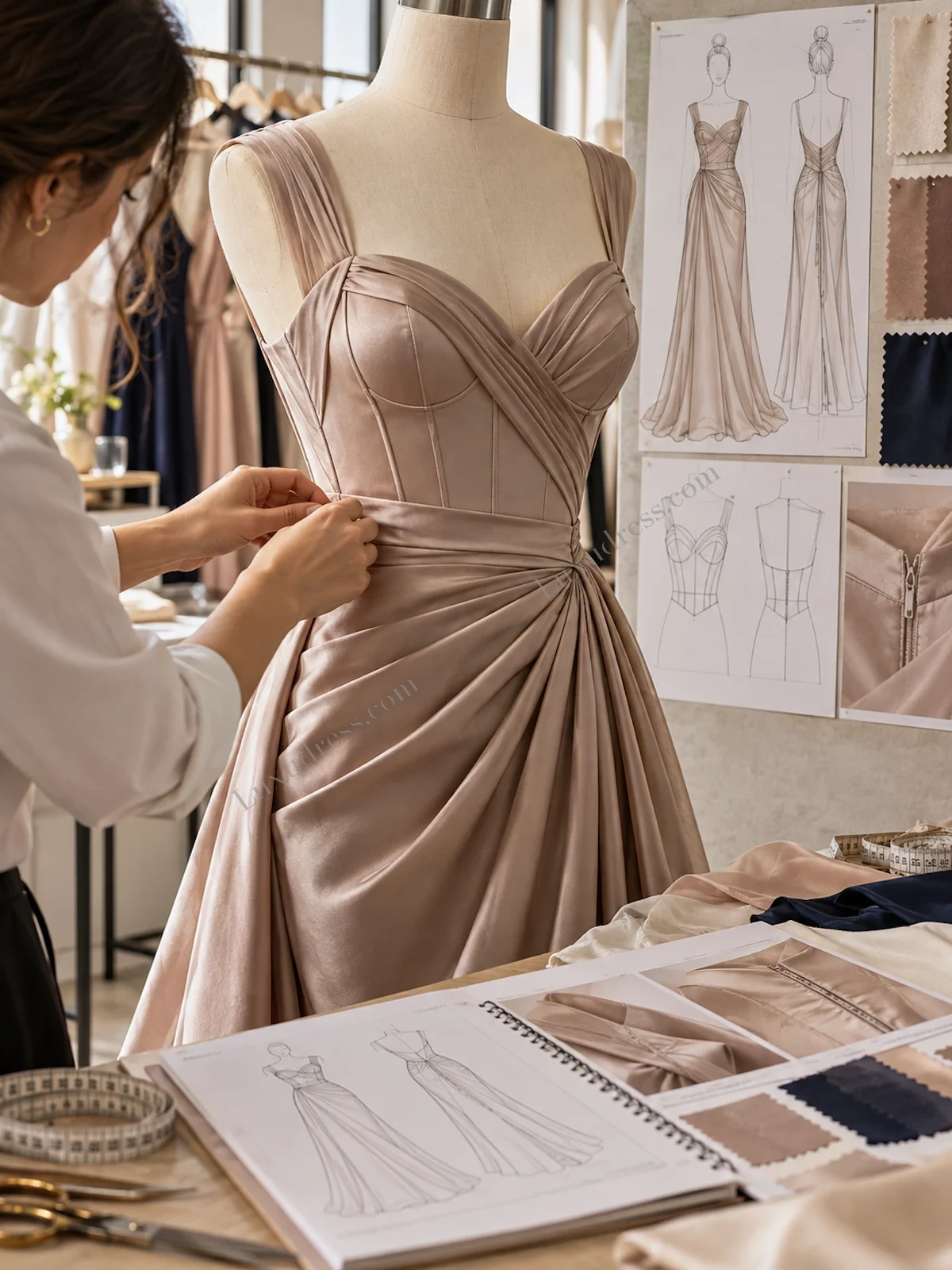
Launch with a calendar and reorder plan
Work backward from the date inventory must be sellable, not from the date you would like to start. Between that date and today sit sample revisions, grading, material approval, bulk production, inspection and freight — and freight is the one most often compressed until it becomes the problem.
A backward calendar
| Working backward | Gate | What can still slip |
|---|---|---|
| Selling date | Inventory on the shelf or in the warehouse | Nothing |
| Minus freight and clearance | Goods shipped | Freight method and documentation |
| Minus bulk production | Bulk cut and sewn | Capacity and material arrival |
| Minus inspection | QC passed, packed | Rework if defects are found |
| Minus material approval | Fabric and trims booked | Mill lead time and dye-lot approval |
| Minus grading | Base fit approved | Fit revisions |
| Minus sampling | Tech pack and first sample | Brief quality |
Read the table from the bottom. Every gate has something that can still slip, and the ones near the bottom are cheap to move while the ones near the top are not. That is the whole argument for starting earlier than feels necessary.
Contingency and continuity
Hold a contingency in both time and money. Material substitutions, a failed fit round and a remake are normal, not exceptional, and a calendar with no slack turns any one of them into a missed season. Identify likely continuity colours and styles before the first order is placed, so a reorder is a phone call rather than a new development project.
Ready stock as a shortcut
If you need product faster than a development cycle allows, that is what ready stock is for. We hold 260 ready-to-ship styles available from one piece, and a number of new brands use them to test which silhouettes and colours actually sell before committing to a custom range. The sales data from that test is a better brief than any forecast, and it costs a fraction of a development cycle.
- Work backward from the date inventory must be sellable.
- Reserve time for sample revisions, grading, material approval, bulk, QC and freight.
- Keep a small time and budget contingency for remakes or material changes.
- Identify likely continuity colours and styles before the first order is placed.
Practical buyer worksheet
Ten fields. If you can complete them, you have a brief a factory can quote against within twenty-four hours — this is the same list we work from on the quote request form:
- Target customer and use occasion
- Target retail and wholesale price
- Target ex-factory or landed cost
- Core fabric and backup fabric
- Size range and base fit size
- Colour count and continuity colours
- Critical construction risks
- Approval sample required
- QC checkpoints
- Latest acceptable delivery date
FAQ
How many styles should a first collection have?
A focused range of roughly 6–12 well-differentiated styles is often easier to fit, merchandise and reorder than a broad launch. Breadth costs development budget and splits it across more fit risks, and each additional unrelated silhouette usually brings its own fabric and its own minimum. Start with the number you can develop properly, not the number that makes the line sheet look complete.
Should a new brand start with ready stock or custom OEM?
Ready stock is useful for market testing: it tells you what sells without a development cycle, and it is available from one piece. Custom OEM makes more sense once fit, design language and margin targets are clear. Many brands do both — test with ready stock, then develop the winners — which is usually cheaper than guessing at a first custom range and cheaper than running a second one to correct the first.
What should I send a manufacturer first?
Category, reference images, fabric direction, quantity, size range, target price, branding needs and delivery window. That is enough for a meaningful quotation. A full tech pack follows if you proceed to sampling, and it is built from the same eight items plus the construction detail the first sample round adds.
What is the biggest early-stage mistake?
Trying to solve design, fit, materials, packaging and too many styles at the same time. Sequence them: fit and fabric first, breadth later. Brands that sequence the work get a second season; brands that try to do everything at once usually spend their whole budget on the first one and learn the expensive way what should have been tested first.
Next step
Developing an evening, prom, bridesmaid or occasionwear collection? Luxudress supports fabric sourcing, pattern development, sampling, private label, quality control and bulk production from our production facilities in Guangzhou and Dongguan. Send reference images or a tech pack together with target quantity, size range, fabric direction and delivery window, and we will come back within twenty-four hours with an itemised view of what is achievable. You can also browse the women's dresses we run and the style library before you write the brief.