On this page

Once bulk starts, there is no cheap way back. We say that plainly because it is the one thing new buyers underestimate. Before the cutting tickets print, a change costs a conversation. After the marker is laid and the line is running, the same change costs fabric, labour, and calendar days you cannot get back. The dress you approved as a sample is not the same thing as the one that comes off a production line of forty operators. The sample was made slowly, by a senior hand, against a single piece. Bulk is made fast, by a team, against a standard. The gap between those two is where most expensive mistakes live.
This is a checklist. It is written to be saved, printed, and carried into your pre-production meeting. Every item below has three parts: what to check, what a pass looks like, and what happens if you skip it. We have seen every consequence in this list happen on a real order. None of them are hypothetical. Read it once before you approve the pre-production sample. Read it again on the day bulk is meant to start.
Our minimum is one hundred pieces per design, with one hundred to two hundred per colour depending on the fabric and whether it has to be dyed to order. Sampling runs seven to ten days. Bulk runs twenty to twenty-five days in peak season and fifteen to twenty off season. A quote with a complete brief comes back within twenty-four hours. Those are the constraints this checklist works inside.
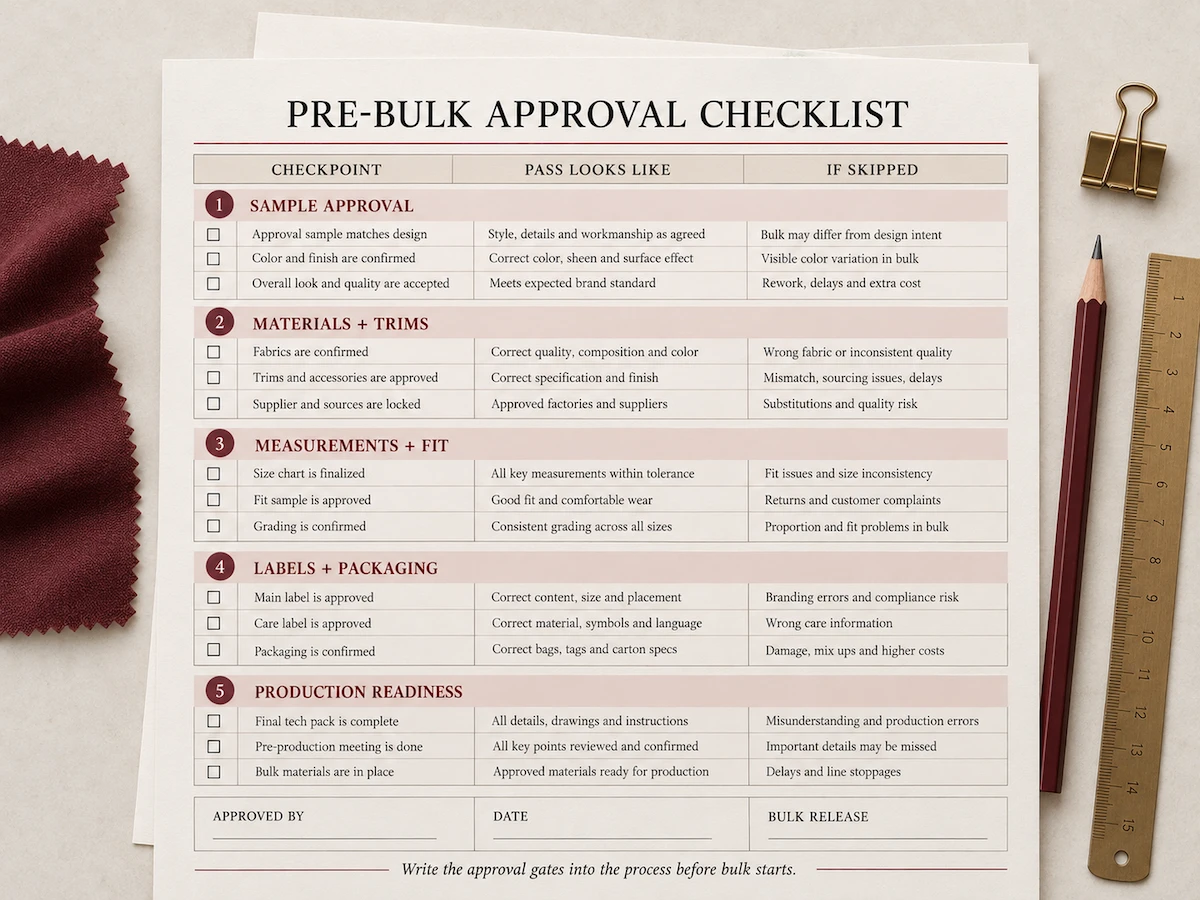
The five categories below cover the whole run from the moment you approve the sample to the moment the carton is booked. Work them in order. A weak pre-production confirmation cannot be fixed by a strong shipping check. Each category is built as a table you can tick off, followed by one example of what happens when that category is ignored.
1. Pre-production confirmation
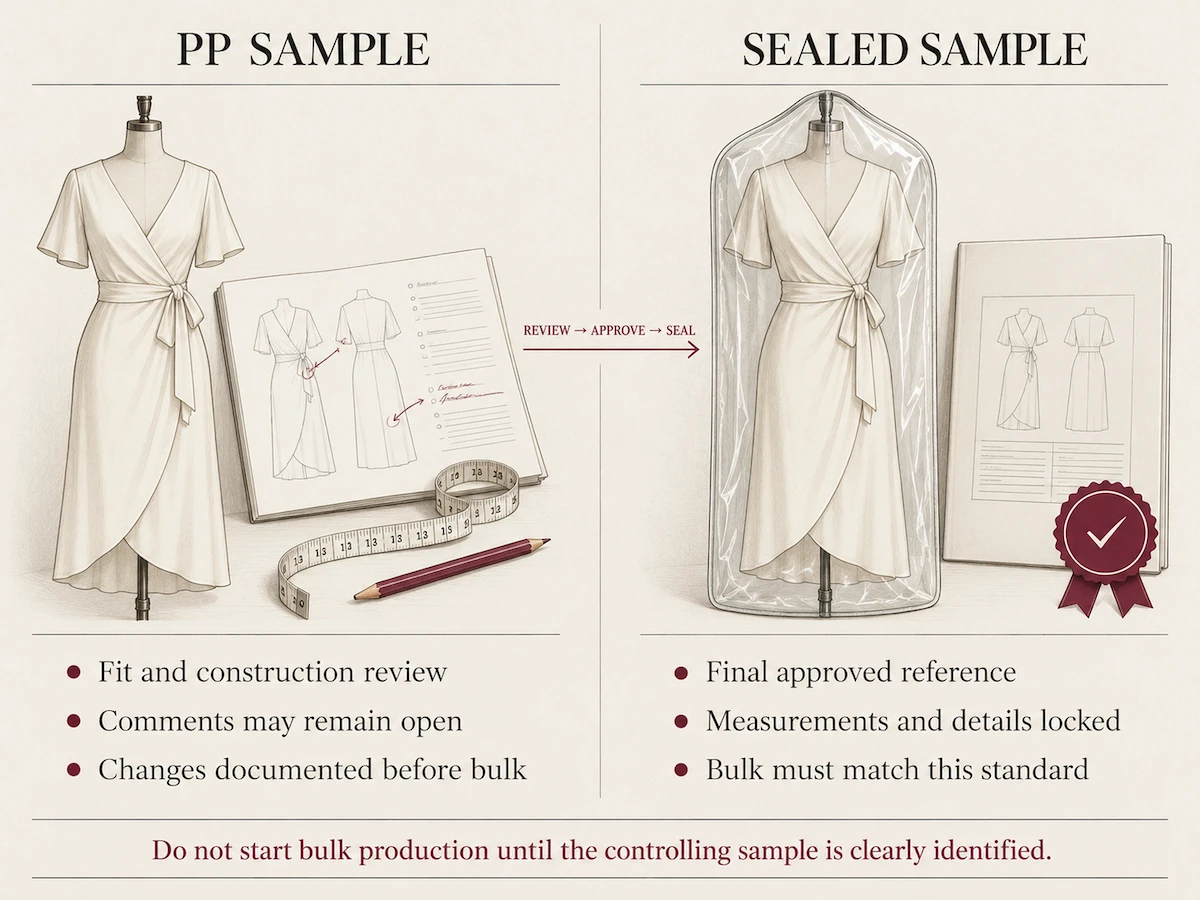
This is the layer most buyers treat as paperwork and most factories treat as the contract. The pre-production sample is the physical agreement. Everything downstream is measured against it. If the document and the sample disagree, the line stops, and a stopped line costs money every hour.
| What to check | What "pass" looks like | Consequence of skipping |
|---|---|---|
| Sealed pre-production sample | One signed garment locked in a sealed bag, dated, with both parties holding a copy | You argue about the standard after 600 pieces are sewn, and nobody can prove what was agreed |
| Approved colour standards | Every colour signed off against a physical swatch, not a screen shot | Two slightly different blues ship in one order and the customer thinks it is a defect |
| Tech pack version locked | A single file version marked "APPROVED", with older versions archived | An operator works from last week's file and builds the wrong neckline on the whole run |
| Construction and sewing spec | Stitch type, seam allowance, and finish written per seam, not "as sample" | Each operator interprets the seam their own way and the garment loses its shape across sizes |
| Trim card confirmed | Every button, zip, label, and thread swatched and signed on one card | The wrong zip arrives at the line, bulk stalls for nine days waiting on a replacement |
| Care label and branding copy | Care symbols, fibre content, and brand text proofed and signed | A wrong fibre claim on the care label becomes a compliance problem at the port |
| Packing specification | Polybag, hangtag, carton, and folding method written and sampled | The packed carton cubes out wrong and you pay for a half-empty container |
| PO, price, and ship date | Purchase order, unit price, and dated delivery all confirmed in writing | The factory schedules your job behind a larger one and your season misses its window |
The single most common failure here is treating the pre-production sample as a formality. It is not. It is the reference every inline checker uses at hour three of the run and hour three of day nine. If it is not sealed, signed, and duplicated, you have no agreed standard. You have a memory, and memories diverge under production pressure.
One order stays with us as the textbook case. The buyer sent a revised neckline by email on a Tuesday. The factory had already cut the first two hundred pieces on the Monday file. The difference was a two centimetre facing. The whole batch needed a re-cut band, and the ship date moved by eleven days. The cost of version-locking the tech pack was zero. The cost of skipping it was a lost season for a small label that had pre-sold the style.
2. Fabric and trims
Fabric is where cost and quality are both decided, and it is where most bulk surprises start. A fabric that tested fine as a swatch can behave differently by the roll. Trims are smaller but they fail loudly, often at the worst possible moment, which is the day before the container closes.
| What to check | What "pass" looks like | Consequence of skipping |
|---|---|---|
| Fabric composition and weight | Lab report confirms fibre mix and grams per square metre matches the order | The delivered cloth is 12% lighter than the sample and the garment drapes differently |
| Shrinkage tested and allowed | Pre-shrink test run, result noted, marker adjusted for it | Garments shrink after the first wash and come back as returns |
| Colourfastness (rub, wash, light) | Rub, wash, and light tests passed to the agreed grade | A white bag stains from a dress in the same carton and the whole shipment is disputed |
| Dye lot continuity | All bulk fabric from one dye lot, or lots approved side by side | A visible seam appears where two slightly different lots meet in one garment |
| Zip and button quality | Pull test and cycle test done on a sample of the actual trims | The zip jams on the carton line and 400 units fail final inspection |
| Hardware compliance (nickel, lead) | Metal trims pass nickel and lead screening for the target market | A failed test holds the goods at customs and the air freight to recover costs more than the margin |
| Lining and interlining matched | Lining weight and interlining type confirmed against the shell | The lining shows through a light shell and the dress looks cheap on the hanger |
| Fabric inspection (4-point) | Incoming cloth inspected on the 4-point system, defects graded and accepted or rejected | A hidden flaw runs down a roll and 90 pieces carry a slash mark no one caught |
Colourfastness is the one buyers ask about least and regret most. A dress and a white blouse packed in the same carton is a real scenario, and if the dye bleeds in transit the claim is not one garment, it is the carton. We test to the grade the market requires before bulk, not after.
We once took delivery of bulk jersey in two dye lots because the first lot ran short and the mill topped it up from a later batch. The difference was invisible on the bolt. On a colour-blocked style, the seam between the two lots read as a shadow line. The buyer rejected the carton and the fix was a full re-dye of lot two at our cost. A continuity check at the booking stage costs nothing and saves a carton of rejects later.
3. Size specifications

A size chart is only useful if it is the one everyone is measuring against, and if the tolerance around it is agreed in writing. Most fit complaints are not bad sewing. They are a chart that was never signed, or a tolerance nobody set, or a grade that drifted between the smallest and largest size.
| What to check | What "pass" looks like | Consequence of skipping |
|---|---|---|
| Graded size chart signed | All sizes on one approved chart, signed, with the block it is graded for | Each size is cut to a different chart and the range does not hang as a set |
| Sample measured against chart | Every key point measured on the sealed sample and recorded | The sample fits the body but not the chart, so bulk follows the wrong one |
| Tolerance agreed | Written allowance, e.g. plus or minus 1 cm on length, agreed by both sides | A 1.5 cm drift is rejected by your QC and half the run is reworked |
| Fit on body confirmed | Fit sample tried on a real model in the target size range | The garment passes the ruler but not the mirror and sells poorly |
| Grade rules set | How each point grows between sizes documented, not left to the grader | The xl is longer than the s in a way that looks wrong on the rail |
| Size ratio confirmed | Exact count per size locked to the order, e.g. 30/30/30/10 | The factory cuts an even split and you are long on the sizes that do not sell |
| Measurement method agreed | Same measuring protocol on both sides, including where the tape sits | Your inspector and ours record different numbers for the same garment |
| Size label and FNSKU mapping | Each size maps cleanly to its label and its marketplace code | The wrong FNSKU is applied and Amazon inbound rejects the carton |
Grading is where small brands lose money quietly. A grade rule that is not written down gets rebuilt by whoever runs the marker, and a rebuilt grade is a new garment. Set the rule, sign it, and keep it with the sealed sample so the two never drift apart.
A buyer once graded for the US block while our line defaulted to a UK grade on the first run. The UK size twelve ran narrower at the hip by three centimetres. The dresses passed the ruler against the wrong chart and failed the mirror in the showroom. The error was caught at the pre-production fit, not in bulk, because the chart was signed and the sample was measured against it. That is the entire value of a signed chart. It turns a silent mistake into a caught one.
4. Production setup
This is the machinery of the run. The sample proved the garment could be made. Production setup proves it can be made two hundred times the same way. Skip a step here and the failure shows up at final inspection, which is the most expensive place to find it.
| What to check | What "pass" looks like | Consequence of skipping |
|---|---|---|
| Marker and lay plan approved | Marker planned for the fabric width, pieces nested to minimise waste | Fabric consumption runs 9% over the quote and the order loses its margin |
| Cutting tickets issued | Each bundle carries a ticket with style, size, and quantity | Bundles get mixed on the line and sizes are sewn in the wrong ratio |
| Machine settings confirmed | Stitch length, tension, and presser set and sampled on scrap | The first 80 units show puckering and have to be unpicked and redone |
| Line operators briefed | The sewing spec was shown to the operators running the style | An operator uses a shortcut that saves seconds and ruins the seam |
| Inline QC checkpoints set | Named check points in the process, not only a final look | A construction error repeats across 300 pieces before anyone notices |
| Sealed sample at workstation | The sealed sample sits at the line, not in an office | Operators forget the detail and the bulk drifts from the approved version |
| Bulk fabric re-checked on arrival | Incoming bulk cloth re-tested against the approved swatch | The bulk dye lot is off and the whole run is the wrong shade |
| Pressing and finishing protocol | Press temperature and finish method written and sampled | A heat mark burns a panel and 50 pieces are unsellable |
| Carton cube planned | Carton size and how many units per carton calculated up front | The packed goods do not fit the booked space and freight jumps |
The marker is the quiet money line. A marker planned for a 145 cm width that is actually cut on 110 cm cloth eats fabric you already paid for in the quote. We plan the marker against the real bulk width before the lay, not after, because that is the only point where the waste is still free to fix.
On a pleated skirt we once planned the marker for 145 cm cloth. The bulk arrived at 140 cm after a mill substitution that nobody flagged. The lay was not re-planned. Consumption ran eight per cent over the quote across five hundred pieces. The fabric overage ate the margin and then some. The width now gets confirmed on the incoming inspection ticket before the lay is cut. The check is one line on a form and it protects the whole order.
5. Shipping
Shipping is where a perfect garment becomes an unhappy delivery. The goods can be flawless and still arrive late, mislabelled, or undocumented. The last week of an order is also the week with the least slack, so the checks here are worth doing early, not at the dock.
| What to check | What "pass" looks like | Consequence of skipping |
|---|---|---|
| Carton dimensions and cube | Carton size and total cube calculated and shared before booking | The cartons do not fit the container plan and you pay for empty air |
| Gross and net weight | Both weights recorded per carton and per shipment | The freight quote was based on wrong weight and the carrier re-invoices |
| FNSKU or barcode applied | Correct barcode on each unit or each packing unit, scannable | The marketplace cannot receive the stock and it sits in a warehouse |
| Shipping marks and carton labels | Carton face marked with style, size, and count, readable | The receiver opens the wrong carton and the count goes missing |
| Packing list and commercial invoice | Documents match the cartons exactly, down to the unit count | Customs queries the mismatch and the container is held for days |
| Compliance documents | ISO 9001, OEKO-TEX STANDARD 100, amfori BSCI audit, SGS inspection records attached as required | A missing certificate blocks the shipment at the buyer's border |
| Booking and cut-off confirmed | Vessel or truck booked, cut-off time confirmed in writing | The goods are ready and the slot is gone, pushing the date by a week |
| Cargo insurance | Cover confirmed for the declared value on the agreed terms | A damaged carton at sea becomes a total loss with no recovery |
Carton cube is the part buyers forget and freight forwarders charge for. A carton that is two centimetres too deep cubes out at a loss across a full container, and that loss is yours. We calculate the cube from the real packed carton, not from an estimate, before the space is booked.
A winter coat order once shipped on an estimated carton. The real packed carton was four centimetres deeper because of the hanger and the tissue. The booked container held sixty cartons fewer than planned. The forwarder charged for the empty space and the balance moved by air at three times the rate. The cube is now calculated from a packed sample carton, never from a number on a spec sheet. That single check has paid for itself more times than we can count.
Printable checklist
This is the save-and-print version. It strips the tables to one line per item so you can tick it on a phone or a printed page. Work it top to bottom. An empty box means the run is not ready to release. We use the same list on our side before we cut the first bundle, and we can fill it with you during the pre-production meeting.
Tick each box before you release bulk. If a box is empty, the run should not start.
- [ ] Pre-production sample sealed, signed, and duplicated
- [ ] Colour standards approved against physical swatches
- [ ] Tech pack version locked, older versions archived
- [ ] Construction and sewing spec written per seam
- [ ] Trim card confirmed with every component swatched
- [ ] Care label and branding copy proofed
- [ ] Packing specification sampled and agreed
- [ ] PO, price, and ship date confirmed in writing
- [ ] Fabric composition, weight, and shrinkage verified
- [ ] Colourfastness (rub, wash, light) tested to grade
- [ ] Dye lot continuity confirmed
- [ ] Zip, button, and hardware tested and compliant
- [ ] Lining and interlining matched to the shell
- [ ] Incoming fabric inspected on the 4-point system
- [ ] Graded size chart signed for the right market block
- [ ] Sample measured against the chart and recorded
- [ ] Tolerance agreed in writing
- [ ] Fit confirmed on a real body
- [ ] Grade rules set and documented
- [ ] Size ratio locked to the order
- [ ] Measurement method agreed by both sides
- [ ] Size label and FNSKU mapping correct
- [ ] Marker planned against real bulk fabric width
- [ ] Cutting tickets issued per bundle
- [ ] Machine settings sampled on scrap
- [ ] Line operators briefed on the spec
- [ ] Inline QC checkpoints named
- [ ] Sealed sample placed at the workstation
- [ ] Bulk fabric re-checked on arrival
- [ ] Pressing and finishing protocol set
- [ ] Carton cube calculated before booking
- [ ] Gross and net weight recorded
- [ ] FNSKU or barcode applied and scannable
- [ ] Shipping marks and carton labels correct
- [ ] Packing list and invoice match the cartons
- [ ] Compliance documents attached (ISO 9001, OEKO-TEX STANDARD 100, amfori BSCI, SGS)
- [ ] Booking and cut-off confirmed
- [ ] Cargo insurance confirmed
What we handle for you
You should not have to run this list alone. On every order we open, our team owns the factory side of it so you are checking, not building the system from scratch.
We seal and keep the pre-production sample and hold a copy against your order. We run the fabric and trim verification, including the colourfastness and hardware compliance screening, before the line is set. We plan the marker against the actual bulk width and confirm the carton cube before freight is booked. We keep the sealed sample at the line and run named inline checkpoints so a drift is caught at unit forty, not unit four hundred.
Our production facilities in Guangzhou and Dongguan are ISO 9001 certified, OEKO-TEX STANDARD 100 referenced, amfori BSCI-audited, and SGS-inspected, so the compliance documents in the shipping section above are part of the standard file, not a favour. If something in your market needs a specific certificate, tell us during the quote and we attach it to the shipment.
We also keep the records that make the list auditable later. The sealed sample is photographed and stored against your order number. The fabric test results, the marker plan, and the carton cube are filed with the shipment so that if a question comes up six months after delivery, we can answer it from the same documents. A buyer running a recall or a quality claim needs that paper trail, and we build it as the order moves rather than assembling it after the fact.
The point of the checklist is not to make buying feel hard. It is to move the risk to the front of the process, where it is cheap to fix, and away from the back, where it is not. Send a complete brief and you get a quote within twenty-four hours. Approve the pre-production sample and the list above is what we work through together before the first bundle is cut. If you would rather we ran the whole pre-production confirmation on your behalf, say so in the brief and we will return it filled, with the boxes ticked and the open items flagged.
Related reading
- What should be in a clothing manufacturing quote?
- Three Dresses, Costed: What a Factory Actually Charges For
- How MOQ is calculated in clothing manufacturing
Ready to lock your pre-production spec? Send us your tech pack or reference images and we will come back within twenty-four hours with a quote and the checklist filled for your style.