On this page
- An Approved Sample Is a Standard, Not a Guarantee
- Sample Production and Bulk Production Are Different Operating Environments
- The Wrong Pattern Version Reaches Production
- The Fabric Is Technically the Same but Behaves Differently
- Sample Cutting and Bulk Cutting Do Not Create the Same Risk
- A Sample Machinist and a Production Line Work Differently
- Machine Settings Can Change the Result Without Changing the Design
- Pressing Can Change Fit More Than Buyers Expect
- Measurement Tolerance Is Not the Same as Target Measurement
- The Approved Sample May Contain Changes That Were Never Documented
- Bulk Fabric Relaxation and Shrinkage Can Change Measurements
- Trims Can Change Between Sample and Bulk
- Bulk Production Creates Cumulative Variation
- First-Piece Approval Is the Bridge Between Sample and Bulk
- Inline Quality Control Catches Drift Before It Becomes a Finished-Goods Problem
- A Golden Sample Helps Only If the Factory Uses It Correctly
- What Happens When the Tech Pack and Physical Sample Disagree?
- The Approved Sample Should Not Become a "Perfect Handmade Exception"
- How Buyers Can Reduce Sample-to-Bulk Variation Before Production Starts
- What Should Be Locked Before Bulk Cutting?
- A Practical Sample-to-Bulk Control Workflow
- Five Questions to Ask When Bulk Does Not Match the Sample
- Sample-to-Bulk Problems Are Often Handover Problems
- Not Every Difference Means the Bulk Order Is Defective
- The Best Bulk Production Starts With a Sample That Was Built for Production
- Final Checklist: From Approved Sample to Bulk Production
- The Real Lesson: Sample Approval Is a Transfer of Control
- Working With Luxudress
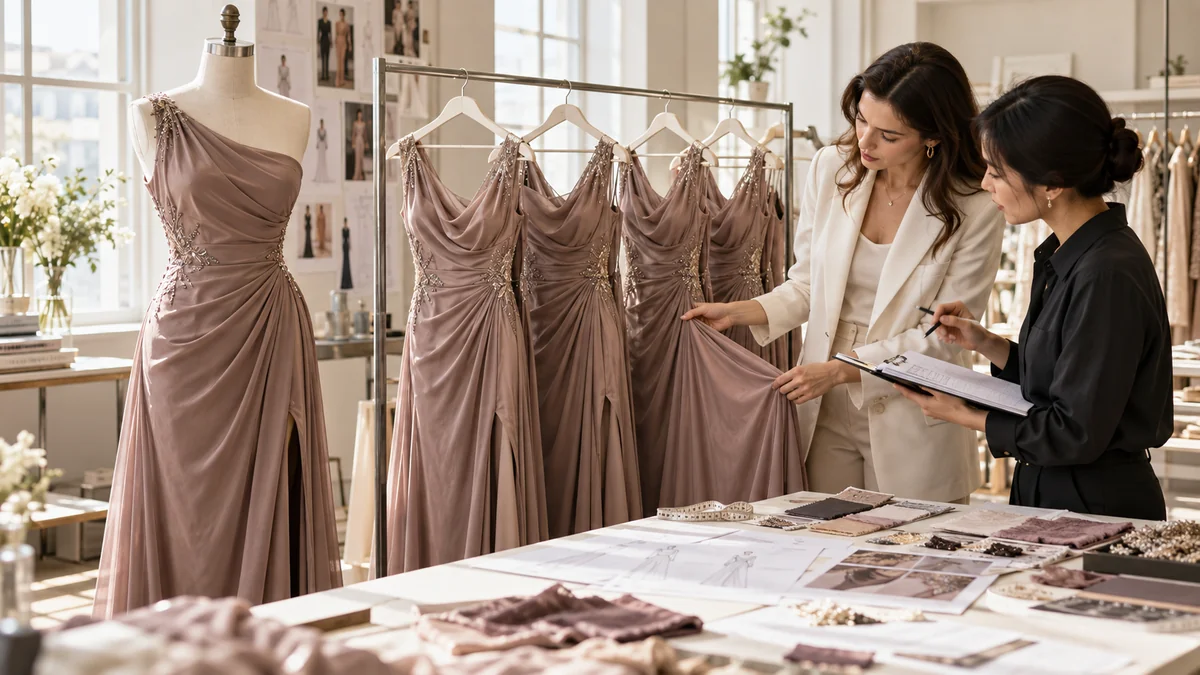
The sample was approved. The measurements were signed off. The fabric looked right. The zipper sat flat. The neckline held its shape. The buyer confirmed the comments were closed.
Then bulk production arrived.
The skirt fell slightly heavier. One neckline opened more than the approved sample. A zipper that had looked clean on the sample developed a small wave. Some garments measured within tolerance but still appeared different on the body. The factory insisted that production followed the specification. The buyer looked at the approved sample and asked the obvious question:
If the sample was approved, why does the bulk order not look exactly the same?
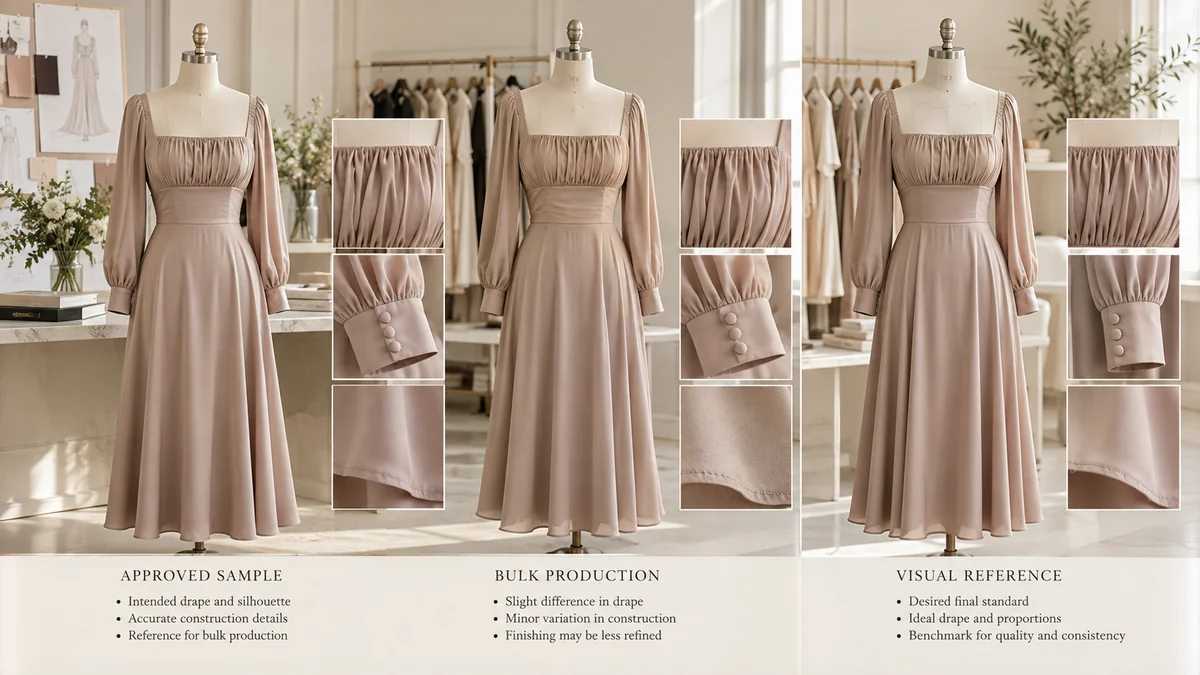
This is one of the most important questions in apparel manufacturing, because an approved sample proves that one garment can be made correctly. Bulk production has to prove something much harder.
That difference matters.
A development sample may be cut individually, sewn by an experienced sample machinist and pressed with extra care. Bulk production introduces fabric rolls, cutting lays, multiple operators, repeated machine settings, production speed, handling, finishing and inspection.
The goal is not to expect every garment to behave like a handmade one-off sample.
The goal is to identify which characteristics must remain fixed, which variations are acceptable and which production controls prevent small differences from becoming commercial problems.
This guide explains where sample-to-bulk differences come from, why some are difficult to detect before production begins and how fashion brands can build a more reliable handover from approved sample to bulk manufacturing. Two adjacent guides cover the ground either side of it: approving the sample in the first place and confirming everything before a run starts. This one assumes both and asks why the result still moves.
An Approved Sample Is a Standard, Not a Guarantee
An approved sample is important because it establishes an agreed reference.
Depending on the product and the manufacturer's process, the approved reference may include:
- the final pattern
- approved measurements
- fabric and colour
- lining
- trims
- construction methods
- seam positions
- labels
- artwork
- embellishment placement
- pressing and finishing
- overall appearance
However, one approved garment does not automatically control every variable in production.
A sample can answer: can this garment be made correctly?
Bulk production has to answer: can this garment be repeated consistently?
Those are not the same manufacturing problem.
A single sample may involve one cutter, one machinist and one piece of fabric. A 1,000-piece order may involve several fabric rolls, large cutting lays, different sewing operations, multiple operators, several machines, finishing staff and more than one inspection stage.
This is why brands should think of sample approval as the start of production control, not the end of product development.
Sample Production and Bulk Production Are Different Operating Environments
The physical garment may be the same design, but the manufacturing environment changes significantly.
| Area | Sample development | Bulk production |
|---|---|---|
| Cutting | Often one or a few garments | Multi-layer cutting lays |
| Fabric | Small selected piece | Multiple rolls or dye lots |
| Sewing | Often handled by a sample machinist | Operations divided across a production line |
| Pattern | One working pattern | Production pattern must be controlled by version |
| Machine setup | Adjusted specifically for one sample | Must remain stable across repeated operations |
| Pressing | More individual attention | Standardised finishing process |
| Inspection | Detailed review of one garment | Statistical, inline and final production controls |
| Speed | Development-focused | Output and line efficiency matter |
| Variation risk | Low quantity | Variation can multiply across hundreds of garments |
The approved sample therefore has to be translated into a production system.
If this translation is weak, even a very good sample can be followed by inconsistent bulk production.
The Wrong Pattern Version Reaches Production
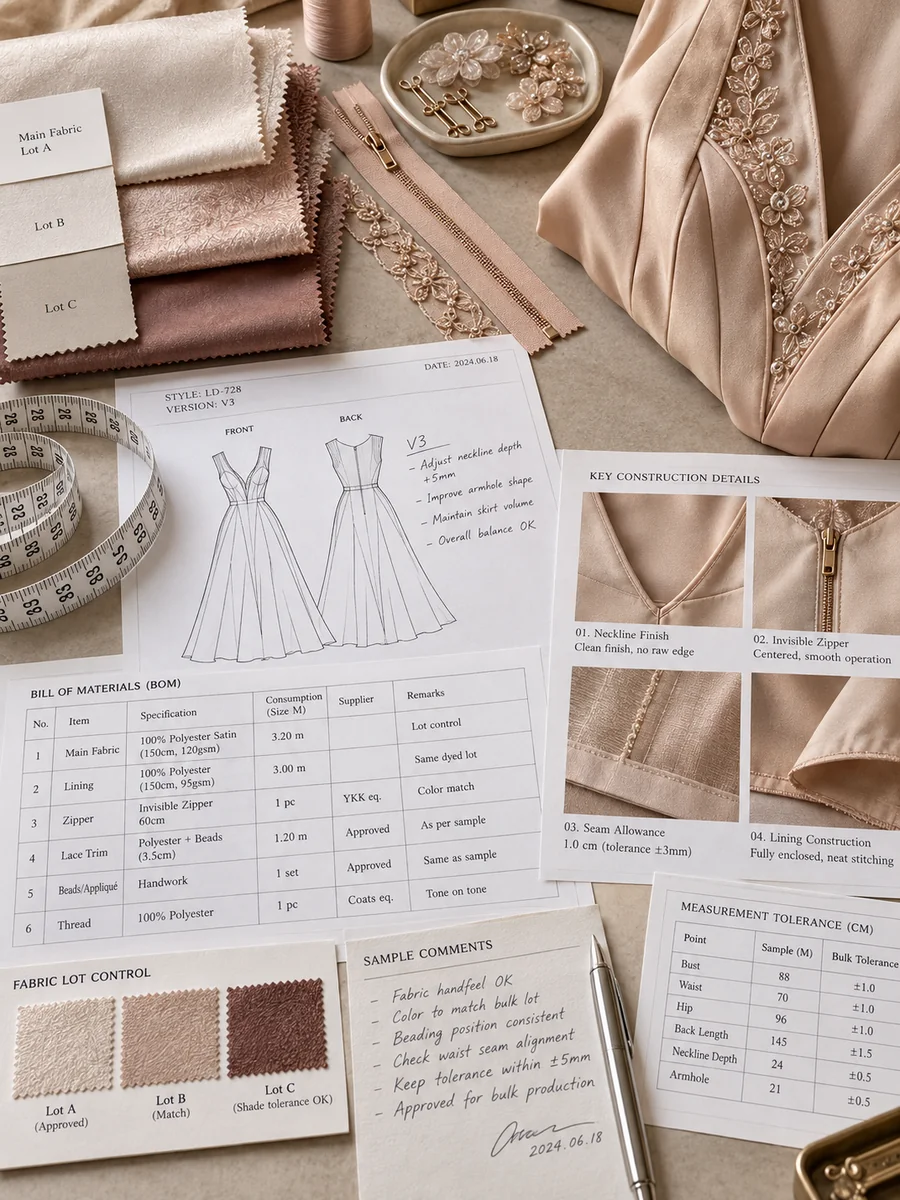
One of the simplest causes of sample-to-bulk variation is also one of the most damaging: the factory produces from the wrong version of the pattern or specification.
Garments often go through several rounds of development. For example:
- Version 1: first prototype
- Version 2: fit correction
- Version 3: neckline and waist adjustment
- Version 4: approved PP version
If the approved garment was made from Version 4 but the cutting department receives Version 3, the bulk order may reproduce an earlier fit problem even though the physical sample was approved.
The same risk applies to:
- measurement charts
- BOMs
- construction sheets
- print artwork
- embroidery artwork
- label placement
- trim specifications
Version control is not administrative housekeeping. How pattern making works covers what a production pattern is and why grading is not scaling; the point here is narrower — the file the cutting room opens is the only one that matters.
Why Version Errors Happen
Version problems usually come from process weaknesses rather than sewing mistakes. Common causes include:
- revised files sent through separate email or chat threads
- old pattern files remaining in the production folder
- comments approved verbally but not updated in the final specification
- different teams using different file names
- last-minute changes made to the sample but not reflected in the documents
- production starting before the final package is formally released
A Better Production Release System
Before bulk cutting, the production team should be working from one controlled package.
| Production reference | Example control |
|---|---|
| Pattern | Approved version number |
| Measurement chart | Final revision / date |
| BOM | Approved material list |
| Construction sheet | Final sewing notes |
| Artwork | Signed-off production file |
| Colour | Approved lab dip / swatch |
| PP sample | Physical reference |
| Packing | Approved packing instruction |
The important point is not the exact naming system. The important point is that everyone knows which version is final.
A file called final-final-new2.pdf is not version control.
The Fabric Is Technically the Same but Behaves Differently
Fabric is one of the largest sources of sample-to-bulk variation.
A buyer may approve a sample made in the correct composition and colour, yet bulk fabric can still behave differently, because fabric identity is not defined by fibre content alone.
Two fabrics described as 95% polyester / 5% elastane can differ significantly in:
- GSM
- width
- stretch percentage
- stretch direction
- recovery
- shrinkage
- surface finish
- yarn construction
- drape
- friction
- compression
- dye and finishing treatment
Even fabrics from the same article number can show small roll-to-roll differences.
Why This Matters for Fit
Fabric behaviour directly changes how a garment sits on the body.
A slightly heavier fabric may:
- pull a neckline lower
- add length through gravity
- make draping look fuller
- change the way a bias section hangs
A fabric with stronger recovery may:
- make a bodycon garment feel tighter
- reduce waist stretch
- change sleeve comfort
- increase tension around seams
A softer fabric may:
- collapse a structured silhouette
- change pleat definition
- alter skirt volume
- make the garment look longer
This is why bulk fabric approval should not stop at "the colour looks correct".
The material also has to perform close enough to the approved sample fabric. Colour accuracy and handfeel are measurable rather than a matter of taste — see how colour matching works and how fabric weight affects fit and drape.
Fabric Lot Variation Is Especially Important in Repeat and Large Orders
Large production orders may use several rolls. Even when all rolls are acceptable, minor differences may exist. The production team may need to control:
- roll identity
- shade group
- shrinkage
- usable width
- relaxation
- defect rate
For visually sensitive fabrics such as satin, velvet or smooth solid-colour fabrics, small variations can be more visible than on textured or printed cloth.
For this reason, the approved sample should be treated as a performance and visual reference, not merely a colour reference.
Sample Cutting and Bulk Cutting Do Not Create the Same Risk
A sample is usually cut as one garment or in a very small quantity. Bulk production is different: dozens of fabric layers may be spread and cut together. This creates a new group of technical risks.
Fabric Movement
Some fabrics move easily during spreading and cutting. Examples include:
- satin
- chiffon
- lightweight viscose
- slippery linings
- stretch fabrics
If layers shift, the top and bottom pieces may not be exactly the same.
Grain Direction
A sample cutter may pay very close attention to grain on one garment. In bulk production, grain control must be built into:
- marker planning
- spreading
- alignment
- cutting instructions
A panel slightly off-grain may twist or hang differently after sewing.
Nap and Surface Direction
Velvet, brushed fabrics and some satins can appear different depending on direction.
If production pieces are cut in inconsistent directions, the garments may look as if they are different colours under light.
Bias-Cut Garments
Bias garments are especially sensitive because the fabric is intentionally cut away from the straight grain. A bias-cut dress may continue to relax after cutting and sewing.
The approved sample therefore does not only establish measurements. It also establishes the intended drape and balance after relaxation.
Why Satin and Bias Dresses Need Extra Control
Satin is visually unforgiving. Small differences can show as:
- seam puckering
- distorted grain
- zipper waves
- pressing shine
- uneven drape
- visible tension
Bias-cut satin adds another variable: gravity. If the garment is not allowed to relax consistently before hemming or final measurement, bulk garments can finish at slightly different lengths.
This is one reason a good sample cannot simply be copied visually. The production method that created the sample has to be understood and repeated.
A Sample Machinist and a Production Line Work Differently
Sample rooms and bulk sewing lines have different responsibilities.
A sample machinist may construct most or all of one garment. That person can continuously see:
- the overall silhouette
- how one seam affects another
- where the fabric is beginning to distort
- whether the neckline needs extra control
- whether the zipper is creating tension
Bulk manufacturing normally divides the garment into operations. One operator may sew side seams. Another may attach sleeves. Another may install zippers. Another may finish hems.
This is efficient, but it means consistency depends on each operation being clearly controlled.
Small Sewing Differences Can Become Visual Differences
Examples include:
- seam allowance variation
- stitch density variation
- inconsistent feed
- different machine tension
- stretching during sewing
- pressing between operations
- operator handling
One millimetre at a single seam may not matter. But several small differences can accumulate across the garment. For example:
A slightly larger side seam allowance plus a slightly smaller waist seam allowance plus stronger pressing can change the appearance of the waist even if every individual measurement remains technically close to tolerance.
Machine Settings Can Change the Result Without Changing the Design
A tech pack can specify construction, but machine setup determines how that construction behaves.
This is especially important in:
- stretch fabrics
- lightweight satin
- chiffon
- knitwear
- curved seams
- invisible zippers
- elasticated areas
Variables include:
- thread tension
- presser foot pressure
- feed
- needle size
- needle type
- stitch length
- differential feed
- operator handling
A sample may have been sewn after careful machine adjustment. If bulk production starts on another machine without reproducing the setting, the garment may look different even though the same construction method is technically being used.
Typical symptoms include:
- seam puckering
- stretched neckline
- wavy zipper
- twisted hem
- uneven gathering
- skipped stitches
This is why the first production pieces are important. They test the manufacturing setup under real line conditions.
Pressing Can Change Fit More Than Buyers Expect
Pressing is often treated as the final cosmetic stage. It is not.
Pressing can affect:
- seam shape
- neckline edge
- lapel roll
- waistband appearance
- hem length
- pleat definition
- drape
- garment balance
A garment can measure correctly before pressing and appear different afterward.
Examples
A stretched neckline may shrink slightly during controlled steam pressing.
A bias skirt may lengthen after hanging and steaming.
A blazer front may look flat until the lapel is shaped correctly.
A satin seam may become visually obvious if excessive heat or pressure creates shine.
For this reason, fit review should ideally consider the garment in its intended finished condition. Comparing an unpressed bulk garment against a fully finished approved sample can produce misleading conclusions.
Measurement Tolerance Is Not the Same as Target Measurement
This is one of the most common misunderstandings in bulk apparel production.
Suppose the approved waist measurement is 70 cm and the agreed tolerance is plus or minus 1 cm. That does not mean the production target is anywhere between 69 and 71 cm. The target remains 70 cm.
The tolerance is the permitted variation around that target.
This distinction matters. If a production line gradually begins making garments at 71 cm because that is still inside tolerance, the process has shifted away from the intended measurement even though garments may technically pass inspection.
Target vs Tolerance
| Term | Meaning |
|---|---|
| Target measurement | The measurement the factory should aim to produce |
| Tolerance | The acceptable deviation around that target |
| Process drift | Production consistently moves toward one side of tolerance |
| Out of tolerance | Measurement exceeds the agreed acceptance range |
A strong quality system does not use tolerance as permission to manufacture inaccurately. It uses tolerance to recognise normal production variation while still aiming at the approved specification.
Not Every Point of Measure Should Have the Same Tolerance
A common mistake is applying one universal tolerance to the entire garment. A 1 cm difference at a skirt sweep may have little visual impact. A 1 cm difference at:
- neckline depth
- strap length
- bust position
- waist width
- front rise
may significantly change fit.
Tolerance therefore needs to reflect:
- construction
- fabric
- garment type
- point of measure
- fit sensitivity
- measurement method
This is why measurement instructions are as important as measurement numbers. Two people can measure the same curved neckline differently if the method is not defined.
Where grade rules come from, and how one approved measurement is carried across a size run, is covered in how size grading works from one approved sample.
The Approved Sample May Contain Changes That Were Never Documented
This is a particularly dangerous situation.
During final sample development, the sample room may make a small correction directly on the garment. For example:
- remove 5 mm from neckline depth
- increase strap tension
- reshape the armhole
- change seam allowance
- add light interfacing
- adjust zipper position
- reduce gathering
The buyer approves the physical sample. But the production document is not updated. The bulk line then follows the old written specification rather than the final physical change.
The result is a common dispute. Buyer: "The bulk is not the same as the sample." Factory: "The bulk matches the tech pack."
Both statements may be true. The real problem is that the approved sample and the production documents were no longer aligned.
Sample Approval Must Close the Document Loop
Before bulk production, every approved change should exist in the production package. That may include:
- pattern update
- measurement update
- BOM revision
- construction note
- artwork revision
- trim code
- approved sample comment
- buyer sign-off
The goal is simple: there should be no important feature visible on the approved sample that exists only in somebody's memory.
This is the failure mode the sample approval checklist is built to prevent — approval is only complete once the paperwork has moved with the garment.
Bulk Fabric Relaxation and Shrinkage Can Change Measurements
Some fabrics change dimension before, during or after production. Potential causes include:
- relaxation
- steam
- washing
- heat
- pressing
- fabric tension
- finishing processes
If the approved sample was made after fabric relaxation but production fabric was cut immediately after being unrolled, measurements may shift later.
This is especially important in:
- knits
- stretch fabrics
- viscose
- bias constructions
- washed garments
The exact control method depends on the material and the product. But the principle is the same: the factory should understand when the material reaches the state in which final measurements are expected to be checked.
Trims Can Change Between Sample and Bulk
A garment is not only fabric and pattern. Zippers, elastic, interfacing, hooks, cups, boning, buttons, thread and labels can all affect fit or appearance.
Example: Invisible Zipper
The sample may use one zipper brand or tape stiffness. Bulk production may use another approved equivalent. Both zippers may meet the nominal specification, but differences in tape stiffness can affect how the seam sits.
Example: Interfacing
A slightly heavier fusible interfacing may make:
- collar edges sharper
- waistbands firmer
- bodices less flexible
Example: Elastic
Two elastics with the same width can have different recovery. That can change:
- waistband fit
- sleeve opening
- gathered section
- strap tension
This is why the BOM should control function, not only appearance.
Bulk Production Creates Cumulative Variation
Manufacturing variation rarely comes from one dramatic mistake. More often, several small changes combine. For example:
- bulk fabric is slightly heavier
- side seam is sewn 3 mm inside target
- waistband pressing is stronger
- zipper tape is slightly stiffer
- garment is measured immediately after pressing
Each difference may be small. Together, they can create a garment that feels noticeably different from the approved sample.
This is what makes sample-to-bulk consistency a system problem.
The solution is not "tell the sewing line to be more careful". The solution is to control the variables that can accumulate.
First-Piece Approval Is the Bridge Between Sample and Bulk
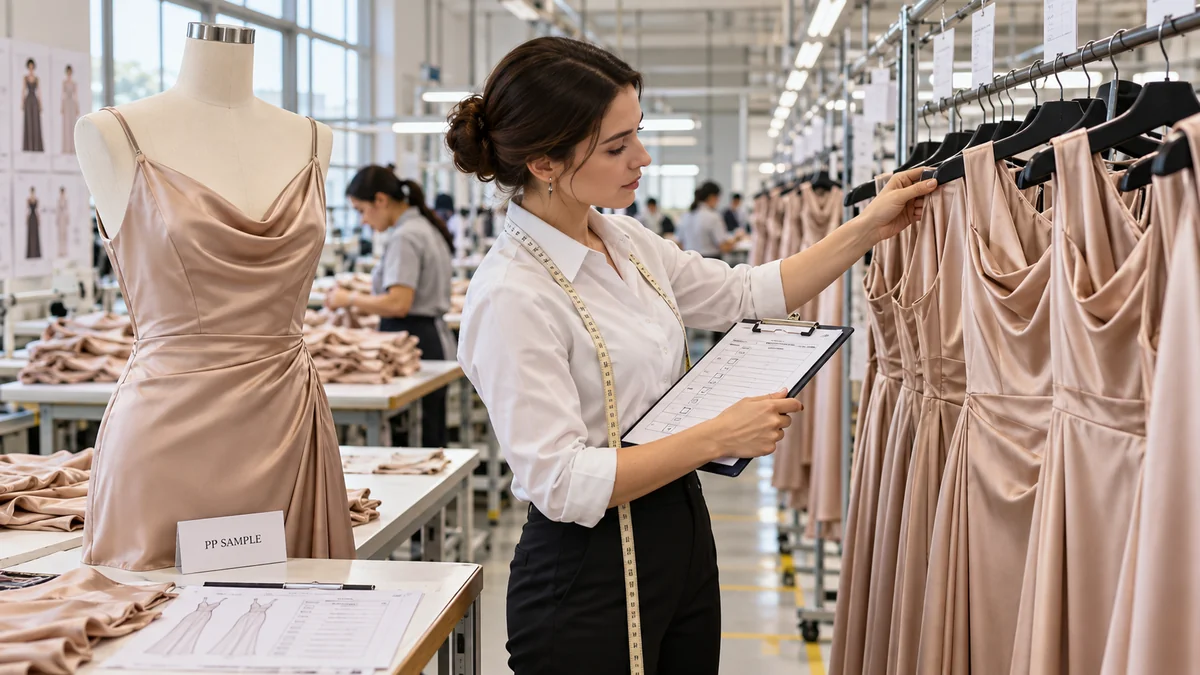
One of the most useful controls is the first production garment, or first-off-line piece.
This is not another development sample. It is made under actual production conditions. That matters because it tests:
- production pattern
- bulk fabric
- bulk trims
- line sewing method
- machine settings
- production pressing
- actual operators
The first piece therefore answers: does the approved product still look correct when manufactured through the real bulk-production process?
What Should Be Checked on the First Production Piece?
| Area | What to confirm |
|---|---|
| Fit | Overall silhouette and balance |
| Measurements | Critical POMs against approved spec |
| Fabric | Drape, stretch, shade, handfeel |
| Construction | Seam methods and internal structure |
| Zipper / closure | Position, smoothness, tension |
| Pressing | Shape, shine, seam appearance |
| Trims | Correct approved versions |
| Labels | Placement and orientation |
| Artwork | Position, scale, colour |
| Appearance | Comparison with approved sample |
If a problem appears here, it can often be corrected before hundreds of garments are completed.
The wider list of what to have confirmed before a run starts sits in what to check before bulk production; this section is only about the garment that comes off the line.
Inline Quality Control Catches Drift Before It Becomes a Finished-Goods Problem
A final inspection is important, but it happens late. If the same sewing issue has already been repeated across 800 garments, final inspection can identify the problem but cannot make the production time disappear.
Inline control is designed to catch drift earlier. Examples include:
- neckline stretching
- incorrect seam allowance
- zipper distortion
- measurement shift
- trim placement errors
- inconsistent gathering
- stitch defects
The purpose is not to inspect every detail of every garment continuously. The purpose is to identify whether the process is beginning to move away from the approved standard.
Where inline checks sit against final inspection, and how the two are planned, is a separate decision — see inline versus final inspection and the garment quality control checklist.
A Golden Sample Helps Only If the Factory Uses It Correctly
Different brands and manufacturers use terms such as:
- approved sample
- PP sample
- sealed sample
- golden sample
- production reference sample
in slightly different ways. The terminology is less important than the function.
The physical reference should represent the garment that production is expected to reproduce. It should be:
- clearly identified
- protected from accidental alteration
- available to production and QC
- linked to the correct specification version
- used for visual comparison
A sample hanging in an office is not useful if the sewing line and QC team never reference it.
What Happens When the Tech Pack and Physical Sample Disagree?
This situation should ideally be resolved before production. For example:
- Tech pack says neckline depth is 22 cm
- Measurement sheet says 23 cm
- Approved physical sample measures 22.5 cm
- Final buyer email says "sample approved"
Which one controls production? There should not be an assumption. The inconsistency should be closed and documented.
A Practical Approval Hierarchy
The exact hierarchy varies by company, but a controlled system typically needs:
- final approved written specification
- final production pattern
- approved material references
- approved physical sample
- documented approved deviations
If those references conflict, production should stop long enough to clarify the correct standard. A few hours of clarification before cutting is cheaper than explaining 1,000 inconsistent garments after delivery.
When a tech pack and a reference sample disagree because each carries something the other cannot, that is a documented difference rather than a defect.
The Approved Sample Should Not Become a "Perfect Handmade Exception"
There is another problem on the opposite side. Sometimes the approved sample receives so much special handling that it no longer represents a realistic production standard. For example:
- excessive hand adjustment
- manual reshaping
- one-off sewing methods
- unusually long pressing time
- construction that cannot be repeated at production speed
This can create an attractive sample but an unrealistic bulk benchmark.
A strong sample should not only look correct. It should also be manufacturable. The development team should therefore ask:
- Can this construction be repeated?
- Is the sewing method stable?
- Are the trims commercially available?
- Can the pressing method be standardised?
- Is the tolerance realistic?
- Can the garment be inspected consistently?
The best sample is not the garment that required extraordinary effort. It is the garment whose approved result can be reproduced through a controlled production process.
How Buyers Can Reduce Sample-to-Bulk Variation Before Production Starts
The buyer also influences production consistency. Clear approvals reduce interpretation. Before releasing an order into bulk production, confirm that the factory has the same understanding of the following.
Product
- final style number
- final pattern version
- approved size range
- approved measurement chart
- grading rules
Materials
- shell fabric
- lining
- colour
- trim codes
- zippers
- buttons
- elastic
- interfacing
- embellishments
Construction
- seam type
- seam allowance
- reinforcement
- topstitching
- lining method
- closures
- hem
- pressing requirements
Branding
- main label
- size label
- care label
- hangtag
- packaging
- placement
Approval
- PP sample status
- approved comments
- outstanding comments
- acceptable deviations
- buyer sign-off
What Should Be Locked Before Bulk Cutting?
Use this as a practical pre-production control table.
| Item | Must be confirmed before cutting? | Why |
|---|---|---|
| Final pattern | Yes | Controls shape and measurements |
| Final measurement chart | Yes | Defines target dimensions |
| Fabric article | Yes | Controls behaviour and appearance |
| Bulk colour | Yes | Prevents shade disagreement |
| Main trims | Yes | Can affect fit and construction |
| Construction method | Yes | Prevents operator interpretation |
| Artwork | Yes | Avoids placement and scale errors |
| PP sample | Preferably yes | Physical production reference |
| Packing method | Before finishing | Avoids last-minute repacking |
| Shipping carton | Before shipment | Does not normally control sewing |
Not every decision has the same production deadline. But anything that affects cutting, fit, sewing or fabric appearance should not remain open after bulk production begins.

A Practical Sample-to-Bulk Control Workflow
A reliable process can be visualised as a chain.
Step 1 — Development Sample
Purpose: confirm the design can be interpreted into a garment. Do not treat this as the production standard.
Step 2 — Fit Revision
Purpose: correct proportion, measurement, balance and movement. Close fit problems before adding unnecessary production complexity.
Step 3 — Material Confirmation
Purpose: confirm the material that bulk production will actually use, or an agreed equivalent process if bulk material is not yet available. Check:
- handfeel
- weight
- stretch
- recovery
- colour
- shrinkage
- drape
Step 4 — PP Approval
Purpose: bring together the final pattern, materials, trims, construction and branding. The PP garment should be close to the intended bulk result.
Step 5 — Production File Release
Purpose: ensure the final approved documents match the approved garment, and remove obsolete versions from the active production package.
Step 6 — Bulk Fabric and Trim Check
Purpose: verify that production materials match approval. This is where differences in bulk lot, shade, handfeel or trim substitution should be identified.
Step 7 — First-Piece Approval
Purpose: check whether actual production conditions reproduce the approved standard. This is the critical bridge between development and volume.
Step 8 — Inline Control
Purpose: detect drift while it can still be corrected. Focus on high-risk operations.
Step 9 — Final Inspection
Purpose: confirm finished production meets the agreed quality and quantity requirements.
Final inspection should verify the process result. It should not be the first time major fit or construction problems are discovered.
Five Questions to Ask When Bulk Does Not Match the Sample
When a discrepancy appears, avoid beginning with blame. Start with diagnosis.
1. Was the correct pattern version used?
Check physical or digital production records.
2. Was the bulk fabric the same approved material?
Compare article, lot, weight, stretch, handfeel and shade.
3. Did the sewing method change?
Review the affected operation.
4. Is the difference actually measurement, or visual appearance?
A garment can measure correctly and still drape differently.
5. Is the issue isolated or systematic?
One garment may indicate random variation. Fifty garments showing the same difference usually indicate process drift. This distinction determines the corrective action.
Sample-to-Bulk Problems Are Often Handover Problems
Development and production are sometimes treated as separate departments. But the product does not know when one department ends and another begins. A garment only sees:
- a pattern
- fabric
- trims
- machines
- operators
- pressing
- inspection
When important information is lost between sample room and production floor, variation appears.
The strongest manufacturers therefore treat sample approval as a controlled handover. Questions include:
- What changed during sampling?
- Which change was final?
- Which risks were identified?
- What needs special monitoring in production?
- Which POMs are fit-critical?
- Which seams are visually sensitive?
- Which materials are difficult to handle?
That information is more valuable than simply attaching a label saying "approved".
Not Every Difference Means the Bulk Order Is Defective
This point also matters.
Bulk production is not expected to reproduce every garment with microscopic identity. Textiles are flexible materials. Normal production includes controlled variation.
The question should be: does the bulk production remain within the approved fit, appearance, measurement and quality standard?
For example:
- a tiny measurement variation within the agreed tolerance may be acceptable
- a small natural shade difference within the approved shade range may be acceptable
- slight variation in hand-applied embellishment may be inherent to the technique
But:
- a neckline consistently sitting lower
- a zipper repeatedly waving
- a dress systematically measuring toward one tolerance extreme
- colour visibly shifting between panels
should not be dismissed as normal variation.
The role of the specification and approval process is to separate acceptable variation from production drift.
The Best Bulk Production Starts With a Sample That Was Built for Production
A beautiful sample is useful. A reproducible sample is more useful.
Before final approval, both buyer and manufacturer should understand:
- what the product must look like
- what measurements matter most
- what construction details are critical
- which material properties affect the fit
- which areas are vulnerable during production
- what variation is acceptable
- how bulk production will be checked
If those decisions remain vague, the factory has to interpret them during production.
Interpretation creates variation. Clear standards reduce it.
Final Checklist: From Approved Sample to Bulk Production
Before bulk production begins, confirm the following.
Pattern and Specification
- Final production pattern identified
- Final measurement chart released
- Measurement methods defined
- Critical tolerances confirmed
- Old versions removed from production use
Fabric and Trims
- Bulk fabric checked
- Colour and shade approved
- Stretch and recovery checked where relevant
- Shrinkage reviewed where relevant
- Bulk trims confirmed
- Substitutions documented
Construction
- Sewing method final
- Seam allowances confirmed
- Reinforcement defined
- Pressing expectations agreed
- Special handling points identified
Sample Approval
- PP or approved reference identified
- All sample comments closed
- Final deviations documented
- Buyer approval recorded
Production Control
- First production piece reviewed
- High-risk operations identified
- Inline checks planned
- QC team has approved reference
- Finished garment comparison method agreed
The Real Lesson: Sample Approval Is a Transfer of Control
An approved sample should not be treated as a photograph of what the buyer wants. It is a manufacturing reference. Its value comes from how effectively the information behind it is transferred into production.
When bulk clothing differs from the approved sample, the cause is often not one careless sewing operator or one incorrect measurement. The difference may begin much earlier:
- an old pattern version
- a fabric lot behaving differently
- a cutting method changing the grain
- a production machine set differently
- a trim substitution
- an undocumented sample-room correction
- an unclear tolerance
- a missing first-piece approval
The closer a brand gets to bulk production, the less it should rely on memory and interpretation.
Patterns should be version-controlled. Materials should be identified. Measurements should have clear targets. Approved changes should be documented. The physical sample should be available as a real production reference.
And the first garments coming off the production line should be compared against that standard before variation has time to multiply.
That is how sample approval becomes more than a sign-off. It becomes a production control system.
Working With Luxudress
For womenswear brands moving from approved development samples into bulk production, Luxudress supports the handover between product development, sampling, material confirmation, production and quality control.
When reviewing a style for production, useful information includes:
- tech pack
- approved sample comments
- measurement chart
- fabric specification
- size range
- colourways
- order quantity
- label and packaging requirements
The objective is not simply to reproduce the appearance of one approved sample. It is to identify the parts of that approval that must remain controlled when the garment moves into repeatable production.
Our sampling and quality control lines cover the two ends of that handover, with product development between them, fabric sourcing on the material side and volume runs under OEM manufacturing.
Send your tech pack, approved sample information or reference garment for a production review and quotation. If you would rather start from something that already exists, the style library and ready stock are both available to order, and women's dresses is the category most of these controls were written around.