On this page
- A Sample Comment Is Not an Opinion
- Start by Separating the Problem From the Solution
- First Decide: Is It a Sample Error or a Specification Error?
- Use a Five-Part Sample Comment
- Weak Sample Comments vs Factory-Ready Comments
- Measurement Comments and Fit Comments Are Not the Same
- Do Not Use Measurements Without a Defined POM
- Photos Should Support the Comment, Not Replace It
- Do Not Send Sample Feedback Across 20 Messages
- Use a Sample Comment Sheet
- Never Delete Old Comments
- Divide Comments by Priority
- Avoid Using "Please Fix in Bulk" Without Defining the Risk
- Sample Comments Should Separate Observation From Diagnosis
- Be Specific When the Correction Is Measurable
- Be Outcome-Focused When the Technical Cause Is Uncertain
- Fabric Comments Need More Than "Feels Cheap"
- Colour Comments Need an Approved Reference
- Construction Comments Should Describe the Functional Problem
- When a Comment Changes the Design, Update the Tech Pack
- Know When a Photo Is Enough and When a New Measurement Is Needed
- Fit Comments Should Be Made on the Intended Body or Fit Model
- Do Not Correct One Area Without Checking What Else It Changes
- Use "Keep" Instructions to Protect Approved Areas
- Do Not Mix Design Preference and Defect Correction
- Use Clear Approval Language
- A Complete Sample Comment Sheet Example
- Case Study: From "The Dress Does Not Fit Right" to a Production-Ready Revision
- Common Sample Comment Mistakes
- Sample Comments Should Become Production Knowledge
- A Practical Sample Review Workflow
- Sample Comment Sheet Template
- Final Checklist Before Sending Sample Comments to a Factory
- FAQ
- Sample Feedback Is a Production Tool
- Working With Luxudress

"The waist is too loose. Please make it fit better."
To a buyer, that may sound clear. To a pattern maker, it creates several unanswered questions.
Is the finished waist measurement actually too large? Is the waist positioned too low? Is excess fabric coming from the side seam, the back panel or the dart? Is the sample outside the approved specification? Or does the sample match the specification and the specification itself needs to change?
Each answer requires a different correction.
This is why useful sample feedback is not simply a description of what a buyer likes or dislikes. A factory-ready sample comment should tell the development team:
- where the issue appears
- what the current result is
- what the intended result should be
- what needs to change
- whether the issue blocks approval
- which documents need to be updated
The difference matters because a vague comment creates interpretation. And interpretation creates another sample round. A clear comment creates a production instruction.
For fashion brands, retailers and private-label buyers, learning how to comment on a clothing sample properly can reduce unnecessary sample rounds, prevent old changes from reappearing later and make the transition from development into bulk production far more controlled.
This guide is about writing that comment back. It assumes the sample already exists: how a factory builds a first sample covers getting one, and the sample approval checklist covers deciding whether it is right. This one covers what to say when it is not.
A Sample Comment Is Not an Opinion
Sample review often begins with a reaction. The buyer puts on the garment or sees it on a fit model and thinks:
- the waist feels loose
- the neckline looks wrong
- the sleeve feels heavy
- the skirt is too flat
- the fabric does not look premium enough
- the zipper area is pulling
- the proportions feel different from the reference image
These reactions are useful. They identify where attention is needed. But they are not yet production instructions.
A factory cannot reliably act on "make it nicer", or "the fit feels strange", or "can you make it more flattering", because those comments do not define what has to change.
A useful sample comment converts the reaction into something observable. For example:
Reaction: the waist feels loose. Observation: finished waist measures 73 cm against a 70 cm specification. Instruction: reduce finished waist circumference to 70 cm while keeping CF length and approved waist position unchanged.
Now the factory knows what is wrong, how much it differs, what target to work toward and what must remain unchanged. That is the difference between a comment and an instruction.
Start by Separating the Problem From the Solution
One of the most common mistakes in sample feedback is jumping directly to a correction before diagnosing the actual issue.
For example: "take 2 cm from the side seams". That sounds precise. But what if the excess volume is actually caused by:
- back waist shaping
- front dart position
- fabric stretch
- an incorrect waist position
- balance between front and back body length
Reducing the side seams may make the waist smaller while creating a new fit problem elsewhere.
A better process is: observe, measure, diagnose, instruct. Not: react, then tell the factory to change something.
Example
Suppose a fitted dress appears loose at the back waist. Do not begin with "take in the CB seam by 2 cm". Begin with:
Excess fabric appears at the back waist when worn. Finished waist circumference measures to specification. Review back waist shaping and bodice balance before reducing total waist measurement.
That comment gives the factory room to identify the technical cause without changing an approved measurement unnecessarily.
First Decide: Is It a Sample Error or a Specification Error?
This is one of the most important distinctions in sample development.
Imagine the tech pack says waist 72 cm, the factory sample measures 72 cm, but when the buyer fits the garment the waist still feels too loose. The factory has not necessarily made the sample incorrectly. It has followed the specification. The problem may be that the specification itself needs to change.
Now imagine the tech pack says waist 70 cm but the sample measures 73 cm. That is different: the sample has deviated from the specification.
These situations require different comments.
| Situation | What it means | Correct response |
|---|---|---|
| Sample differs from approved spec | Execution deviation | Correct sample back to specification |
| Sample matches spec but fit is wrong | Specification issue | Revise measurement or pattern |
| Measurements pass but appearance is wrong | Construction, pattern balance or material issue | Diagnose visual or structural cause |
| Sample uses substitute fabric | Fit may not represent bulk fabric | Separate fabric effect from pattern decision |
| Sample is correct but buyer changes design | Design revision | Update tech pack and pattern intentionally |
This distinction prevents unnecessary arguments. If a sample measures exactly to the buyer's own specification, the comment should not accuse the factory of making the garment incorrectly. The specification should be revised instead.
Use a Five-Part Sample Comment
A practical sample comment can be built from five parts.
1. Location
Where is the issue? Examples:
- front neckline
- CB waist
- left side seam
- sleeve opening
- front rise
- skirt hem
- invisible zipper
- armhole
- bust dart
- shoulder seam
Avoid comments such as "top part wrong". The production team should not have to guess which area is being discussed.
2. Current Result
What is happening now? Examples:
- neckline stands approximately 8 mm away from body
- finished waist measures 73 cm
- left shoulder is visibly higher
- hem drops at CB after hanging
- zipper creates horizontal pulling
- sleeve opening feels restrictive
- front skirt twists toward left side
The current result can be measured, photographed, observed on a fit model, compared with a reference, or compared with approved specification.
3. Desired Target
What should the corrected result be? Examples:
- finished waist should return to 70 cm
- neckline should sit flat without reducing approved depth
- maintain current skirt volume but correct hem balance
- sleeve opening should allow movement without changing sleeve silhouette
- zipper seam should sit flat and match approved PP reference
The target gives the factory a destination. Without a target, the correction becomes subjective.
4. Required Action
What needs to happen next? This does not always mean telling the pattern maker exactly which line to redraw. Sometimes the correct instruction is "review neckline shaping and stabilisation". Other times it is specific: "reduce finished sleeve length from 61 cm to 59 cm from approved POM".
The more confident the buyer is about the technical cause, the more specific the instruction can be. When the cause is uncertain, describe the required outcome clearly and ask the factory to review the pattern or construction.
5. Status
Every comment should have a status. For example:
- Must Fix
- Review
- Watch in Bulk
- Approved
- Closed
This makes it possible to track comments across sample rounds.
Example: A Complete Sample Comment
Comment C07 — Front Neckline. Location: centre front neckline. Current result: neckline depth measures 24.5 cm and the edge opens approximately 8 mm away from the body when worn. Target: maintain approved neckline depth of 24 cm while improving edge contact against the body. Required action: review neckline shaping and stabilisation; do not reduce approved bust ease. Status: must fix before PP approval.
This is far more useful than "neckline too loose, please fix".
Weak Sample Comments vs Factory-Ready Comments
The easiest way to understand good sample feedback is to compare it with comments that create ambiguity.
| Weak comment | Why it fails | Factory-ready version |
|---|---|---|
| Waist too loose | No measurement or location | Waist measures 73 cm vs 70 cm spec. Reduce finished waist to 70 cm. |
| Sleeve too long | No target | Sleeve length measures 61 cm. Revise to 59 cm from approved POM. |
| Neckline looks strange | Subjective | Neckline stands away from body at CF. Maintain approved depth and review edge shaping. |
| Make skirt fuller | No amount or construction direction | Increase finished hem sweep while maintaining approved waist and front length. |
| Fabric looks cheap | Subjective | Fabric lacks the approved sample's weight and recovery. Review closer quality to approved swatch. |
| Colour too dark | No reference | Sample is visibly darker than approved lab dip under agreed lighting. Match approved colour reference. |
| Zipper bad | No symptom | Invisible zipper waves below waist seam. Review zipper application and seam tension. |
| Fit is wrong | Too broad | Excess fabric appears at CB waist while total waist measures to spec. Review back shaping. |
| Make it like photo | Photo may hide construction | Match the reference silhouette at shoulder and waist; construction follows approved specification. |
| Please improve quality | No defined standard | Correct skipped stitches at side seam and improve topstitch consistency to approved sample standard. |
A strong comment removes interpretation.
Measurement Comments and Fit Comments Are Not the Same
A garment can measure correctly and still fit badly. This is why sample comments should distinguish between measurement problems and fit problems.

Measurement Problem
Example: sample waist measures 73 cm against target 70 cm. This is straightforward — the garment is outside the intended measurement.
Fit Problem
Example: waist circumference measures to specification, but excess fabric appears at CB when worn. In this case simply reducing total waist measurement may be wrong. The problem could relate to:
- back waist length
- dart shaping
- side seam balance
- centre-back shaping
- fabric stretch
- waist position
The comment should therefore describe the fit issue rather than prescribing an arbitrary circumference reduction.
A Useful Rule
If the garment is outside specification, correct the garment to the approved specification. If the garment matches specification but does not fit as intended, review the specification or pattern. That distinction prevents the development team from fixing the wrong problem.
Do Not Use Measurements Without a Defined POM
A measurement is only useful if both sides measure it the same way.
For example, "neckline depth = 24 cm" still leaves questions. Measured from HPS? From shoulder seam? Vertically? Along the neckline edge? To the seam line? To finished edge?
A Point of Measure, or POM, should define how the measurement is taken. Without it, the buyer and factory can both report different measurements and both believe they are correct.
Good Sample Comment
Front neckline depth measures 24.8 cm from HPS vertically to finished neckline edge. Approved target is 24 cm.
Weak Sample Comment
Neckline should be 24 cm.
The first creates a repeatable measuring method. The second creates another interpretation. Where the grade rules behind those POMs come from is covered in how size grading works from one approved sample.
Photos Should Support the Comment, Not Replace It
Photos are extremely useful in sample reviews. But a photo alone is often not enough.
A buyer may send an image with a red circle, an arrow, "wrong", "fix this" or "too big". The factory can see the location, but still may not know the intended correction.
A stronger photo annotation includes:
- comment number
- arrow
- reference line
- POM
- measurement
- comparison point
- short instruction
For example: C04 — Sleeve Opening. Current: 25 cm. Target: 27 cm. Increase circumference while keeping cuff width unchanged.
Use One Comment Number Everywhere
If the annotated image says C04, the comment sheet should also say C04, and any revised tech pack note should reference C04.
This sounds simple, but it dramatically reduces confusion when there are 15 comments, 20 photos, three sample versions, two buyers, one merchandiser and one pattern maker.
Do Not Send Sample Feedback Across 20 Messages
A common real-world problem is fragmented communication:
- Monday: waist too loose
- Tuesday: also sleeve maybe shorter
- Tuesday evening: actually keep sleeve
- Wednesday: can you change neckline like this photo?
- Thursday: do not change neckline depth, only shape
Now imagine a merchandiser trying to explain the final decision to the sample room. Which instruction is current? Which one was cancelled? Which photo belongs to which comment?
This is exactly how old comments reappear in later samples.
Consolidate Each Sample Round
Each sample round should have one controlled comment document. For example: style LD-1024, sample Fit Sample V2, date reviewed 2026-09-29, comment sheet Rev 02.
All comments from that review should be consolidated there. Chat, email or video calls can be used to discuss the issues, but the final decisions should be written into one record.
Use a Sample Comment Sheet
A useful sample comment sheet does not need to be complicated. It needs to be consistent.
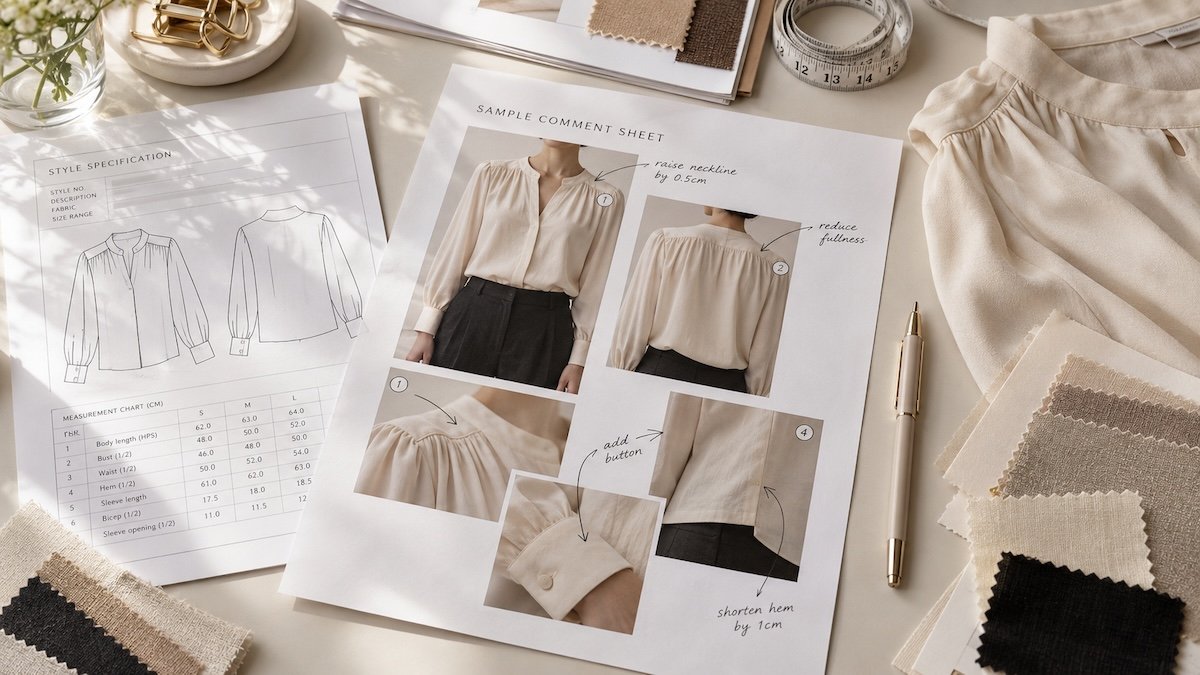
Recommended Structure
| No. | Area / POM | Current result | Approved target | Required action | Photo ref | Priority | Status |
|---|---|---|---|---|---|---|---|
| C01 | Waist | 73 cm | 70 cm | Reduce finished waist 3 cm | IMG01 | Must Fix | Open |
| C02 | CF neckline | Edge gaps from body | Sit flat | Review shaping / stabilisation | IMG02 | Must Fix | Open |
| C03 | Sleeve length | 61 cm | 59 cm | Reduce 2 cm | IMG03 | Should Fix | Open |
| C04 | Hem | Approved | — | No change | IMG04 | — | Closed |
| C05 | Zipper | Slight wave below waist | Sit flat | Review zipper application / tension | IMG05 | Must Fix | Open |
This table gives the factory everything needed to track the sample.
Never Delete Old Comments
When Sample V2 arrives, do not create a completely new document with no history. Keep the previous comments and update their status.
| Comment | V1 status | V2 status | Final decision |
|---|---|---|---|
| C01 Waist | Open | Corrected | Closed |
| C02 Neckline | Open | Improved but not accepted | Carry Forward |
| C03 Sleeve | Open | Corrected | Closed |
| C04 Hem | Approved | Approved | No Change |
| C05 Zipper | Open | Corrected | Closed |
This creates a development history. If the neckline problem returns in PP sample, the team can see when it first appeared, what was changed and whether it had previously been approved. Without history, every sample round becomes a new conversation.
Divide Comments by Priority
Not every sample issue deserves the same response. A missing button and a major fit problem should not be treated as equal. A practical system can use three levels.
Must Fix
The sample should not proceed to approval until the problem is corrected. Examples:
- incorrect fit
- wrong pattern shape
- major measurement deviation
- wrong fabric
- wrong construction
- functional zipper problem
- incorrect cup position
- poor neckline stability
- incorrect artwork
Should Fix
The issue should be corrected, but the risk may not require a full new sample depending on the product and production stage. Examples:
- minor trim placement
- small topstitch adjustment
- internal finishing
- label position
- non-fit-critical visual correction
Watch in Bulk
The sample may be approved, but the point should be monitored during production. Examples:
- pressing consistency
- hand embellishment variation
- stitch consistency
- small fabric handling risk
- packing presentation
This category is especially useful when the sample is acceptable but the process could drift in volume production — the same drift that explains why approved samples change in bulk.
Avoid Using "Please Fix in Bulk" Without Defining the Risk
One of the most dangerous sample comments is "approved, please fix this in bulk". Sometimes that is reasonable. Sometimes it transfers an unresolved development problem directly into production.
Before approving with a bulk correction, ask:
- Is the issue already understood?
- Is the correction measurable?
- Is the production method stable?
- Does the change affect pattern or fit?
- Does it affect fabric consumption?
- Does it affect other sizes?
- Does it require another visual approval?
If the answer is uncertain, another sample may be cheaper than fixing the issue after cutting begins.
Sample Comments Should Separate Observation From Diagnosis
Consider a satin dress with a wavy invisible zipper.
Observation: zipper seam waves below waist. That is a fact.
Possible diagnosis:
- zipper tape stiffness
- sewing tension
- fabric stretching
- seam allowance handling
- pressing
The buyer may not know which one is responsible. That is fine. The comment can say:
Invisible zipper seam waves below waist. Review application, fabric handling and seam tension. Final result should sit flat in line with approved silhouette.
This is better than guessing "use lower thread tension". If thread tension is not the real cause, that instruction can create another problem.
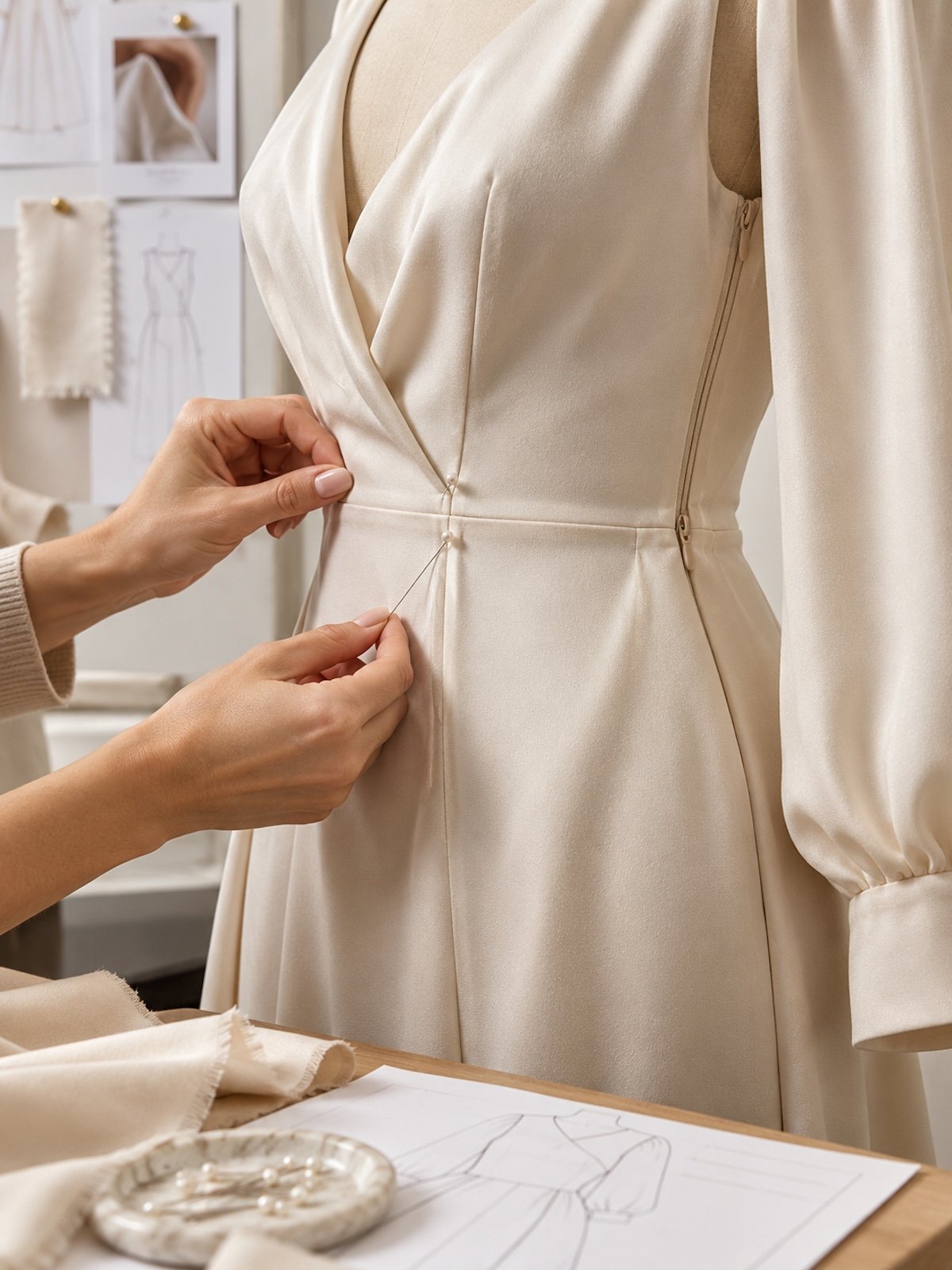
Be Specific When the Correction Is Measurable
Some comments should be extremely precise. For example: sleeve length measures 61 cm, approved target 59 cm. Or: move button position 8 mm toward CF. Or: reduce shoulder width by 1 cm total.
When the correction is measurable, avoid words such as slightly, a little, more, less, around or maybe, because the factory still has to decide what those words mean.
Be Outcome-Focused When the Technical Cause Is Uncertain
Not every buyer needs to be a pattern maker. If you know the desired result but not the technical correction, describe the result.
Example: front neckline should sit closer to the body without reducing approved neckline depth or bust ease.
That tells the pattern maker what must improve and what must remain unchanged. It is more useful than prescribing a technical change you are not certain about.
Fabric Comments Need More Than "Feels Cheap"
Fabric feedback is often too subjective. "The fabric feels cheap" may be emotionally accurate but technically weak. What does cheap mean? Possibilities include:
- too lightweight
- too shiny
- too stiff
- insufficient recovery
- too transparent
- rough surface
- low density
- weak drape
A better comment identifies the property.
Example
Sample fabric is lighter and more transparent than the approved reference. Please review a quality with similar drape but higher opacity and slightly more body.
Now sourcing knows what to look for — which is the difference between a comment and a shopping trip. How fabric weight affects fit and drape covers why weight and recovery move a garment more than colour does.
Colour Comments Need an Approved Reference
Comments such as "too pink" or "make it more burgundy" create a colour conversation with no fixed reference. Colour comments should refer to:
- approved lab dip
- Pantone reference where relevant
- physical swatch
- approved previous sample
- approved bulk standard
Example: sample colour is visibly warmer than approved Lab Dip B under agreed lighting. Match approved Lab Dip B for next sample. That makes colour approval reproducible. The mechanics are in how colour matching works.
Construction Comments Should Describe the Functional Problem
A buyer may see a twisting seam, a rolling neckline, puckering, visible lining, an uneven hem, unstable boning or zipper pulling. The comment should connect appearance with required performance.
Example: neckline edge rolls outward after movement. Finished neckline should remain flat against body during normal wear.
That is more useful than "neckline construction bad".
When a Comment Changes the Design, Update the Tech Pack
Sample comment sheets should not become permanent substitutes for the tech pack. If a sample comment changes the final product specification, the master production documents should eventually be updated. Typical changes that should move into the tech pack include:
- measurements
- pattern-related dimensions
- fabric
- trims
- construction
- artwork
- label placement
- stitch type
- seam allowance
- colour
- packaging requirements
Otherwise, the final sample and the final specification can drift apart. That is one of the most common reasons an approved sample later differs from bulk production — the failure mode described in why approved samples change in bulk. If it is not clear which document carries what, tech pack versus reference sample sets out the split.
Know When a Photo Is Enough and When a New Measurement Is Needed
Some issues are primarily visual:
- pleat direction
- print placement
- beading density
- neckline shape
- drape
- seam puckering
Photos are very useful here. Other issues need measurements:
- sleeve length
- waist
- hip
- neckline depth
- shoulder width
- strap length
- rise
- garment length
A good sample comment system uses both.
Fit Comments Should Be Made on the Intended Body or Fit Model
A garment hanging on a hanger cannot reveal all fit problems. Fit issues such as armhole restriction, bust tension, neckline gaping, rise discomfort, shoulder balance and waist position need to be reviewed on the intended body or approved fit model where possible.
The sample comment should also record the relevant fit context. For example: fit reviewed on size M fit model corresponding to approved brand measurements. That is more useful than "tried on by office staff".
Do Not Correct One Area Without Checking What Else It Changes
Garment fit is connected. A change at one point can affect another.
| Change | May affect |
|---|---|
| Shortening shoulder strap | neckline depth, armhole depth, bust position |
| Reducing side seam | waist, hip, bust, balance |
| Raising waist seam | torso length, skirt length, pocket position, zipper position |
| Increasing skirt sweep | fabric consumption, hem behaviour, drape, cost |
Sample comments should therefore identify what must remain unchanged.
Use "Keep" Instructions to Protect Approved Areas
Buyers often focus only on what must change. But it is also useful to state what must not change. For example:
- Reduce sleeve length by 2 cm. Keep sleeve opening and cuff width unchanged.
- Improve neckline contact against body. Keep approved neckline depth unchanged.
- Increase skirt fullness. Keep waist measurement and CF length unchanged.
These keep instructions prevent one correction from unintentionally changing another approved feature.
Do Not Mix Design Preference and Defect Correction
A defect is different from a design change.
Defect
Spec says zipper should be invisible. Sample zipper is visibly exposed. Correction: correct zipper installation to approved construction.
Design Change
Buyer decides after seeing the sample that the zipper should move from CB to side seam. That is not a factory defect. It is a new design decision.
The sample record should distinguish between factory correction and buyer revision, because design revisions may affect pattern, price, sample cost, lead time and material consumption.
Use Clear Approval Language
Do not finish a sample review with "looks good". Use one of several clear statuses.
Approved
No open comments affecting production.
Approved With Documented Comments
The sample is approved, but specific minor points must be corrected or monitored. The comments must state whether another sample is required.
Revise and Resubmit
Important comments remain open. A revised sample is required before approval.
Redevelopment Required
The current sample is too far from the intended product and needs broader pattern, material or construction review.
Clear approval status prevents production teams from interpreting casual language as final approval.
A Complete Sample Comment Sheet Example
Below is a simplified example for a satin midi dress.
Style Information
| Field | Example |
|---|---|
| Style | LD-SM-204 |
| Product | Satin Bias Midi Dress |
| Sample Round | Fit Sample V2 |
| Review Date | 2026-09-29 |
| Sample Size | M |
| Reviewer | Brand Product Team |
| Overall Status | Revise and Resubmit |
Comment Sheet
| No. | Area / POM | Current result | Target | Required action | Priority | Status |
|---|---|---|---|---|---|---|
| C01 | CF Neckline | Opens 8 mm from body | Sit flat | Review neckline shaping, keep depth unchanged | Must Fix | Open |
| C02 | Waist | 71 cm | 70 cm | Reduce 1 cm total | Must Fix | Open |
| C03 | Left side seam | Pulling below hip | Smooth hang | Review bias balance and seam handling | Must Fix | Open |
| C04 | Sleeve | — | — | Not applicable | — | Closed |
| C05 | Hem | CB drops 1.5 cm after hanging | Level hem | Allow relaxation before final hem correction | Must Fix | Open |
| C06 | Zipper | Slight wave | Sit flat | Review zipper application and pressing | Should Fix | Open |
| C07 | Fabric | Drape approved | No change | Keep same quality | — | Approved |
| C08 | Colour | Matches approved swatch | No change | Maintain | — | Approved |
This table can travel with the sample through the next revision.
Case Study: From "The Dress Does Not Fit Right" to a Production-Ready Revision
Consider a satin bias midi dress. The buyer receives Sample V2 and sends the first reaction:
The dress is not fitting well. Neckline is loose, waist seems big and hem is uneven. Please improve.
This tells the factory that something is wrong. But it does not tell the factory what should happen next.
Step 1: Check Measurements
| POM | Target | Actual |
|---|---|---|
| Waist | 70 cm | 71 cm |
| CF neckline depth | 24 cm | 24.2 cm |
| CF length | 118 cm | 118 cm |
| CB length after hanging | 120 cm | 121.5 cm |
The waist is slightly over target. But neckline depth is close to specification. Therefore, the neckline problem may not come from excessive depth.
Step 2: Review Fit
On the fit model: neckline stands away from body at CF, side seam pulls slightly backward, CB hem hangs lower, waist feels loose. Now there are four different problems. They should not be combined into one sentence.
Step 3: Separate the Comments
C01 — Neckline. Current: neckline opens away from body approximately 8 mm. Target: maintain approved neckline depth but improve body contact. Instruction: review neckline shaping and stabilisation; do not shorten shoulder or reduce bust ease without review.
C02 — Waist. Current: finished waist 71 cm. Target: 70 cm. Instruction: reduce 1 cm total while maintaining approved waist position.
C03 — Side Seam Balance. Current: side seam pulls toward back below waist. Target: side seam should hang vertically. Instruction: review bias balance before altering hip circumference.
C04 — Hem Balance. Current: CB drops approximately 1.5 cm after hanging. Target: approved finished balance. Instruction: allow sample to relax before final hem correction and recheck CB length.
Step 4: Decide What Changes the Tech Pack
Waist measurement changes back to approved target, so no tech-pack revision is needed if 70 cm was already correct. A neckline construction or stabilisation change should update the construction note if the correction changes the approved method. A hem relaxation process should be added as a development or production instruction if necessary.
Step 5: Decide Whether Another Sample Is Required
Because the neckline and bias balance affect appearance and fit, this sample should not be approved directly into bulk. Status: revise and resubmit.
This is a much stronger development decision than "please improve fit and send again".
Common Sample Comment Mistakes
Mistake 1: Commenting From Memory
Review the garment with the tech pack, previous comments and approved reference — not from memory.
Mistake 2: Changing Too Many Things Without Priorities
If a sample has 25 comments, identify which ones affect approval. Otherwise the sample room may spend time correcting low-risk details while a major fit issue remains unresolved.
Mistake 3: Giving Contradictory Instructions
"Make waist tighter" followed later by "keep loose fit". If the final decision changes, clearly cancel the old comment.
Mistake 4: Using Different Documents for Different Comments
One comment in WhatsApp, one in email, one inside a PDF, one spoken on a video call. This creates version risk. Consolidate.
Mistake 5: Approving Visually Without Checking Measurements
A garment may look acceptable on one body but still be outside agreed specification. Fit review and measurement review should support each other.
Mistake 6: Measuring Without Following the Same Method
If the buyer measures the waist stretched flat and the factory measures relaxed, the numbers cannot be compared directly.
Mistake 7: Asking the Factory to "Copy the Photo Exactly"
A reference image does not show internal construction, exact fabric, pattern, measurements, lining or closures. Use the photo to communicate design intent, not as the only technical specification.
Sample Comments Should Become Production Knowledge
Good sample comments do more than correct one garment. They create information for bulk production.
If sample development reveals that a neckline stretches easily during sewing, production should know that. If the hem needs relaxation before finishing, production should know that. If the fabric is sensitive to pressing, production should know that.
The sample process should therefore produce not only an approved sample but also a clearer production standard. This is what turns sampling into manufacturing preparation.
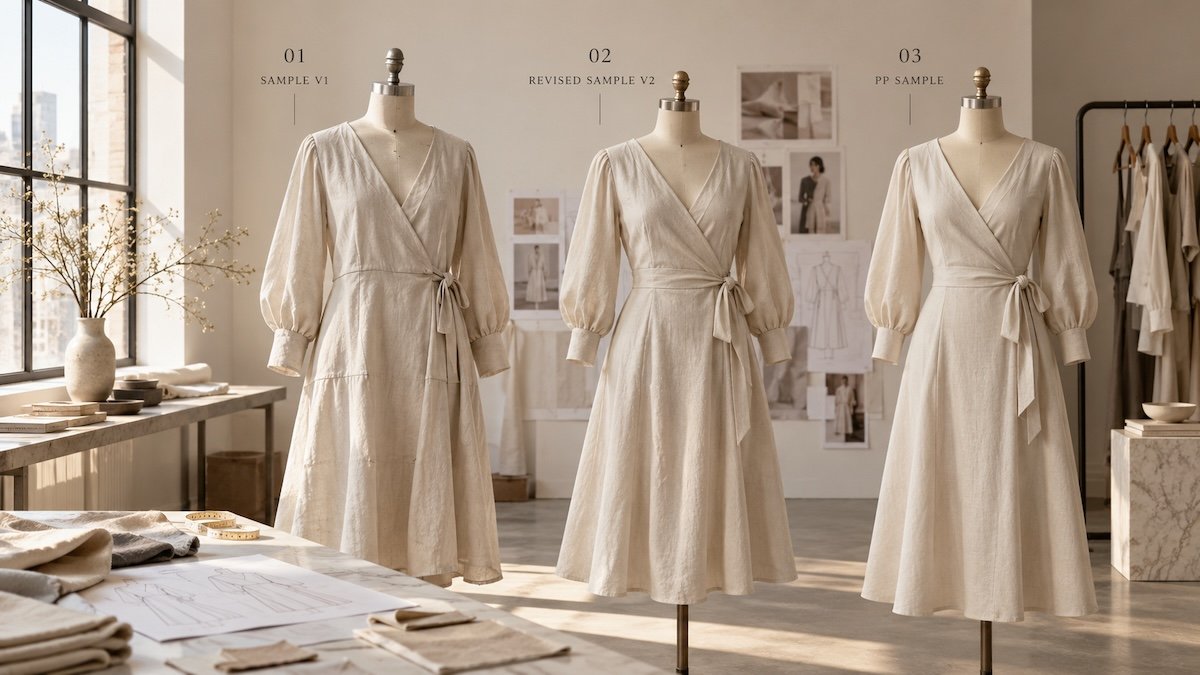
A Practical Sample Review Workflow
A disciplined sample review can follow this sequence.
Step 1 — Verify Sample Identity
Check style number, sample version, size, fabric and colour.
Step 2 — Compare Against Previous Comments
Before creating new comments, confirm what was supposed to change, what was corrected and what remains open.
Step 3 — Measure
Check critical POMs against the current specification.
Step 4 — Fit
Review the garment on the intended body or fit model.
Step 5 — Inspect Construction
Look at seam quality, zipper, lining, neckline, hem, closures and internal structure.
Step 6 — Review Fabric and Trims
Confirm handfeel, drape, stretch, colour and trim function.
Step 7 — Write Comments
Use: location, current result, target, action, status.
Step 8 — Annotate Photos
Match each image to its comment number.
Step 9 — Assign Priority
Must Fix, Should Fix, Watch in Bulk.
Step 10 — Decide Approval Status
Approved, Approved with Comments, Revise and Resubmit, Redevelopment Required.
Step 11 — Update Master Documents
Any approved specification change should be transferred into the master production file.
Sample Comment Sheet Template
Brands can use the following structure internally.
Sample Header
- Brand
- Style Number
- Product
- Sample Version
- Sample Size
- Date Received
- Date Reviewed
- Reviewer
- Overall Status
Comment Table
Columns: Comment No., Area / POM, Current Result, Target Result, Required Action, Photo Ref, Priority, Status. Add one row per comment.
Approval Summary
- Approved items
- Open items
- Tech pack revisions required
- Pattern revisions required
- New sample required: yes / no
- Approved for bulk: yes / no
Final Checklist Before Sending Sample Comments to a Factory
Before sending the comment sheet, ask:
Identification
- Correct style number
- Correct sample version
- Correct size
Measurements
- Current measurements checked
- Approved POM method used
- Target measurements stated
Comments
- Every comment has a location
- Current result is described
- Target result is clear
- Required action is understandable
- Priority is assigned
Photos
- Photos are clear
- Comment numbers match the sheet
- Arrows or reference lines are visible
Version Control
- Previous comments remain traceable
- Cancelled comments are marked clearly
- Updated decisions are consolidated
Approval
- Overall sample status is stated
- Factory knows whether another sample is required
- Production is not released while major comments remain open
Everything that has to be true before cutting starts is collected in what to check before bulk production.
FAQ
How detailed should clothing sample comments be?
Detailed enough that the factory does not need to guess what the buyer means. A useful comment normally identifies the location, current result, desired target and required action. Comments do not need to be long. They need to be specific.
Should a buyer tell the factory exactly how to change the pattern?
Only when the buyer or technical team is confident about the correction. If the buyer knows the desired outcome but not the technical cause, it is better to describe the problem and target clearly and let the pattern maker review the correction.
Should every sample comment include a measurement?
No. Some issues are visual or construction-related. However, fit-critical and dimensional comments should include measurements whenever the issue can be measured reliably.
Can I send sample comments through WhatsApp or email?
Discussion can happen through chat or email, but final comments should be consolidated into one controlled sample-comment document. Fragmented comments increase the risk of missed or outdated instructions.
What is the difference between a fit comment and a measurement comment?
A measurement comment identifies a numerical deviation from the specification. A fit comment describes how the garment behaves on the body. A garment can measure to specification and still require a pattern or balance adjustment.
What if the factory sample matches my tech pack but I still do not like the fit?
Then the issue may be the specification rather than factory execution. The measurement, pattern or design may need to be revised. The factory should not be treated as having failed simply because it followed a specification that the buyer later decides to change.
Should old sample comments be deleted after correction?
No. Keeping comment history helps track development decisions and prevents old problems from reappearing. Corrected comments should be marked as closed rather than deleted.
What does "approved with comments" mean?
It means the sample is accepted subject to clearly documented minor corrections. The buyer should still specify whether another sample is required or whether the correction can be controlled during production. Major fit or construction issues should generally not be hidden inside an approved-with-comments decision.
When should a new sample be requested?
A new sample is usually justified when open comments affect fit, pattern, major construction, fabric behaviour, critical visual appearance or function. Minor corrections that are well understood may not always require another full sample. The decision should be based on production risk.
How do sample comments affect bulk production?
Approved sample comments should eventually become part of the final production standard. If the approved garment changes but the tech pack, pattern or BOM does not, bulk production may follow an older version. That is why sample comments and production documents must be aligned before cutting begins.
Sample Feedback Is a Production Tool
The purpose of a sample review is not simply to decide whether a garment looks good. It is to convert design intent into a standard that can be repeated.
A vague comment transfers uncertainty to the factory. A precise comment reduces it.
The strongest sample feedback does five things:
- identifies the problem
- shows the current result
- defines the intended result
- records the required correction
- closes the decision before production
That process makes sampling faster, but more importantly, it creates cleaner information for the next stage. Because an approved sample alone cannot control bulk production. The pattern, specification, materials and approved comments behind it have to agree.
When they do, the factory is no longer trying to interpret what the buyer wants. It is working toward a defined standard.
Working With Luxudress
Luxudress supports womenswear brands through product development, sampling, fit review, material sourcing and bulk manufacturing.
When requesting a sample review or revision, useful materials include:
- tech pack
- previous sample comments
- annotated photos
- measurement chart
- reference garment or images
- fabric requirements
- size range
- target order quantity
If a comment relates to fit, construction or material behaviour, the development team can review whether the issue is best corrected through the specification, pattern, construction method or fabric choice before the next sample is made. What belongs in the pack in the first place is set out in what a fashion tech pack should include, and how pattern making works explains what a pattern change actually moves.
Our sampling line covers the rounds themselves, with product development and custom clothing either side of it, quality control on the inspection side and volume runs under OEM manufacturing.
Send your tech pack, sample photos or existing comment sheet for development review and quotation. If you would rather start from something that already exists, the style library and ready stock are both available to order, and women's dresses is the category these comments are usually written around.