On this page
- Packing is risk control, not housekeeping
- Pack according to the risk profile
- Finish before folding
- Protect embellishment surfaces
- Manage long skirts and trains
- Control cartons and moisture
- The five risk axes and the systems they select
- The master carton and document check
- Practical buyer worksheet
- FAQ
- Next step
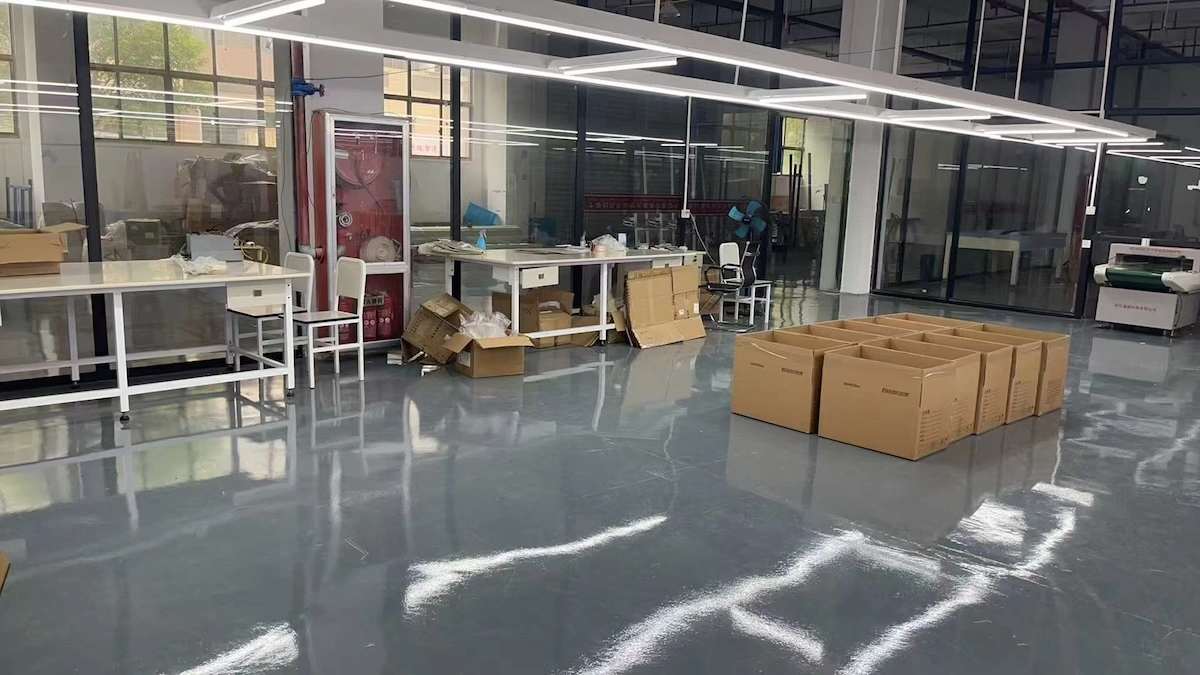
This is written for fashion brands, retailers and sourcing teams shipping occasionwear, prom, bridesmaid and gala garments. It picks up where inspection finishes, which our evening dress quality control checklist covers, and it sits inside the schedule described in our prom production timeline. What follows is the packing decision itself. The category is on our occasionwear manufacturing and evening dress pages.
Packing is risk control, not housekeeping
Packing is usually treated as the last and least technical step in an order, and it is where a correctly made garment acquires a defect. The defect is not introduced by carelessness; it is introduced by a method that was not chosen for the garment.
Why formal wear is different
A formal dress has properties that no other category combines. It is long, so it must be folded or hung. It frequently carries surface work, so contact between areas of the garment is a risk rather than a convenience. It often has structure, so compression changes its shape rather than merely creasing it. And it is usually pale or deeply saturated, which are the two extremes where marks show most. A packing method that works for a cotton shirt does not work for any of those properties.
Where damage usually appears
Damage from packing is not distributed evenly across a garment, and the places it appears are predictable. It shows at the fold lines, because that is where pressure is concentrated. It shows where two surfaces of the same garment touch, because that is where one can mark or abrade the other. It shows at any stiffened edge, because a stiffened hem or a boned channel does not recover from a tight fold. And it shows at the point where the garment rests on the carton, because that is where the package and the packing meet.
Knowing the four locations changes the packing decision, because it points at what to protect rather than at how much protection to add. A pack that controls pressure at the fold lines, keeps surfaces apart, keeps stiffened edges on a wide radius and keeps the garment off the carton board addresses almost every failure in this article, and it does so without adding bulk to the parts of the garment that were never at risk.
The five risks
| Risk | What causes it | What it looks like on arrival |
|---|---|---|
| Crease | A fold held under pressure, or fabric packed before it cooled after pressing | A hard line through a skirt or a bodice that does not steam out |
| Snag | Contact between a rough or hard element and a fine surface | Pulls in chiffon or mesh, marks on a satin face, broken threads at a seam |
| Crush | Compression of a structured or voluminous garment | A bodice that has lost its shape, a horsehair hem that has kinked, flattened volume |
| Moisture | Humidity in transit, condensation, or a garment packed warm | Mildew, odour, water marks on a pale ground, and dyestuff movement |
| Colour transfer | Contact between a dark and a pale surface, or between a garment and a printed carton | A shadow or a mark that cannot be removed without cleaning the garment |
The cost of getting it wrong
A packing failure is more expensive than a production defect of the same visual severity, because it happens at the end of the chain. The garment has been cut, sewn, finished, inspected and packed. Recovering it may mean returning it, re-pressing it, replacing it from a second production run, or accepting a reduced price. And on a prom or wedding order, the timing is the worst possible: the damage is found when the goods are needed, which is the one moment when a replacement cannot be made.
Pack according to the risk profile
A simple crepe midi does not need the same system as a beaded ball gown, and treating them the same wastes money on one and damages the other. The method should be the lightest system that controls the risks the style actually carries.
Score the style first
Score each style on the five risks as low, medium or high, and let the two or three highest scores choose the method. The scoring takes a minute per style and it produces a decision that can be written into the order and repeated, which is the point — a method left to the packing table will vary between orders and between operators, and the variation is what produces inconsistent complaints.
The systems, and what they control
| System | Controls | Suits | Cost it adds |
|---|---|---|---|
| Flat fold with tissue interleaving | Crease, snag, colour transfer | Simple styles with no structure and no heavy surface work | Low, and it is the default |
| Flat fold with a shaped insert or a padded roll | Crush and crease on a structured bodice or a shaped waist | Bodices with boning or cups, drop-waist styles | Moderate, in material and time |
| Soft folding on broad folds, no sharp creases | Crease on a long skirt, kinking at a horsehair hem | Floor-length skirts, trains, layered tulle | Moderate, and it increases packed volume |
| Individual protective bag | Snag, colour transfer, surface contact | Beaded, sequinned or metallic surfaces | Moderate per garment, and it slows packing |
| Hanging transport | Crease almost entirely | High-value structured and beaded pieces where the garment's shape is the product | Highest — volume, carton dimension and freight |
Standardise by style
The output of the scoring exercise is a packing standard per style: the method, the materials, the fold pattern where there is one, and the carton type. Written down, it becomes something a new operator can follow and something an inspection can check. Left as a verbal instruction, it becomes the thing that was done correctly on the first order and differently on the reorder.
Who owns the packing decision
Packing standards sit between three parties and are frequently owned by none of them. Production owns the finishing sequence and the cooling period. Quality owns the inspection that has to be complete before the fold. And the commercial side owns the freight volume and the delivery date, which the carton and the method both affect. Where none of the three holds the standard, it is set at the packing table by whoever is folding, and it changes between orders.
The fix is to treat the packing standard as an order document rather than a finishing instruction. That places it where the shipment quantity, the delivery date and the carton are already being decided, which is the only point at which a method can be chosen against its freight consequence rather than discovered after it. It also gives the standard an owner, which is what makes it repeat on the reorder.
Finish before folding
Packing is the last step, and everything that touches the garment before it has to be complete. Three of those steps have a direct effect on whether the packing method works.
Complete pressing and thread cleaning first
A garment folded with a thread end still attached will hold that thread against the surface it touches, and on a fine fabric the mark can be permanent. Pressing has to be complete as well, because a garment packed in a partly pressed state will develop a crease along the fold that no later steaming removes cleanly. Both belong before the packing station, not at it.
Let the garment cool
Steam and residual heat are the mechanism behind creases that appear in transit on garments that were correctly pressed. Fabric that is folded while warm holds the fold more firmly, and the effect is strongest on a structured or heavy fabric, which cools more slowly than a light one. A short cooling period between the press and the fold is one of the cheapest controls available, and it costs only space.
Close and secure before packing
Zips should be closed so that the slider and the teeth cannot contact anything, hooks should be fastened into their eyes, and any removable element should be secured or packed separately. Loose hardware is the most common cause of a snag, because it moves during handling and finds the thinnest point of whatever it rests against.
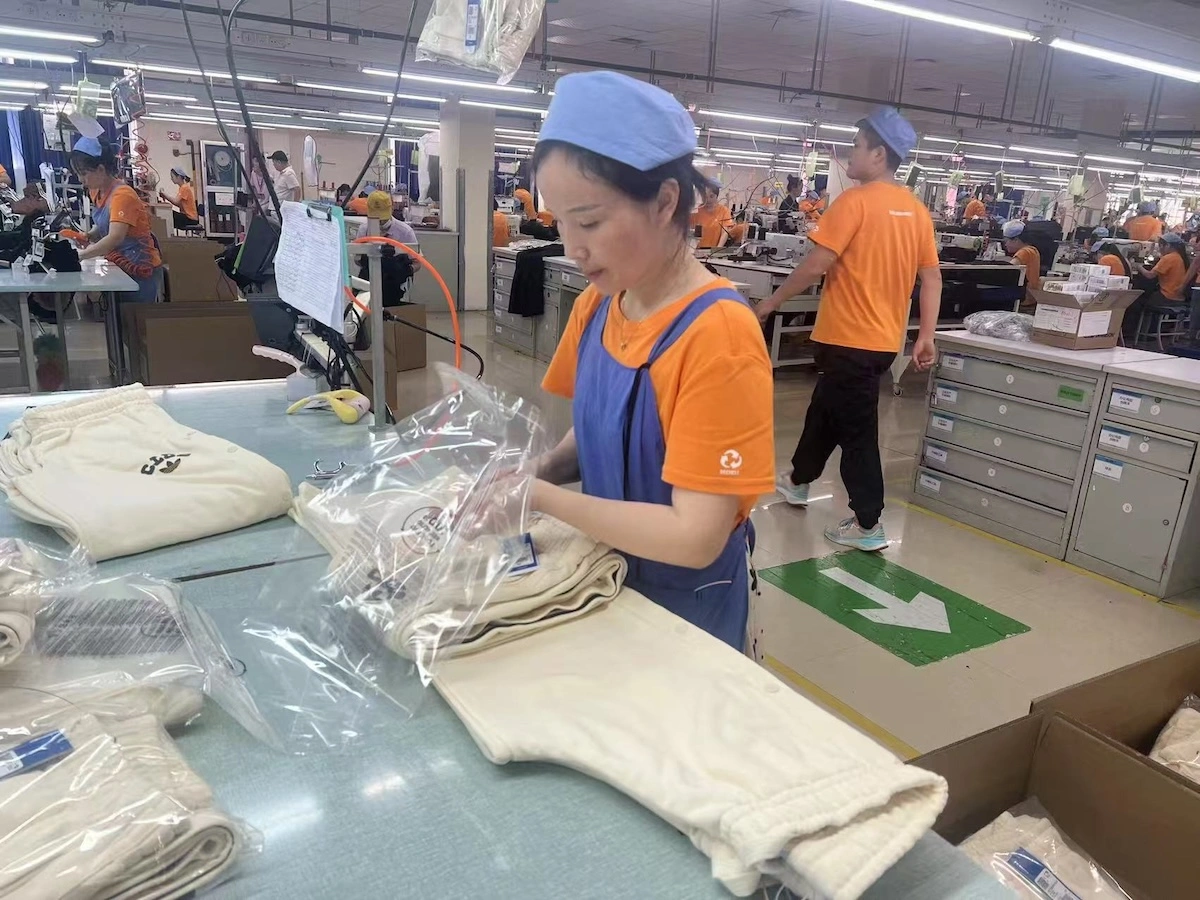
Photograph the standard
Photographs of the folded garment, the interleaving, the insert and the finished carton are the fastest way to communicate a packing standard across a factory, a second site or a new order. They are also the evidence that the method was specified, which matters when a damage claim has to be resolved with a freight provider or a customer.
Protect embellishment surfaces
Beads, sequins, stones, applique and hardware are the parts of a garment most likely to be damaged and most likely to damage something else. They need protection on both sides of the contact.
Interleave where surfaces meet
Where a decorated area of the garment will rest against another part of the same garment, tissue or a soft interleaving keeps the two apart. Acid-free tissue is the usual choice in a pale garment, because it does not itself transfer a mark. The interleaving is not only protection for the decoration; it is protection for whatever the decoration would otherwise press into, which on a beaded bodice is usually the skirt or the bodice front.
Avoid hard folds across stones and applique
A hard fold across a decorated area concentrates pressure on individual elements, which can break them, distort a motif's alignment or emboss the shape of the decoration into the fabric underneath. Where the garment's size forces a fold through a decorated zone, the fix is usually to change the fold's position rather than to add protection: a fold that runs beside a decorated panel is cheaper and safer than one that runs across it.
Keep hardware away from fine fabric
Hooks, clasps, zipper pulls and any sharp trim should be positioned so they cannot contact chiffon, mesh or a fine satin during handling and transit. The practical measures are a small wrap around the hardware, a barrier between the hardware and the fine surface, and orienting the garment so the two are not adjacent in the pack. All three are trivial at packing and impossible to correct on arrival.
Individual protection for premium pieces
On the pieces where the surface is the product, an individual protective bag is the appropriate standard rather than a shared pack. It prevents contact between garments, keeps the decoration away from carton surfaces, and gives the retailer a garment that can be handled without touching the surface. It also slows packing and adds material, so it belongs on the styles whose scores justify it rather than on the whole order.
Manage long skirts and trains
Length is what makes an occasionwear pack difficult. A long skirt has to be reduced to a packable shape, and the reduction is where creasing and press damage happen.
Broad folds, not tight folds
A long skirt folded on a broad, soft fold distributes the curvature across a wide area and the crease that results is shallow. A tight, compact fold produces a crease the garment cannot recover from without a full press. The trade is volume: broad folds take more space, and the extra space is a freight cost. Calculating that cost against the cost of a re-press, a markdown or a return is the decision, and it is usually resolved in favour of the larger pack on the styles where the skirt is the design.
Support a horsehair hem
A horsehair or otherwise stiffened hem kinks if it is folded tightly, and a kink in a horsehair does not disappear when the garment is hung. It has to be supported through the fold, usually by keeping the fold radius wide and placing the hem so it is not the hardest crease in the pack. This is one of the specific failures that a general packing method does not anticipate, and it is worth adding to the risk scoring for any style with a stiffened hem.
Do not let the bodice carry the skirt
In a folded pack, the relationship between the bodice and the skirt changes: whatever weight sits above will press down on what is below. Where a heavy skirt is folded so that its mass rests on the bodice, the boning, cups or waist structure are under a load they were never designed for, and the result is a distorted bodice rather than a creased skirt. Position the fold so the skirt's bulk sits on the base of the pack, not on the structure.
Hanging transport
Where a garment is shipped hanging, two mechanical questions decide whether it arrives correctly: whether the hanger is strong enough to carry the garment's weight for the duration of the journey, and whether the carton is dimensioned so the garment does not rest on its hem or compress against the lid. A hanger that bends lets the garment slide, and a carton that is too short presses the hem — both of which defeat the reason for hanging it in the first place.
Control cartons and moisture
The carton is part of the packing system, and the two things it has to do are resist the compression it will meet in transit and keep the garment's moisture environment stable.
Carton strength against freight cost
Cartons are stacked and are frequently over-stacked, and a carton that deforms under load transfers that load to the garments inside. The choice is between a stronger carton and a larger one, and both cost money: strength adds board weight, and volume adds freight. The useful discipline is to test the intended carton under a realistic stack for a realistic duration before a full order is packed, because the failure is not visible until the goods are already in transit.
Moisture control by route
The moisture risk depends on the route and the season rather than on the garment. A humid climate, a sea journey and a change of temperature between a warm factory and a cold hold all produce condensation, and the consequences on a pale garment are mildew, odour and water marks that do not come out. Where the route justifies it, a barrier layer or a desiccant controls the immediate environment around the garment; where it does not, adding one is an unnecessary cost. The decision belongs to the shipping method, which is why it is worth deciding the packing standard and the freight method together rather than in sequence.
Do not overpack
Packing a carton as full as it will go is a natural response to freight cost, and past a point it destroys the pressing that was completed an hour earlier. The limit is the point at which the garments begin to compress each other rather than merely fill the space; beyond that, the pack has converted a pressing cost into a presentation problem. Vacuum packing is the extreme case and is unsuitable for structured, embellished or voluminous formal wear, because it removes the air that is holding the garment's shape.

The five risk axes and the systems they select
The working version of this article: score the style, read the two highest risks, and the method follows. The last column is what to write into the order.
| Score | Likely style | Method it selects | What the order specifies |
|---|---|---|---|
| Crease high, others low | Floor-length skirt in a plain fabric, no structure | Flat fold on broad folds, tissue at the fold | Fold pattern, tissue, carton dimension |
| Snag high | Beaded, sequinned or metallic surface | Individual protective bag, interleaving at contact points | Bag specification, interleaving material and placement |
| Crush high | Boned bodice, drop waist, layered tulle, horsehair hem | Shaped insert or broad folds, skirt bulk at the base | Insert type, fold position, packed volume allowance |
| Moisture high | Long sea route, humid season, pale ground | Barrier layer or desiccant, sealed inner pack | Barrier material, carton type, shipping method confirmed together |
| Colour transfer high | Dark surface adjacent to a pale one, or printed carton board | Interleaving between surfaces, plain inner liner | Interleaving, liner, and no direct contact with printed board |
Read the top two, not all five
A method that answers every risk at once is expensive and usually unnecessary. The two or three highest scores decide the method; the rest are controlled by the default pack. Reading only the top scores is what keeps the standard proportionate, and it is also what makes the standard affordable to apply consistently across a range rather than only to the hero pieces.
The master carton and document check
Before a full order is packed, one master carton should be built and checked. It is the cheapest way to prove a method, because everything it finds is found before the order exists rather than after it has shipped.
What the master carton proves
- That the carton's dimensions are right for the folded or hanging garment, with no pressure on the hem and no movement inside.
- That the carton resists a realistic stack, tested rather than assumed.
- That the fold pattern works in the actual fabric rather than in theory.
- That the packed volume matches what was budgeted for freight.
- That the labels, the pack list and any carton marking are correct and legible.
- That the garment can be unpacked and handled by the retailer without touching a decorated surface.
The documents that travel with it
The master carton check is also where the paperwork is confirmed: the pack list matching the carton contents, the size and colour breakdown, and the markings the destination requires. A carton that arrives correctly packed and incorrectly documented still costs a delay, and a delay is the failure mode that matters most on a prom or wedding order.

Practical buyer worksheet
Fill this in before the order is confirmed. For a packing problem the third and tenth lines matter most: a stated landed cost and a stated delivery date are what make the carton and the method a decision rather than a discovery.
- Target customer and use occasion
- Target retail and wholesale price
- Target ex-factory or landed cost
- Core fabric and backup fabric
- Size range and base fit size
- Colour count and continuity colours
- Critical construction risks
- Approval sample required
- Inspection checkpoints
- Latest acceptable delivery date
FAQ
Should formal dresses ship hanging?
Sometimes, and the decision is a trade of freight cost against the value of the garment's shape. Hanging transport removes almost all creasing, which is a genuine advantage on a long skirt, a structured bodice or a decorated surface. It also consumes far more volume, requires a carton dimensioned for the garment's full length, and needs a hanger strong enough to carry the weight for the whole journey. Where the shape is what the customer is buying, hanging is often worth the volume; where the garment is a simple packable style, a fold on broad folds costs less and works.
How should sequins be protected?
By preventing abrasive contact and avoiding hard folds across decorated areas. In practice that means interleaving wherever a decorated surface would meet another part of the garment or another garment, positioning folds so they run beside a decorated panel rather than across it, and protecting anything raised enough to press into the fabric underneath. On a sequinned or beaded surface, the damage usually appears on the garment the decoration pressed against rather than on the decoration itself, which is why the protection has to be considered in both directions.
Can vacuum packing be used?
It is generally unsuitable for structured, embellished or voluminous formal wear. Vacuum packing removes the air that is holding a garment's shape, so volume, a boned bodice's curve and the light hand of a tulle layer all flatten, and the compression that produces the saving is exactly what a formal dress cannot absorb. Where freight volume is the concern, the controls that do work are a more efficient fold, a carton dimensioned to the garment rather than to a standard size, and a properly tested carton rather than an over-full one.
What causes mildew or odour?
Residual moisture, a humid route and insufficient protection, usually in combination. A garment packed warm carries its own moisture into the pack; a humid climate and a sea journey add more from outside; and a sealed carton without a barrier holds it against the fabric for the length of the voyage. The symptoms on a pale ground are mildew, an odour that does not wash out, and water marks that appear only when the garment is unpacked. The controls are a cooling period before packing, a barrier or desiccant where the route justifies it, and confirming the packing method together with the shipping method.
Next step
We produce and pack occasionwear at our production facilities in Guangzhou and Dongguan, with a scored packing standard per style, finishing and cooling sequenced before the fold, interleaving and individual protection where the surface requires it, broad-fold handling for long skirts and horsehair hems, carton and moisture controls matched to the route, and a master carton built and checked before a full order is packed. Send the styles and the shipping method, and we will come back with a packing standard and a freight volume rather than a note to handle with care. Request a quote, or see the category on our occasionwear manufacturing page.
Our quality control checklist covers the inspection the garment passes before it reaches the packing table, and our prom production timeline places packing and freight inside the season calendar. Silhouettes already in production are on our style library and ready stock pages, and the wider category is on the women's dresses page.