On this page
- A Range Without Price Architecture Becomes a Discount Rack
- What Actually Separates the Tiers
- Building the Tiers From the Costing Sheet Up
- Entry Price Without Looking Cheap
- Premium Without Wasting Money Where Nobody Looks
- The Middle Is Where Range Planning Fails
- Price Points and Selling Channels
- Where Ready Stock Fits in a Price Architecture
- FAQ
- Working With Luxudress
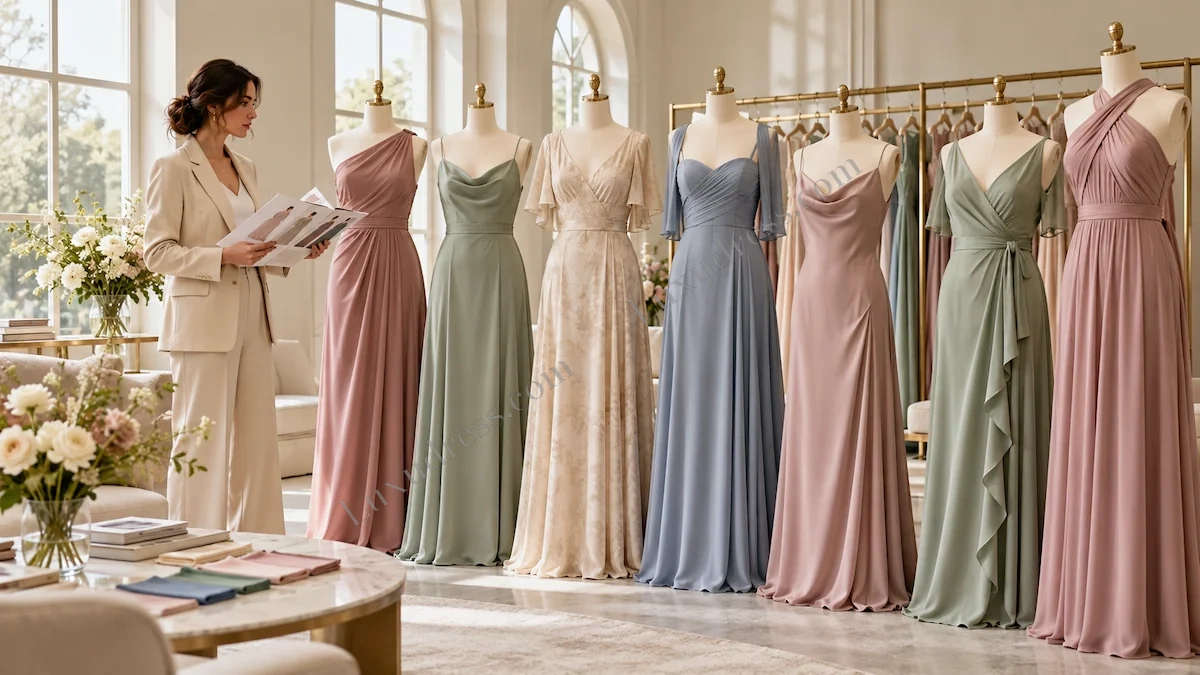
Price architecture is the deliberate arrangement of a range across price levels: what the entry piece is, what the middle of the range is anchored to, what the ceiling is, and how the pieces between them differ. It is a planning decision, and it is one of the few decisions in a collection that a brand can make entirely on its own, without depending on a supplier.
The reason it matters is that customers shop a range, not a garment. A shopper who sees three similar dresses at three similar prices does not conclude that the brand has options; she concludes that the brand has not decided anything, and she waits for the markdown. A shopper who sees a clear difference between the pieces — different fabric, different construction, a visible reason for the price — buys the one she can justify and understands why the others are different.
The manufacturing side of this is more useful than it sounds. The differences a brand can create between tiers are not marketing differences; they are things that are either present in the garment or absent from it, and they are all decisions made at development. That is why the tiers are best built from the cost sheet upwards rather than by setting prices and working backwards.
A Range Without Price Architecture Becomes a Discount Rack
The failure mode is recognisable and it follows a consistent pattern.
- The range is designed first and costed second. Pieces are chosen for how they look together, which is a legitimate design instinct that produces a range with no cost structure at all.
- The costs cluster. When the quotations arrive, most pieces land within a narrow band, because they were designed with similar fabric and similar construction.
- Prices are set on a multiple. The brand applies a consistent markup to the costs, which preserves the cluster in retail terms.
- The range competes with itself. Several pieces at similar prices, similar fabrics and similar ideas mean the customer has no reason to prefer one, so the brand's own garments cannibalise each other.
- Markdowns arrive early. Unsold pieces that are indistinguishable from the pieces that sold are discounted first, and discounting one undermines the price of all of them.
- Next season is designed defensively. The brand responds by cutting cost across the range, which narrows the differences further and repeats the cycle.
The step that matters is the second one. Cost clustering is not a pricing problem; it is a development problem, because it means the range was never designed to have tiers. By the time the brand is setting prices, the structure is already fixed and the only remaining lever is margin.
The reason this is worth solving at development rather than at pricing is that the tier differences are all sourced from the same place: the same fabric selection, the same construction specification and the same component choices that determine everything else about a garment's cost. Building tiers therefore does not require new work; it requires deciding at the start which lever each tier is pulling.
What Actually Separates the Tiers
The instinctive answer is that premium garments use more expensive fabric. Fabric is part of it, and it is not the biggest part. Six drivers separate the tiers, and the most useful ones are the ones a customer can see and touch.
| Driver | How it moves with the tier | How visible it is |
|---|---|---|
| Fabric | Fibre quality, weight, hand and finish improve; the difference is felt more than seen | Felt on contact |
| Lining and interlining | Presence, quality and construction method improve markedly | Felt in wear, and it is the most under-priced difference in the market |
| Construction method | Seam finishes, edge finishes, closures and internal structure become more considered | Seen on close inspection and felt in wear |
| Hand-work | Hand finishing, hand-set details and hand embellishment increase | Seen immediately, and it is the clearest visual signal |
| Components | Zip, trimming, hooks, buttons and internal supports improve in quality and consistency | Felt and seen at close range |
| Fit and grading | The number of sizes, the fit refinement and the amount of development all increase | Felt in wear, and it is the strongest reason for a repeat purchase |
The lining row is the one worth dwelling on, because it is where the biggest quality difference can be created for the smallest visible change. A well-lined garment behaves differently: it hangs better, it does not cling, it survives a season without losing its shape, and the inside looks finished. Customers rarely name the lining when they explain why one dress feels better than another, and it is frequently the actual reason.
The fit row is where a brand has the most durable advantage and the least visible one at the point of sale. More sizes, a better grade and a properly fitted top of the range are not things a customer can see on a hanger, and they are the reason a customer comes back. On a category where returns are driven by fit, investing in grading rather than in surface detail is the difference between a premium tier that reads as premium and one that reads as merely expensive.
There is a sequencing point here that is easy to miss. The six drivers differ in how quickly they can be changed. Fabric and components can be altered on a sample with limited disruption. Construction can be altered at development. Hand-work and embellishment change lead time as well as cost. Fit and grading are the slowest of all, because improving them means more sizes, more development rounds and a longer path to production. A brand that decides late that its premium tier needs a better grade is asking for the one change that cannot be made quickly.
That makes fit the decision to take first, and it is also the decision that most reliably supports a premium price — because it is the only one of the six that a customer experiences every time the garment is worn rather than at the moment of purchase.
Building the Tiers From the Costing Sheet Up
The practical method is to decide the levers before the designs, not after the quotations.
- Name the tiers and their job. Entry brings customers in and must be profitable at a lower price. Mid carries the volume and is the reference point for value. Premium establishes the brand's ceiling and gives the range its reason for existing.
- Assign each tier the levers it will pull. Entry might pull on fabric and components but keep construction solid. Mid might use a standard construction with a better lining. Premium might add hand-work, a better grade and a more complex construction.
- Design to the tier. When the designs are drawn, each one already knows which levers are available, which prevents a range where everything tries to be premium and nothing is differentiated.
- Cost the range as a set. Compare the costs across the range before setting prices, and check that the tiers have actually separated. If the entry and mid pieces cost within a very narrow band, the issue is the design rather than the price.
- Set prices to the architecture, not to a uniform multiple. Uniform markups preserve whatever structure the range already has, including its faults. Deliberate architecture sometimes means different margins at different tiers, which is normal and defensible.
- Check the architecture against the selling channel. The tiers have to make sense at the price points the channel supports, which is the subject of a later section.
The second step is the one that gets skipped. Assigning levers is uncomfortable because it means deliberately designing some pieces to be less than the best, which feels like a compromise. It is not — it is the mechanism by which the best pieces are legible. A range where every garment is as good as the brand can make it has no entry, no ceiling and no internal contrast.
The cost side of this also becomes easier to manage. A brand that has decided its levers can ask for quotations with an understanding of what it is comparing, rather than asking for a price and reacting to it. And a brand that understands which levers it is pulling can hold a supplier to them, which is far more useful than a general instruction to make something cheaper. The structure of a garment's cost is covered in how a costing sheet is built, and a worked comparison across three garments at different levels is in three dresses costed.
Entry Price Without Looking Cheap
The entry piece has an unfair job: it has to be affordable and it has to be recognisably the same brand as the pieces around it. Three moves achieve that, and three undermine it.
Do
- Simplify the design rather than the construction. Fewer panels, fewer seams, a simpler silhouette and a straightforward closure cost less without signalling cheapness, provided the construction that remains is sound.
- Keep the interior honest. A clean seam finish, a proper facing and a lining that is not the weakest thing in the garment are inexpensive relative to how much they change the experience.
- Spend on the one thing the customer touches. A single good component or a slightly better hand on the fabric at the point of contact does more than any amount of improvement spread thinly.
Do not
- Use a fabric that behaves badly to save money. A cheap fabric that puckers, clings or creases in the wrong place makes the whole brand look cheaper than the price suggests, and the saving is invisible against the reputational cost.
- Strip the lining or the interlining to reach a price. These are the components the customer feels and never sees attributed, which is the worst combination: a real reduction in quality with no visible explanation for the lower price.
- Change the fit to reach a price. Reducing the number of sizes or the refinement of the grade saves development cost and creates returns, and returns cost more than the development did.
The governing principle is that an entry piece should be simple rather than compromised. A customer can see the difference between a garment that was designed to be simple and one that was designed to be expensive and then reduced, and the second reads as a mistake even when the price is attractive.
Premium Without Wasting Money Where Nobody Looks
The premium piece fails in the opposite direction. Brands overspend in places the customer cannot perceive and underspend where she can, and the two errors are usually driven by the same instinct: to make the garment as good as possible in every respect.
- Spend where the customer's hand goes. Fabric hand, weight and surface are felt before anything else. So is the weight of the garment when it is picked up.
- Spend where the garment is closed and opened. Closures are operated by hand and noticed immediately, and a poor zip on an otherwise premium garment is disproportionately damaging.
- Spend on the inside, selectively. Not on every seam, but on the parts of the interior a customer will encounter — the neckline edge, the waistband, the top of the lining.
- Do not over-specify the invisible. A construction detail nobody will ever see costs money and adds nothing, and it can actively hurt by adding weight or stiffness.
- Do not confuse complexity with quality. More panels, more seams and more trims are not premium; they are expensive, which is a different thing and one customers distinguish.
- Do spend on the fit. The top of the range is where fit problems are least tolerated and where the strongest argument for the price exists.
There is a specific trap on embellished occasionwear, where the temptation to add hand-work is strongest and the relationship between hand-work and perceived value is weakest. Beading and embroidery are visible and they do justify a price, but only when the work is at the standard the price implies. A garment that carries a lot of embellishment at a moderate quality level reads worse than a plainer garment made well, because the flaw in the embellishment becomes the thing the customer looks at. The manufacturing side of that trade-off is covered in hand embellishment in womenswear.
The Middle Is Where Range Planning Fails
The entry and the premium are conceptually easy: one is as simple as it can be, one is as good as it can be. The middle is where the range actually lives, where the volume is, and where most planning fails — for a structural reason.
The middle has to do two incompatible things at once. It has to be recognisably better than the entry, or the entry becomes the sensible purchase and the middle becomes pointless. And it has to be recognisably different from the premium, or the premium becomes an indulgence and the middle absorbs its customers. The window between those two is narrow, and it gets narrower as the number of pieces in the range grows.
- Too many pieces in the middle produces internal competition, which is the clustering problem in miniature.
- Too few pieces in the middle produces a range with an obvious gap, and customers either trade down or away.
- Middle pieces that differ only in fabric are hard for a customer to value, because the difference is felt rather than seen.
- Middle pieces that differ only in detail are easy to discount, because a customer can wait for the detail to be marked down.
- Middle pieces with a clear construction difference hold their price best, because the difference is visible and cannot be recreated by discounting.
The practical rule is to keep the middle small and make its differences legible. Two or three pieces that differ clearly from both the entry and the premium will outperform several that differ subtly from each other, and they will discount less, because a customer can see what she is paying for at the moment of decision.
Price Points and Selling Channels
A price architecture is not channel-neutral. The same garment at the same cost has to work at very different retail prices depending on where it is sold, and the tiers have to be set with the channel in view.
- Wholesale requires the garment to carry the brand's margin and the retailer's margin, which pushes the achievable cost down and makes the entry tier the default unless the brand has a clear reason for a higher piece.
- Direct-to-consumer removes a layer of margin, which is what makes a genuine premium tier possible at a lower retail price than the same garment would reach through wholesale.
- Rental is priced on wears rather than on ownership, which changes the tiers entirely: durability and cleaning behaviour become the premium attributes, and the architecture is built around how many times the garment can be worn well.
- Boutique and concept retail rewards visible construction and story, which means the tiers can be separated by craft rather than by price alone.
- Marketplaces compress the range, because the platform's own comparison tools make the middle tier the safe purchase and make an expensive piece hard to justify.
The consequence is that a range designed for one channel usually needs reworking for another rather than simply repricing. A collection built for direct-to-consumer will look overpriced in a marketplace and a collection built for wholesale will look thin in a boutique. That is not a failure of the design; it is the architecture responding to a different set of constraints.
Where a brand sells through more than one channel, the honest approach is to accept that the tiers will not be identical across them. Designing one range and distributing it everywhere is a decision that flattens the architecture, and the flattening shows up as markdowns in the channel where the pieces do not fit.
Where Ready Stock Fits in a Price Architecture
A brand with a stocked, repeatable range has an asset that most brands do not: a known cost, a known construction and an immediate availability. That changes how it can sit in a price architecture.
- As a tested entry tier. A stocked style whose construction is already proven can carry the entry price without a development cycle in front of it.
- As a speed tier rather than a price tier. Availability commands a different kind of value, and a stocked piece bought for a delivery date is not competing on price with a made-to-order one.
- As a comparison point. A stocked garment a brand can physically handle makes the quality difference between its tiers concrete for the buyer, which is far more persuasive than a specification sheet.
- As a mid-tier substitute for a development round. Where a brand needs volume in the middle of the range quickly, a developed and stocked style can fill the position while a bespoke piece is developed.
- Not as a premium tier. A premium position is defined by specificity, and a stocked style exists precisely because it is repeatable, which is the opposite quality.
The most common mistake with stock is treating it as a way to lower the price of the range rather than as a way to occupy a position in it. A stocked piece that is priced as a cheap version of a bespoke piece cannibalises the bespoke piece; a stocked piece that is positioned as its own tier, with its own reason to exist, adds a position to the architecture that the brand did not previously have. Ready stock is developed for exactly this kind of reuse, and you can see the current range by the piece or browse the developed style library to understand what is already built.
FAQ
How many price points should a range have?
Fewer than most brands assume. Three positions — entry, middle, premium — is enough to create contrast, and a range with many more usually ends up with pieces competing rather than differentiating. Where a brand sells through several channels, the positions multiply because the channels change what each one means, and that is a reason to be deliberate rather than a reason to add more.
What is the biggest cost driver between tiers?
Fabric and construction together, and typically it is the construction and the interior — lining, interlining, seam and edge finishing, closures and internal structure — that creates the quality difference a customer feels for the least visible change. A better fabric alone, on a garment whose interior is unchanged, produces a garment that feels expensive to a buyer and ordinary to a wearer.
Should I apply the same markup across the range?
A uniform multiple is simple and it preserves whatever structure the range already has, which is its weakness. Deliberate architecture sometimes calls for a lower margin at the entry position — to keep the entry point reachable — and a higher one at the premium position where the customer is buying specificity. That is a normal commercial arrangement and it is better than distorting the cost to reach a target price.
Can I make a cheaper version of a best-seller?
Sometimes, and it usually damages the original. A lower-cost version of the same design invites direct comparison, and everything the customer liked about the original becomes the explanation for why the cheaper one is worse. A better approach is a different design at the lower position that shares the brand's construction standard, so the pieces are comparable in quality and different in idea.
What makes a garment read as premium?
Weight in the hand, a clean interior, a closure that operates properly, a neckline edge that holds its line, and a fit that does not need adjusting. None of those is the most expensive thing in a garment, and all of them are visible or felt within seconds. Embellishment reads as premium only when its execution is at the standard the price implies.
Why does my middle price point not sell?
Usually because it is not different enough from the pieces on either side. A middle piece has to be visibly better than the entry and visibly cheaper than the premium; if it is only slightly better than one and only slightly cheaper than the other, the customer chooses on price and the position collapses. Making the difference legible — through construction or through a clearly different idea — is what holds the position.
We are launching our first range. Where do we start?
With the middle. Decide what the reference piece is, design it properly, and then decide what the entry is missing and what the premium adds. A range built outward from a single well-resolved reference piece usually has a coherent architecture; a range built by designing a dozen pieces and sorting them by cost usually does not.
Working With Luxudress
Luxudress is the factory-direct front end for womenswear production across production facilities in Guangzhou and Dongguan, covering development, sampling, material sourcing, manufacturing, inspection and export packing.
When a brand brings us a range plan rather than a single style, we will cost the pieces against each other rather than one at a time, tell you which differences between your tiers are actually costing money and which are only visible on the spec sheet, and say plainly when two pieces in a range are close enough to compete.
If you are planning a range, send the tier structure you have in mind. You can also read how a dress cost breaks down, work out how much to order, browse the style library, or order from ready stock by the piece to hold a finished garment and judge its construction before committing to a production run.
Request a quote and we will return a costed plan for the range as specified.