On this page
- How these three were chosen
- Dress A: the jersey column dress
- Dress B: the lined woven midi
- Dress C: the hand-embellished occasion dress
- The eleven line items, one at a time
- What actually moves the number
- Why unit price falls as quantity rises
- What is not in these figures
- Why the second order costs less than the first
- What to send us to get an accurate number
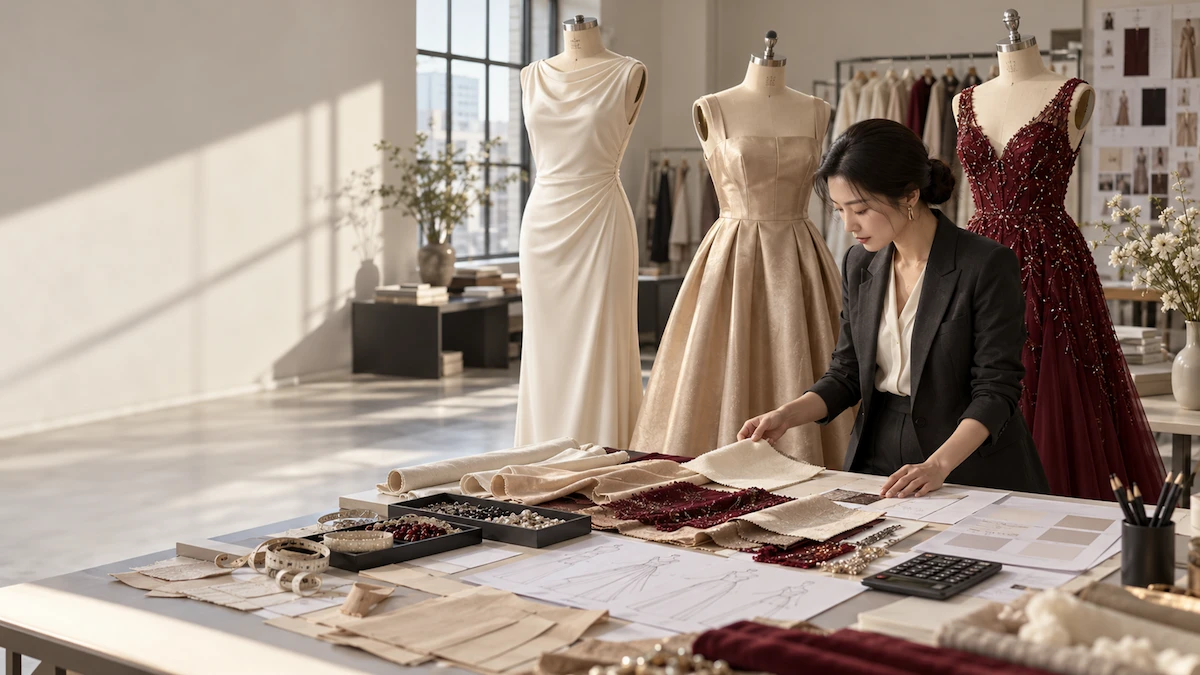
The quote arrives as one number. That is the part buyers complain about, and not without reason. You send a sketch or a reference photo, wait a day, and get back a line that says USD 18.40 per piece FOB Guangzhou. There is nothing to compare it against. You do not know whether that number is cheap, fair, or padded, and you have no way to argue with it because you cannot see how it was built.
So we opened the books on three dresses we run through our own lines in Guangzhou and Dongguan. Three different constructions, three different price points, every line item named and costed the way we actually calculate it. Not averages from a report and not a theoretical model. These are the numbers in the order they matter.
If you read this to the end you will be able to look at any garment quotes you receive afterwards and read them, rather than guess at them. That is the whole purpose of the piece.
Who this is written for. If you already run a nine-figure apparel business you have a costing team and none of this is news. It is written for the person doing that job alone: the founder pricing their first run, the buyer defending a margin to a director, the brand manager who has to explain why a quote moved. You do not need a finance background. You need to know which lines to ask about, and the three tables above are those lines in the order they matter.
How these three were chosen
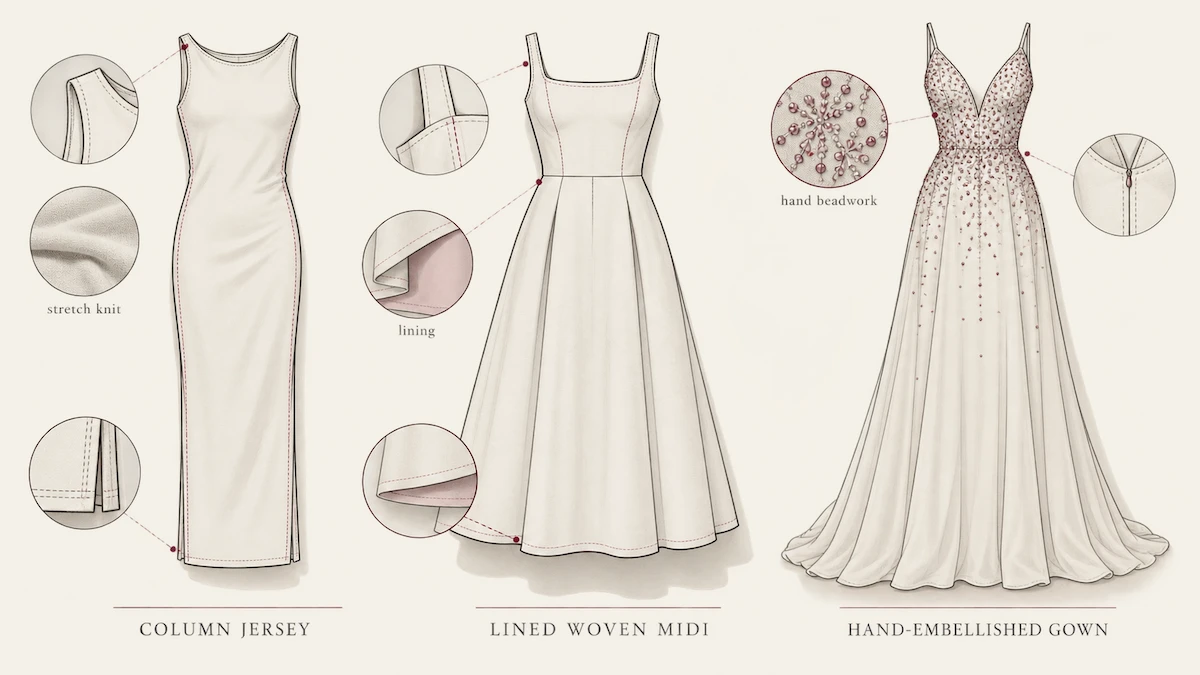
We could have picked thirty dresses. Three is enough if they are far apart on construction, because the point is not the arithmetic. The point is where the money goes.
The jersey column dress is the simplest thing we make that still requires proper grading and finishing. It tells you what the floor costs before anything clever happens.
The lined woven midi adds structure, a closure, and a second fabric. It is the middle of the road for most independent labels, and it is where buyers most often underestimate.
The hand-embellished occasion dress is the honest answer to a question we get constantly, which is why a beaded dress costs three times what the same silhouette costs without beads.
All three assume a first bulk order, not a re-run. That matters, because re-runs are cheaper and the reason they are cheaper is not what most people assume. We get to that further down.
Dress A: the jersey column dress
Simple on paper. Sleeveless, no closure, cut close through the body, hem falls below the knee. Fabric is a 180gsm viscose-spandex jersey, four sizes graded from the approved sample, three hundred pieces, one colour.
Here is the cost sheet.
| Line item | Basis | Cost per piece (USD) |
|---|---|---|
| Fabric | 1.60 m at USD 4.20/m | 6.72 |
| Trims (thread, labels, care label) | per piece | 0.85 |
| Cut, make, trim labour | 22 min at USD 0.085/min | 1.85 |
| Relaxation and steam | per piece | 0.20 |
| Grading and marker | USD 45 per style / 300 pcs | 0.15 |
| Sampling amortised | USD 60 per round / 300 pcs | 0.20 |
| Inline and final inspection | per piece | 0.45 |
| Packing (polybag, hangtag, carton) | per piece | 0.70 |
| Factory overhead allocation | per piece | 0.90 |
| Subtotal | 12.02 | |
| Margin (18%) | 2.16 | |
| Ex-works price | USD 14.20 |
Two things in that table do most of the work.
Fabric is 6.72 out of 14.20, which is just under half the garment. This is typical for anything made from knit, and it is why your fabric choice is effectively your cost choice. A buyer who moves from USD 4.20 per metre to USD 5.60 per metre has moved their ex-works price by roughly fourteen per cent before any other decision is made.
Labour is 1.85 out of 14.20, around thirteen per cent. A twenty-two-minute garment is a genuinely quick garment. Most buyers guess labour is a far larger share than it is on simple styles, and then they are baffled when removing a seam saves almost nothing. Removing a seam on a twenty-two-minute garment saves ninety seconds of operator time. That is under fifteen cents.
Note also what is missing. There is no washing line, because this fabric arrives piece-dyed and does not need one. There is no fusing line, because nothing here is interfaced. Every one of those lines that is absent is why this dress lands where it does.
Dress B: the lined woven midi
This is the shape most buyers actually order first. A woven crepe shell, a stretch satin lining, an invisible zip at the centre back, a lightly boned bodice, an asymmetric hem. Four hundred pieces, one colour.
| Line item | Basis | Cost per piece (USD) |
|---|---|---|
| Shell fabric | 2.10 m at USD 6.80/m | 14.28 |
| Lining fabric | 1.40 m at USD 3.10/m | 4.34 |
| Trims (invisible zip, boning, thread, labels) | per piece | 2.60 |
| Interfacing and fusing | per piece | 0.45 |
| Cut, make, trim labour | 58 min at USD 0.085/min | 4.93 |
| Grading and marker | USD 60 per style / 400 pcs | 0.15 |
| Sampling amortised | USD 120 across two rounds / 400 pcs | 0.30 |
| Inline and final inspection | per piece | 0.75 |
| Packing (polybag, hangtag, carton) | per piece | 0.95 |
| Factory overhead allocation | per piece | 1.60 |
| Subtotal | 30.35 | |
| Margin (17%) | 5.16 | |
| Ex-works price | USD 35.50 |
The jump from 14.20 to 35.50 is real and it is almost entirely explainable by four lines.
Fabric went from 6.72 to 18.62, because now there are two fabrics and the shell fabric costs sixty per cent more per metre than the jersey did. This is the single biggest mover in the whole comparison.
Labour went from 1.85 to 4.93, because fifty-eight minutes is nearly three times twenty-two minutes. A hidden zip takes an operator through several passes and there is no way to rush the finish without it showing at the seam.
Trims went from 0.85 to 2.60. A concealed zipper plus boning plus a proper set of labels is not trivial, and hardware is one of the few inputs where quality is immediately visible to the end customer.
Sampling amortised went from 0.20 to 0.30, and that number is misleadingly small because it spreads a larger total across a larger run. The true cost of developing this dress was USD 120 across two sample rounds. If you had ordered one hundred pieces instead of four hundred, that line alone would have read USD 1.20. More on this below.
One thing that often surprises people here: this dress has no washing or dyeing line either. Both fabrics arrive finished. Add a garment dye or an enzyme wash and you add USD 1.20 to USD 2.80 depending on the process and the load size.
Dress C: the hand-embellished occasion dress
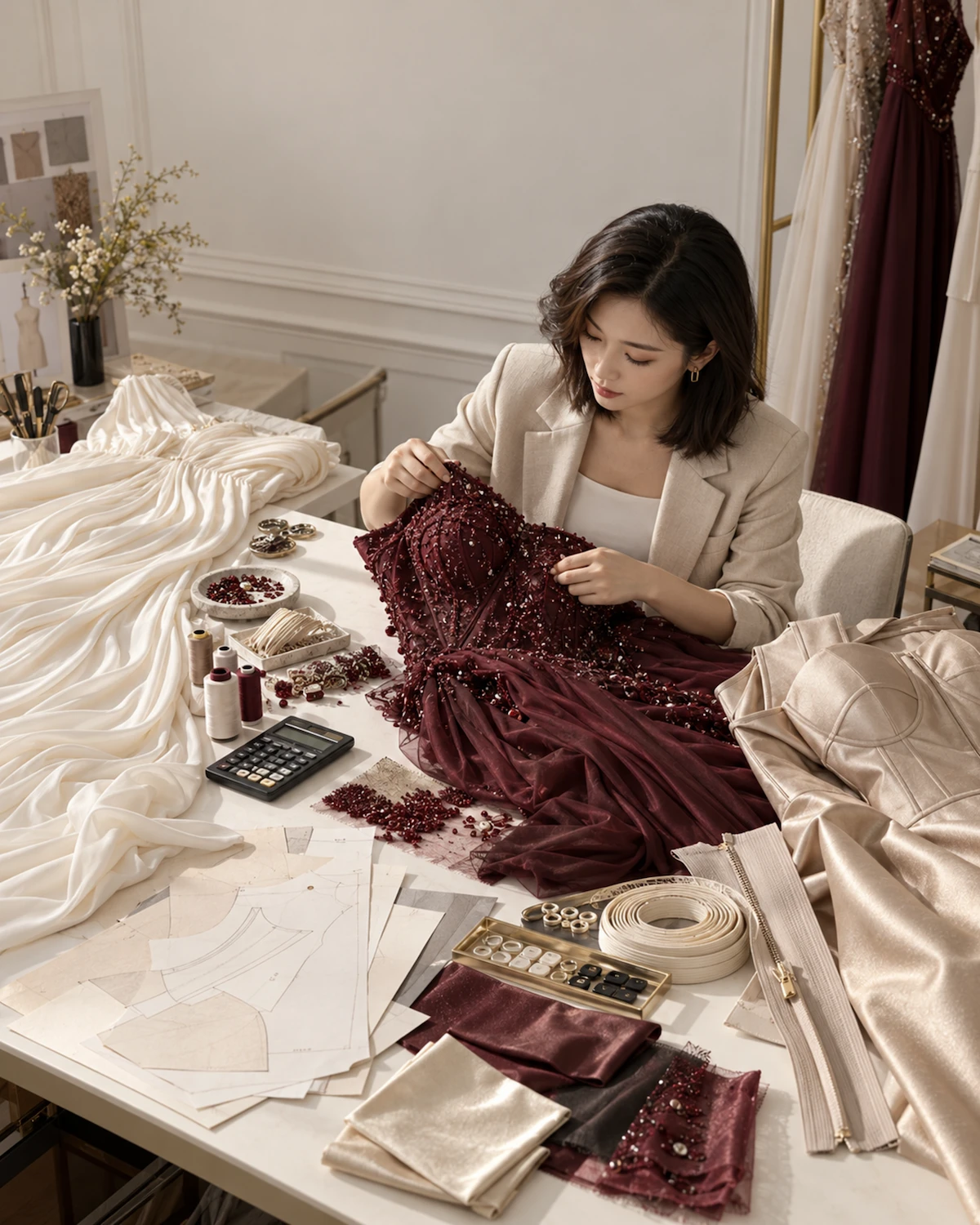
Mesh overlay scattered with sequins and beads stitched by hand, structured bodice with built-in bust support, boning at the side seams, concealed zip, full lining. Two hundred pieces, one colour. The kind of piece that sells because of what is on the surface.
| Line item | Basis | Cost per piece (USD) |
|---|---|---|
| Base fabrics (mesh, lining, crepe underlayer) | per piece | 11.90 |
| Embellishment materials (sequins, beads, thread) | per piece | 4.60 |
| Hand embellishment labour | 4.5 hours at USD 2.10/hour | 9.45 |
| Cut, make, trim labour | 75 min at USD 0.095/min | 7.13 |
| Bodice structure (boning, bust cups, rigilene) | per piece | 1.85 |
| Trims (concealed zip, hook and eye, labels) | per piece | 1.40 |
| Grading and marker | USD 60 per style / 200 pcs | 0.30 |
| Sampling amortised | USD 260 across three rounds / 200 pcs | 1.30 |
| Inline and final inspection | per piece | 1.20 |
| Speciality packing (tissue, individual polybag, shaped carton) | per piece | 1.10 |
| Factory overhead allocation | per piece | 2.40 |
| Subtotal | 42.63 | |
| Margin (16%) | 6.82 | |
| Ex-works price | USD 49.45 |
Read down that table and the answer to "why is a beaded dress expensive" is sitting in one line: hand embellishment labour, USD 9.45, which is more than the entire ex-works price of dress A.
Four and a half hours of hand work per piece. That is not a marketing figure and it is not padded. Sequin and bead placement done by hand at density, following a placement map, is simply slow, and there is no machine that does it to the same standard on a shaped panel. If someone quotes you a hand-embellished dress at close to the price of dress B, one of three things is happening. The work is machine-applied and the price is honest but the garment is different. The density is a fraction of what you think you are getting. Or the quote is not real and the number will move later.
This is also where sampling gets expensive. Three sample rounds at USD 260 total, because structured bodices rarely fit correctly on the first attempt and embellishment placement needs its own approval round. Spread over two hundred pieces that is USD 1.30 a garment. Spread over fifty pieces it would be USD 5.20, and that single difference is why small orders of complicated garments feel disproportionately costly.
The eleven line items, one at a time
The tables above use the same eleven categories every time. Here is what each one actually contains, because this is the vocabulary you need when you are comparing quotes from different factories.
Fabric. Quoted per metre, consumed per piece according to the marker, plus a wastage allowance. Our standard allowance sits between eight and twelve per cent depending on the fabric behaviour and whether the marker has to match stripes or a directional print. If a factory quotes you fabric with no visible wastage allowance, ask what percentage they assumed. Something is assumed. It is better if you know what.
Trims. Thread, zips, buttons, hooks, boning, elastic, labels, care labels, hangtags. Individually tiny, collectively not. Hardware is also the most common source of late-stage surprises, because a metal zipper that fails a nickel test can hold an entire shipment at customs.
Cut, make, trim labour. Usually quoted either as a per-minute rate times the standard minutes for the garment, or as a flat CMT rate. Ask which. A flat CMT rate hides nothing but also explains nothing, whereas the minute-based version lets you see exactly which operation is costing you.
Dyeing, washing and finishing. Garment dye, enzyme wash, stone wash, softening, pressing protocols. Absent entirely from all three dresses above. Present on most casual woven programmes, and it can be anywhere from USD 1.20 to over USD 4.00 depending on the number of processes.
Grading and marker. A fixed cost per style, not per piece. This is why it shrinks as the order grows.
Sampling amortised. Sample development cost divided across the order quantity. Also fixed per style. Also the reason that small orders of complex garments are expensive, and specifically why asking for three sample rounds on a hundred-piece order is a decision with a visible price tag.
Inspection. Inline inspection happens while the line is running. Final inspection happens on the packed goods. Both cost operator time. Skipping inline inspection is how you discover a construction error after six hundred units are already sewn.
Packing. Polybags, cartons, tissue, hangtags, hangers, polybag warning labels if your market requires them, speciality boxes if you have specified them. Packing specifications are frequently changed late, and every change affects carton dimensions, which affects container loading, which affects freight.
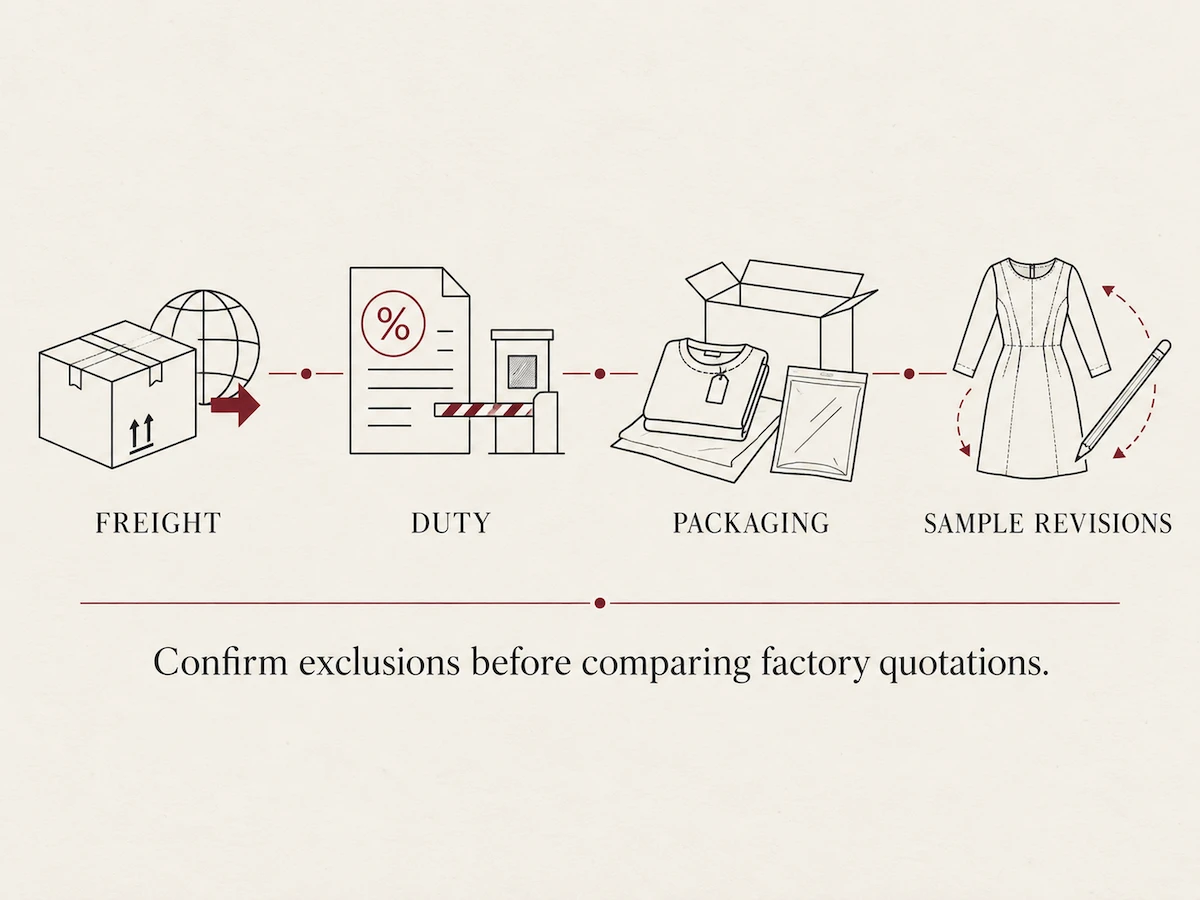
Freight. Not in any of the prices above. Those are ex-works figures. Once you ask for FOB or DDP these numbers move, sometimes substantially, and the movement depends on your destination, your volume and how your cartons cube out.
Duty. Similarly absent. Duty rates depend on the importing country and the classification of the garment, and they are your cost rather than ours, though we can tell you the classification if you ask.
Margin. We show it. Not every factory will. A quote with no visible margin is not necessarily worse value. It just means you cannot see how much room exists, and you will not know what happens to the number when you ask for something to change.
What actually moves the number
Ranked by impact across the three dresses:
Fabric choice is first. It accounts for between forty and fifty per cent of ex-works cost on all three. Choosing a fabric also chooses everything downstream, including how many metres the marker consumes and how much labour each operation takes.
Construction complexity is second. It is not the same thing as fabric. A complex garment in cheap fabric still costs more than a simple one in expensive fabric, and the gap between twenty-two minutes and seventy-five minutes of cutting and sewing time is a three-and-a-half times difference in that line alone.
Handwork is third, and it is binary. Either a garment has it or it does not. When it has it, it dominates.
Order quantity is fourth, and it operates differently from the others because it does not change the total much. It changes where the fixed costs land.
Fabric wastage allowing generously is fifth, and this is the one that buyers never ask about. A marker that has to match a stripe across the body can add fifteen per cent to fabric consumption on its own.
Why unit price falls as quantity rises
This trips people up, so it is worth being precise.
Nothing about making dress B gets cheaper when you order four hundred instead of one hundred. Same twenty-one hundred stitches. Same fifty-eight minutes. Same fabric per garment. If anything, larger runs introduce their own costs in the form of longer production windows and more inspection time.
What changes is the fixed spread. Grading and marker is USD 60 whether you order sixty pieces or six hundred. Sampling is USD 120 across two rounds whether you order sixty pieces or six hundred. Those two lines read USD 3.00 per garment at sixty pieces and USD 0.45 at four hundred.
There is also a real efficiency curve, but it is smaller than people think and it is not linear. Operators settle into a rhythm after the first few dozen units. Cutting can be batched more efficiently at volume. Fabric can sometimes be bought at a better rate in larger lots. Together these amount to somewhere in the region of three to eight per cent between a hundred-piece run and a five-hundred-piece run of the same style.
So when a quote drops twenty per cent between MOQ and five times MOQ, most of that is fixed cost spreading. Someone asking you why their hundred-piece order costs so much more per unit deserves the honest version of this answer.
For reference, our minimum sits at one hundred pieces per design, with one hundred to two hundred per colour depending on the fabric and whether it has to be dyed to order.
What is not in these figures
Say this out loud before you compare anything:
Freight is not included. Duty is not included. Any third-party testing beyond our standard internal checks is not included unless you asked for it and were quoted for it. Speciality retail packaging beyond what is listed is not included.
Also not included: the effect of a specification that changes after you approve the pre-production sample. Every quote assumes the garment is made once, to one agreed specification. Changes after the pre-production sample cost money in direct proportion to how far along the line they arrive, and this is the single most common cause of a final invoice that does not match original quote.
Why the second order costs less than the first
The opening said re-runs are cheaper and promised to say why. Here is the mechanism, because it changes how you should think about your first order.
Two lines in every table above are fixed per style, not per piece. Grading and marker is USD 60 whether you order sixty pieces or six hundred. Sampling amortised is the development cost spread across the run. On the first order those lines are real money sitting in your unit price. On a re-run they collapse, because the grade rule already exists, the marker is already plotted, and the sample is already approved. You are not paying to develop the dress twice.
Take dress B from the table, the lined woven midi at USD 35.50 ex-works for a first run of four hundred pieces. On a re-run of the same four hundred pieces, grading and marker drops from USD 0.15 to nothing, and sampling amortised drops from USD 0.30 to nothing, because both were paid on the first run. That alone takes about USD 0.45 off the piece before anything else moves.
| Line (per piece, 400 pcs) | First run | Re-run | Difference |
|---|---|---|---|
| Grading and marker | 0.15 | 0.00 | minus 0.15 |
| Sampling amortised | 0.30 | 0.00 | minus 0.30 |
| Cut, make, trim labour | 4.93 | 4.93 | unchanged |
| Fabric | 18.62 | 18.62 | unchanged |
| Ex-works | 35.50 | 35.05 | minus 0.45 |
The re-run does not get cheaper because the factory works for less. It gets cheaper because you stop paying twice for the things that only had to be done once. That is the honest version, and it is why we tell new brands to treat the first order as the cost of proving the style, then expect the piece price to ease on the repeat.
Two caveats are worth stating plainly. Fabric can move between runs if the cloth market moves, and a re-run in a new colour still pays for a new dye lot, so the colour saving only applies to a repeat of the same colour. And a re-run carries its own risk, which is shade difference between the two dye lots. We keep a sealed sample from your first run and match the second lot against it, but a repeat is never an exact clone, and if your colour tolerance is tight you should say so before we book the second lot. The price comes down on a re-run. The discipline does not.
What to send us to get an accurate number
We quote within twenty-four hours when the brief contains enough to quote from. Six things make the difference between a same-day accurate quote and three days of back-and-forth:
A tech pack or, if you do not have one yet, reference images plus the measurements you want to hit.
Your target fabric, or at minimum the weight and fibre content. If you have no idea yet, tell us the hand feel and price point and we will propose three.
Your size range and which market you are grading for, since UK, US and EU blocks are not interchangeable.
Your target quantity, honestly. If you are testing with a hundred pieces and plan to reorder, say so, because it changes what we would recommend about fabric and construction.
Your target price. Buyers hate stating this and it is the most useful thing in the entire brief. If we know your target we can tell you immediately whether it is achievable and what to change if it is not.
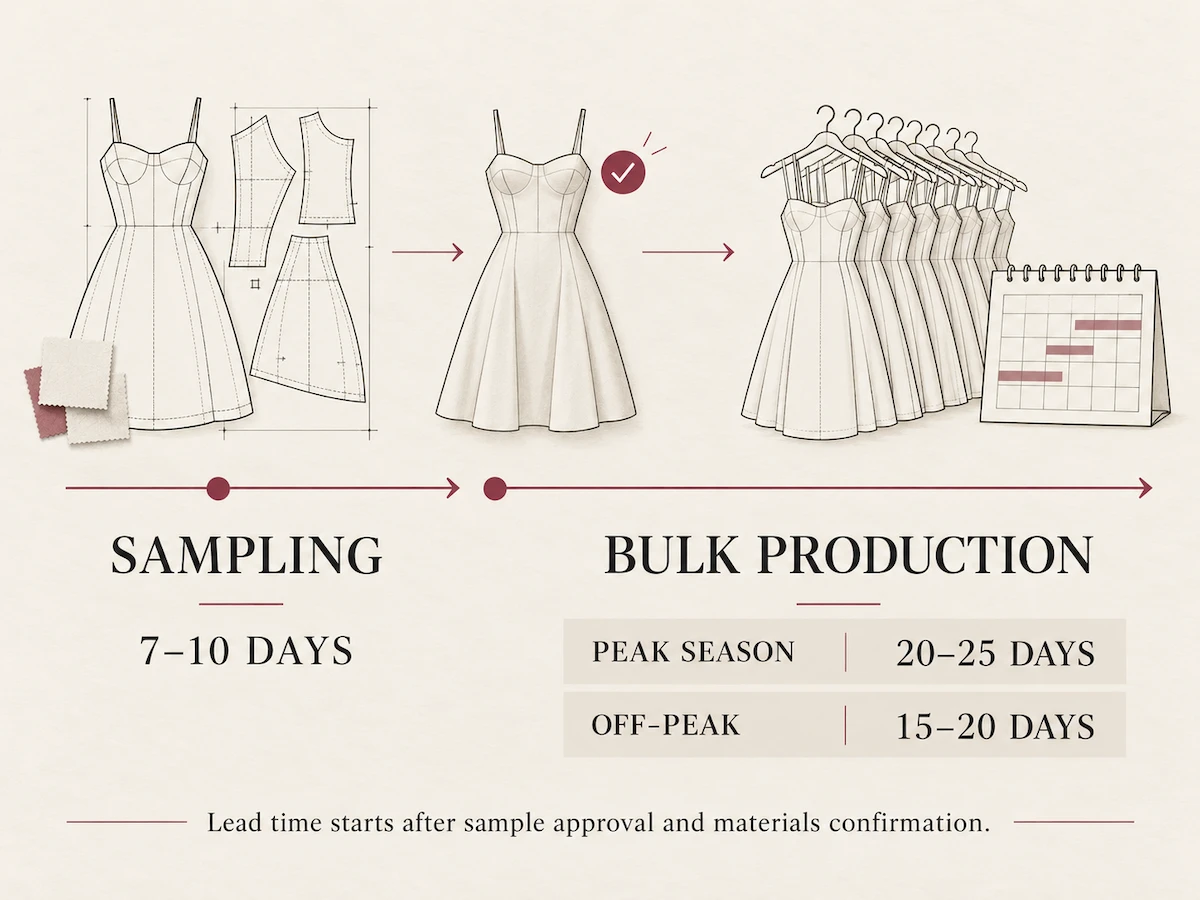
Your delivery window. Peak season runs twenty-five days for bulk and off season runs fifteen to twenty, so a date asked for in September is a different conversation from the same date asked for in April.
Send those six things and you will get back a number you can read, itemised in the same form as the tables above. If it comes back as one lump sum with no breakdown, ask for the breakdown. Any factory that can cost it can also itemise it, and if the number cannot survive being itemised, that tells you something too.
Related reading
- What affects clothing manufacturing costs
- What should be in a clothing manufacturing quote?
- How MOQ is calculated in clothing manufacturing
Ready to cost your own style? Send us your tech pack or reference images and we will come back within twenty-four hours.