
Knowledge centre
Cost & Pricing
Where the money goes in a garment and what moves the number.
The price of a garment is not the fabric plus a margin. It is fabric consumption, trims and hardware, cutting, making, finishing, quality control, packing and freight, plus the cost of the sampling, development and administration that got the style to production in the first place — and then the margin on top. Two styles with the same retail price can have very different cost structures, which is why cutting the wrong 5% destroys the product rather than the profit.
The line items that move most are predictable. Fabric consumption changes with the width of the cloth and the layout of the pattern, so a style cut from a narrow article costs more than the same style cut from a wide one even at the same price per metre. Labour changes with the number of operations and the amount of handwork, which is why a plain shell and a pleated, lined, boned bodice are not close in cost. Trims look minor per unit and are not, once you count a label, a zip, a hook, interlining, thread and packaging.
Volume interacts with all of it. A larger run spreads the fixed costs and often earns a better fabric price, but only if the style is right — a large run of a style that does not sell is a cheap unit price attached to a great deal of unsold stock. That trade-off is the actual skill in costing.
The guides below work through costing sheets, price architecture and what a quotation is really made of. Start from product development if the costing question is really a specification question, which it often is.
Topic
Cost & Pricing
Where the money goes in a garment and what moves the number.
How to Read a Garment Costing Sheet Line by Line
Garment costing sheet anatomy: what each line means — fabric, trims, labour, overhead and margin — and which lines a buyer can actually influence.
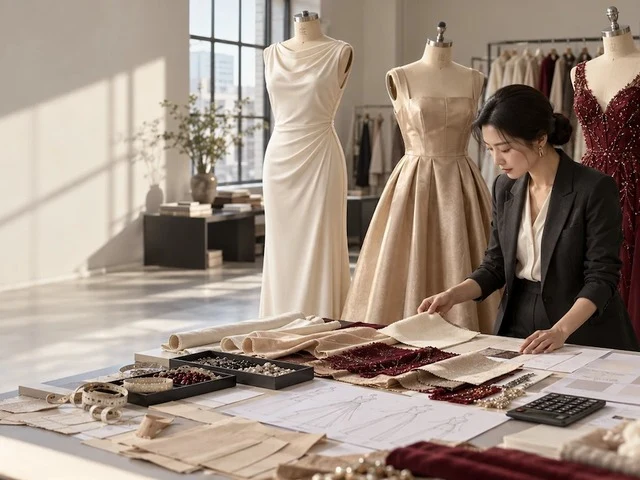
Evening Dress Cost Breakdown for Buyers
An evening dress cost breakdown for buyers: shell fabric, lining and structure, labour, embellishment and landed cost, with the shape each quote should have.
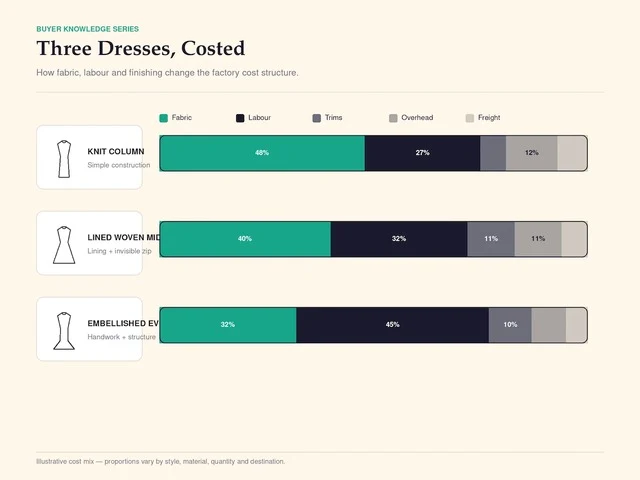
Three Dresses, Costed: What a Factory Actually Charges For
We cost three real dress constructions line by line — fabric, labour and handwork — so you can read any garment quote instead of guessing at the price.

How Much Does Womenswear Manufacturing Cost?
How a womenswear manufacturing price is actually built: the twelve inputs that set it, why a sample costs more per piece than bulk, why MOQ moves unit cost, and how to read a quote so you know what you are comparing.
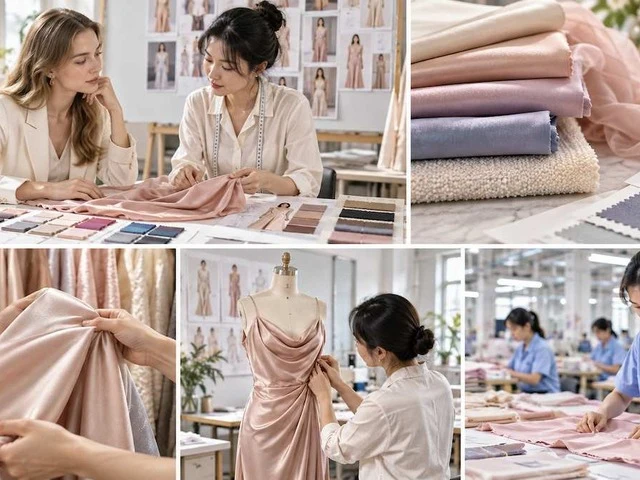
What Affects Clothing Manufacturing Costs?
Every specification decision that moves a clothing manufacturing quote, ranked by impact: fabric basis, construction, pattern complexity, trims, colourways, size range, quantity and packing — and what each change costs you in the garment.
Related
Where this topic leads
Services for this topic
Categories this applies to
Start a project
Need an answer now?
Ask directly. We would rather answer a real question than point you at a placeholder page.