On this page
- Two Costing Shapes: CMT and Full Package
- Fabric: Consumption, Marker Efficiency and Waste
- Trims and Components — the Line Everyone Underestimates
- Labour: What Is Actually Being Charged For
- Overhead, and What Is Not Itemised
- Margin — and Why Asking for It to Be Cut Is the Wrong Question
- Which Lines You Can Actually Move
- Reading Two Costings Against Each Other
- A Costing Sheet Read Out Loud
- Questions to Ask About a Line You Do Not Understand
- What a Useful Costing Conversation Sounds Like
- FAQ
- Working With Luxudress
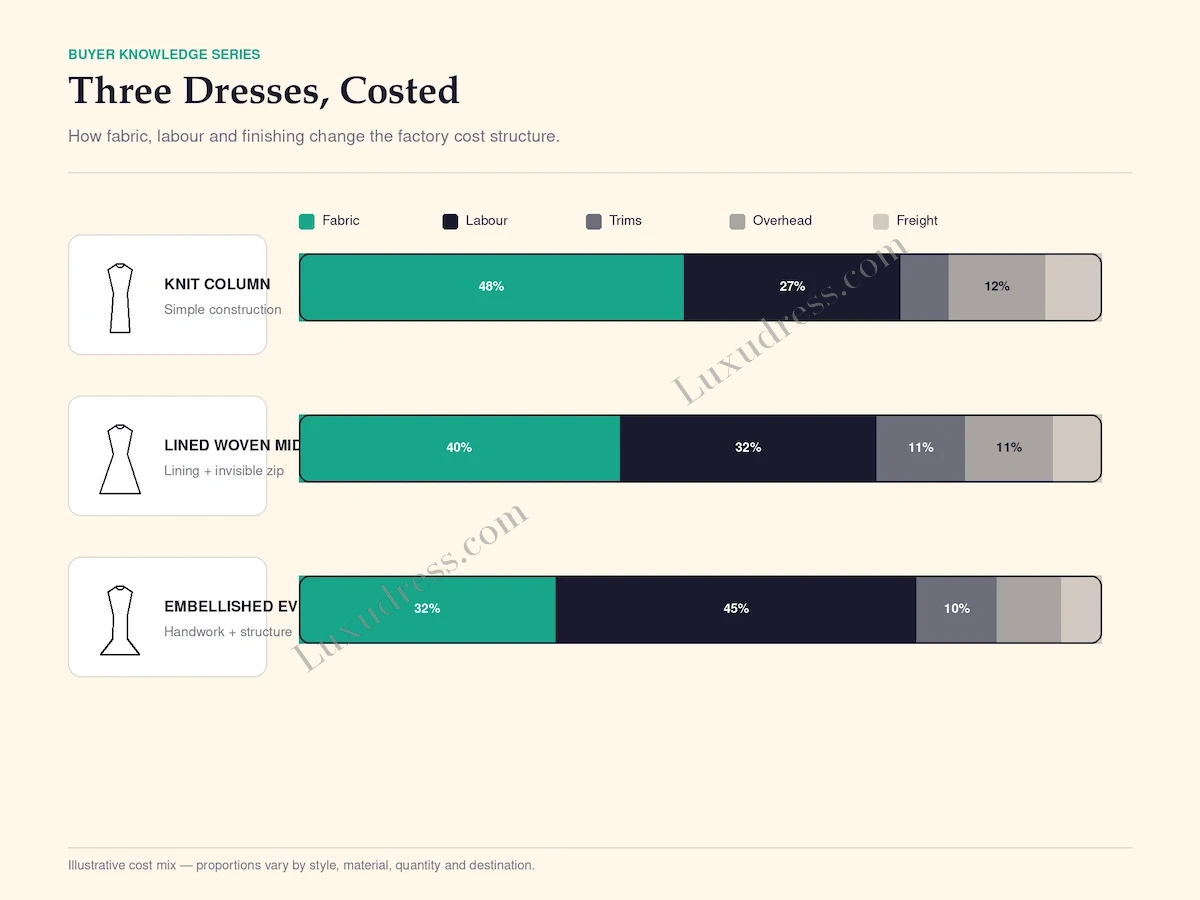
Most buyers receive a costing sheet as a single number with some arithmetic behind it. That is enough to place an order and not enough to negotiate one, because the useful information is in the lines: they tell you what the supplier assumed, which assumptions are expensive, and where a change to your specification would actually pay.
Reading one properly is a skill rather than an accounting exercise, and it is worth acquiring because it changes the conversation from "can you do better on price" to "what happens if we change this".
Two Costing Shapes: CMT and Full Package
Before any line means anything, you need to know which kind of sheet you are reading. There are two common shapes and they are not comparable line for line.
- CMT — cut, make and trim. The supplier charges for labour and factory overhead, and the buyer provides or specifies the fabric and trims. The sheet is short: labour, making, finishing, packing, overhead, margin. Material cost sits on your side of the ledger.
- Full package, or FOB garment. The supplier sources the material as well, so the sheet carries fabric and trims at their own prices. It is longer, and the fabric line becomes the largest single number on most sheets.
Buyers get into difficulty when they compare a CMT quote against a full-package quote and treat the difference as a price difference. It is a scope difference. A CMT price will always look lower because it excludes the material, and a buyer who switches on price alone may simply have taken on sourcing without realising it.
Fabric: Consumption, Marker Efficiency and Waste
On a full-package sheet, fabric is usually the biggest line and the one buyers investigate least. It has three parts, and only one of them is the fabric price per metre.
The price per metre or per kilogram
This is the number buyers look at, and it is the one they have the least leverage over, because it belongs to the mill and depends on fibre, construction, weight, shade and quantity. It moves with order size, and it moves more with fabric choice than with anything else in the garment.
Consumption, and why the number looks odd
Consumption is how much fabric the garment takes, and on a costing sheet it is almost always higher than a buyer expects. That is not padding. Consumption includes the gap between panels required by a cutting marker, the end of the roll, any repeat matching on a print, directional constraints on a nap or pile fabric, and an allowance for defects found during spreading.
- A large repeat on a print forces panels to align, and the offcut between them is unavoidable waste.
- A one-way fabric — a velvet, a brushed fabric, some satins — cannot have panels rotated to nest more tightly, which raises consumption on the same silhouette.
- A bias-cut panel consumes more fabric for the same area of cloth, because the panel has to sit diagonally on the roll.
- A small order raises consumption per piece, because the fixed waste at the ends of rolls is spread across fewer garments.
- Flowy silhouettes with volume — full skirts, wide sleeves, tiers — use what they use; the fabric is the design.
Waste, rejection and the allowance in between
A sheet will normally carry an allowance for fabric lost to defects and to the cutting process. Buyers occasionally read this as a hidden margin. It is better read as a statement of how the supplier expects to cut your garment: a fabric with a high defect rate, or a print that needs matching, legitimately consumes more than the panels measure. If the allowance looks high, the useful question is why — not how to remove it.
Trims and Components — the Line Everyone Underestimates
Trims look like small change and add up to a meaningful figure on embellished womenswear, which is exactly the category where they are most often forgotten at quotation stage.
- Main, size, care and origin labels, plus any woven branding
- Closures — zippers, hooks, eyes, buttons, snaps — including the tape and the finishing
- Interfacing, and the difference between a light and a heavy fusible
- Boning, cups, elastic and the internal structure of a fitted bodice
- Beading, sequins, appliqué and any hand-applied element, which behaves more like labour than like a trim
- Thread, and on a multi-colour garment, the number of thread changes
- Packaging components — polybags, hang tags, tissue, carton dividers — where the buyer's packing specification decides the cost
The pattern worth noticing is that several of those are specified by the buyer and priced by the supplier, so a change made casually at development can move the trim line substantially. Swapping a standard zipper for a branded one, adding an internal structure, or choosing a heavier interfacing are all decisions taken for design reasons with a cost attached that the buyer rarely sees until the sheet arrives.
This is also the line where substitution is most tempting and most damaging. Two zippers of the same nominal width can behave differently, and an interfacing that is marginally heavier changes how a collar edge or a waistband sits. A costing sheet that shows a trim reduction without a specification change is not a saving; it is a different garment.
Labour: What Is Actually Being Charged For
Labour is the line buyers understand least and argue with most, because it is invisible in the finished garment and it is not obviously proportional to anything.
A costing sheet will usually express labour as a time standard multiplied by a rate — the time it should take to complete the operations, and the cost of the minute. Neither is arbitrary, and both are worth understanding.
- Time is driven by construction, not by size. A simpler seam is quicker than a bound one; a set-in sleeve is slower than a dropped shoulder; a fully lined bodice is slower than a faced one.
- Embellishment behaves like labour. Hand-beading, hand-set pleats and hand-finished edges are time, and they scale with quantity rather than benefiting from it.
- Quantity changes unit labour in two directions. A larger run lets a line specialise and a worker repeat, which lowers the time per piece. Against that, a very small run carries the setup cost — the machine preparation, the first pieces, the learning — across fewer garments.
- Pressing and finishing are labour too, and on structured occasionwear they are a substantial part of it. Buyers routinely under-ask about this block.
- Rejection allowance can sit here or in the material lines. Where it sits tells you something about what the supplier expects to go wrong.
The practical consequence: labour is the line where a change to your construction pays most, and the line where arguing about the rate pays least. Reducing the number of operations by simplifying a finish will move the number. Telling a supplier their rate is too high will not, because the rate is set by wages that are not negotiable in a conversation.
Overhead, and What Is Not Itemised
Every sheet carries something that is not fabric, not trims and not direct labour: factory overhead, development amortisation, quality control, packing, and the cost of running the business between orders.
It is usually expressed as a rate applied to the labour or as a lump per unit, and buyers often treat it as padding. It is not padding, and it is also not the interesting part of the conversation — because overhead does not respond to anything the buyer does, except by changing which factory and which route the order runs on.
- Development amortisation. On a small first order, sample and pattern work is recovered across the run, which is one reason the first order's unit cost is higher than a repeat's.
- Quality control and inspection time. Real, and larger on a construction that requires more checking — a beaded panel or a bias skirt sees more hands.
- Packing and presentation. Determined by your specification, so this line is genuinely a buyer decision even when it appears under overhead.
- Testing and certification. Where a market requires testing, this is a per-order or per-style cost that spreads differently at different quantities.
Margin — and Why Asking for It to Be Cut Is the Wrong Question
The margin line is the one buyers target first and the one where pressure produces the least durable result. There are three reasons.
- It is usually thin in absolute terms on a garment. Which means a supplier can only respond to pressure by changing something else — a substitute trim, a lighter interfacing, a less careful pressing — rather than by genuinely giving up value.
- It funds the things you will need later. Revisions, a problem in production, a rush on a reorder. A supplier running at no margin cannot absorb any of it and will not want to.
- It is the wrong lever for a buyer who wants a lower price. The same reduction is available with fewer side effects by changing the specification, the quantity, or the fabric — all of which are visible on the sheet and none of which damage the working relationship.
The exception worth mentioning: on some programmes, particularly labour-intensive occasionwear, the margin genuinely does vary with the risk of the order. A new construction, a tight deadline and a small quantity carry more risk than a repeat, and a supplier pricing that risk is pricing accurately. A buyer who understands the difference between a margin and a risk premium will negotiate better than one who treats every uplift as profit.
Which Lines You Can Actually Move
| Line | Buyer influence | How to move it |
|---|---|---|
| Fabric price per metre | Medium | Change the fabric, change the quantity, accept a stock shade, consolidate colourways |
| Fabric consumption | Medium | Simplify the silhouette, avoid large repeats, avoid one-way fabrics unless the design needs them |
| Trims | High | Specify deliberately; every substitution has a design consequence |
| Labour time | High | Simplify construction; reduce handwork; increase quantity |
| Labour rate | None | Set by wages and the market, not by negotiation |
| Overhead | Low | Changes only by changing route, factory or order structure |
| Margin | Low | Better addressed through specification, quantity and fabric than through pressure |
| Packing | High | Entirely your specification |
| Freight and duty | Medium | Outside the costing sheet, but often the larger number. See landed cost |
Read the table as a map of where effort pays. Three of the nine lines are highly responsive, and they are the three that describe the garment rather than the business. That is not a coincidence: a costing sheet is mostly a description of a decision you already made.
There is a version of this that applies to the very first costing a buyer ever reads, and it is worth saying plainly: the total will probably be higher than expected, and that is usually not a sign that something is wrong. First costings arrive before the specification is settled, before the quantity is fixed and before the fabric is chosen, so they absorb the uncertainty of all three. A costing read at that point is a baseline to be reduced by decisions, not a verdict on the supplier.
Reading Two Costings Against Each Other
The most useful exercise with a costing sheet is comparison, and the most common mistake is comparing the totals.
- Check the scope matches. Same delivery term, same packing specification, same trims, same quantity. If any of those differ, the totals are not comparable and the gap is not a price difference.
- Compare line by line. Two sheets with the same total can have quite different structures, and the structure tells you which supplier fits your product. One may be stronger on fabric and weaker on labour; on a beaded gown that matters more than the total.
- Find the outlier. A single line materially out of step with the others is the one to ask about, and the answer is usually a specific assumption rather than an error.
- Ask what would change the total. A supplier who can name the two or three levers that would move their price understands their own costing. A supplier who cannot is working from a number rather than a sheet.
- Write down the assumptions. Then check them against your specification. Most costing disputes are assumption mismatches discovered late.
A Costing Sheet Read Out Loud
The fastest way to learn to read a sheet is to walk one. The figures below are illustrative — the point is the sequence of questions, not the numbers, which change with every category, fabric and quantity.
| Line | What it is telling you | The question worth asking |
|---|---|---|
| Fabric, per metre | The mill's price for the material | Is this a stock shade or dyed to order, and at what quantity? |
| Consumption, per piece | How much cloth the garment actually takes | What does this assume about the repeat, the nap direction and the marker? |
| Fabric, per piece | The product of the two lines above | If consumption is high, is it the silhouette or the fabric? |
| Trims | Everything that is not cloth | Which of these did I specify, and does the list match my specification? |
| Labour, per minute | The cost of a production minute | Nothing — this is set by wages, not by negotiation |
| Labour, minutes | The time the construction should take | Which operations are driving this, and which could be simplified? |
| Finishing and pressing | Time away from the sewing line | Is this proportionate to how structured the garment is? |
| Overhead | The cost of running the business per unit | Is any of this actually my packing specification? |
| Margin | What the supplier earns | Is this flat, or does it carry a risk premium for this order? |
| Total | A summary of decisions already made | Which of those decisions would I change if I saw this earlier? |
Read down the last column and a pattern appears: almost every useful question is about a decision the buyer made, or about an assumption that has not been stated. That is what a costing sheet is — a set of decisions, priced. Which is also why arguing with the total is so unproductive, and why changing a specification is so effective.
Questions to Ask About a Line You Do Not Understand
Buyers avoid asking about lines they do not recognise, for fear of looking inexperienced. It is worth getting over, because an unexplained line is either an assumption you should know about or a mistake — and both are better found before the order than after.
- "What is this line for?" — the simple question, and almost always answered directly.
- "What does this figure assume?" — the useful question, because the assumption is usually where the surprise lives.
- "Is this per piece or per order?" — the distinction between a cost that scales and a cost that does not, and the one buyers most often get wrong.
- "Would this change if I changed the quantity?" — exposes the fixed lines, which is where a larger order genuinely pays.
- "Did this come from my specification, or is it a default?" — separates your decisions from the supplier's habits.
- "Which line would move first if we wanted a lower price?" — a good supplier will name two or three, and those are your levers.
Six questions, none of which requires technical knowledge, and between them they turn a costing sheet from a document you accept into one you can use. A supplier who answers them well is also telling you something about how they will behave when a production question arises later.
What a Useful Costing Conversation Sounds Like
Most price conversations are about the total and produce nothing except a slightly smaller total and a slightly worse garment. A costing conversation does something different: it establishes what the product costs, why, and what would have to change for it to be different.
That shape of conversation has three moves, and a buyer can initiate all of them.
- Confirm the specification first. Before any number is discussed, agree exactly what is being costed — fabric, construction, trims, packing and quantity. Half of all price disagreements are actually specification disagreements.
- Read the structure together. Ask which line is largest and why. A supplier will usually explain this willingly, and the explanation tells you where your money goes — which is almost never where buyers assume.
- Name the constraint, then ask for options. "My target is this number" invites a yes or a no. "My target is this number — which parts of the specification would have to move to reach it?" invites a plan.
Done this way, the costing sheet stops being a document you dispute and becomes one you use. The most valuable outcome of a costing conversation is not a lower price; it is knowing which of your decisions produced the price you have, so that the next garment can be designed with the cost in view rather than discovered afterwards.
FAQ
The supplier will only give me one price. Is that a problem?
Not necessarily — some suppliers cost internally and quote a single figure as a matter of practice. It becomes a problem when you need to make a decision and cannot see where the cost sits. A reasonable middle ground is to ask for the fabric, trim and labour subtotals rather than the full sheet.
The consumption figure looks too high. Is it padded?
Usually it is not, and the reason is usually visible in the fabric or the silhouette: a large print repeat, a one-way fabric, a bias panel, a full skirt. Ask what the figure assumes. If the assumption does not match the fabric you have specified, the figure is wrong and worth correcting. Otherwise it is the garment.
What is the fastest way to lower a garment cost?
For most womenswear: increase the quantity, then simplify the construction. Quantity spreads the fixed lines — development, setup, freight's fixed components — across more pieces. Construction simplification attacks the labour line. Fabric choice attacks the largest line but changes the product, so it is a commercial decision rather than a costing one.
Should I ask the supplier to reduce their margin?
You can ask, and it is usually the least productive request available. A thin margin responds to pressure by changing something in the garment, not by giving up value. If the total is too high for your target, the specification, the quantity and the fabric are where the money actually is.
Why does labour cost more per piece on a smaller order?
Because the non-repeating parts of the work do not shrink with the quantity. Setting up machines, producing and reviewing the first pieces, learning a new construction — those are one-off costs across the whole run. On a large run they nearly disappear; on a small one they can dominate.
Two suppliers quoted very different prices for the same style. What should I look at first?
Scope, before price. Check the delivery term, the packing specification, the trim list, the fabric and the quantity. It is common for a 20 percent gap to be entirely scope — one quote assumes a stock shade and simple folding, the other includes a dyed-to-order fabric and individual bagging. Once the scope matches, compare the lines rather than the totals.
My repeat costs more than my first order. Why?
Several possible reasons, and they are worth asking about rather than assuming. A different fabric or shade, a different quantity break, a change in the material market since the first order, or the removal of a first-order assumption. A supplier who can point at the specific line that moved is describing a costing; one who cannot is describing a mood.
Working With Luxudress
Luxudress is the factory-direct front end for womenswear production across production facilities in Guangzhou and Dongguan, covering development, sampling, material sourcing, manufacturing, inspection and export packing.
When you ask us to cost a style, you will get the structure rather than a single figure — fabric and consumption, trims, labour, finishing and the assumptions behind them — because a buyer who can see where the cost sits can make a decision about it. Where an assumption depends on something you have not decided yet, such as the print repeat or the packing specification, we will say so rather than bury it in a line.
If you want a style costed against a target price, send the specification, the quantity and the target and we will tell you which lines can reach it and which cannot. You can also order from ready stock by the piece if you would rather establish a real landed cost before committing to development, or browse the style library to see constructions already developed with their consumption settled.
Request a quote and we will return a costed plan with its assumptions written down.