On this page
- Two dresses, the same silhouette, two different shapes
- The shape of an evening dress cost sheet
- Shell fabric is only the starting point
- Lining and internal structure create hidden value
- Labour rises with operation count
- Embellishment is a separate cost system
- Where a cheap quote hides its saving
- Reading a quote whose proportions do not add up
- Use a buyer cost model
- Practical buyer worksheet
- FAQ
- Next step
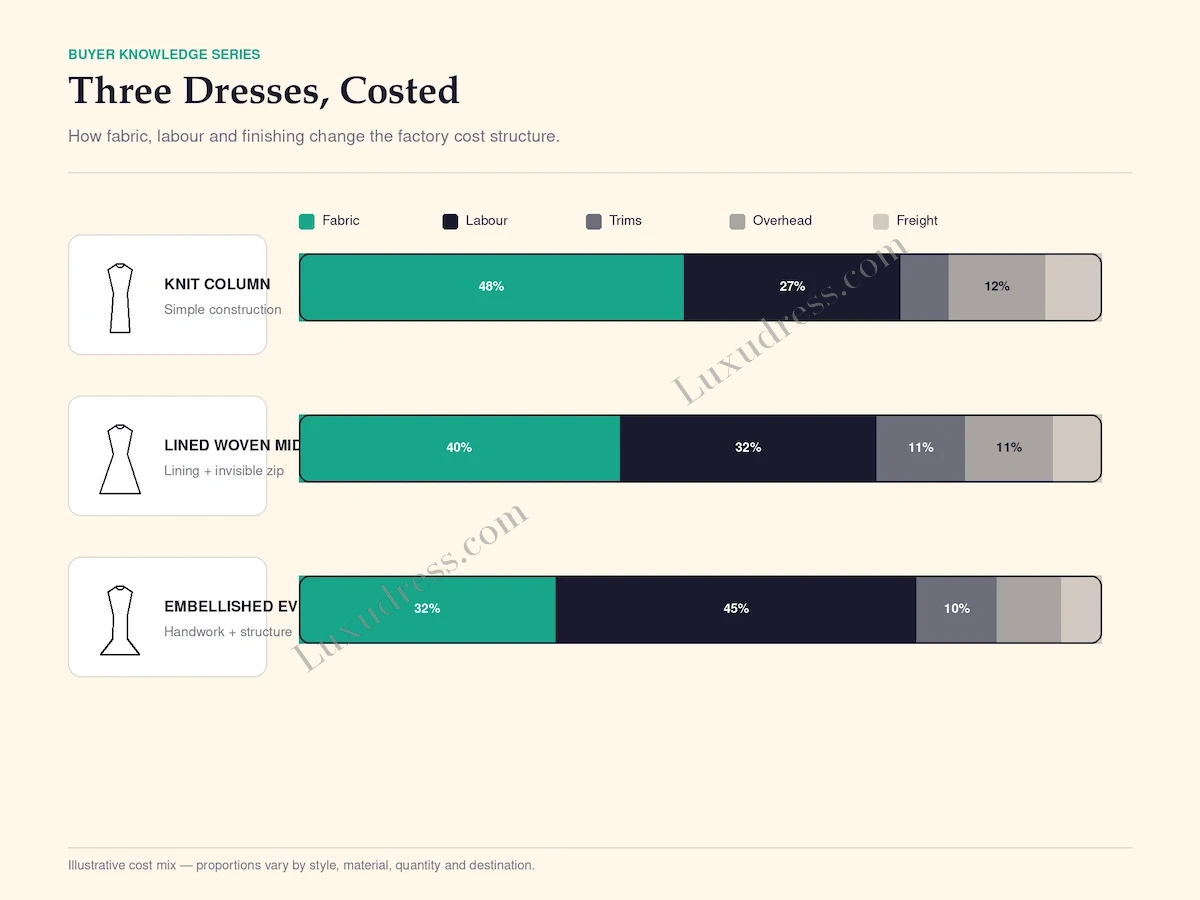
This is a reading guide for that proportion. Not what an evening dress costs, which depends on the dress, but what shape the number should have, and what it means when the shape does not match the garment.
This is written for fashion brands, retailers and product developers comparing evening and occasionwear quotes. It assumes the general picture, which our guides to what womenswear manufacturing costs, what affects manufacturing costs and what a factory charges for cover, along with what a quote should include. What follows assumes those and reads the quote for its shape rather than its total. The category is on our evening dress manufacturing page.
Two dresses, the same silhouette, two different shapes
Consider a lined satin column dress with a concealed zip and a small beaded shoulder detail. Quoted by two suppliers, it may come back at two prices twenty per cent apart. The instinct is to assume one supplier is more expensive. The more useful reading is that the two quotes are describing different garments, and the difference is distributed rather than concentrated.
| Block | Quote A — as briefed | Quote B — cheaper |
|---|---|---|
| Shell fabric | The specified satin, at the specified weight | A lighter weight in the same family, easier to cut and cheaper per metre |
| Lining | Full lining, hem finished separately | Partial lining, or a shorter lining that stops above the vent |
| Internal structure | Interfacing at the neckline, a waist stay, a faced armhole | Interfacing omitted, stay replaced by a seam |
| Closure | Concealed zip with a proper facing | Shorter zip, simpler finish |
| Labour | Narrow hem, finished lining, matched pattern | Wider hem, simpler finishing, less handling |
| Embellishment | Hand-set stones on a fixed placement | Pre-stoned trim applied as a band |
Nothing in quote B is unsellable, and nothing in it is obviously defective. What has happened is that the specification was reduced across five blocks rather than one, and each reduction is small enough that no single line looks like a decision. The buyer's job is to see the shape of the second quote, decide which reductions are acceptable at the intended price point, and make those decisions explicitly rather than discovering them in the bulk.
Why shape matters more than total
The total tells you whether the dress fits the price architecture. The shape tells you what the dress is. A quote whose fabric share is low and whose labour share is high is describing a construction-led garment: many operations, moderate material, and a cost that falls as the operator becomes familiar with the style. A quote whose fabric share is high is describing a material-led garment: fewer operations, and a cost that tracks the fabric market rather than the labour rate. Those two dresses behave differently on a reorder, respond to different cost reduction attempts, and fail in different ways. A buyer who only reads the total cannot tell which one they are buying.
The shape of an evening dress cost sheet
The table below sets out the blocks a full costing should carry and the approximate share each occupies across the eveningwear spectrum. The shares are illustrative, they are not a rate card, and they vary with construction, quantity and fabric. Their purpose is to give the reader a reference: a quote that departs sharply from the expected shape for its construction is describing a different garment, or has omitted a block altogether.
| Block | Simple lined column | Structured or boned bodice | Heavily embellished gown |
|---|---|---|---|
| Shell fabric | Large share, and the block that moves most with the fabric market | Moderate to large, plus a lining and often a mesh or tulle layer | Moderate; surface work can exceed the shell cost |
| Lining and internal structure | Small: a straight lining and basic facings | Significant: interfacing, stays, cups, boning channels and their assembly | Significant, and frequently underestimated |
| Trims and closures | Small: a zip, a hook, a thread set | Moderate: hardware, boning, cups, and usually a more complex closure | Moderate, plus a large consumables line for stones, thread and replacement |
| Labour | Low operation count, and the block that falls fastest with volume | High operation count, with several operations that cannot be split across operators | Very high, dominated by hand time rather than machine time |
| Embellishment | None, or a small applied detail | Usually none | The largest single block, and the least predictable |
| Preparation amortised | Small and recoverable across a moderate run | Large: pattern block, support structure and sample rounds | Large, and it does not fall with quantity |
Read down a single column and the shape is a signature. The simple column dress is a fabric purchase with sewing attached. The structured bodice is an engineering project with fabric attached. The embellished gown is a piece of handwork that happens to be attached to a garment. Negotiating all three the same way is what makes a cost conversation unproductive, because a lever that works on one is irrelevant to the next.
Shell fabric is only the starting point
Shell fabric is the most visible cost line and frequently not the largest. Two figures matter, and buyers often arrive with only one of them.
Price per metre and consumption
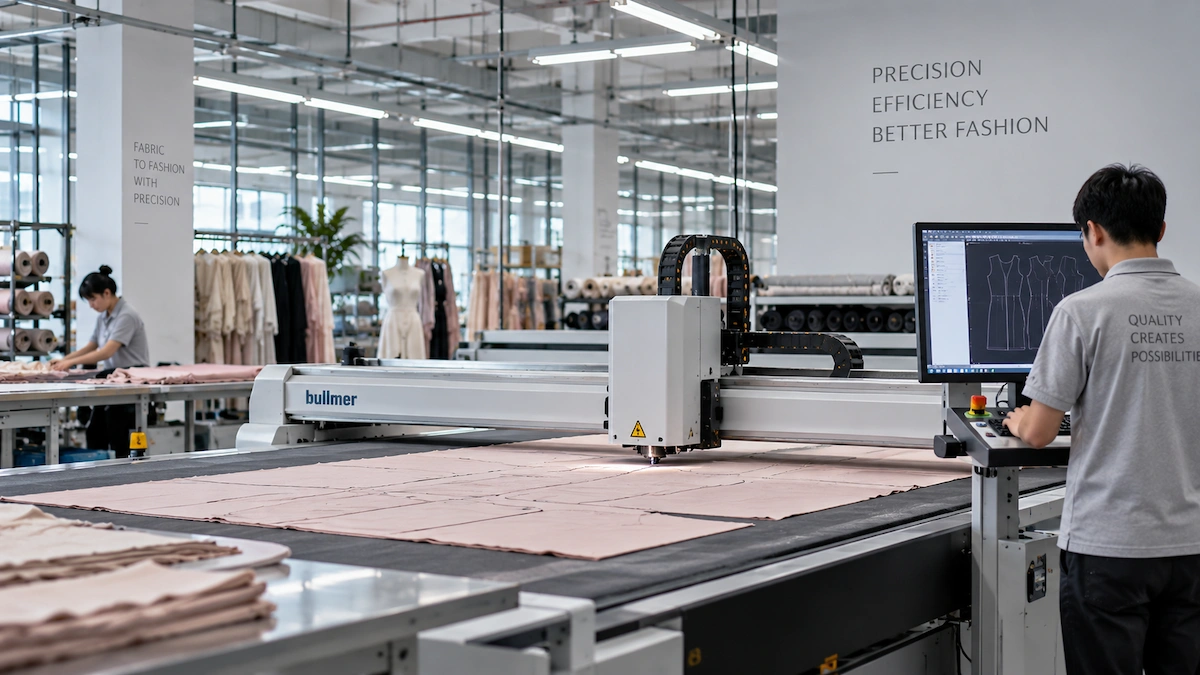
The cost of the shell in a garment is price per metre multiplied by consumption per piece, plus a waste allowance. The first number is negotiated and understood. The second is a property of the design and is where most of the variance sits. A bias-cut skirt, a full circle skirt, a train, a fabric with a large repeat that requires pattern matching, or a one-way nap that forbids rotating a piece all raise consumption without changing the price per metre at all. A buyer comparing two fabrics at the same price per metre can still be comparing a cheap and an expensive dress.
Where consumption actually goes
- Bias and true-bias panels, which use markedly more fabric per garment than a straight grain cut.
- Circulated, gored and tiered skirts, where the sweep is bought in fabric.
- Trains, which are almost pure addition with little reuse of the lay.
- Pattern matching on a printed or repeated fabric, which can add a full repeat per panel.
- One-way pile, nap or sequin direction, which prevents pieces being rotated in the marker.
- Narrow fabric width, which raises the metres needed for the same pattern pieces.
The waste allowance
Every quote contains an allowance for fabric lost to defects, end-of-roll, cutting and rejects. It is legitimate and it is worth knowing what it is, because it is the line most often quietly raised to cover a difficult fabric and the line a buyer can most reasonably question. A fabric with a high defect rate, a narrow width or a fragile surface genuinely costs more to consume, and the allowance should reflect the cutting method actually used rather than a round number carried across every style.
Lining and internal structure create hidden value
This is the block least visible in a quote and most responsible for whether an evening dress feels like the price the customer paid. It is also the block cheapest to remove and hardest to notice on a hanger, which makes it the natural target of a quote that has been reduced.
What the internal block carries
A full lining, an underlining layer, a fused or sewn interfacing at the neckline, a waist stay, bought-in or moulded cups, boning and its channels, and an internal support structure that transfers the skirt's weight to the body. Each of these costs material and labour, and each of them does something the customer experiences: opacity, structure, comfort under load, and the dress holding its shape after an evening rather than collapsing into it.
How removing them changes the product
The reason to look at this block carefully is that its removal does not produce a cheaper version of the same dress. A shorter lining that stops above a slit changes how the dress reads when the wearer moves. Omitting a waist stay moves the skirt's weight onto the seam, and the seam begins to fail after a few hours rather than immediately. Substituting a seam for a faced neckline changes how the neckline behaves after cleaning. Each is a different product with a different failure mode, and the failure appears in use rather than at inspection, which is the worst place for it to appear.
Compare internal construction when comparing suppliers
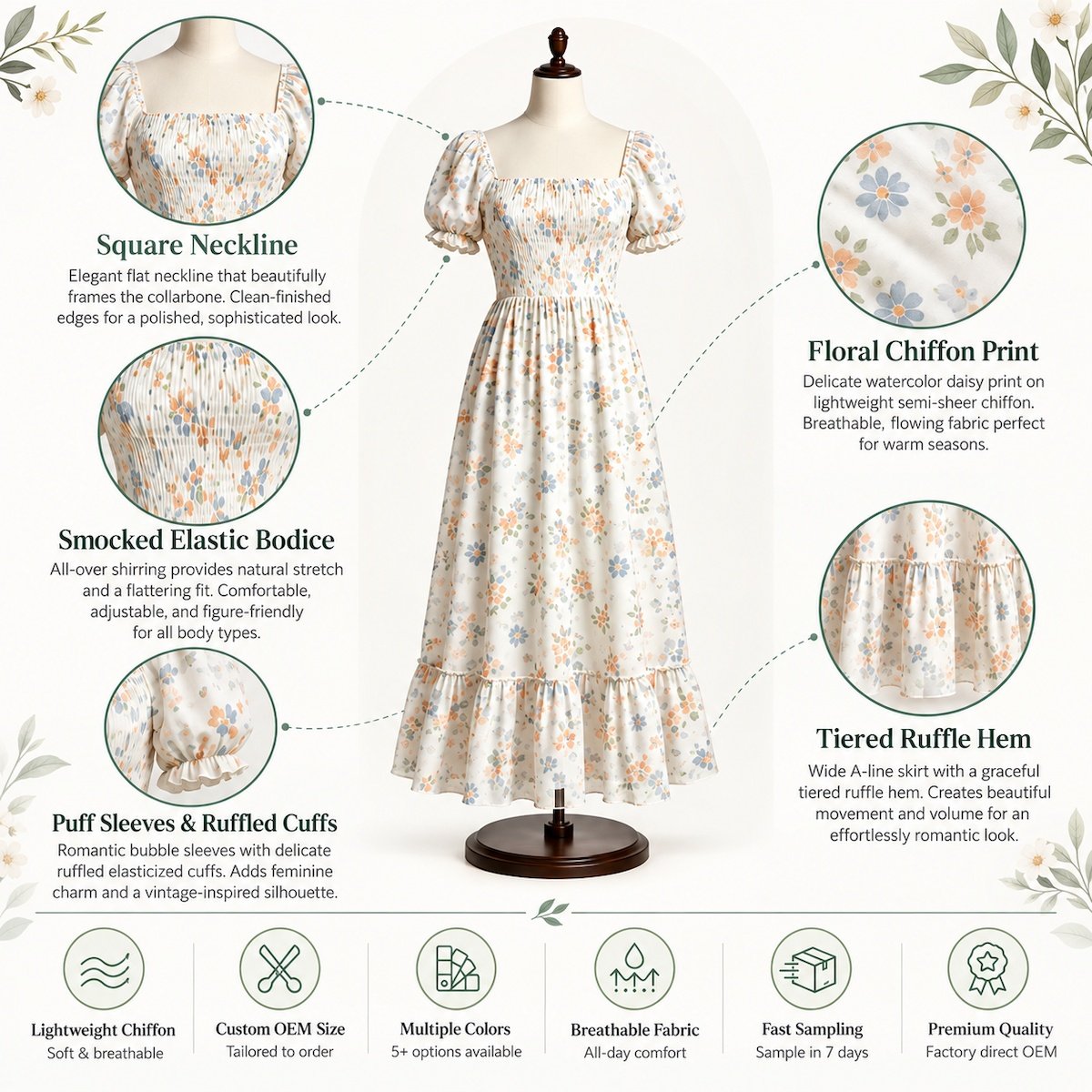
Two quotes for the same brief that differ materially should be compared inside the garment rather than on the line sheet. Ask what the lining specification is, whether there is interfacing and where, whether there is a stay or a support structure, what the closure involves, and how the hem is finished. Those five answers explain most of the difference between two quotes for a garment that looks identical in a photograph. A supplier who can answer them at quotation stage is quoting a construction; one who cannot is quoting a silhouette.
Labour rises with operation count
Labour in an evening dress is not a function of difficulty in the abstract. It is a function of how many separate operations the garment contains, how many of them can be run in sequence by one operator, and how much of the time is machine time rather than hand time.
Where the operations come from
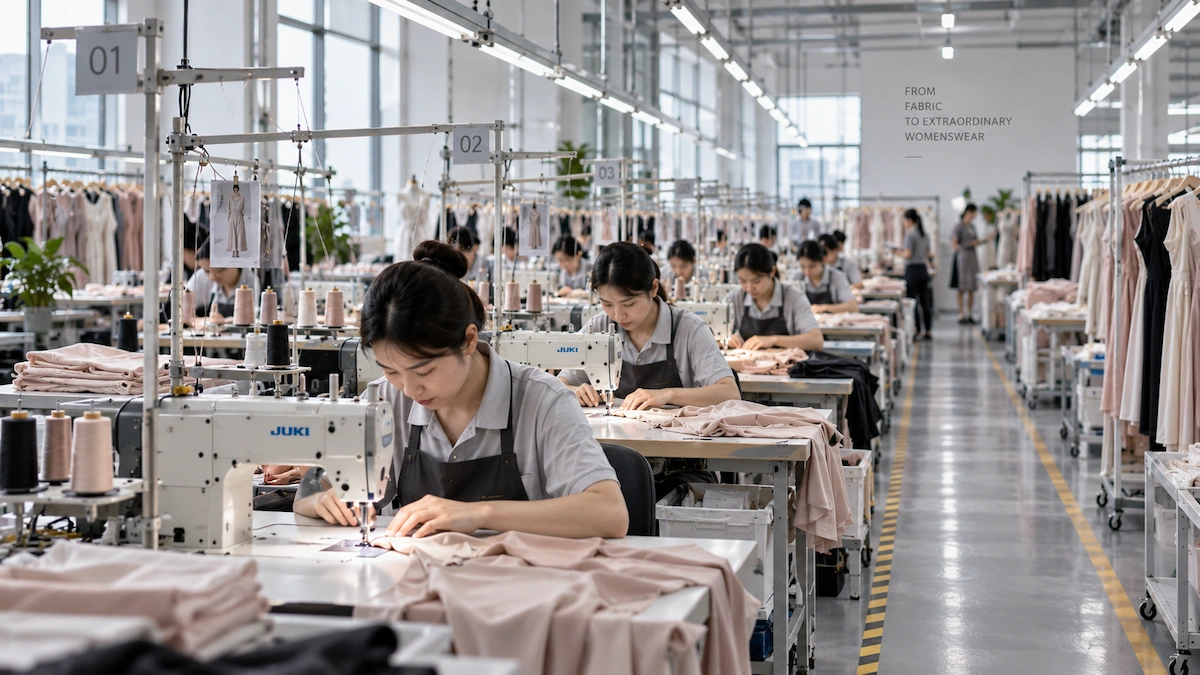
Draping and bias assembly take time because the fabric has to be handled rather than fed. Narrow hems and rolled edges take multiples of the time of a standard hem. Corsetry adds a sequence of channel, bone and finish operations plus an internal assembly that has to be closed invisibly. Concealed zippers in a bias panel, multiple layers that must be joined without slipping, and a full lining that has to be attached and turned are all operation multipliers. None of them looks expensive in isolation; their cost is in the count.
Small quantities make line setup less efficient
Labour also contains a fixed component. Setting up a line for a style, balancing the operations across operators, and reaching a normal pace takes time that is spread across the order. On a large run that component almost disappears into the unit price; on a small run it can be the difference between a comfortable quote and an uncomfortable one. This is the honest reason a small order costs more per piece, and it is a better explanation than a vague statement about minimums.
Ask for cost drivers rather than only a discount
A percentage discount across a quote tells nothing about what changed. A named cost driver does. If the labour share is high because of a specific operation, the buyer can decide whether that operation is carrying its weight — a hand-finished internal seam on a dress that is never seen inside is a cost with no customer. Asking which operations carry the largest share is the fastest way to find a reduction that does not reduce the product.
Embellishment is a separate cost system
Embellishment does not behave like the rest of the cost sheet, and treating it as a modifier to the garment cost produces an estimate that is wrong by a wide margin. It has its own materials, its own labour model and its own defect behaviour.
Three routes, three structures
| Route | Cost behaviour | Where the risk sits |
|---|---|---|
| Pre-embellished fabric, bought with the stones or sequins already on it | Predictable per metre, and chosen at the fabric stage | Pattern matching on the repeat, seam placement through the embellished ground, and weight |
| Placement embroidery or applique | Setup-driven: the artwork, the frame and the first piece dominate on a small order | Distortion at the frame edge, needle damage on a delicate ground, and colour matching to the base |
| Hand beading or hand-set stones | Entirely labour: hand time per piece, plus consumables and a repair allowance | Weight, thread durability at the attachment point, breakage in transit and the cost of repair |
The lines that are easy to miss
Three cost lines attach to embellishment and rarely appear as separate items. The first is seam cleanup: beads and sequins must be removed along a seam before it can be sewn and replaced afterwards, and that work is per seam, not per garment. The second is replacement allowance: stones and beads break, and a production run needs spare material and spare time for the pieces that are re-applied. The third is repair time identified at inspection, which on a hand-beaded garment is not a small correction but a piece of handwork done again.
Concentrate premium surface work where it supports retail value
The commercial discipline is to place surface work where the customer's attention already is, and to leave the rest plain. A beaded bodice panel, a shoulder, a defined area of a sleeve or a specific band usually carries the impression; an evenly scattered treatment across a whole skirt costs far more, is harder to repair, weighs more, and photographs less clearly under indoor light. Concentration raises the impression per unit of hand time, which is the only favourable ratio available in this block.
Where a cheap quote hides its saving
A quote does not undercut another by accident. Something in it is different, and the useful exercise is to find out what rather than to accept or reject it. The reductions are almost always in the same few places.
- A lighter or narrower shell in the same fabric family, which lowers both the price per metre and the perceived quality of the hand.
- A shortened or partial lining, which is invisible on a hanger and obvious when the wearer moves.
- Omitted interfacing, stay or support structure, which changes how the garment behaves after a few hours of wear.
- A simpler closure or hem finish, which is a genuine reduction in labour and a genuine change in the product.
- Fewer pattern pieces, which can be a legitimate simplification or can alter the silhouette in ways the buyer did not intend.
- Pre-made trim substituted for applied handwork, which changes both the cost and the surface quality.
- A packing and presentation reduction, which is legitimate if it was specified and a problem if it was not.
- A quantity assumption built into the quote, where the price quoted assumes a larger order than the brand intends to place.
Read that list as a set of questions rather than a set of accusations. Each item is a specification line, and the correct response to a lower quote is to confirm the specification on each line and re-price, not to assume the difference is efficiency.
Reading a quote whose proportions do not add up
Sometimes the giveaway is not a line item but the relationship between the blocks. A quote for a boned, hand-finished evening gown whose labour share is low relative to its embellishment share is describing a different construction from the one that was asked for. A quote for a simple column whose shell share is unusually low is describing a lighter fabric, or has priced a quantity the brand did not offer.
| What the quote shows | What it usually means | What to ask |
|---|---|---|
| High fabric share, low labour share | The garment is a material purchase with limited construction | Confirm the construction and the internal block, which may be lighter than expected |
| Low fabric share, high labour share | Construction-led, with many operations and moderate material | Ask which operations dominate, and whether any of them are visible to the customer |
| Low lining and internal block, otherwise normal | The garment has been lightened inside | Ask for the lining, interface and support specification in writing |
| Very high embellishment share | Handwork is the garment; everything else is a carrier | Confirm hand versus application route, and the replacement allowance |
| Low total with no visible reduction | The comparison is not like-for-like, or the quantity assumption differs | Re-price both quotes against one written specification and one quantity |
The value of this reading is that it turns a price comparison into a specification conversation, which is the only conversation that produces a reliable number. Our guide to comparing manufacturers covers the same discipline from the supplier side.
How the shape changes on a reorder
A second order is not the first order with new quantities. Three blocks move, and knowing which ones tells the buyer where the saving will and will not come from. Preparation cost is already spent, so the pattern block and the sample rounds drop towards zero. Labour becomes more efficient because the line has run the style before, so the per-unit labour share falls while the operation list stays the same. Materials do not move at all: the shell, lining, trims and stones cost what they cost, and if anything they rise if the shade has to be re-dyed.
The practical consequence is that a reorder on a material-led garment saves less than the brand expects, because the largest block in it is the one that does not respond to learning. A reorder on a construction-led garment saves more, because the blocks that do respond are the ones that dominate it. That is worth knowing before a first order is placed, since it decides which styles are genuinely worth carrying forward and which only looked affordable because the development cost was not counted.
Use a buyer cost model
The ex-factory price is the beginning of the brand's cost, not the end. A model that compares only ex-factory prices across suppliers will choose the wrong supplier as soon as the delivery method, the payment terms or the defect rate differ.
Three levels, not one
- Ex-factory: the garment at the factory gate, with the specification confirmed line by line.
- Landed: ex-factory plus freight, duty, inspection and insurance, at the shipping method the schedule requires.
- Fully loaded: landed plus payment fees, warehousing and handling, the expected defect and markdown allowance, and the cost of the sample and development rounds amortised across the order.
Most first-order decisions are made on the first level and justified on the third without being calculated. The development cost in particular is invisible in an ex-factory quote and real: two sample rounds, a grade, a fit session and a courier are all money the brand has already spent, and on a small first order they can be a meaningful part of the true unit cost. Amortising them honestly is what tells the brand whether the style can be reordered at a better price or was never going to work at that volume.
Test margin at normal and promotional retail
An order that works only at full retail is not an order, it is a hope. Occasionwear sells into a promotional environment, and the wholesale price has to leave the retailer a margin at both the planned price and a realistic markdown. Running the model at both prices is the test that separates a style the brand can reorder from a style that looked affordable because only one price case was examined.
The landed-cost ladder
| Level | What it contains | What it decides |
|---|---|---|
| Ex-factory | Garment, trims, labour, finish and packing, at the confirmed specification | Whether the garment is developable at the price architecture |
| Landed | Ex-factory plus freight, duty, inspection and insurance | Whether the delivery method the schedule requires is affordable |
| Fully loaded | Landed plus payment fees, warehousing, defect and markdown allowance, and amortised development | Whether the style can be reordered and still carry the margin |
Practical buyer worksheet
Complete this before comparing any two quotes. Without it, the comparison will be between two different garments.
- Target customer and use occasion
- Target retail and wholesale price
- Target ex-factory or landed cost
- Core fabric and backup fabric
- Size range and base fit size
- Colour count and continuity colours
- Critical construction risks
- Approval sample required
- Inspection checkpoints
- Latest acceptable delivery date
FAQ
What usually costs more: fabric or labour?
It depends on the design, and that is the useful answer rather than a dodge. A simple satin column is fabric-led: the material is the largest block and the labour is a modest number of straightforward operations. A corsetry-led dress or a hand-beaded gown is labour-led: the material matters, but the cost is dominated by the operations and the hand time required to build and finish the garment. A quote that shows the wrong leader for the construction it describes is worth questioning before the total is compared.
Why can a similar dress be cheaper elsewhere?
Because the specifications differ, and the difference is usually distributed across the fabric weight, the lining and internal structure, the closure and hem finish, the pattern piece count and the embellishment route rather than concentrated in one visible place. A lower price is not evidence of either efficiency or corner-cutting on its own. Confirming the specification line by line and re-pricing is the only way to know which of the two a given quote represents.
Should packaging be in the cost model?
Yes, whether it is quoted separately or inside the unit price. Packaging for an evening dress is not a commodity: the method has to protect a structured bodice, a beaded surface and a long skirt, which usually means a hanging or supported method rather than a flat fold, and it changes the carton dimensions and therefore the freight volume. A model that omits packaging and volume compares quotes that assumed different protection, usually to the disadvantage of the brand that chose the better one.
What is the best way to lower cost?
Simplify the most expensive feature while protecting the main visual idea, then consolidate fabrics and colours so the order stops paying for fragmentation. In most eveningwear quotes the largest available saving is not a cheaper fabric or a lower rate; it is removing an operation, a colour or a component that the customer does not experience. Where a reduction cannot be found in the design, the honest options are the order structure — quantity, colour count, continuity across seasons — rather than a rate discussion that will be recovered somewhere else.
Next step
We develop and produce evening, cocktail and occasionwear at our production facilities in Guangzhou and Dongguan, and we quote from a line-by-line cost sheet rather than a single figure: shell and lining consumption, the internal construction, the operation count, the embellishment route and the packing method are all visible to the buyer. Send the ten lines above and the shape you are expecting, and we will come back with a quote you can compare block by block against any other. Request a quote, or see the constructions we run on our evening dress manufacturing page.
If the range is still being costed, our fabric comparison for evening dresses covers the material decisions that carry the largest share of this cost sheet, and our style library and ready stock both show silhouettes already in production. The wider category we work across is on the women's dresses page.