On this page
- Quick answer: what is a low MOQ clothing manufacturer?
- Why fashion brands look for lower MOQs
- Low MOQ does not mean the same thing as small batch, private label or ready stock
- What actually determines the minimum for a clothing order?
- One dress can have three completely different minimums
- How low MOQ changes your unit cost
- How to lower MOQ without lowering garment quality
- How to plan a first collection for low-MOQ production
- Low MOQ vs the lowest possible MOQ
- How to evaluate a low MOQ clothing manufacturer
- What should you send when asking for a low-MOQ quote?
- Red flags when a supplier advertises an extremely low MOQ
- What small brands should prioritise instead of the smallest MOQ
- How Luxudress approaches lower-volume womenswear projects
- Frequently Asked Questions
- Conclusion

A low MOQ clothing manufacturer is not simply a factory willing to accept a small order.
In womenswear manufacturing, the workable minimum depends on the product itself: the fabric, number of colours, construction, trims, pattern development, size range, finishing method and whether the manufacturer already has a suitable block or proven construction.
A simple blouse made from stocked fabric may support a relatively small production run. A structured blazer in a custom-dyed fabric may not. An embellished evening dress can introduce another minimum from the embroidery or handwork supplier even before sewing begins.
That is why the most useful question is not "What is your lowest MOQ?"
It is "What is setting the minimum for this specific style?"
For small fashion brands, startups, boutiques and DTC labels, this distinction matters. A lower first order can reduce inventory exposure and make product testing easier, but forcing every design into an artificially low quantity can also increase unit cost, restrict material options and create production compromises.
This guide explains how to find and work with a low MOQ clothing manufacturer, how different production routes affect minimum quantities, how to design a smaller first collection intelligently, and what to check before committing to bulk production.
If you need the underlying definition before going further, start with our guide to what MOQ means in clothing manufacturing. This article focuses on the next question: how a brand should actually operate when it wants a smaller production run.
Quick answer: what is a low MOQ clothing manufacturer?
A low MOQ clothing manufacturer is a supplier whose production structure can support smaller commercially viable orders than a conventional high-volume factory.
That does not mean there is one industry-wide quantity that qualifies as low MOQ.
The realistic minimum changes with the product.
A manufacturer may be able to run one dress at a relatively low quantity when the fabric is already available, the pattern is based on an existing block and the style uses standard trims. The same manufacturer may require a much larger commitment for another dress if the fabric must be dyed to order, a new pattern must be developed and a specialist workshop must produce custom embellishment.
For a buyer, therefore, a genuine low MOQ capability should mean more than a small number advertised on a website.
It should mean the manufacturer can explain:
- which part of the specification sets the minimum;
- which elements can be changed to reduce it;
- which elements cannot;
- what the lower quantity does to unit cost;
- which development costs remain fixed;
- and how a small first run can be repeated efficiently if the style sells.
That is the difference between a genuinely flexible production system and a marketing claim.
Why fashion brands look for lower MOQs
Small production runs are attractive for one obvious reason: they reduce the amount of capital committed before demand is proven.
But inventory risk is only part of the picture.
A new fashion brand may not yet know which silhouette will become its core product. A DTC brand entering a new category may have strong customer data in dresses but no evidence that the same audience will buy tailoring. A boutique label may want to introduce three carefully selected pieces rather than finance a full seasonal range.
In each case, smaller production can function as a commercial test.
The objective is not simply to order fewer garments.
The objective is to learn something useful before the next production decision.
That may mean learning which colour converts best, whether customers accept a new price point, whether the fit generates returns, whether an unfamiliar category deserves to become permanent, or whether a design looks strong in a campaign but performs poorly once customers handle it.
For startups especially, the first collection should therefore be treated as capital allocation rather than a race to launch the largest possible range.
A focused group of styles that has been sampled properly and can be reordered is often commercially stronger than a wide collection divided into tiny quantities.
Our guide to manufacturing for fashion startups goes deeper into that first-collection problem.
Low MOQ does not mean the same thing as small batch, private label or ready stock
These terms are often mixed together, but they describe different production structures.
| Production route | What is already established | What the brand changes | Typical minimum logic | Best suited to |
|---|---|---|---|---|
| Ready stock | Finished product already exists | Usually limited branding or none | Based mainly on current inventory | Very early market testing |
| Private label | Proven garment construction exists | Labels, tags, packaging and selected specifications | Lower development burden | New brands and category testing |
| Small batch custom | Product is made specifically for the buyer | Design, material, colour and branding | Depends on specification | Focused branded collections |
| ODM | Manufacturer develops from a concept or adaptable starting point | Design direction and agreed customisation | Development plus material constraints | Brands without an internal pattern room |
| OEM | Brand supplies the defined design or specification | Production according to approved specification | Product and material dependent | Brands with developed styles |
| Full custom development | Most elements begin from a new brief | Construction, pattern, materials, finishes and branding | Highest number of independent constraints | Highly differentiated products |
A ready-stock order can be small because the development, material booking and cutting decisions have already been made.
Private label can reduce development exposure because the construction is proven. That does not necessarily mean every private label project has the same minimum; custom labels, packaging, colours or materials can still introduce their own requirements.
OEM is different again. If you supply an original design, pattern or detailed tech pack, the factory still has to determine whether your specified materials and order structure are commercially workable.
If you are deciding between these routes, see OEM vs ODM clothing manufacturing and how private label clothing manufacturing works.
The important point is that low MOQ is not itself a production method.
It is the result of how the product and the supply chain have been structured.
What actually determines the minimum for a clothing order?
Several separate constraints can exist in the same garment. The highest one usually becomes the practical minimum.
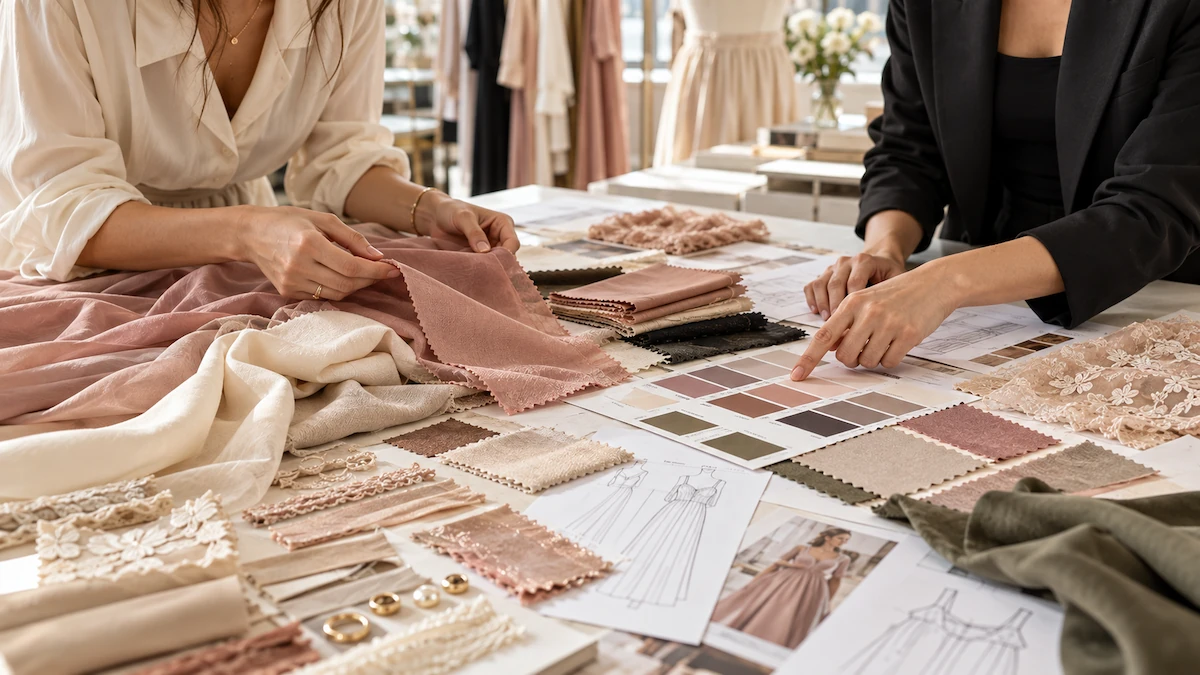
1. Fabric availability
For many small womenswear orders, fabric is the first issue to check.
If an appropriate cloth is already stocked, the manufacturer may be able to purchase only what the order requires.
If the fabric must be dyed, woven, knitted, printed or finished specifically for the project, the mill can impose its own minimum. That requirement may apply separately to each colour.
This is why fabric should be checked before the collection is fully committed.
Designing an entire range around a material and only asking about its minimum afterwards can leave the brand with a specification it cannot economically buy.
Our fabric sourcing service works from the garment requirement first—drape, weight, stretch, recovery, hand and finish—so alternative materials can be compared before bulk booking.
2. Number of colours
Colour can quietly multiply a small order.
Suppose the total volume looks reasonable, but the brand wants several colourways. Those colours may require separate fabric bookings, cutting runs, shade approvals and production handling.
The total order may therefore be large enough while each individual colour is too small.
For early collections, one or two commercially important colours are often easier to execute than spreading the same budget across many options.
3. Pattern and development work
A new garment needs a production-ready pattern.
If a manufacturer already has a relevant block, development may begin from that foundation. If the silhouette, fit or size architecture is genuinely new, more work is required before the style reaches bulk.
Pattern development, fit correction and grading do not disappear because the final quantity is small.
They are fixed costs associated with the style.
That is one reason extremely small custom runs can produce unexpectedly high unit economics.
4. Construction complexity
A simple unlined top and a structured blazer are not equivalent production problems.
Lining, boning, internal support, tailoring, pleating, corsetry, complex closures, matched panels and specialist finishing all increase the number of operations required before the garment is stable enough for repeat production.
Complex construction does not automatically mean an order must be large. It means that the setup and development burden has to make sense relative to the number of garments being produced.
5. Trims and embellishment
Buttons, zippers and standard elastics may be available from stock.
Custom hardware, branded metal trims, lace, specialist embroidery, sequins and hand embellishment can carry separate minimums.
The garment factory may not control those minimums because the specialist operation may be performed by another supplier.
A low garment quantity is therefore only useful if every important component can also be purchased at that scale.
6. Size range
A wider size range affects more than the number of labels required.
Grading must work across the range, and certain categories may require additional fit validation at different body points.
For small orders, spreading a very limited quantity across many sizes can also produce an impractical size ratio.
The question is not whether extended sizing should be offered. It is whether the pattern, fit validation and order quantity have been planned together.
7. Packaging and branding
Custom woven labels, printed packaging, boxes, hangtags and other brand components can each carry their own supplier minimum.
They are frequently forgotten during early MOQ discussions because they are not part of the garment construction itself.
For a smaller first order, standardising packaging across several styles can sometimes make more sense than producing a unique packaging system for each product.
| Constraint | What can set the minimum | Where there is usually room to move |
|---|---|---|
| Fabric | Mill minimum, per colour, when the cloth is dyed, woven, knitted or printed to order | Move to a stocked cloth, or share one approved fabric across several styles |
| Colour count | Each colourway may need its own booking, shade approval and cutting run | Concentrate volume into one or two colours, expand later |
| Pattern and grading | New silhouette, fit or size architecture needs development and correction | Start from a suitable existing block where differentiation does not depend on it |
| Construction | Lining, boning, tailoring, corsetry, pleating, matched panels | Simplify internal structure on the first run, keep the visible design |
| Trims and embellishment | Specialist suppliers set their own minimums, outside the factory | Use stock trims on the first run, develop custom hardware after repeat |
| Size range | Grading and fit validation per size, plus a workable size ratio | Match the size run to the quantity, widen it when the style repeats |
| Packaging | Woven labels, printed boxes, hangtags each carry a supplier minimum | Standardise one packaging system across the whole drop |
One dress can have three completely different minimums
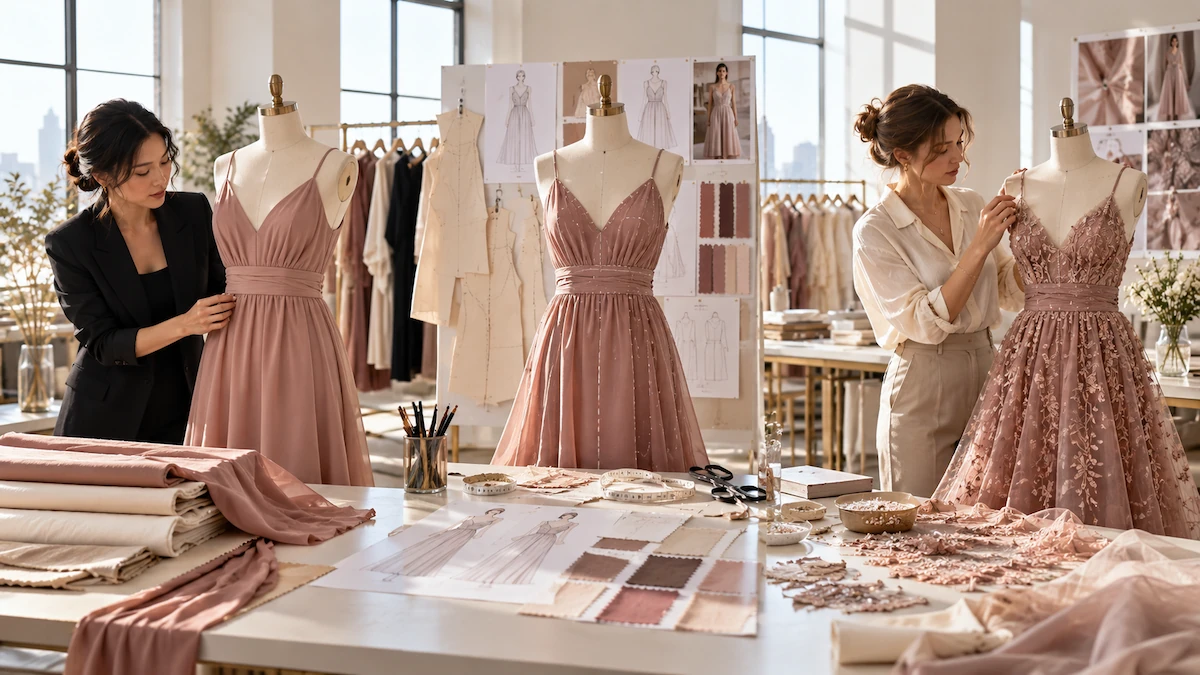
Consider the same basic midi dress sold through three different production structures.
Route A: stocked fabric and an existing block
The brand selects an appropriate fabric already available through the manufacturer, works from a proven fit block, chooses one colour and uses standard trims.
The product still needs to be adapted and sampled, but relatively few new supply-chain constraints are introduced.
This is the lowest-risk route of the three.
Route B: new pattern and multiple colours
The silhouette now requires original pattern development. The brand also requests several colours.
Nothing about the retail concept has necessarily changed dramatically, but the production structure has.
There is more development work, more approvals and more material fragmentation.
Route C: custom material and specialist embellishment
Now the fabric is dyed specifically for the project and the bodice includes placement embroidery or hand-applied decoration.
The style may visually resemble Route A, but it now contains at least three separate production systems:
- the garment factory,
- the fabric supplier,
- and the embellishment supplier.
Each may create a minimum.
This is why comparing factories only by asking "What is your MOQ?" rarely produces useful information.
The number means nothing without the specification behind it.
For the calculation itself, see how clothing manufacturers calculate MOQ.
How low MOQ changes your unit cost
Lower production volume usually reduces inventory commitment, but it does not normally reduce the development work required to make the style.
This is the trade-off every small brand needs to understand.
Imagine that pattern development, sample correction, grading, material approvals and production setup all happen before the first finished bulk garment is sold.
Those activities cost money whether the factory later produces a short run or a much larger one.
When more units are produced, those fixed costs are spread across more garments.
When fewer units are produced, each garment has to carry a larger share.
Small orders may also lose purchasing efficiency in fabric, trims and packing materials. Cutting can be less efficient. Specialist operations may charge setup fees. Freight per garment can be less favourable.
For that reason, the cheapest total order and the cheapest unit price are not the same objective.
A small brand might rationally accept a higher unit cost on its first run because the lower total inventory exposure is more valuable than achieving the lowest possible factory price.
But that only works if the retail price and gross margin can support it.
Before approving production, build the commercial model backwards: target retail price → required margin → landed cost allowance → factory cost ceiling → viable product specification.
Do not design the entire product first and discover the commercial limit at quotation.
For a deeper breakdown, see how much womenswear manufacturing costs and what should be included in a clothing manufacturing quote.
How to lower MOQ without lowering garment quality
There is an important difference between removing unnecessary complexity and removing quality.
A good low-MOQ strategy does the first.
It should not do the second.
Use stocked fabric where it suits the design
Stock fabric can remove one of the largest external minimum constraints.
The key phrase is where it suits the design.
Do not substitute a technically unsuitable cloth simply because it is available in a small quantity.
A lower MOQ is not useful if the finished product no longer hangs, stretches, recovers or wears as intended.
Reduce colour count before reducing quality
A first collection rarely needs every possible colour.
Concentrating volume into fewer colourways can create a healthier production structure while maintaining the same construction standard.
If a style proves itself, colours can be expanded in later runs.
Reuse materials across a range
Several styles using the same base cloth can improve purchasing efficiency and create a more coherent collection.
The garments do not need to look identical.
A dress, skirt and top can share a fabric while using different construction details.
Start from an appropriate existing block
If the manufacturer's existing fit architecture is suitable for the product and customer, adaptation can be more efficient than starting from a blank page.
This should not be confused with copying an existing finished garment.
The point is to avoid repeating technical work that does not create meaningful differentiation for the brand.
Simplify custom trims on the first run
A standard zipper in the correct quality may make more sense than developing custom hardware before the style has proven demand.
Brand differentiation should be concentrated where the customer notices and values it.
Consolidate rather than fragment
Five extremely small styles can be harder to produce economically than two stronger styles using the same total number of garments.
Every new style can introduce another pattern, another sample process, another marker, another production setup and another risk of unsold stock.
The goal is not to make the collection look small.
It is to make the capital work harder.
How to plan a first collection for low-MOQ production
The strongest small collections are usually edited before they reach the factory.
Start by separating the range into three groups:
- Core styles are the garments you believe can repeat.
- Test styles introduce a new silhouette, fabric or price point.
- Statement styles create visual impact but may be less predictable commercially.
A common early-stage mistake is treating all three categories as equally important.
They are not.
- Core styles deserve the cleanest repeat pathway.
- Test styles should be structured so the financial exposure is controlled.
- Statement styles may justify complexity, but their production burden should be understood before they consume the budget for the rest of the collection.
Then look for common infrastructure.
- Can three garments use one approved fabric?
- Can two styles share a zipper, lining or label system?
- Can the same packaging work across the entire first drop?
- Can one block support two related silhouettes?
- Can the collection launch with two colours instead of five?
Every shared decision removes one variable.
That matters because the first collection already contains enough unknowns: customer response, fit feedback, return rates, content performance, price acceptance and actual sell-through.
Manufacturing should not introduce unnecessary uncertainty on top.
Low MOQ vs the lowest possible MOQ
This distinction is important.
A brand should not automatically search for the factory offering the smallest number.
The objective is to find the lowest sensible quantity for the product and business model.
A factory that accepts an exceptionally small custom order may compensate through a much higher unit price.
Another may be using available stock materials that cannot be repeated later.
Another may call a relabelled ready-made garment custom manufacturing.
Another may accept the order but place it at the back of the production schedule because it is too small to receive normal line priority.
None of these models is automatically wrong.
The problem begins when the buyer thinks they are purchasing one production model while actually receiving another.
A slightly higher minimum from a manufacturer with controlled sampling, documented materials, repeatable patterns and consistent quality may create less commercial risk than the smallest advertised number.
Evaluate the production system, not just the quantity.
Our detailed guide to choosing a womenswear manufacturer covers the broader supplier evaluation process.
How to evaluate a low MOQ clothing manufacturer
When contacting a potential supplier, ask questions that reveal how the operation works rather than questions designed only to extract a number.
Ask whether the minimum is per style, colour or fabric
If a supplier gives one number immediately without seeing the product, ask what that number assumes.
A useful quotation should distinguish the garment quantity from any material or colour requirement.
Ask what is causing the minimum
A competent manufacturer should be able to identify the constraint.
It might be fabric, custom dyeing, pattern development, embroidery, cutting setup or another supplier.
Once the cause is known, alternatives can be discussed intelligently.
Ask whether the quoted fabric is stocked
Two quotes for the same dress may not be comparable if one uses existing stock fabric and the other assumes custom production.
Ask for the material basis in writing.
Ask how repeat orders are handled
The first order is only one part of the relationship.
Find out whether the approved pattern, material reference, trim specification, colour standard and sample are retained.
A successful style should become easier to repeat, not require redevelopment every season.
Ask about sampling before bulk
A low MOQ does not reduce the need for fit validation.
In fact, when a brand has limited capital, approving the product before bulk matters even more.
Our guide to how a factory creates a first garment sample explains what a useful first sample should establish.
Ask what happens when the order grows
A manufacturer suitable for the first test should ideally be capable of supporting a successful repeat.
Ask what changes at a higher quantity.
- Does the material source remain the same?
- Does production move to another line or facility?
- Does the quality control process remain documented?
- Can the same block and specification be retained?
Ask how quality is controlled
Low volume should not mean informal production.
The inspection method, workmanship standard and approval process should still be defined.
See our garment quality control service for the production stages that should be controlled rather than relying only on a final check.
What should you send when asking for a low-MOQ quote?
The better the brief, the more meaningful the answer.
At minimum, send:
- The product category and a clear design reference.
- A tech pack if one exists.
- Your target quantity per style.
- Your target quantity per colour.
- The intended size range.
- Fabric preference or required performance.
- Any important trims or decoration.
- Branding and packaging requirements.
- Target price if you have one.
- The date the goods need to be in your hands.
Do not hide the fact that the order is small.
The purpose of the first conversation is to discover whether the product and production model fit each other.
A factory cannot structure the right solution if it believes you are planning 3,000 units when the realistic first order is a fraction of that.
Likewise, do not ask for your best price for 100–1,000 pieces.
Those are completely different costing exercises.
Give the most realistic first-order scenario and ask what changes when the reorder increases.
For a fuller template, use our guide to requesting a clothing manufacturing quote.
Red flags when a supplier advertises an extremely low MOQ
Low MOQ is useful marketing language, which means buyers need to inspect what sits behind it.
The factory gives the same MOQ for every product
A basic camisole and a structured blazer do not carry identical development and production constraints.
One universal number deserves further explanation.
The quote does not identify the fabric
A low price and low minimum based on an unspecified fabric is not yet a usable production quote.
Material must be defined well enough to repeat.
Custom and ready-made products are treated as the same thing
There is nothing wrong with ready stock.
It can be an excellent market-testing route.
But it should not be described as original OEM development if the garment already existed before the brand selected it.
Sampling is discouraged
A supplier that pushes directly to bulk before the construction, fit and material are validated is transferring development risk to the buyer.
The supplier cannot explain the repeat order
Ask what will be retained after production.
If the pattern, material standard and trim specification cannot be identified later, the second order may behave like another first order.
Low quantity is achieved by changing the specification without approval
Watch for unapproved fabric substitutions, simplified construction, different linings or trims chosen only because the original material is unavailable at the requested quantity.
Reducing complexity should be a buyer-approved commercial decision, not a hidden factory decision.
Every answer is yes
Good manufacturing conversations contain limits.
A supplier who can explain why something will not work—and propose a technically sound alternative—is often more useful than one who accepts every request before costing or sampling it.
What small brands should prioritise instead of the smallest MOQ
For an early-stage brand, the priority order should usually be: product viability → sample approval → repeatability → commercial margin → sensible production quantity.
MOQ matters, but it sits inside that system.
A 50-piece order of the wrong product is still excess inventory.
A slightly larger run of a product that has been properly sampled, correctly priced and designed for repeat may be commercially safer.
The goal is therefore not simply to make the first order small.
It is to make the first order informative.
After launch, track what the production decision actually teaches you:
- Which sizes move first?
- Which colours sell without discounting?
- Which style creates repeat demand?
- Which product receives the lowest return rate?
- Which garment can support paid acquisition at its current margin?
- Which style should be repeated rather than replaced?
The value of small-batch production appears when that information changes the second order.

How Luxudress approaches lower-volume womenswear projects
At Luxudress, we start with the style rather than treating MOQ as one universal number.
The first review looks at the product construction, fabric basis, colour count, pattern requirement, trims, branding and intended quantity.
From there, the useful question is whether the specification supports the target order.
If a material minimum is the problem, the next step may be to review stocked or alternative fabrics.
If the range is divided across too many colours, consolidating colour may be more effective than changing the garment.
If full original development creates more risk than the brand needs for a first launch, an adaptable ODM or private label route may be more appropriate.
If the brand already has a developed pattern and technical specification, OEM production may be the cleaner route.
The objective is not to force every project into the same production model.
It is to identify the route that preserves the important parts of the product while keeping the first commitment commercially workable.
You can compare the routes through our OEM manufacturing, ODM development and private label manufacturing services.
For a project-specific answer, send the style, intended quantity, colour direction, fabric preference and target delivery date through Request a Quote.
Frequently Asked Questions
What is considered a low MOQ in clothing manufacturing?
There is no universal quantity that defines low MOQ across the clothing industry. A workable minimum depends on product type, fabric availability, colour count, development requirements, construction, trims and production method. A quantity that is low for a structured custom garment may be normal for a simple style using stocked materials.
Can a startup find a clothing manufacturer for small quantities?
Yes, but the product and production route need to suit the quantity. Startups generally have a better chance of achieving a workable first run when they concentrate on fewer styles, limit unnecessary colour fragmentation, use available materials where appropriate and validate samples before committing to bulk.
Is low MOQ clothing manufacturing more expensive per piece?
Usually, lower quantities produce a higher unit cost because fixed development and setup costs are spread across fewer garments. Smaller orders may also have less favourable material purchasing, cutting efficiency, trim pricing and freight economics. The total financial commitment can still be lower, which is why small runs can make commercial sense for testing.
How can I reduce the MOQ for a custom clothing order?
First identify what is creating the minimum. Common options include moving from custom-dyed to stocked fabric, reducing the number of colours, adapting an existing block, consolidating volume into fewer styles, simplifying custom trims or choosing a private label or ODM route where full original development is unnecessary.
What is the difference between low MOQ and small batch clothing manufacturing?
Low MOQ describes the minimum quantity a supplier can viably accept. Small batch describes the production scale of the order itself. A manufacturer may specialise in small batches, while another larger factory may accept a lower-volume run only under certain material or construction conditions.
Is private label better than OEM for a small fashion brand?
It depends on how much product differentiation the brand needs. Private label uses an existing proven construction and can reduce development work. OEM is more suitable when the brand already controls the design and technical specification. A first-time brand that needs speed and lower development risk may prefer private label or ODM, while a brand with established patterns may be better suited to OEM.
Can I use custom fabric with a low MOQ?
Sometimes, but custom fabric can become the binding constraint. Dyeing, weaving, printing or special finishing may carry a mill minimum, often per colour. If that minimum exceeds the garment order, stocked fabric or a different sourcing route may be required.
Should I choose the clothing manufacturer with the lowest MOQ?
Not on MOQ alone. Compare category experience, sampling, pattern capability, fabric sourcing, repeatability, quality control, communication, pricing basis and production capacity. The smallest first order is not valuable if the product cannot be reproduced consistently when it sells.
Do I still need a sample for a small production run?
Yes. Small quantity does not remove fit, construction or material risk. An approved sample provides a physical standard for bulk production and is particularly important when a young brand cannot afford to write off an unsuccessful first run.
What should I send a low MOQ clothing manufacturer for a quote?
Send the design or reference, product category, quantity per style and colour, size range, fabric preference, trim and decoration requirements, branding needs, target price if available, and required delivery date. A tech pack is useful but not always necessary for the first conversation.
Conclusion
Finding a low MOQ clothing manufacturer is not about discovering a factory with the smallest number printed on its website.
It is about building a product specification that can be manufactured responsibly at the scale your business can support.
Fabric, colour, development, trims, construction and size architecture all influence the result. Change those variables and the workable quantity changes with them.
For small fashion brands, the most effective strategy is usually to reduce unnecessary complexity rather than reduce quality: fewer strong styles, fewer fragmented colourways, appropriate stocked materials, validated samples and a clear path to repeat production.
Then ask the manufacturer the question that reveals whether they understand the job:
What is setting the minimum for this specific style?
A useful manufacturing partner should be able to answer.
And once you know the answer, MOQ stops being an arbitrary barrier.
It becomes another production decision you can design around.