On this page
- The five stages, in order
- Not every sample has the same job
- Stage 1 — brief intake and technical review
- Stage 2 — pattern development
- Stage 3 — making the sample
- When a substitute fabric is acceptable
- Stage 4 — fit session and comments
- Sample comment version control
- Where the timeline actually goes
- How to brief a sample so it lands closer
- What the second round should and should not contain
- FAQ
- The sample approval record
A first sample arrives four weeks after the brief was sent. The fit is close, the fabric is right, and the buyer's comment sheet comes back with eleven points. The factory revises and sends a second sample. Three of the eleven points come back unchanged, two are now wrong in a different way, and a new problem has appeared at the neckline that was not there before.
The buyer concludes that the factory does not listen. The factory concludes that the comments were not clear. Both are usually describing the same thing: a sample that was made before the specification was settled, and a comment sheet being used as a design brief rather than as a correction.
A first sample is not a garment that is "tried out". It is the first physical translation of a design intent into a producible specification — and the quality of that translation depends almost entirely on what was decided before the pattern was cut.
This article follows the process the way a sample actually moves through a factory, marks where it goes wrong, and ends with the record that should exist when a sample is signed off.
The five stages, in order
A first sample is produced in five stages. Each one assumes the previous one is closed.
| Stage | What it produces | What it depends on |
|---|---|---|
| 1 — Brief intake and review | A technical read of the design, and a list of what is missing | A complete brief, or an honest list of what is not yet decided |
| 2 — Pattern development | A pattern that reflects a specific fabric and construction | Fabric behaviour, and the construction decisions |
| 3 — Making the sample | A physical garment, made by the methods bulk will use | Pattern, fabric, trims, and the agreed construction route |
| 4 — Fit session and comments | A record of what to change, and why | A wearer or a fit model, and a measurement reference |
| 5 — Revision and approval | A corrected sample, or a second round | Comments that are corrections, not new requirements |
Most first-sample problems are not sewing problems. They are stages that were run out of order — a pattern cut against an unresolved specification, or comments given as preferences rather than as corrections. Which is why the most useful thing to know before reading the rest of this article is which kind of sample you have actually asked for.
Not every sample has the same job
"Sending a sample" describes at least seven different exercises, and they have different purposes, different standards and different acceptable outcomes. Treating them as one thing is the single most reliable way to generate extra rounds.
| Type | What it is for | Can it use substitute materials? |
|---|---|---|
| Proto sample | Proving the idea exists and reading the silhouette. Early, rough, and explicitly provisional | Yes — behaviour-representative substitutes are normal and expected |
| Fit sample | Reading fit on a body at a target size | Only if the substitute behaves like the intended cloth, or the fit reading is meaningless |
| Development sample | Working through a construction or a detail that is not yet solved | Often yes, as long as the construction being tested is the construction in question |
| Salesman / showroom sample | Presenting the design — to a buyer, a retailer, an investor | Yes, and commonly does, with a note that it is a presentation piece |
| Size-set sample | Confirming the range holds across sizes, not just at the base size | No — the range must be read on production-intent material |
| Pre-production (PP) sample | Confirming that the settled specification can be produced as specified | No. PP is meant to be the production-intent article |
| TOP / production sample | The reference piece taken from or alongside the actual run | No — by definition |
Two consequences follow immediately.
A first sample is usually a development or fit sample, not a PP sample. That is why the question "will bulk match the first sample?" has an awkward answer: it depends on whether the first sample was ever meant to be matched. The one that bulk is measured against is the PP sample — and if a brand skips that step, it is effectively asking the first sample to do a job it was never specified for.
"Approved" has to name the round. A comment like "approved sample" is ambiguous in exactly the way that causes disputes six weeks later. Approved at which round, against which measurement chart version, with which fabric, and subject to what conditions — all of that belongs in the record, which is covered at the end of this article.
Stage 1 — brief intake and technical review
This stage is short and it decides most of what follows. The brief is read, and the design is translated into a technical proposition: what construction the shape implies, what fabric behaviour it needs, which decisions are already made and which are still open.
What is actually being checked
- Is the design producible as drawn? Occasionally a design asks for something that cannot be made at the target price or in the intended fabric. Finding that here costs a conversation.
- Is the specification complete enough to draft against? A pattern needs measurements, construction and fabric behaviour. If any of the three is open, drafting cannot start — or it starts against an assumption that will have to be undone.
- What is the reference? A tech pack, a sketch, a photograph of an existing garment, or a physical reference sample. Each carries a different amount of information, and a photograph carries the least. Where the reference is thin, the first sample is really a design conversation made physical, and it should be treated as one — which is a different scope, and a different number of rounds.
- Which kind of sample is this? A proto, a fit sample and a PP sample are three different exercises. Naming the round before it starts is what stops the wrong standard being applied to the wrong piece.
The output of stage 1 is not a sample. It is either a green light, or a short list of what has to be decided before the pattern can be cut. The single most valuable thing a factory can send at this stage is that list — because a brief that gets answered later produces a sample that has to be re-made.
Stage 2 — pattern development
The pattern is where the design becomes reproducible. Everything the fit session will discuss is decided here, and most of it is decided in relation to the fabric.
Starting point: an existing block, or a new one
Where the style fits an existing block — a proven foundation for a body shape and category — development is faster and the fit risk is lower. Where the silhouette is new, the block itself has to be developed, and that work precedes the sample rather than being folded into it.
This distinction matters commercially because it is the difference between a sample and a development project. It is also why how pattern making works in womenswear manufacturing is worth understanding before commissioning a sample: the block is the asset, and any single sample is one expression of it.
What the pattern is drafted against
Three things, and all three have to be settled:
- Measurements. A size to be drafted to, and a measurement chart to grade from later. Where the chart is the buyer's own it needs to be supplied; where it is the factory's it needs to be reviewed and approved.
- Fabric behaviour. A pattern is drafted against a specific stiffness, weight and stretch. Drafting against a description rather than a material is the most common reason a first sample "fits but doesn't look right" — the same phenomenon described in how fabric weight affects fit and drape.
- Construction. Where the seams run, where the closures sit, how the garment is finished. These are pattern decisions, not sewing decisions, and they are made before the sample is cut.
The common failure at this stage
The most common failure is not a technical error. It is starting to draft against an open specification. A pattern developed around a fabric that is later substituted, or around a construction that is later simplified, produces a sample that is correct in every measurable way and wrong in the way it behaves. That is why a factory that holds the pattern until the fabric is confirmed is being careful rather than slow.
Stage 3 — making the sample
Here is where a widely repeated rule needs qualifying, because taking it literally causes as many problems as ignoring it.
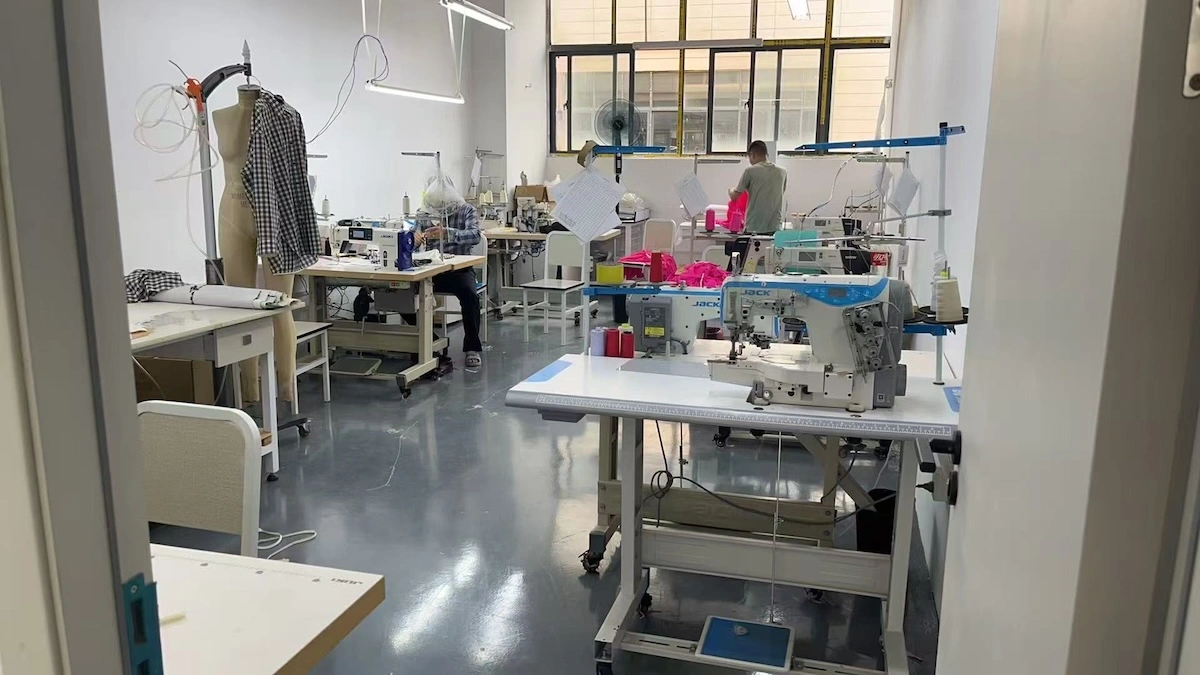
The rule says a sample should be made on the same equipment and by the same people as bulk. In reality, most factories run a sample room staffed by specialist sample machinists who are not the bulk line — and that is not a defect in the process, it is how sampling works. Sample machinists are usually more skilled and slower, working on constructions they may see once. A bulk line is faster, more specialised and organised around repetition.
So the honest version of the rule is narrower and more useful: the people may differ; the method must not. What has to match is the construction route and the method at the points that decide the garment — the seam sequence, the way a piece is stabilised before a closure is set, the interlining and how it is applied, the press method, the way a hem is finished. If those differ between sample and bulk, the two garments will behave differently on a hanger-identical garment, in exactly the places a fit session is judging.
Where the difference is most damaging:
- Interfacing and interlining. A sample room often applies these by hand, piece by piece. Bulk may fuse them in a batch. Heat and pressure are not always identical across a batch press, and the resulting difference in firmness is invisible on a form and visible on a body.
- Pressing. Hand pressing with individual attention is not the same as production pressing. On structured garments this is where the build consolidates or does not.
- Stabilising before closures. A zip or a button stand set into a piece that was not stabilised first will ripple — and whether the stabilising step happened is not visible in the finished sample.
Where structure is important, that gap widens — how structured bodices are made in womenswear covers why the build, not the measurement chart, decides how a structured garment holds.
What the sample should carry
A useful sample is not just the garment. It should carry:
- The construction decided in stage 2, made by the methods bulk will use.
- The trims and closures intended for production, or stated close equivalents, because trim substitution changes weight and behaviour at exactly the places a fit session looks.
- A measurement chart for the sample, so the fit session can separate "this measurement is wrong" from "this measurement is right but the garment still feels wrong" — two different problems with different fixes.
When a substitute fabric is acceptable
Fabric substitution during sampling is normal, and it is not automatically a mistake. What decides whether it is acceptable is which round you are in and what the substitute is being used to test.
| Round | Substitute material | Why |
|---|---|---|
| Proto | Usually acceptable | The question is whether the shape exists and reads, not how the cloth behaves at 2 mm of tolerance |
| Fit | Acceptable only if the substitute is behaviour-representative | Fit is read through the cloth. A substitute with different stiffness, weight or stretch produces a fit reading for a garment that will not be made |
| Development | Acceptable where the construction is the subject | If you are solving a collar or a closure, the exact face cloth may be secondary — as long as that is stated |
| Size set | Not acceptable | A grade is validated on the material it was calculated for |
| Pre-production | Not acceptable | PP exists to confirm the settled specification, and a substituted material means the specification has not been confirmed |
Two rules make substitution safe rather than risky.
State the substitution, in writing, on the sample itself. A sample that arrives without a note about what was substituted invites the buyer to read it as production-intent, and then to be disappointed by bulk. A hangtag on the sample naming the substitute and the reason removes the whole problem.
Never let a substitute quietly become the specification. The failure mode is specific: the sample is approved on the substitute, the bulk is made in the intended cloth, and the two differ in drape and weight. Nobody changed the specification; the substitution was simply never recorded, so the "approved sample" now describes a different garment.
Where a substitution is unavoidable and the round matters, the practical answer is to re-read the points that the substitute can affect — drape, weight at the shoulder, how a bodice holds, how a hem falls — rather than re-approving the sample wholesale.
Stage 4 — fit session and comments
The fit session is where a sample becomes data. It is also where most of the avoidable cost of sampling is created, because comments are frequently written as preferences rather than as corrections.
On a body, not on a hanger
A garment on a form has no movement, no soft tissue and no posture. Fit is decided on a wearer or a fit model, at the size the style will be bought in. Where the sample is only reviewed flat or on a stand, the session produces opinions about appearance rather than findings about fit.
Writing comments that can be acted on
A comment is actionable when it says three things: what is wrong, where, and in which direction. "Waist too loose" is a preference. "Waistband sits 15 mm below the intended line; take in at the side seams so the waist hits the marked line" is a correction, and it can be executed without interpretation.
| Comment type | Example | What the factory can do |
|---|---|---|
| Preference | "I'd like the waist higher" | Guess how much, where, and by which method |
| Finding | "Waist sits lower than the approved chart" | Correct to the reference |
| Correction | "Waist 15 mm low at side seams; raise by re-cutting at waist seam" | Execute and verify |
The three forms cost the same to write. Only the third reliably produces the intended change.
What the session should produce
A written record — the comments, the measured sample against the chart, and any re-measurement — plus a decision: revise, or re-sample. Where the sample is close and the corrections are local, a revision is usually right. Where the fabric, construction or block has changed, the honest answer is often a re-sample, because revisions will not reach far enough.
Sample comment version control
Comment sheets are documents, and documents that are revised without version control produce the third-round problem in the opening example: points that were "already answered" coming back unchanged.
Six fields turn a comment sheet into a record:
| # | Field | Why it has to be there |
|---|---|---|
| 1 | Round number and date | So "round two" means the same thing to both sides |
| 2 | Sample code | Ties the comments to a physical piece, not to a style name |
| 3 | Measurement chart version | A comment about a measurement is meaningless if the chart moved underneath it |
| 4 | Fabric and trim version | A comment about drape is meaningless if the cloth changed |
| 5 | Numbered comments | So each can be marked done, declined, or open, individually |
| 6 | Pattern revision reference | Confirms which pattern state the corrections were applied to |
And the disposition of each numbered point: made / declined with a reason / still open. A declined point with a reason is what prevents the same request returning a third time; a silent omission is what guarantees it will.
This is not bureaucracy for its own sake. It costs one extra column and it removes one of the most common causes of a sample round that fixes nothing.
Where the timeline actually goes
| Stage | Typical work | What makes it slip |
|---|---|---|
| Brief intake and review | Reading, technical read, gap list | An incomplete brief answered by assumption instead of by question |
| Pattern development | Block selection or creation, drafting, grading to sample size | Starting before the fabric and construction are settled |
| Making the sample | Cutting, sewing, finishing, pressing | Method differing from bulk; trims not confirmed |
| Fit session | Wearing, measuring, commenting | Reviewing on a form; comments written as preferences |
| Revision and approval | Correcting, verifying, approving | Revisions not measured; approval given from a photograph |
The five things that actually delay a sample
- An open fabric decision. Drafting cannot be finalised against a behaviour that has not been chosen.
- An incomplete brief, answered by guessing. A gap list costs a day; a guess costs a round.
- Method differing between the sample room and the bulk line. The session produces findings about a garment that will not be manufactured.
- Comments that are preferences. Every one of them is executed as an interpretation and re-reviewed.
- An unnumbered, unversioned comment sheet. Points get re-raised, and the round produces less progress than it should.
None of these are about sewing skill. All five are about the order in which decisions are closed.
How to brief a sample so it lands closer
A sample brief is short. Seven things, and each one removes a reason for the sample to miss.
| # | What to state | Why it changes the outcome |
|---|---|---|
| 1 | The round — proto, fit, development, size set or PP | Sets the standard the sample will be judged against |
| 2 | The reference — tech pack, sketch or physical sample | Sets how much is being interpreted versus executed |
| 3 | The size to be made and the measurement reference | Removes the "is it the garment or the size" ambiguity |
| 4 | The fabric, with its behaviour described, not just its name | Patterns are drafted against behaviour |
| 5 | The construction decisions already made | Stops the sample answering questions you have already answered |
| 6 | The trim list for the sample | Trim changes weight and behaviour where fit is judged |
| 7 | What is still open, stated as open | Turns assumptions into questions |
The two lines buyers forget
What is still open. Declaring an open item invites a question instead of an assumption, and a question costs a day.
The round. A first sample that the buyer intends as a PP confirmation, and the factory intends as a rough proto, will satisfy neither — and the disagreement surfaces as a quality complaint rather than as a scoping error. What to send an OEM clothing manufacturer covers the inputs that close a specification before drafting begins.
What the second round should and should not contain
Where a sample produces a second, the second round is a different exercise and should be scoped as one.
What it should contain: only the corrections agreed at the fit session, applied to the same pattern and the same construction, made by the methods bulk will use. Its purpose is to confirm that the corrections produced the intended result — not to introduce anything new.
What it should not contain: new design decisions. A second round that also changes the fabric, the closure or the block is not a confirmation round; it is a new development cycle wearing the same name, and it will produce a third sample. Where a design change is genuinely needed, it is cheaper to say so and treat the round as development than to present it as a revision.
The test is simple. If the comments from round one can be checked off individually, it is a revision. If they cannot, the round is development.
Where the base size is settled and the range is next, the exercise changes again — how size grading works from one approved sample covers what a size set has to confirm and why it cannot be read on a substitute cloth.
FAQ
How long does a first sample take? It depends on whether the style fits an existing block, and whether the fabric and construction are settled. A confirmation sample on a held block is fast; a sample for a new silhouette, with the specification still opening, is a development project and behaves like one.
What do I need to send for a first sample? At minimum the round you want, a reference, a target size, a fabric with its behaviour described, the construction decisions already made, and a note of anything still open. Missing items are unavoidable; missing items that are not declared are what cost rounds.
Why does my sample look right but fit wrong? Usually because it was drafted against a fabric description rather than a fabric. Behaviour — stiffness, weight and stretch — is what the pattern is drafted against, and a substitution afterwards changes the garment while every measurement stays correct.
Is it acceptable to use a different fabric for the sample? It depends on the round. A proto can be made in a representative substitute; a fit sample only if the substitute behaves like the intended cloth; a size set or a PP sample, no. The substitution has to be recorded on the sample and in the comment sheet so that nobody later reads the sample as production-intent.
Can I start without a tech pack? Yes, and it is common. What changes is that more is decided during development, so the first sample answers more questions and the process takes longer. What to know about manufacturing without a tech pack covers what has to be settled first.
Do samples have to be made on the bulk line? No — most factories use a sample room with specialist sample machinists, and that is normal. What matters is that the construction route and the methods match: seam sequence, interfacing and how it is applied, stabilising before closures, and the press method. Those are the places where a sample and a bulk garment diverge invisibly.
How many rounds should I expect? One to two where the specification is closed before drafting; three to four where the fabric, construction or block is still being settled during sampling. The variable is how much was settled in advance, not the factory.
How do I approve a sample properly? Measure it against the chart, confirm the fit on a body, check the numbered corrections from the previous round individually, record the disposition of each, and approve the garment and the specification together. Approving from photographs approves an appearance rather than a specification.
The sample approval record
Everything above reduces to one document, and it is the document a claim is settled against six months later. It is short.
| Field | Example of what good looks like |
|---|---|
| Round | Round 2 — PP confirmation |
| Sample code | LUX-2411-ST07-R2 |
| Fabric and trim version | Face: approved lot 3, no substitution · Trim: as per trim list v2 |
| Measurement chart version | Chart v3, measured and within tolerance at 9 of 9 points |
| Fit outcome | Read on a fit model, size M; corrections 1–6 verified; 7 declined (reason recorded) |
| Construction record | Interlining: light sew-in, applied by hand · Press: soft, no direct pressure on supported area |
| Substitutions | None — or a named list, with the round in which they are removed |
| Disposition | Approved for bulk, subject to the construction record above |
Eight rows. Read the "construction record" row and you can see why two samples with identical measurement charts can produce different garments. Read the "substitutions" row and you can see whether bulk is being compared against a garment that was ever meant to represent it.
A sample that is approved without this record is approved as a garment rather than as a specification — and bulk is compared against a specification.
If you want a sample developed against a settled specification and recorded against the build rather than only the measurements, send the brief and the reference you have. Sampling covers what each round is for, and what a tech pack should contain and the difference between a tech pack and a reference sample cover the inputs that make a brief complete.