On this page
- Approval is a decision, not a compliment
- Three samples, three different approvals
- Fit and silhouette
- Fabric and colour
- Construction and inside finish
- Measurements, grading and branding
- What cannot be approved from a photograph
- Reopening an approved sample
- Create one bulk reference
- Practical buyer worksheet
- FAQ
- Next step
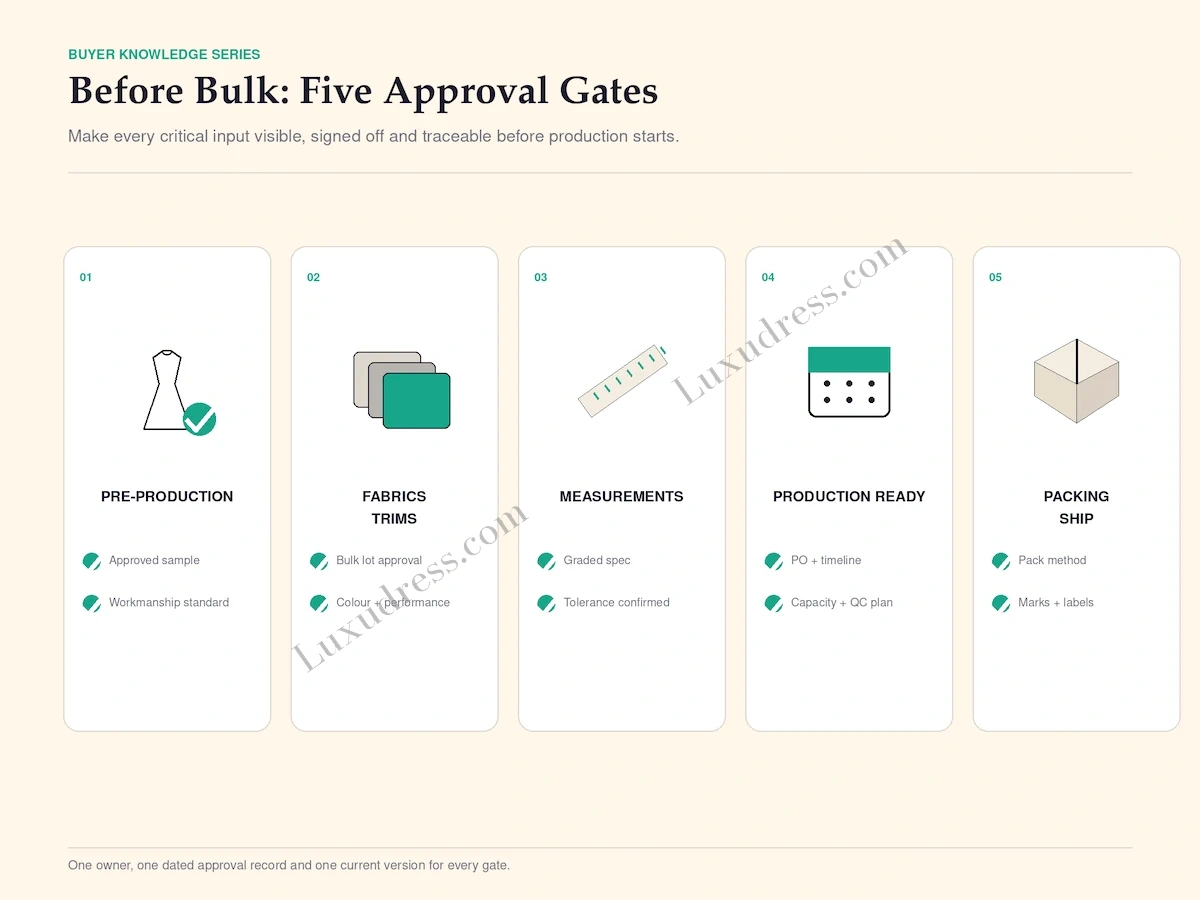
The approval sample is the bridge between development and production. What follows is a checklist for what that bridge actually signs off, and what it cannot.
This is written for fashion brands, retailers and product developers approving evening and occasionwear samples. It assumes how samples are made, which our guide to how a factory creates a first garment sample covers, and what a factory needs in order to brief one, covered in tech pack versus reference sample, along with how grading is released from an approved sample. What follows assumes those and covers the approval decision itself. The category is on our evening dress manufacturing page, and the private-label route is on our private label page.
Approval is a decision, not a compliment
The most useful way to understand an approval is as a transfer. Before the signature, a question about the garment sits with the brand, because the brand is the party that knows what it intended. After the signature, the same question sits with the factory, because the factory is now expected to reproduce the approved garment exactly. That transfer is the whole purpose of the sample round, and it only works if the brand has actually decided the things it is transferring.
What the signature transfers
| Before approval, the question sits with | After approval, it sits with |
|---|---|
| What the garment is meant to look like | The factory, which reproduces the approved garment |
| Which fabric, shade and trim is correct | The factory, which buys and matches to the approved reference |
| What the fit should be at the base size | The factory, which cuts to the approved pattern |
| How the garment should be finished inside | The factory, which follows the approved construction |
| What the measurements are | The factory, which is inspected against the approved chart |
| What the brand will pay for | Both parties, which is why the specification has to be written before the price is finally agreed |
Read the right-hand column and the risk becomes obvious. Every line that has not been decided when the sample is signed becomes a factory assumption. Some assumptions will be right, most will be close, and one will be wrong in a way that only appears at the inspection — by which time the only remedies are rework or a deviation. The value of a disciplined approval is not that it prevents the factory from making mistakes. It is that it removes the class of mistakes that comes from nobody having decided.
The cost of an open question
An open question is cheap at the sample stage, because changing a sample is a matter of a few days. It is expensive after cutting, because it is a matter of rework. The same observation is worth several times more on an evening dress than on a simple garment, because the operations that eveningwear is built from are the ones that cannot be undone: a bond or a channel sewn into a bodice, a handwork placement applied to a finished panel, or a hem finished on a bias skirt. An approval checklist is therefore not bureaucracy. It is the list of things that are cheap to decide now and expensive to decide later.
Three samples, three different approvals
One of the more common causes of a confused approval is that the garment in front of the brand is being asked to answer questions that belong to a different round. Eveningwear development usually runs through three garments, and they are approved against different standards.
| Sample | What it exists to decide | What it cannot decide | Who signs it |
|---|---|---|---|
| Fit or development sample | Proportion, silhouette, construction approach and the base fit | The final fabric hand, the production closure and the finishing standard | Design and technical, jointly |
| Photo sample | The garment as it will be presented and sold | Bulk reproducibility, and often the shade that will actually be delivered | Marketing and design, with the deviation from production documented |
| Pre-production or approval sample | The production standard in every respect: fabric, shade, trims, construction, measurement and branding | Nothing remaining — this garment becomes the reference | Technical and sourcing, with commercial sign-off |
Why the distinction matters
A fit sample approved as though it were a production sample produces exactly the failure the three-round structure exists to prevent: the brand believes it has approved a garment, and the factory believes it has approval to produce the fit sample's construction in a bulk fabric nobody has seen. For eveningwear, where the fabric hand, the shade and the weight all affect how the garment hangs, the difference matters more than in any other category. A bodice that reads correctly in a development fabric can read entirely differently in the bulk weight, and the change is a garment-level change rather than a detail.
If only one garment is made
Small brands frequently run a single round, and it is a legitimate choice when the construction is simple, the fabric is a stock ground already specified, and the quantity is small enough that a rework is affordable. What is not legitimate is calling that garment an approval sample while the fabric, the closure or the finishing remains open. If one garment has to serve both purposes, the approval should be recorded as conditional, with the open items named and their default resolutions agreed in writing. That converts an assumption into a decision, which is what the extra round was for.
Fit and silhouette
The first block of the checklist, and the one where a brand's comments are most likely to be useful and least likely to be precise. The discipline is to describe the correction rather than the feeling.
What to confirm on the body
- Shoulder or strap position, and whether the neckline holds it without adjustment.
- Bust, waist and hip at the base size, against the intended fit rather than against a remembered number.
- Bodice length, and where the waist seam sits relative to the natural waist.
- Overall balance: whether the skirt hangs from the intended line and the garment reads as the sketch intends.
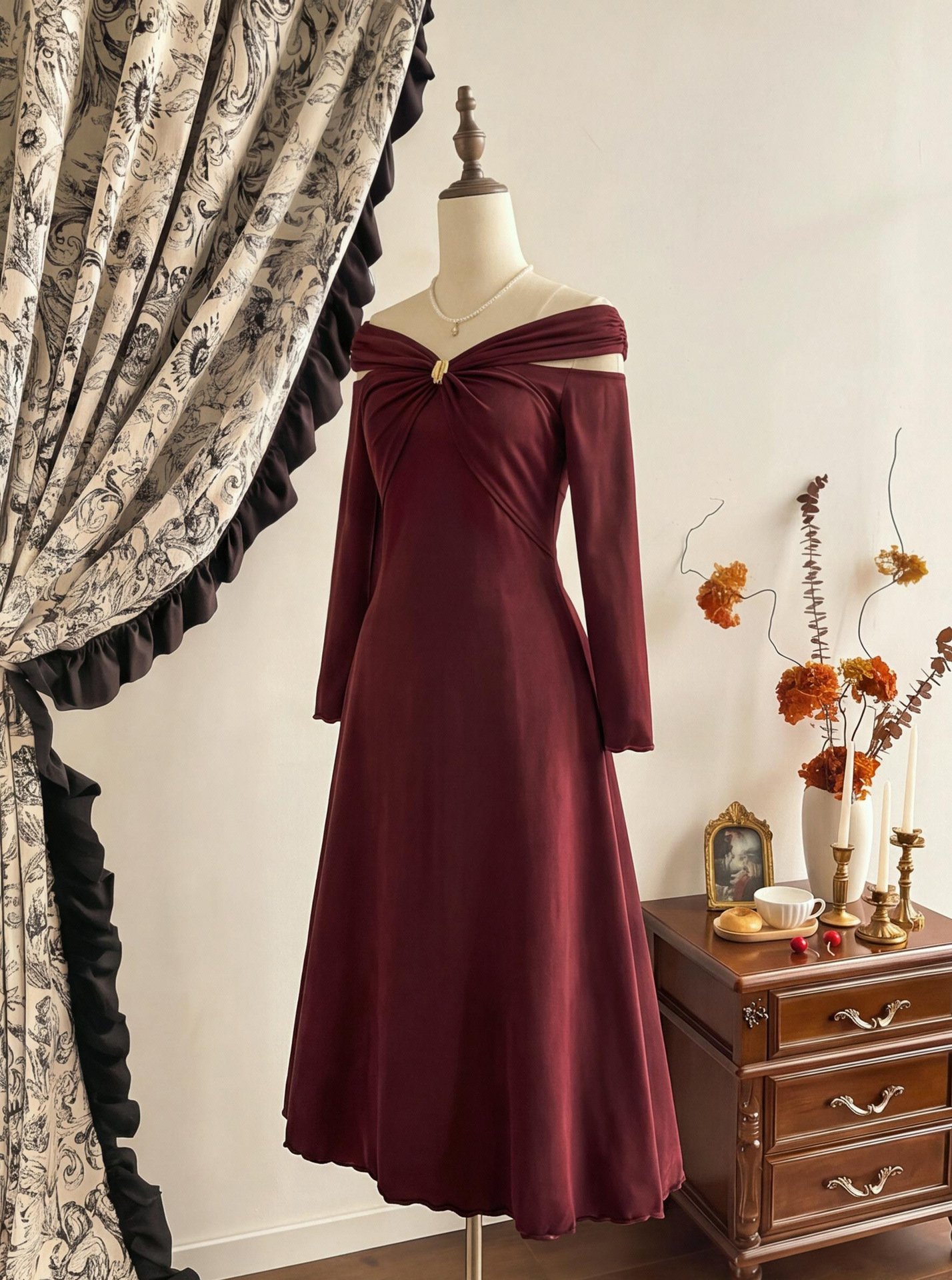
- Neckline security, slit height and movement, tested by moving rather than by looking.
- Intentional ease or compression, stated explicitly, because both are visible to an inspector only as a measurement and are read as an error if they are not written down.
Evaluate it sitting and walking
An evening dress is approved on a body in motion, not on a form. Sitting changes the load path from the shoulders and the waist to whatever structure the bodice contains, and a bodice that has never been tested seated will be tested by the customer. Walking reveals hem clearance, slit behaviour and whether the neckline stays. Both are worth doing with the sample on a person of the intended fit before any comment is written, because the comment that comes out of a seated test is specific and the comment that comes out of a rail inspection is not.
Writing a fit comment that can be actioned
A comment that says the bodice feels tight in the bust is a feeling. A comment that says the bust is two centimetres small and the front neckline therefore sits higher than intended is a correction. The second version can be measured, applied and verified; the first produces a second sample that may or may not have addressed it. Where the correction has a knock-on effect — a larger bust changes the neckline position, which changes the strap length — say so, because the pattern room will make the change and an unstated dependency becomes a second round.
Fabric and colour
This block is where an approval most often gets recorded as complete while remaining open, because the correct answer is frequently a physical object that has not arrived yet. The rule worth holding is that the approval record distinguishes between what has been approved and what is pending.
What has to be approved as an object
The shell fabric, at the weight and finish that will be delivered rather than the weight that was developed. The lining, including its opacity and its hand, because a lining that is too stiff changes how the outer garment moves. Any mesh, tulle or interlining. The interfacing, where there is one. And the shade, physically, on the actual ground, under the light the customer will buy in.
Recording supplier codes and retained swatches
An approved shade is only reproducible if it is recorded as three things: the supplier and article code, the physical retained swatch, and the light and date it was approved under. A code alone is not enough, because a code can be substituted or re-dyed. A swatch alone is not enough, because it detaches from the transaction. Both together are what allows a dispute about a shade to be settled by comparison rather than by recollection.
The photo sample shade problem
Where a photo sample was made before the bulk shade was available, the shade in the imagery may be a stand-in. That has to be recorded as a difference at the approval stage, in writing, so that the bulk shade is not rejected later for differing from a photograph nobody intended to be a specification. Occasionwear is unusually exposed to this problem because the imagery is commissioned early, before fabric booking is complete.
Construction and inside finish
This is the block a brand is least equipped to check and the one that most decides whether the bulk behaves like the sample. It is also the block where an approval is most valuable, because it is written down once and applied to every subsequent unit.
The construction checks
- Seams, darts and their finish, including whether the seam allowance treatment is the one specified.
- Draping or gathering behaviour, and how the panels fall relative to the intended design line.
- Boning: channel layout, channel closure, bone ends and their protection.
- Cups: type, position, coverage and how the edge is concealed.
- Lining: attachment method, length, behaviour at the slit and finish at the hem.
- The hem method, which for a bias or a curved hem decides whether the garment stays even.
- Closures: the zip, its length, its facing and any secondary hook, eye or loop.
Approve the stitch and the finish
Stitch type and any visible topstitching are worth naming explicitly, because they are the most easily substituted parts of a garment and among the most visible. A topstitch at a standard stitch length is a different look from the same line at a shorter one, and a seam that has been sewn at a reduced density is the single most common way an approved construction is quietly changed. If a stitch is part of the design, it belongs in the approval record as a number rather than as an impression.
Inspect the inside as a deliverable
Internal cleanliness and comfort are approval items, not production trivia. Raw edges, exposed bone ends, thread chains left at a seam, and a waist seam that catches against the skin are all decided at the sample stage, because a sample that is clean inside is evidence that the construction was understood. If the sample is finished inside to a higher standard than the specification states, that is also a finding, since the bulk will be made to the specification rather than to the sample. Agreement now prevents a conversation at the inspection about which of the two was intended.

Where a visible detail does the most work
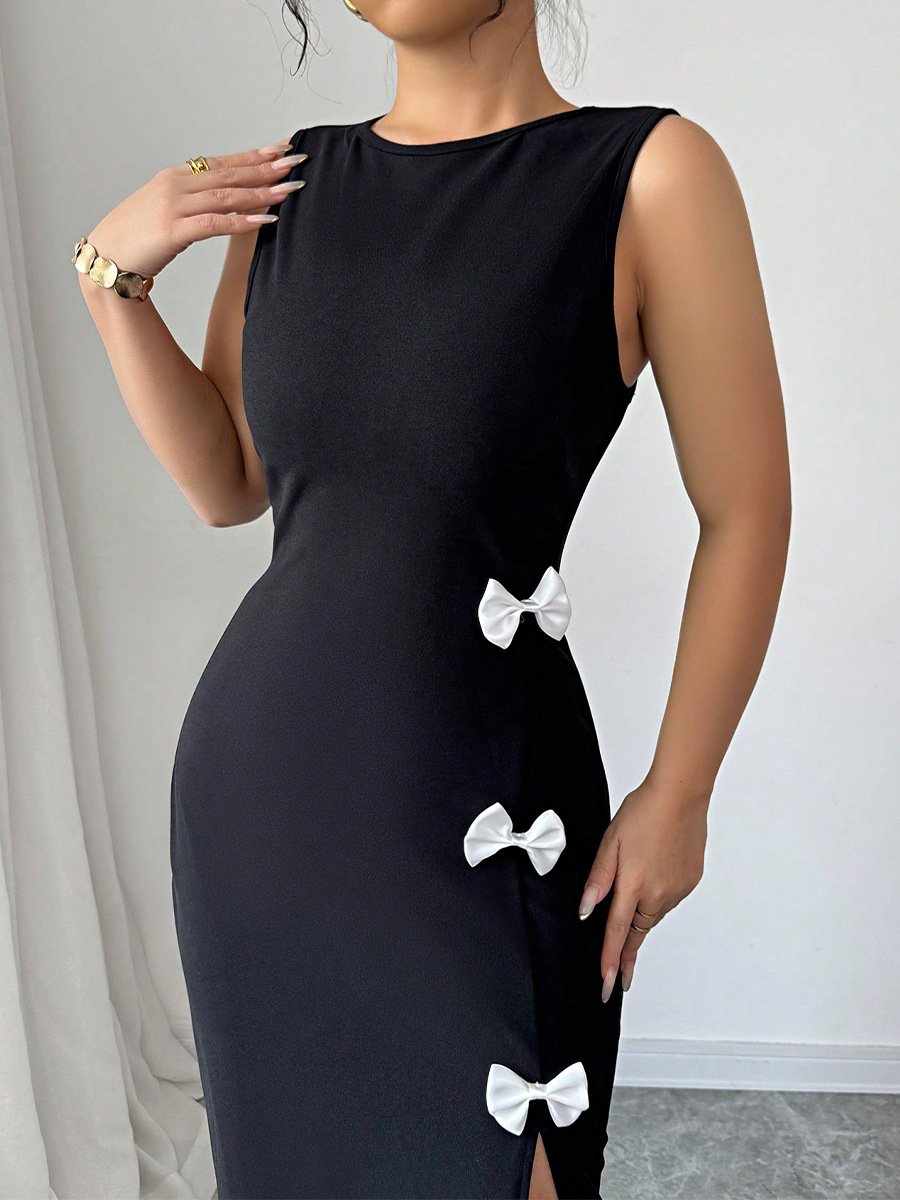
A visible detail is where an approval earns its keep, because it is the part of a garment a factory can most easily substitute without anyone noticing until the bulk arrives. A bow, a buckle, a row of covered buttons, a defined band of trim or a specific topstitch line all belong in the record with their method and their dimensions written down. If the finish is part of what the brand is selling, the approval should carry the stitch, the width and the placement, not a photograph of a sample that has since been taken apart for fitting.
Measurements, grading and branding
The measurement block closes the approval, because it is the document against which production is inspected. Approving the garment without approving its measurement chart leaves the inspection without a standard.
Sign off the specification for the approved size
Measure the approved sample and record the numbers as the specification for that size, with tolerances and the reference points they were taken from. A chart that was written before the sample was made describes the intention; a chart measured from the approved sample describes the garment, and it is the second one that should be used. Where the two differ, the difference is a decision rather than an error, and it is worth writing down which one governs.
Resolve the pattern before grading
Grade rules multiply a pattern's decisions across every size, so a pattern correction made after grading has to be applied at every size it touches. The approval is the last point at which a correction is a single change. This is why pattern corrections belong at the fit approval rather than at the sample approval, and why an approval that leaves a known pattern issue unresolved will produce a size set with that issue repeated. Where the range includes petite or tall lengths, those rules belong in the approval too, because they are derived from the same base.
Approve the branding in place
Labels, care information, hangtags and their placement are checked on the sample rather than from a specification, because placement is what customers notice and what varies between runs. The care information content is worth confirming as well as its presence: a care instruction that does not match the fabric is a claim the brand has to stand behind. On eveningwear, the packing method belongs in this block too, since a bodice or a beaded surface usually requires a supported or hanging method rather than a flat fold.
What cannot be approved from a photograph
Remote approval is a normal part of working with an overseas manufacturer and it is workable for many things. It is not workable for everything, and the items where it fails are worth naming because each one has produced a bulk dispute somewhere.
The items that need the garment or the object
- Colour and shade, which shift with camera, white balance, screen and lighting, and which no photograph reproduces reliably enough to be a specification.
- Fabric hand, weight and drape, which are physical properties and cannot be assessed from an image at all.
- Fit at the base size, because a photograph conceals the small differences that decide whether a garment is comfortable.
- Stretch and recovery on a knitted or bias construction, which only appear when the garment is worn.
- Fine finishing: stitch density, edge neatness and internal cleanliness, all of which require the garment in hand.
- Touch and comfort at a seam, a bone end or a neckline edge, which is the difference between a garment that can be worn for an evening and one that cannot.
How to approve remotely without guessing
Remote approval works when the physical items are separated from the visual ones. Send the swatches: a shade, a lining, a lace and a trim can all be couriered, and they are the part of the approval that cannot be digital. Use photographs for proportion, construction sequence and branding placement, where the image carries the decision adequately. Keep the items that require the garment in hand as a conditional approval to be confirmed on arrival, and state the condition in writing. That structure gives the brand most of the speed of remote approval without transferring a decision it cannot actually make.
Reopening an approved sample
Samples get reopened, and the reason is usually legitimate: a fabric becomes unavailable, a shade is discontinued, a buyer changes a commercial decision. What matters is that a reopened approval is treated as a new approval rather than an amendment, because the downstream documents were all built on the first one.
What a change after sign-off touches
| If the change is to | It invalidates | Typical consequence |
|---|---|---|
| The fabric or its weight | The fit, the drape, the shade approval and any photography | The sample no longer represents the garment, so a new sample round is the honest route |
| The shade only | The shade approval and usually the imagery | A new physical approval, and a check that the trims still match |
| The construction or an internal component | The construction specification and possibly the measurement chart | Rework, and often a second sample to confirm the change behaves as intended |
| The pattern | The grade, the markers and the size chart | The most expensive class of change, because it multiplies across every size |
| The order quantity or colour count | The price and often the material booking | A revised quotation, and a check on whether any component minimum has been breached |
The document discipline that makes it survivable
A reopened approval is survivable when the original record is good. If the approval named the fabric, the shade, the construction, the measurement chart and the branding, then a change can be traced to the documents it affects instead of being rediscovered through the programme. If the original approval was a message saying the sample looks good, the change has no defined starting point and the only reliable recovery is to re-approve from the specification. That difference is the return on the checklist, and it appears precisely at the moment the brand least wants a surprise.
Create one bulk reference
The final step in the approval is producing the object that production and inspection will both compare against. Without it, the approval exists only as a decision, and decisions are remembered differently by different people.
Keep a sealed or controlled sample
A sealed sample is a copy of the approved garment, retained unaltered and used only for comparison. It matters because the approved garment itself will be examined, handled and eventually changed by the process of approving it. Where a physical sealed sample is impractical, a controlled reference — a documented set of measurements, swatches and photographs taken at approval — is the equivalent, and it should be labelled as such rather than treated as a substitute for the garment.
Issue a closing comment sheet
Every approval should close with one document that states what was approved, what was changed since the previous round, what remains open, and who is responsible for each open item. This is the document that prevents the two most common failures of an approval: a comment that was discussed and never recorded, and an open item that both sides assumed the other was handling. Given the number of moving parts in an evening dress — fabrics, lining, structure, cups, boning, closures, handwork, branding and packing — the closing sheet is short and its absence is expensive.
Photograph what inspectors will compare
Photographs taken at approval are not a substitute for the sample, but they are the fastest way for an inspector at a distance to know what correct looks like. The useful ones are close and specific: the inside of the waist, the boning channel closure, the cup edge, the hem finish, the zip facing, the label placement and the packing method. A set of twenty such photographs attached to the approval record does more for consistency across a bulk run than any number of general views of the garment.

Do not use chat history as the standard
The most common substitute for an approval record is the message thread in which the approval was discussed. It is not a standard, for three reasons: it contains superseded versions, it mixes decisions with questions, and it is not available at the cutting table or the inspection table where the standard is actually needed. Consolidating the decision into one controlled document is not an administrative nicety — it is the difference between a specification and a conversation.
Practical buyer worksheet
Complete this before the approval meeting. For approval purposes the third and fourth lines do most of the work: a stated approval sample and named inspection points are what turn the meeting into a record.
- Target customer and use occasion
- Target retail and wholesale price
- Target ex-factory or landed cost
- Core fabric and backup fabric
- Size range and base fit size
- Colour count and continuity colours
- Critical construction risks
- Approval sample required
- Inspection checkpoints
- Latest acceptable delivery date
FAQ
What is the difference between a fit sample and a pre-production sample?
A fit sample develops fit, proportion and construction approach, and it is approved by design and technical together for those purposes. A pre-production or approval sample should represent the agreed bulk in every respect — the actual fabric and shade, the production trims, the production construction and finish, the measurement chart and the branding — and it is the garment bulk is inspected against. The distinction is not ceremonial: a fit sample approved as a production standard allows a production run to be made in a fabric, a shade or a construction that was never approved. On eveningwear, where the fabric weight changes how the garment hangs, that is a garment-level risk rather than a detail.
Can bulk start before every detail is approved?
It can, and it creates a defined risk rather than a vague one. Starting production with open items is a trade of time against the cost of correcting those items after cutting, and the trade is sometimes correct when the open items are cosmetic and interruptible — a hangtag, a packing method, a care label. It is rarely correct when the open items are structural, because every one of them touches the pattern, the marker or the internal construction, and those cannot be corrected without rework. Where bulk starts early, each open item should be named with a default resolution and a decision date, so that the factory is never waiting for an answer it did not know it needed.
Who should keep the sealed sample?
Both parties should retain a controlled reference or its documented equivalent. In practice the manufacturer keeps the physical sealed sample, because that is where it is compared against production, and the brand keeps the documentation: the measured specification, the approved swatches and the photographs. Where a brand holds the only reference, an inspection at the factory has nothing to compare against; where the factory holds the only reference, the brand has no way to verify a finding independently. The documentation travels, and it is what makes the arrangement work at a distance.
What should never be approved only by photo?
Colour and shade, fabric hand, weight and drape, fine finishing, stretch and recovery, comfort at a seam or a bone end, and many fit issues are all difficult or impossible to judge reliably from an image, because the photograph carries the camera and the screen as well as the garment. None of them should be signed off on imagery alone. What photographs do well is proportion, construction sequence, branding placement and packing method, and a workable remote approval separates the two groups: physical items couriered, visual items photographed, and anything requiring the garment in hand approved conditionally and confirmed on arrival.
Next step
We develop and produce evening, prom, bridesmaid and gala wear at our production facilities in Guangzhou and Dongguan, and every programme runs on a written approval record: the fabric and shade approved against a retained swatch, the construction approved against a sample, the measurement chart measured from the approved garment, the branding and packing confirmed in place, and a controlled reference held for inspection. Send the sample you have and the open questions you have not resolved, and we will come back with a closing comment sheet rather than a message saying the sample looks good. Request a quote, or see the constructions we run on our evening dress manufacturing page.
Our evening dress quality control checklist covers what happens to the approved standard at inspection, and our style library and ready stock both show constructions already in production and already approved. The wider category we work across is on the women's dresses page.