On this page
- Tulle is structure, not decoration
- Soft and stiff tulle do different jobs
- Layer count changes more than opacity
- Gathering ratio controls silhouette
- Horsehair and edge finishes shape the hem
- Colour is an optical result
- Reading the skirt as a load path
- What the layer plan has to specify
- Practical buyer worksheet
- FAQ
- Next step
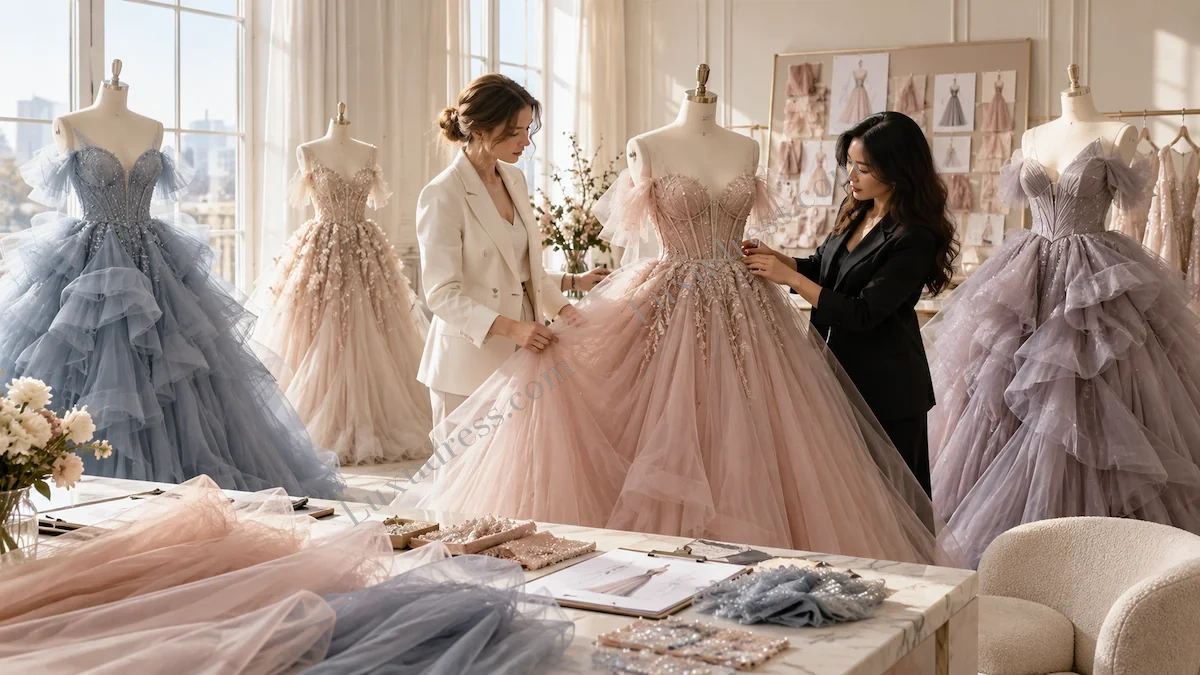
This is written for fashion brands, retailers and product developers building prom, gala and ball-gown styles. It assumes the material comparison itself, which our guide to evening-dress fabrics covers by property. What follows assumes a tulle has been selected and asks a different question: what does this tulle do to the construction? The category is on our prom dress manufacturing and gala dress pages.
Tulle is structure, not decoration
In a tulle skirt the layers are not a surface applied to a garment. They are the garment's volume, and in many ball-gown constructions they are also its structure. The waist seam is carrying the weight of every layer at once, the hem is a finished edge repeated on each of those layers, and the silhouette is produced by how much fabric was gathered rather than by a pattern shape.
Read the skirt as a stack
The useful mental model is a stack in which each layer has one job. A brand that can write down the job of every layer can cost the skirt, brief it, and diagnose it when it does not behave; a brand that cannot will be told that the skirt has four layers, which is a quantity rather than a specification.
| Layer | The job it does | What happens if it is missing |
|---|---|---|
| Lining or base | Opacity and comfort against the body | The skirt reads sheer under any direct light and the tulle touches the skin |
| Structural layer | Body and projection — the volume the silhouette depends on | The skirt collapses to a flat fall regardless of how much tulle is added |
| Body layer | Colour depth and density where the skirt is not supported | The intended shade does not read; the skirt looks thin at the hip and full at the hem |
| Surface layer | Texture, finish and the outer visual quality | The skirt reads as a plain netting volume rather than as a designed surface |
| Underskirt or crinoline | Load distribution and hem shape | The waist seam carries the entire weight and the hem loses its line |
Two things follow from writing the stack down. The first is that adding volume and adding layers are different operations, and only one of them is cheap. The second is that the layer that carries the skirt's weight is usually not the layer the customer sees, which is exactly why it is the layer most often removed when a style is costed down.
Why this matters more in prom and gala
Prom and gala are the categories where this volume is largest and where it carries the most weight. A short tulle overlay on a midi dress is a surface treatment; a full ball-gown skirt is several metres of fabric hanging from a waist seam that also has to hold the bodice in place. The mechanics are the same and the loads are not, which is why a construction that works at midi length cannot simply be scaled up.
Soft and stiff tulle do different jobs
The single most consequential decision in a tulle skirt is the stiffness of the material, and it is usually made accidentally, by asking for tulle and being sent whatever the mill's current standard is.
What soft tulle does
Soft tulle creates fluid, layered volume. It falls, it moves, and it layers without producing hard lines; a skirt built from soft tulle gets its fullness from the number of layers rather than from the stiffness of any one of them. It is the right material for draped overlays, gathered tiers, and any shape where the skirt is meant to read as light.
What stiff tulle does
Stiff tulle holds a shape under its own weight. It is what produces projection — a skirt that stands away from the body rather than falling from it — and it is the material that makes a full circular or panelled ball-gown skirt possible without a crinoline underneath. It is also less forgiving: a stiff tulle gathers into crisp folds that read as pleats, shows every handling mark, and cannot be compressed for packing the way a soft grade can.
Mixing grades is the normal answer
Most well-built ball gowns use more than one grade, and the reason is that a single grade forces a compromise. A stiff structural layer holds the shape while a soft surface layer supplies the hand the customer actually touches. Done well, this creates structure without a harsh outer surface — which is the specific defect of a single-grade stiff skirt, where the outer layer feels like netting against the hand and looks hard in a photograph.
Approve the hand physically
Stiffness is not specified by a name. Grades that share a description vary between mills and between lots, and a grade described as medium can arrive materially softer than the approved sample. The only reliable approval is physical: a swatch of each layer, handled and folded, held against the approved reference. Where a skirt's silhouette depends on stiffness rather than on gathering, the grade belongs in the bill of materials as an approved physical standard rather than as a supplier's word.
- Soft tulle creates fluid layered volume.
- Stiffer tulle holds an underskirt and supports a projected shape.
- Mixing grades creates structure without a harsh outer hand.
- Approve hand feel and recovery physically, never by fabric name alone.
Layer count changes more than opacity
Layer count is normally discussed as an opacity decision, and opacity is the smallest of its four consequences.
The four things a layer adds
- Colour saturation: each additional sheer layer deepens the final tone, so a shade approved on one layer will not be the shade the finished skirt reads as.
- Body: the skirt gains fullness and stands further from the body, which changes the silhouette and the way it moves.
- Weight: every layer adds fabric and therefore load on the waist seam, the bodice and the hanger the garment is stored on.
- Labour: each layer is cut, gathered, attached and hemmed, so the cost of a layer is not the cost of its fabric.
The fourth item is the one most often left out of a cost estimate, and it is why a skirt that gains a layer at the sampling stage rarely gains it without a price revision. The third item is the one most often left out of the construction, and it is why a skirt that gains a layer late sometimes has to gain structure as well.
Unequal layer lengths
Layers do not have to end at the same place, and staggering them is the cheapest way to get visual depth in a sheer skirt. Shorter inner layers concentrate colour and body where the skirt has the most visible area; longer outer layers give a clean line at the hem. The stagger also controls where the skirt's weight sits, because a layer that stops well above the hem contributes volume near the waist rather than at the bottom.
When too many layers overwhelm
There is a point past which an additional full layer makes the skirt worse rather than fuller. The waist seam begins to fail under the accumulated load, the bodice is pulled down by the skirt it is attached to, and the packed volume of the garment grows past what a carton can take without crushing. That last consequence is easy to miss in development and impossible to ignore at dispatch: a five-layer floor-length tulle skirt is a freight and packing decision as much as a design one.
Define the layer plan before costing
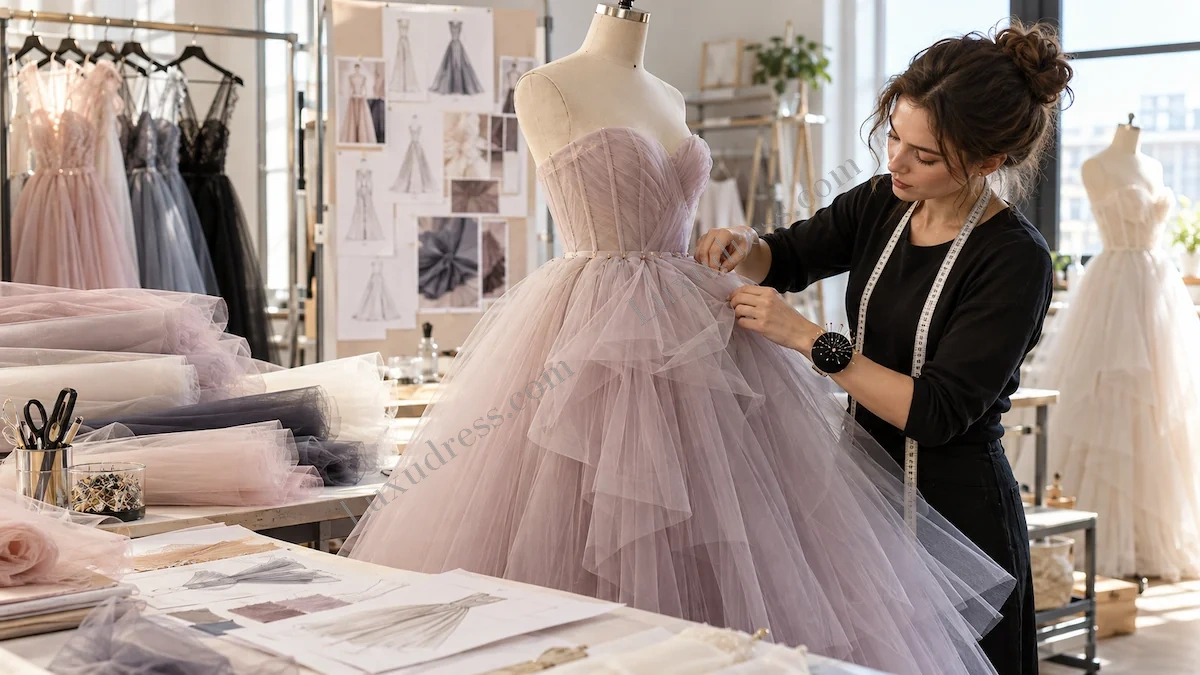
The layer plan is a short table — layer, material, grade, finished length, gathering, hem method — and it should exist before the first costing brief rather than after the first sample. Without it, the costing is done on a silhouette and the construction is decided later, which is the sequence that produces a style that cannot be made at the price it was planned for.
Gathering ratio controls silhouette
The gathering ratio is how much flat fabric goes into one unit of finished width. It is the number that decides whether a skirt reads as a full, dense volume or as a clean vertical fall, and it is almost never written down.
High and low gathering
High gathering packs more fabric into the waist, producing density, strong volume and a shorter effective length as the fabric pulls upward. Low gathering gives a cleaner vertical fall and a more architectural line, and it uses less fabric. Between them sit the ratios that most ball gowns actually use, and the difference between adjacent ratios is visible in the finished skirt — which is why the ratio belongs in the specification as a number rather than as a description of volume.
Gathering at a structured waist
Where the skirt is attached to a corset or a boned bodice, the distribution of the gathered bulk matters more than the total. Bulk concentrated at one point pushes the bodice outward and distorts a panel that was fitted to the body; bulk spread evenly keeps the waist line intact. The practical control is to mark the distribution at the waist rather than relying on an operator to spread it, because the difference between two operators doing the same style can be a visible asymmetry at the front.
Marking and operator consistency
Gathering is hand work, so it repeats only if it is measured. Marking the waist and the skirt into matching sections, and specifying the finished width the gathers must produce, converts a judgement into a check. On a bulk run this is the difference between a skirt that is consistent across the order and one where the fullness varies piece to piece — and the variance is the kind that passes an inspection because every measurement is within tolerance.
Horsehair and edge finishes shape the hem
The hem of a tulle skirt is a construction decision repeated on every layer, and it is where the skirt's movement is decided.
What horsehair does
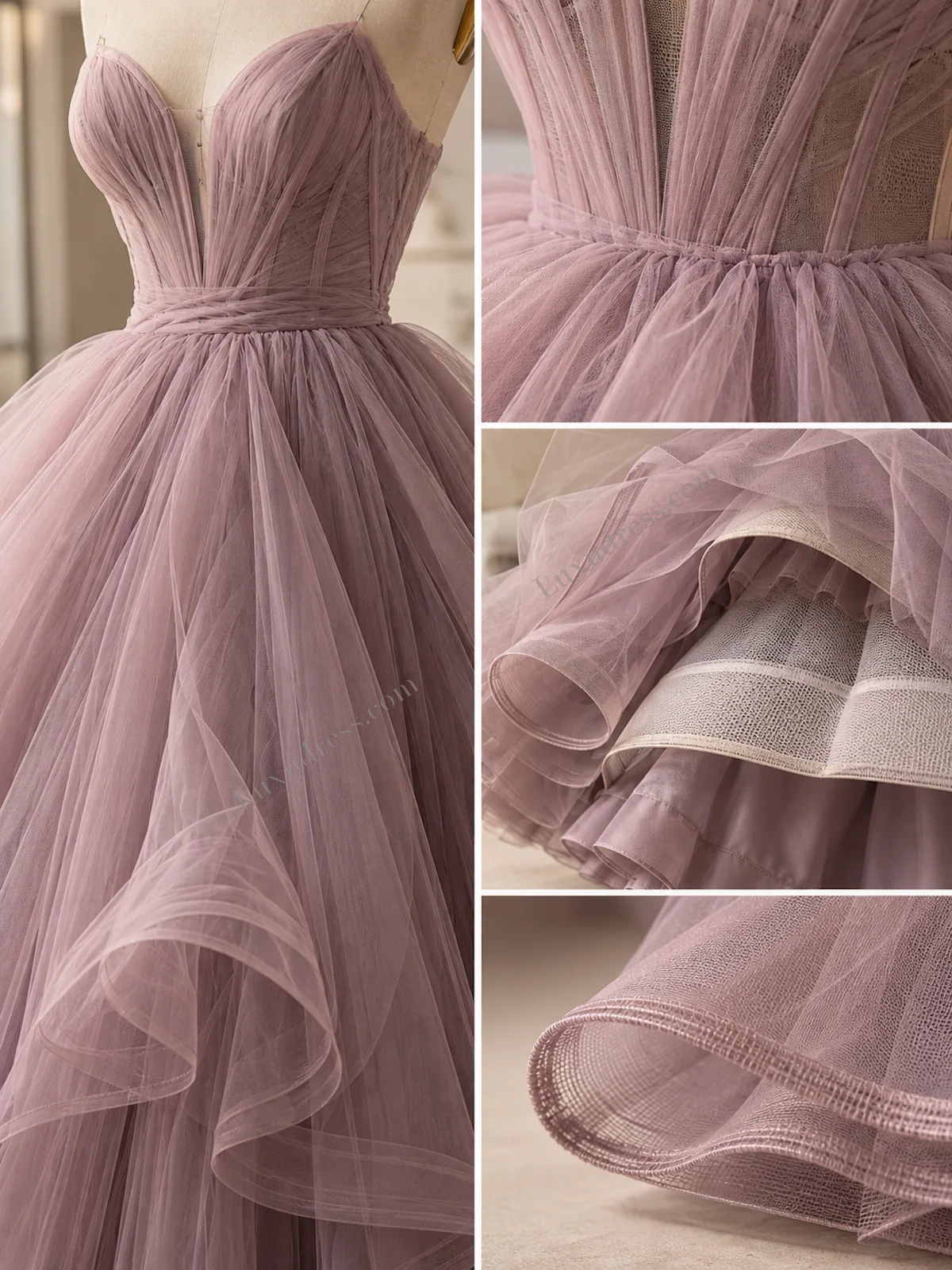
A horsehair braid in a hem holds waves and increases projection. It is the tool that makes a curved hem stand outward instead of curling, and it is what gives certain ball-gown hems their defined, sculpted line. It also adds weight at the very bottom of the skirt, where weight has the most effect on how the garment hangs and how it packs. Horsehair is a design tool for a specific hem behaviour, not a default upgrade: a skirt that does not need projection is made heavier and harder to pack by having it.
Rolled hems and raw edges
A narrow rolled hem softens the edge and lets the layers move more freely, and on multiple layers it is the single largest labour item in the skirt. Raw edges can work aesthetically on a tulle that does not fray, and there are skirts where a cut edge is the correct answer — but a raw edge is a consistency decision as much as a design one, because it has to be clean on every layer and every garment, and it needs to be tested for snagging against the layer beneath it.
Choosing the finish by weight
| Hem method | Suits | What it costs |
|---|---|---|
| Rolled hem, narrow | Soft, fine tulle where a soft edge and free movement matter | The largest single labour item on a multi-layer skirt |
| Horsehair braid | A hem that has to hold waves or project away from the body | Weight at the bottom, plus pressing and packing complexity |
| Bound or faced hem | Heavier tulle on a structured skirt where the edge needs to hold shape | Moderate labour, and a firmer fall at the hem |
| Cut edge | A tulle that does not fray, on a skirt where a crisp line is intended | Low labour, high consistency risk, and a snag test is essential |
Test the edge in movement
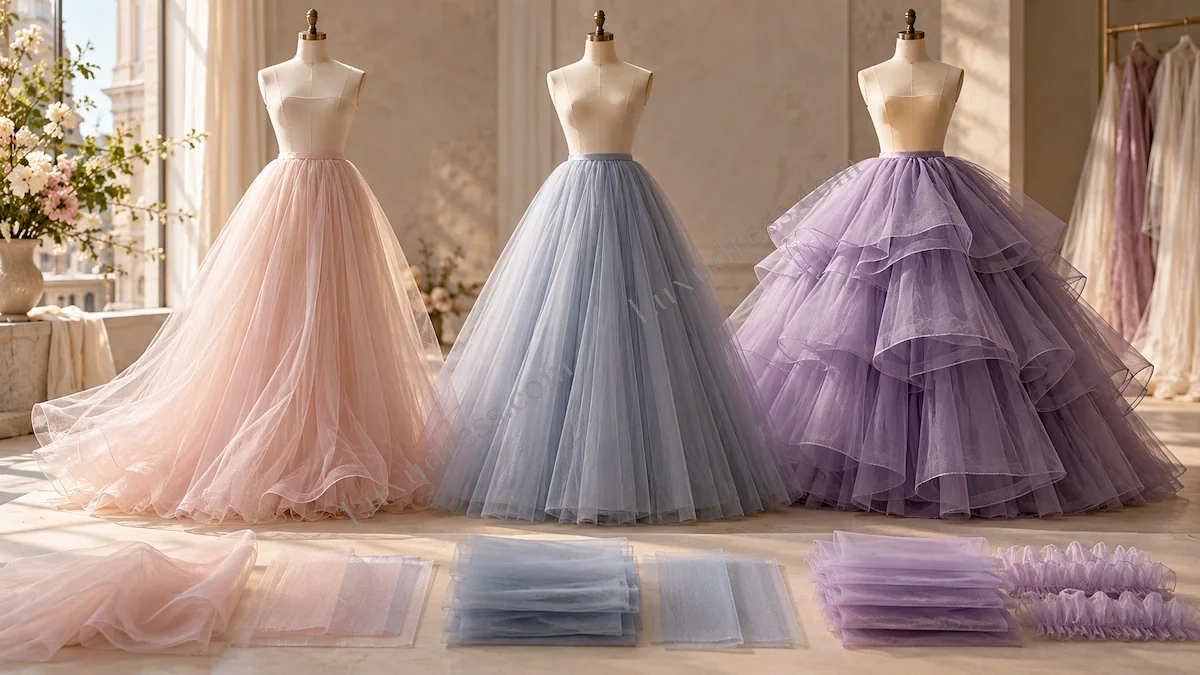
A hem method is confirmed hanging and moving, not flat on a table. The failures worth finding are a horsehair that kinks where the skirt was folded, a rolled hem that has drawn the layer shorter than its neighbour so the stagger has changed, and a cut edge that has snagged against the layer beneath it. All three are invisible in a flat measurement and obvious when the dress is hung.
Colour is an optical result
In a sheer stack the colour of the finished skirt is not the colour of any one component. It is the result of the layers, their number and their order, the lining beneath them and the light the garment is seen in. Approving a swatch therefore approves one input to a result the customer never sees.
Why multiple layers deepen the tone
Each sheer layer removes a proportion of the light passing through it, so adding layers deepens and saturates the final colour. A single layer of a given shade over white lining reads pale; four layers of the same shade read as a solid, deeper colour. This is the mechanism behind most late shade changes in a tulle programme: the swatch was right and the skirt is darker than intended, or the reverse, and nobody costed a layer change at the point the shade was approved.
Contrasting lining shifts perceived colour
The lining is not only an opacity device. A warm-neutral lining under a cool tulle pushes the finished colour warmer than the tulle alone, and a dark lining under a pale tulle produces a muted, deeper result that no swatch on white will predict. Where a brand is trying to hold a specific shade across a range, the lining colour is part of that shade's specification and has to be approved as a pair rather than separately.
Glitter and coating change under flash
A glitter tulle, a coated tulle or one with a metallic finish behaves differently again, because its colour depends partly on reflected rather than transmitted light. Under direct flash it can read brighter, flatter or a different hue from the same fabric under showroom light. Since a large part of prom retail is decided from an image, the test that matters is the one the customer's phone camera performs, and it should be part of the shade approval rather than a discovery on a look book shoot.
- Multiple sheer layers create a deeper final tone than one swatch.
- A contrasting lining shifts the perceived colour of the whole skirt.
- Glitter tulle changes reflectivity under direct flash.
- Approve the complete layer stack, not only the top layer.
Reading the skirt as a load path
Once the stack is written down, the same information answers the question that decides whether the dress is wearable. Every layer's weight travels to the waist seam, and from the waist seam into whatever the bodice contains.
Where the load goes
In a tulle ball gown the skirt can weigh more than the bodice. If the waist seam is the only thing holding it, then the seam is carrying that load through fabric rather than through structure, and the failure it eventually produces is a seam that gives way, a waist that rides down, or a bodice that is pulled out of shape at the front. A waist stay or an internal support that transfers the load to the body is what prevents all three, and its absence is not visible in any flat measurement.
Test it loaded
The test that finds this is cheap: put the finished dress on a form or a fitter, leave it for the length of a real event with the wearer seated for part of that time, and watch the waist line, the waist seam and the shoulder position. A dress that begins to slide or distort within minutes has a load path problem rather than a size problem, and it is a pattern and structure correction rather than an alteration. Our bridesmaid grading guide covers the same problem expressed across a size range, where the load increases and the structure stays the same.
What the layer plan has to specify
This is the document that makes a tulle skirt repeatable, and it is short. Every line exists because leaving it out produces a variance that only appears in bulk.
| Line | What it fixes | What its absence produces |
|---|---|---|
| Per layer: material and grade | Stiffness and hand, by physical reference | A substitute grade that changes the silhouette |
| Per layer: finished length | The stagger and therefore where the weight and colour sit | A skirt that reads heavier at the hem than intended |
| Gathering ratio per layer | Density and effective length | Piece-to-piece variance in fullness |
| Waist distribution marks | Even bulk around a structured waist | Asymmetry at the front and a distorted bodice panel |
| Hem method per layer | Movement, edge quality and labour | A hem that kinks, shortens or snags |
| Underlying lining specification | Opacity and the final perceived colour | A shade that reads differently from the swatch |
| Load transfer | Whether the skirt's weight reaches the body or the seam | A waist that rides down in wear |
Who owns each line
Two of these lines are commercial rather than technical, and they are the two that get left undecided. The grade decision determines cost as well as behaviour and belongs to whoever owns the price architecture; the load-transfer decision determines whether the style can be sold in a full size range and belongs to whoever owns the fit strategy. Assigning them to design by default is how a skirt ends up correct on the sample and unbuildable at the planned cost.
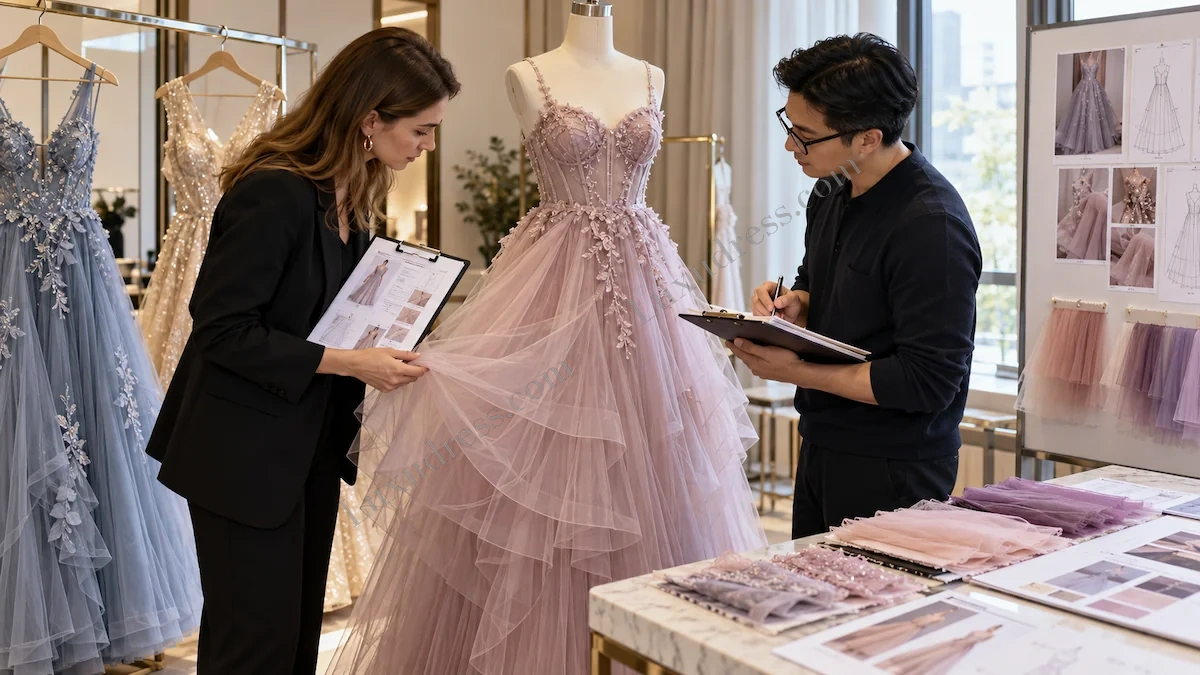
Practical buyer worksheet
Fill this in before the first tulle style is sampled. For a layered skirt the last two lines do the most work: the critical risk on a tulle style is almost always load and hem, and both are settled before production or not at all.
- Target customer and use occasion
- Target retail and wholesale price
- Target ex-factory or landed cost
- Core fabric and backup fabric
- Size range and base fit size
- Colour count and continuity colours
- Critical construction risks
- Approval sample required
- Inspection checkpoints
- Latest acceptable delivery date
FAQ
How many tulle layers are needed?
There is no fixed number, and the reason is that the count is the output of several inputs rather than a specification in itself. The grade's stiffness decides how much volume each layer contributes; the skirt's circumference decides how much area each layer covers; the lining and any underskirt decide how much opacity and structure are already present; and the desired volume decides what is still missing. Two layers of a stiff grade can produce more volume than five of a soft one. The number to write down is the layer plan, not the count.
Can tulle raise MOQ?
It can, and for the same reason as any other material: a custom colour or a specialty finish is bought to a dye-lot or minimum-run quantity rather than off the shelf, and tulle consumes a large area per garment, which converts metres into pieces quickly. A stock shade on a standard grade carries no such minimum. Where a range needs a bespoke tulle shade, the useful approach is to concentrate it on the styles that carry the collection and use stock shades on the rest, rather than spreading one custom lot thinly across the whole range.
Why do tulle skirts look uneven?
Because several independent causes produce a similar appearance, and the diagnosis has to separate them. Layer lengths that were meant to be staggered and were instead cut straight produce a thin patch; gathering that was distributed unevenly produces a dense side and a sparse one; a layer that stretched during handling hangs longer than its neighbour; and a waist attachment that pulled one section tighter tilts the whole skirt. Each has a different correction, which is why the layer plan records finished lengths and waist distribution marks rather than describing the skirt as a whole.
Is horsehair always needed?
No, and adding it where it is not needed makes a garment heavier, harder to press and harder to pack. Horsehair is the right answer when a hem has to hold a wave, project away from the body, or keep a curved edge from curling. Where the intended hem behaviour is soft movement, a rolled or bound finish delivers it with less weight and less pressing risk. The decision follows from what the hem is supposed to do, which is worth writing into the plan rather than leaving to be rediscovered on the sample.
Next step
We develop and produce prom, gala and ball-gown styles at our production facilities in Guangzhou and Dongguan, including layered tulle skirts, grade-matched layer stacks, gathering control at a structured waist, horsehair and rolled hem work, load-transfer structure inside the bodice, and physical approval of each layer's grade. Send the silhouette you are aiming at and the volume you have in mind, and we will come back with a layer plan and a construction route rather than a fabric list. Request a quote, or see the constructions we run on our prom dress manufacturing page.
Our fabric guide covers the material properties that sit upstream of this, and our prom dress grading guide covers what happens to a layered skirt as it is graded across a size run. Silhouettes already in production are on our style library and ready stock pages, and the wider category is on the women's dresses page.