On this page
- Start by aligning the cost basis: EXW, FOB, DDP
- Scenario A: one style, 200 pieces, fast reorders, design-heavy
- Scenario B: one style, 2,000 pieces, price-sensitive, weak seasonality
- Scenario C: strong compliance or strong IP-protection needs
- When not to choose us
- A real landed-cost worked example
- Risk comparison: China vs domestic
- The hybrid model: overseas sampling, local replenishment
- The decision tree

The question arrives loaded with feeling. A buyer tells us they want to keep production local, or they tell us they are worried about shipping everything from China. Both statements are about something other than cost. They are about control, about carbon, about a story the founder wants to tell investors, about a promise printed on the swing tag.
Those things are real. They are also separate from whether the order pencils out. The choice between a domestic manufacturer and a production facility in Guangzhou or Dongguan is an arithmetic problem before it is anything else. If the numbers do not work at the unit price you need to hit, the story does not matter, because there is no product to tell it with. A brand that cannot afford its first run does not get a second one.
So this article sets the feeling aside. We walk through what each side actually costs, build three concrete buyer scenarios, and then tell you plainly when you should not work with us. The last part is the one most factories will not write, and it is the part that should earn the rest of this piece your trust. Read it before the tables, if you like. The honesty is the point.
Start by aligning the cost basis: EXW, FOB, DDP
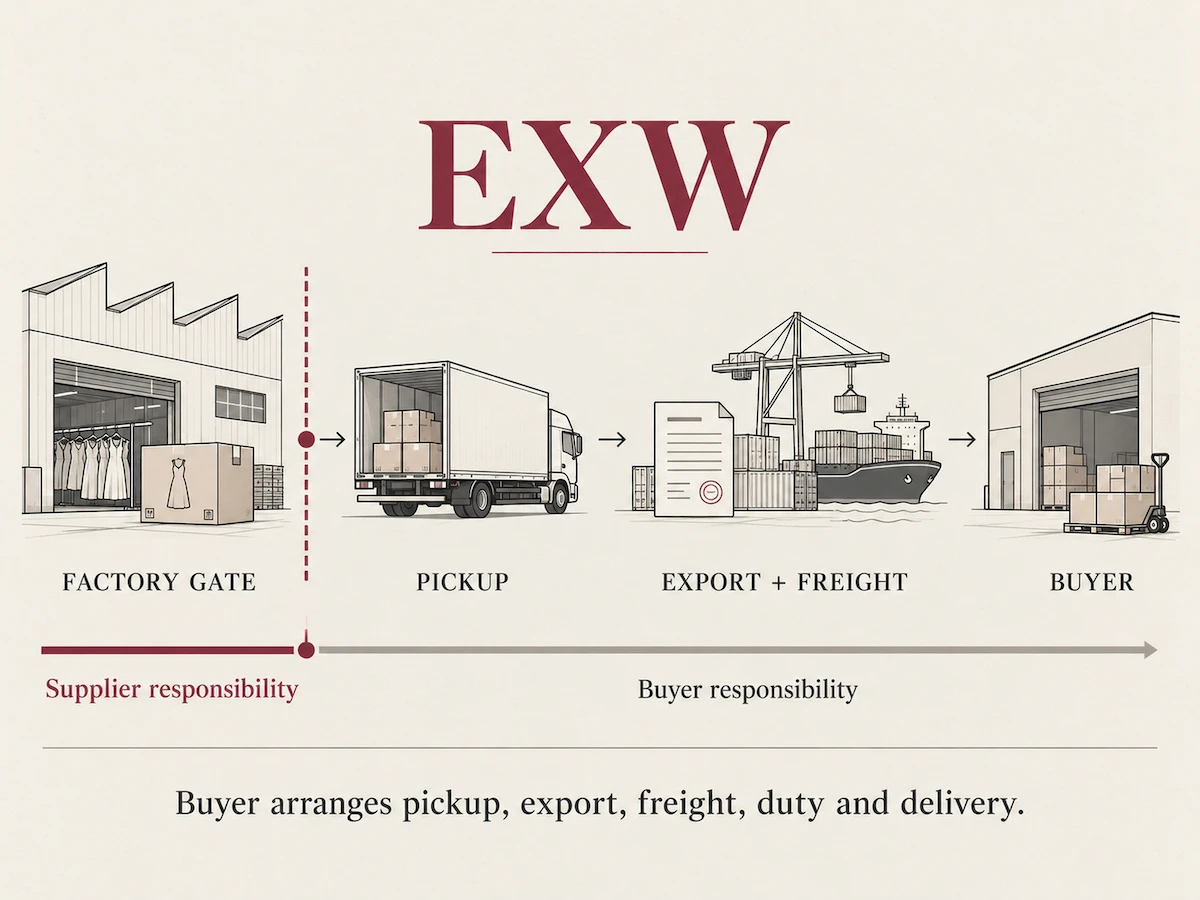
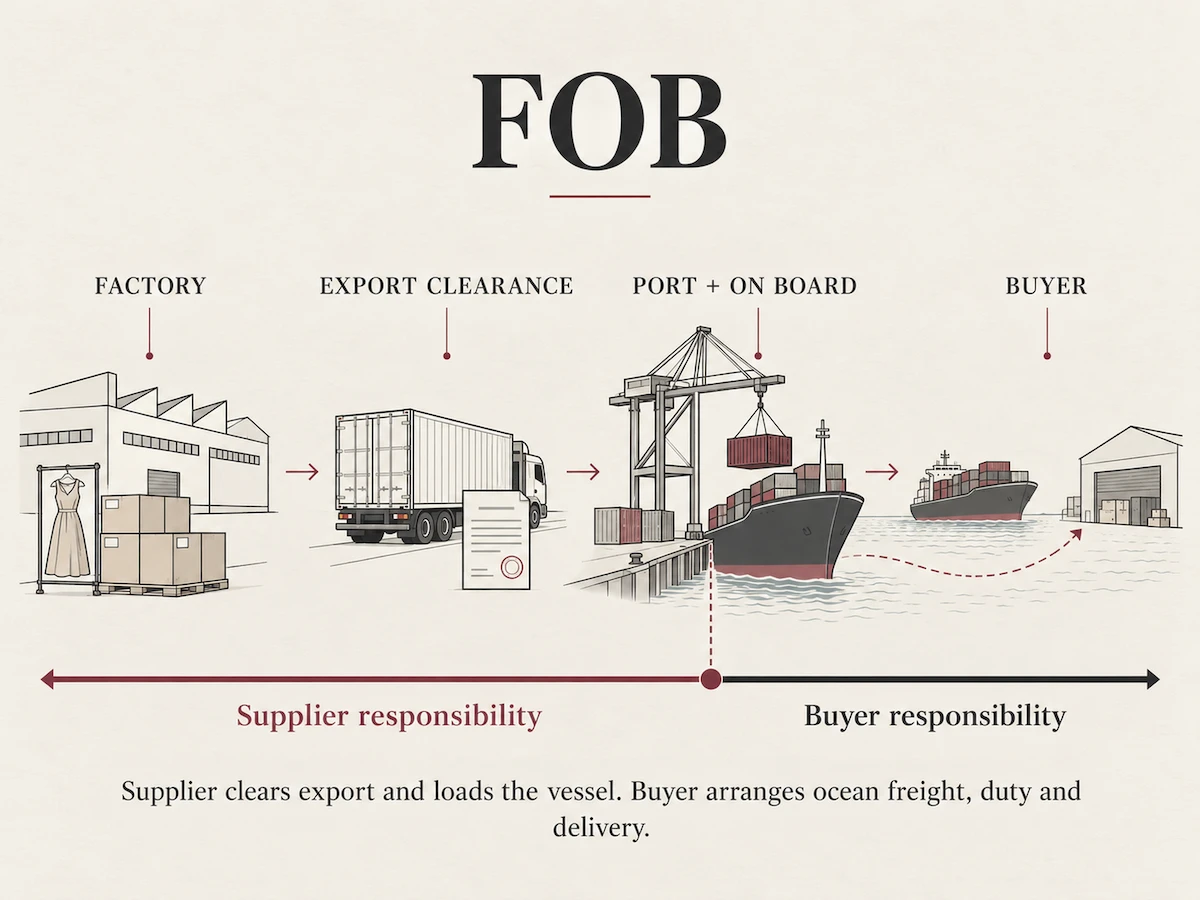
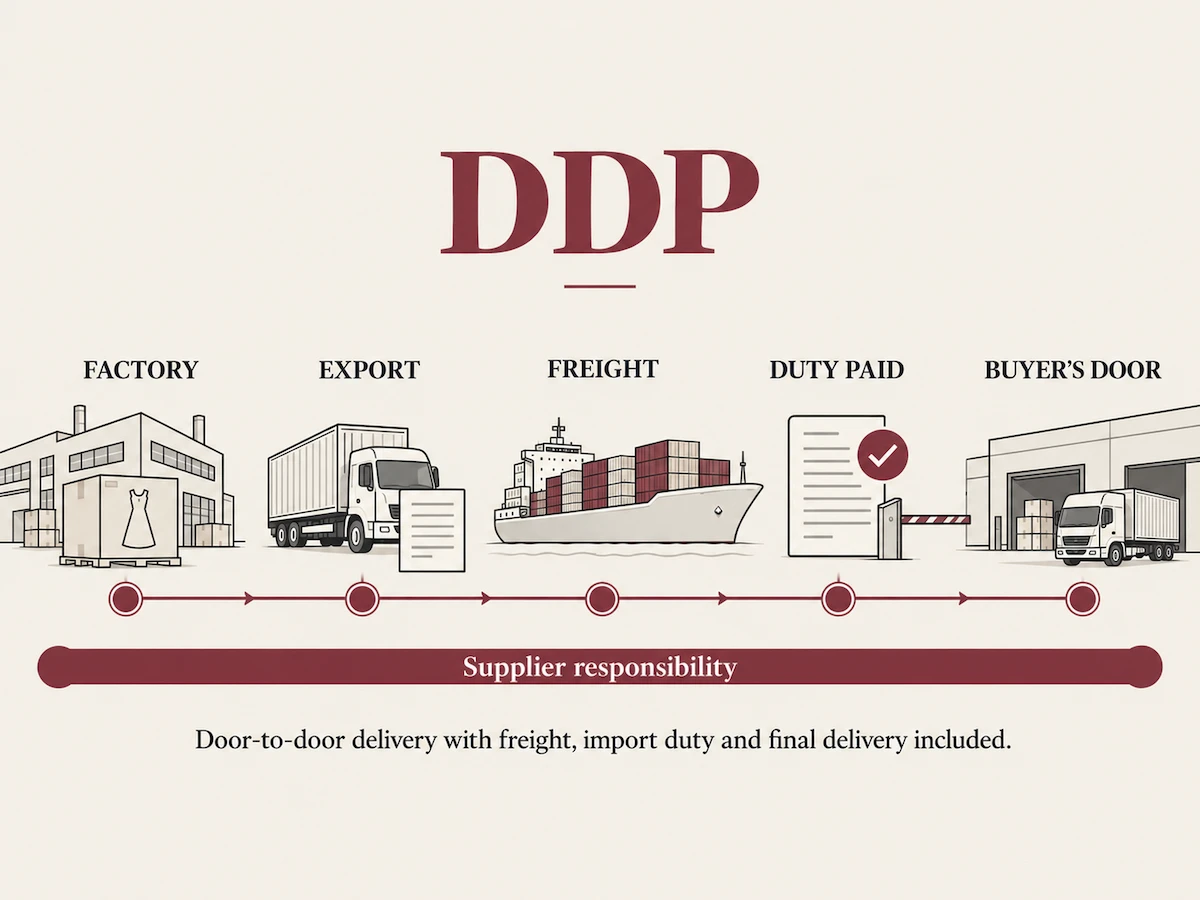
Before any comparison means anything, the two quotes have to be expressed in the same terms. A domestic factory quotes you a price that already includes labour, overhead, and packing, and you collect the goods from their dock. A China quote can arrive in three different shapes, and most buyers compare the wrong pair. This is the single most common error we see in a buyer's spreadsheet, and it flips the answer.
Here is what each term contains, and what each one leaves for you to pay.
| Term | What is included | What you still pay for |
|---|---|---|
| EXW (ex-works) | Garment, trims, labour, factory overhead, packing | Everything else: trucking to port, ocean or air freight, insurance, import duty, last-mile delivery to your warehouse |
| FOB (free on board) | EXW scope plus inland China trucking and loading onto the vessel at the named port (Guangzhou or Shenzhen) | Ocean or air freight, marine insurance, destination handling, import duty, last-mile |
| DDP (delivered duty paid) | EXW scope plus all freight, insurance, and import duty to your nominated address | Nothing, provided the address and the volume were exactly as quoted |
The trap is comparing an EXW China number against a delivered domestic number. The China EXW price looks like half the cost it actually is, because it omits every dollar between the factory floor and your warehouse. That is the number that wins the beauty contest and loses the budget. Conversely, a DDP China quote can look scary next to a domestic ex-works quote, when in fact the DDP quote already carries the freight and duty the domestic quote left off your desk and pushed into a later line you forgot to add.
We quote EXW, FOB and DDP, and we send all three for the same order so the comparison is honest. Most of our international buyers buy FOB and arrange their own freight forwarder, or buy DDP when they do not want to touch customs. Either is fine. The only version that is not fine is a comparison where one side has freight and the other does not. Match the basis, then subtract.
Scenario A: one style, 200 pieces, fast reorders, design-heavy
This is the most common profile we see from a new DTC label or a boutique buyer. One hero dress, a small first run to test the market, a plan to reorder within the season if it sells, and a cut that needs real development because it is the reason the brand exists. The dress is the brand, so the fit has to be right and the first batch has to be affordable enough that a miss does not sink the company.
At 200 pieces the China side wins on unit cost by a wide margin, and the margin matters more than usual here because the brand is still proving the product. Using the lined woven midi from our costed example, the ex-works price is USD 35.50 at our Guangzhou or Dongguan lines. Add FOB freight and duty and the landed cost lands near USD 44.00. A comparable domestic run of the same dress, quoted on the same construction, comes in around USD 82.00 TBC on a delivered basis, because local labour rates and smaller-batch overhead sit on every unit and do not spread the way they do at volume.
| Scenario A: one style, 200 pcs | China (FOB, landed) | Domestic (delivered) |
|---|---|---|
| Unit cost basis | USD 44.00 | USD 82.00 TBC |
| Total goods cost | USD 8,800 | USD 16,400 TBC |
| Sampling lead time | 7 to 10 days | 10 to 14 days TBC |
| Bulk lead time, off season | 15 to 20 days | 12 to 18 days TBC |
| Reorder flexibility | Strong, 100 pcs MOQ | Weak, often 300 to 500 pcs minimum TBC |
| Fit iteration | Remote, via sealed sample | In-person, same time zone |
The arithmetic is clear. The China route saves roughly USD 7,600 on the first run, which is working capital a startup can spend on photography, a Shopify build, or a second style. The domestic route gives you a shorter lead time and easier in-person fittings, but at a cost that may price the test run out of existence before it starts. For a founder deciding whether the brand is viable at all, that USD 7,600 is often the difference between two styles in market and one style half-funded.
Where the domestic option earns its keep is the fitting loop. If this dress needs three in-person fittings across six weeks because the founder is iterating the drape by hand, the flights to Guangzhou and the lag while the sealed sample ships back and forth may outweigh the saving. That is a real trade, and we address it directly in the hybrid section below. We are not pretending the distance is free.
Scenario B: one style, 2,000 pieces, price-sensitive, weak seasonality
Now the volume changes the maths. At 2,000 pieces the fixed costs that hurt at 200 pieces have spread thin, and the unit price gap between China and a domestic maker narrows as a percentage even though it stays wide in absolute terms. This buyer is price-sensitive and does not care about season, which means they can plan production into our off-season window and skip air freight entirely. Weak seasonality is an asset when your factory runs two shifts whether or not the calendar says peak.
| Scenario B: one style, 2,000 pcs | China (FOB, landed) | Domestic (delivered) |
|---|---|---|
| Unit cost basis | USD 33.50 TBC | USD 74.00 TBC |
| Total goods cost | USD 67,000 TBC | USD 148,000 TBC |
| Freight mode available | Sea, off-season | Local truck |
| Bulk lead time | 15 to 20 days off season | 18 to 25 days TBC |
| Duty exposure | Yes, per HTS classification | None |
| Inventory carrying | Must carry stock | Can top up locally |
At this volume the China saving is about USD 81,000 TBC. That is real money even for an established brand, enough to fund a season of paid acquisition or a warehouse month. The domestic route still has two advantages the table does not fully capture. First, no import duty, which on a women's woven dress can be nine to twelve per cent depending on the destination market, so the true domestic edge over the landed China number is a little smaller than the raw unit gap suggests. Second, no ocean lead time, so a forecast error can be corrected with a local top-up order in days rather than weeks.
But the price-sensitive buyer in scenario B is usually right to choose China, provided they can carry inventory. With 2,000 pieces the per-unit freight is small, the off-season timing removes the peak-season surcharge, and the fixed-cost spread has done its work. We run this profile constantly through our production facilities in Guangzhou and Dongguan, and the 260 styles in our ready-stock programme exist precisely for buyers who want the unit price without the development wait. The ready-stock hub carries real RMB pricing on file, which removes the sampling step entirely for a reorder or a fast launch. A buyer who knows their bestseller can have it in cartons without a 7 to 10 day sample round.
Scenario C: strong compliance or strong IP-protection needs
Some buyers are not buying a dress. They are buying a clean audit trail and a sealed sample they can show a retailer's compliance team. This is common with buying offices supplying department stores, or with brands whose design is the asset and must not leave the building. The dress is a byproduct of the paperwork.
On compliance we hold ISO 9001 for quality management, OEKO-TEX STANDARD 100 for material safety, and we are amfori BSCI-audited with SGS-conducted inspections on finished goods. Those four credentials answer most retail compliance questionnaires without further paperwork, and they travel across a border without losing meaning. A domestic maker will often match or exceed them locally, and in some markets a local certificate is simply what the buyer's compliance team will accept without a fight. We do not pretend our certs substitute for a certificate your regulator will only recognise if it is issued at home.
On IP protection the answer is more nuanced. We protect patterns and sealed samples under standard OEM confidentiality, and we do not produce a buyer's exclusive design for any other customer. That is normal practice on both sides of the trade. The difference is geography. If your IP counsel wants a contract governed by your own jurisdiction, enforced locally, with discovery that happens in your language, a domestic supplier is the lower-risk choice. Cross-border enforcement is possible, but it is slower and it costs legal fees a small brand may not want to carry while also paying for the next collection.
So for scenario C the honest call is mixed. If you need the certificates and the inspection record, we clear the bar and the freight does not undermine them. If you need the contract and the recourse to live in your own backyard, domestic is the safer seat, and no unit-price argument should talk you out of it.
When not to choose us
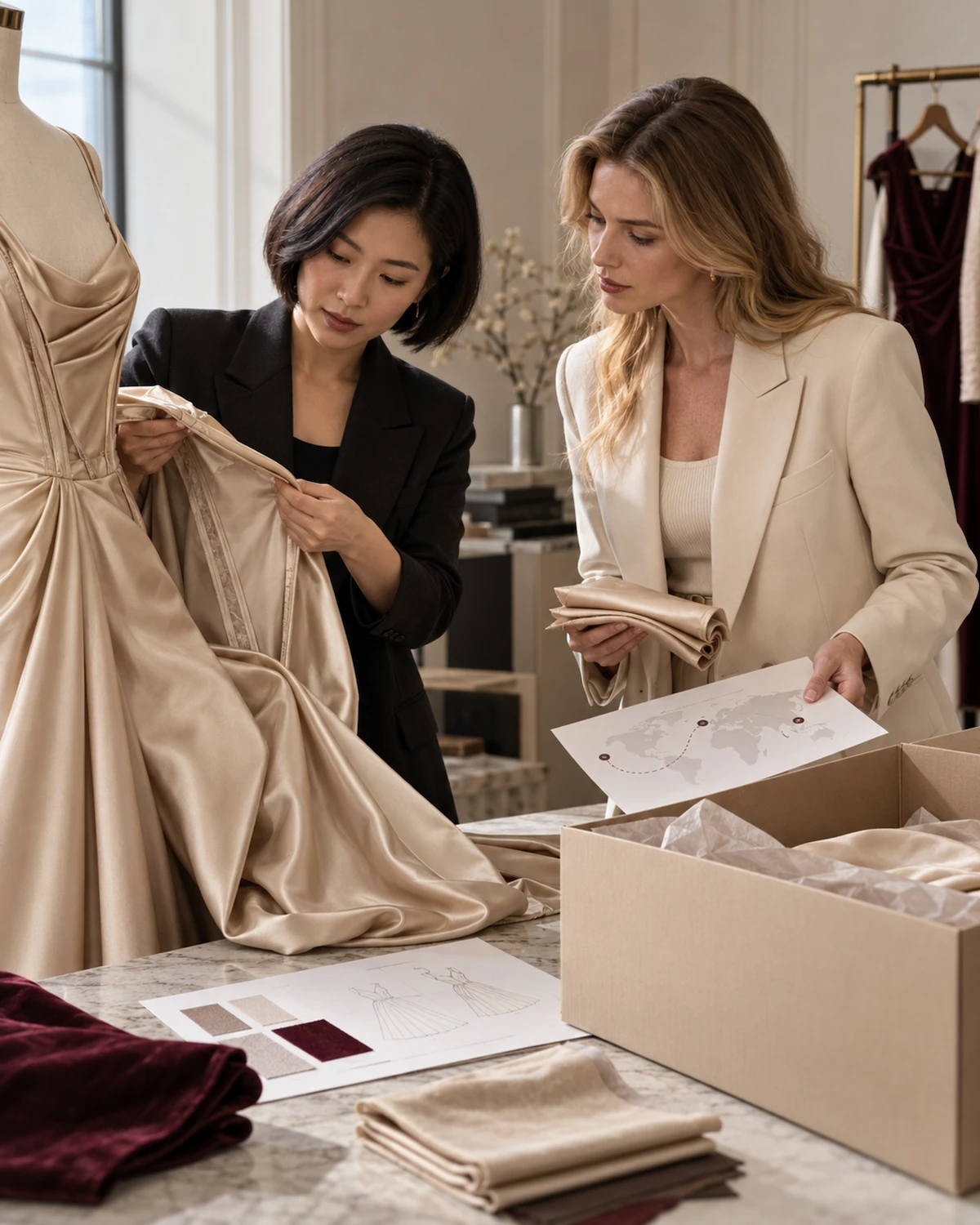
This is the section we could leave out and no one would notice. We are leaving it in, because the buyers who read this far are the ones spending real money, and they deserve the straight version. A factory that only ever tells you to place the order is a factory that does not expect you to reorder.
There are three situations where you should not send the order to Guangzhou or Dongguan, and we will say so plainly. These are not hedge statements. Pick the one that fits and act on it.
First, very high unit-price, tiny batches. If you are making a USD 400 dress in a run of forty pieces, the freight, the duty, and the sampling amortisation per unit erase the Chinese labour advantage before you finish the spreadsheet. A domestic atelier charging a high rate on forty pieces will beat us on total cost once you add the landed maths, and it will beat us badly on the fitting loop, because the atelier is down the road. We have a 100 pieces per design minimum, with 100 to 200 per colour depending on the fabric and whether it is dyed to order, and below that threshold the order does not belong on our lines. Do not shrink your run to hit our MOQ. Find a local maker who lives in that band and thank them for it.
Second, frequent on-site fitting changes. Some products are developed by standing in the room while the pattern is cut. Bridal, extreme couture, and certain structured tailoring fall here, where the difference between right and wrong is a quarter inch the founder feels rather than measures. If your development cycle needs you physically at the machine more than once a week, the flight cost and the lag will dominate every unit-price saving we could show you. A domestic or near-shore partner is the correct choice, full stop. We are not the right floor for that work and we would be wasting your season to pretend otherwise.
Third, a requirement for 100 percent local compliance paperwork. If your retailer or your regulator will only accept certificates issued by bodies in your own country, in your own language, with local audit rights, then no amount of our ISO 9001 or amfori BSCI standing helps you at the door. We can supply OEKO-TEX STANDARD 100 and SGS inspection records, and those carry weight, but we cannot issue your local certificate and we will not tell you otherwise. Buy where the paper is valid, or the goods will sit in a warehouse while the documents are argued over.
There is a fourth, softer case worth naming. If your whole brand story is made locally and that claim is what your customer pays for, then the unit saving is irrelevant and we should not be in the conversation at all. That is not a cost failure. It is a different product with a different cost logic, and the honest move is to make it where the story is true.
A real landed-cost worked example
Numbers earn trust. Here is a full landed-cost build for a 500-piece order of the lined woven midi, bought DDP to a warehouse on the US East Coast. We use the same dress B from our costed article so the figures are consistent with what we publish elsewhere, and so a reader who has seen that piece can check us.
| Landed-cost line | Basis | Amount (USD) |
|---|---|---|
| Ex-works price | 500 pcs at USD 35.50 | 17,750 |
| Inland China trucking to port | flat per shipment | 320 |
| Ocean freight, LCL to NY | per cubic metre, TBC | 1,150 |
| Marine insurance | 0.3 percent of goods value | 53 |
| US import duty (HTS 6104, TBC) | 9.5 percent of goods value | 1,686 |
| Customs broker and destination handling | flat per shipment | 240 |
| Last-mile trucking to warehouse | flat per shipment | 180 |
| Total landed cost | 21,379 | |
| Landed unit cost | total divided by 500 | 42.76 |
Read that table against the domestic delivered quote for the same dress, around USD 82.00 TBC per unit, and the gap is about USD 19.60 a garment, or USD 9,800 across the run. That difference is your margin, your marketing budget, or your second style. It is not a rounding error. It is the reason the China question keeps coming up in every sourcing group.
Two lines in that table deserve a word before you trust them. Duty is shown at 9.5 percent TBC because the rate depends on the exact HTS classification and the destination, and we always confirm the number with your broker before you commit, because a wrong classification is a fine waiting to happen. Ocean freight is marked TBC because LCL rates move with the container market, and we quote them live at order time rather than guessing, because a guessed freight number is the first thing that breaks a budget. Everything else is fixed enough to plan against.
The reason we show DDP rather than FOB here is simple. If you are reading this article to decide where to make your dress, you need the number that lands at your door, not the number that lands at a Chinese port. FOB hides the back half of the cost, the half that surprises buyers at the dock. The whole point of the exercise is to make the back half visible, so the comparison is real and the decision is yours for the right reasons.
Risk comparison: China vs domestic
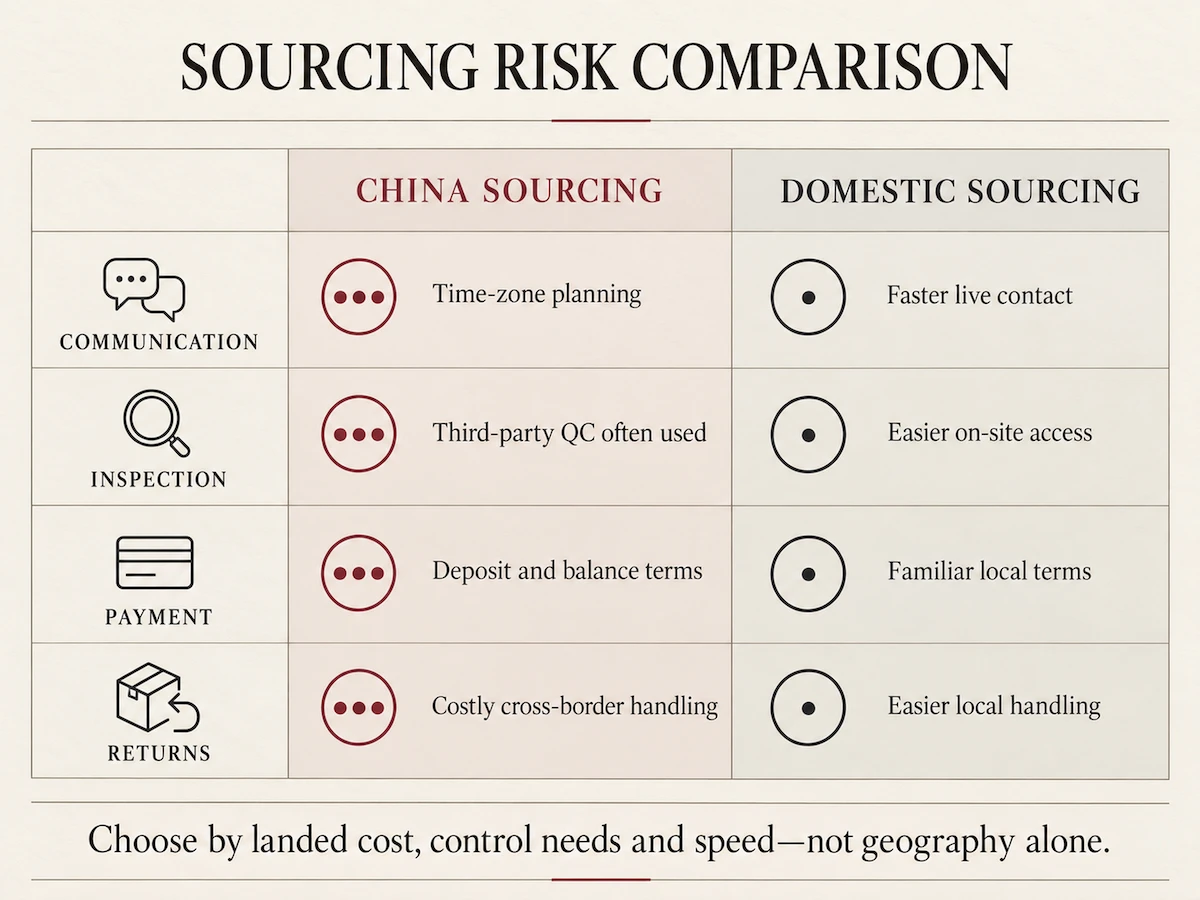
Cost is only half the decision. The other half is what goes wrong and who catches it. Buyers lose money far more often on a late shipment or a missed defect than on a per-unit price difference, because the price difference is known in advance and the failure is not. A cheap dress that arrives late for the season is the most expensive dress you bought.
| Risk area | China (Guangzhou / Dongguan) | Domestic |
|---|---|---|
| Communication | Time-zone gap, email and video calls, 24-hour quote turnaround | Same time zone, same language, faster iteration |
| Inspection | Inline and final inspection, SGS-conducted checks, sealed sample retained | Same-day access, you can be present at the line |
| Payment terms | Typically 30 percent deposit, 70 percent before shipment or against B/L | Often net-30 or milestone-based after first run |
| Returns and defects | Return freight is the buyer's cost, long loop, resewing crosses an ocean | Short loop, local repair or re-cut practical |
The communication row is where domestic wins outright for some buyers. We return quotes within 24 hours with a complete brief, and we run inline inspection so defects surface while the line is running rather than after 500 units are sealed in cartons. But you cannot stand at the machine in Guangzhou the way you can in a local shop, and for a buyer still finding their fit that distance is a real cost that no email bridge removes.
The payment-terms row favours domestic on paper, yet it is the one most often misunderstood. A 30 percent deposit against a USD 21,000 order is USD 6,300 tied up before cloth is cut. A domestic net-30 after delivery removes that pressure but usually sits inside a higher unit price. The two trade against each other, and which is better depends on your cashflow, not your patriotism. A brand with a tight runway may prefer the higher unit price and the later payment, and that is a rational choice the spreadsheet should respect.
The returns row is the one that ends friendships. A defect found after delivery from China means freight back across an ocean, or a local repair you pay for twice, once to the domestic tailor and once in lost time. A domestic defect is a courier ride and a same-week fix. If your defect rate is high because you are still learning the product, domestic risk is cheaper to absorb even at a higher unit cost, because the cost of being wrong is small and local rather than large and far away.
The hybrid model: overseas sampling, local replenishment
Most buyers frame this as either-or. It rarely needs to be. The pattern that works for a lot of the brands we supply is development and first bulk in China, then replenishment or final assembly close to the customer. This is not a compromise born of indecision. It is the structure that captures the China price on the units that matter and the local speed on the units that are urgent.
You develop the pattern with us. Sampling runs 7 to 10 days at our production facilities in Guangzhou and Dongguan, and because we hold 260 ready-stock styles with real RMB pricing, you can validate a silhouette against an existing sample before committing to a full development cycle. The first bulk order runs in China at the unit price the arithmetic above supports, with the pre-production sample sealed and retained so everyone agrees what was approved.
Then, for the reorder, you have two honest options. You can reorder from us at the same low unit cost, accepting the ocean lead time, which suits the price-sensitive buyer in scenario B and most Amazon sellers managing a forecast. Or, if speed to shelf matters more than unit cost, you take the sealed sample and the graded pattern to a local maker for top-up runs. The pattern already exists, the fit is already approved, and the local maker is no longer doing expensive development. They are executing a known garment, which is the work they are good at and cheap at, because grading and marker are done and the sealed sample settles every argument.
This hybrid removes the worst of both sides. You get the Chinese unit price on the volume that matters, and you get local speed on the volume that is urgent, and you never pay for development twice. The only cost is discipline: do not change the pattern between the China bulk and the local top-up, or you have two different dresses and a returns problem that no hybrid can fix. A sealed sample is only useful if you treat it as the law.
The decision tree
Use this to place yourself before you send a brief. It is shorter than the article and it is the part to screenshot.
If your run is below 100 pieces per design, buy local. The maths and our minimum both say so, and the freight will eat you.
If your run is 100 to 500 pieces and you can carry a 15 to 25 day lead time, buy from Guangzhou or Dongguan and keep the working capital for the next style.
If your run is above 1,000 pieces and price-sensitive, buy from us on an off-season window and use the ready-stock programme where it fits your bestseller.
If your product needs weekly in-person fittings or a local compliance certificate, buy domestic and stop calculating the China saving, because it will not survive contact with your real constraints.
If you need both low unit cost and fast local top-ups, run the hybrid: develop and bulk with us, replenish locally against the sealed sample.
Send us the six things we need and we will tell you within 24 hours which of these you are actually in, and what the landed number looks like for your dress.
Related reading
- Three Dresses, Costed: What a Factory Actually Charges For
- How MOQ is calculated in clothing manufacturing
- How to find a clothing manufacturer
Ready to get a landed-cost number for your style? Send us your tech pack or reference images and we will come back within twenty-four hours with EXW, FOB and DDP quoted side by side.