On this page
- What laying is, and why it decides your cost
- Six silhouettes, side by side
- Why bias cut eats the most fabric
- Stripe matching and directional print wastage
- Lined versus unlined, the hidden cost
- How consumption data sets the quote and the MOQ
- How to save fabric without changing the design
- What this means for your first order
- Three things to tell your factory
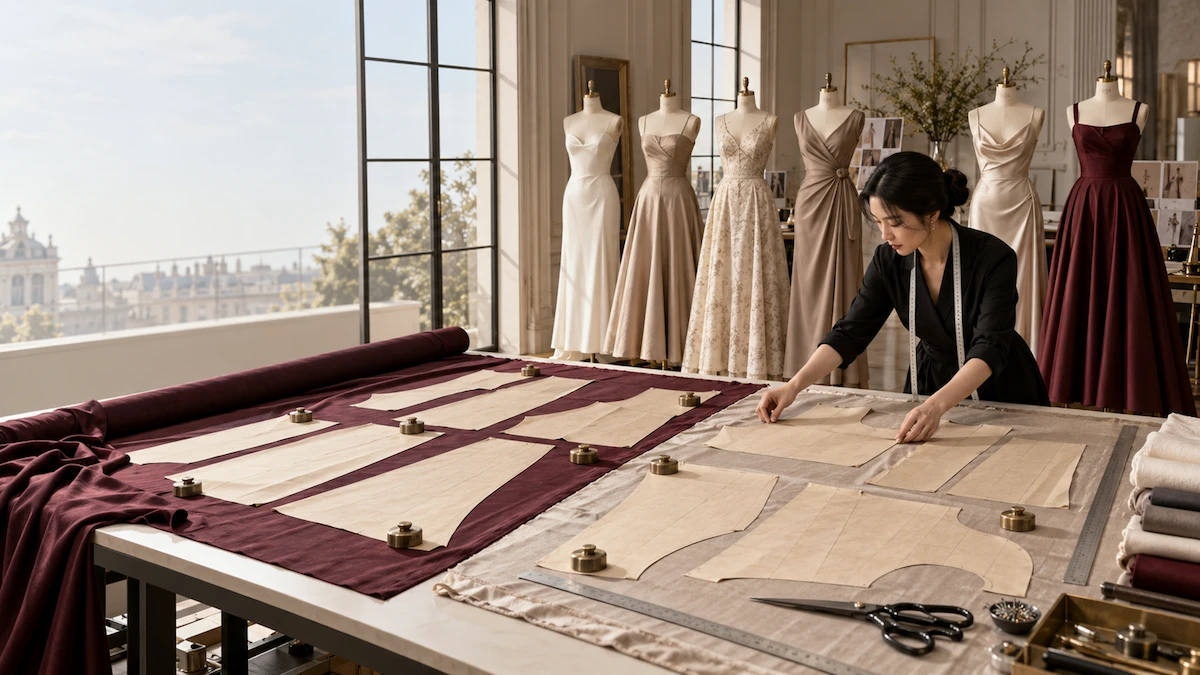
Two buyers once sent us nearly identical briefs. Same length, same size range, same viscose crepe, one colour each. One ordered a straight column dress. The other ordered a full swing dress with the same hem length on paper. The column dress came in at 1.40 metres of fabric per piece on our 145cm marker. The swing dress came in at 2.30 metres. That is a sixty-four per cent difference for a garment that looks, to a buyer who has not seen a lay plan, like the same idea in a different shape.
The gap is not rare. Across the styles we run through our production facilities in Guangzhou and Dongguan, the fabric meterage for one midi dress length can swing by around forty per cent from the leanest silhouette to the widest before we add a single complication like a print or a lining. Most of that difference is decided the moment the pattern is laid on the cloth, long before a machine is switched on. This article explains where the metres go, what a lay plan actually is, and why the silhouette you choose quietly sets your price, your minimum, and your delivery date.
What laying is, and why it decides your cost
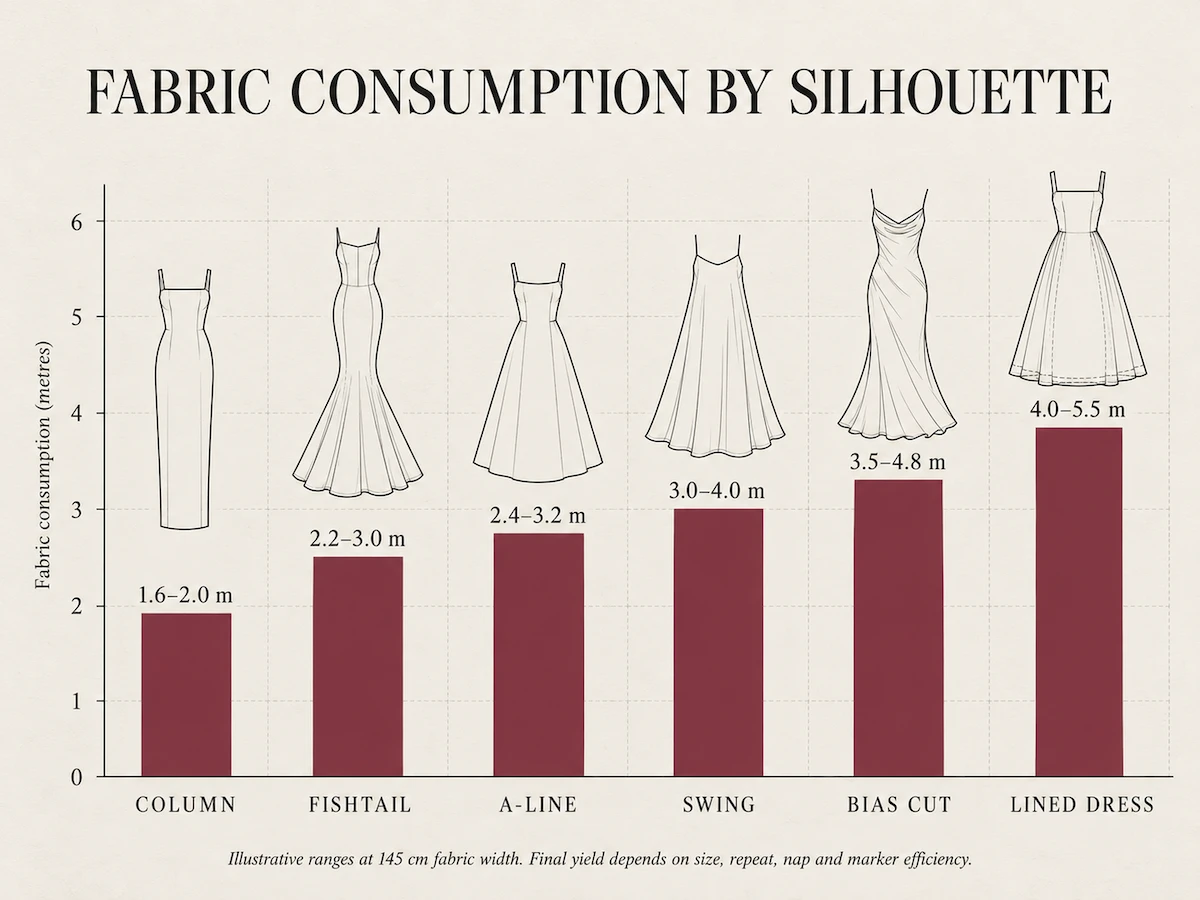
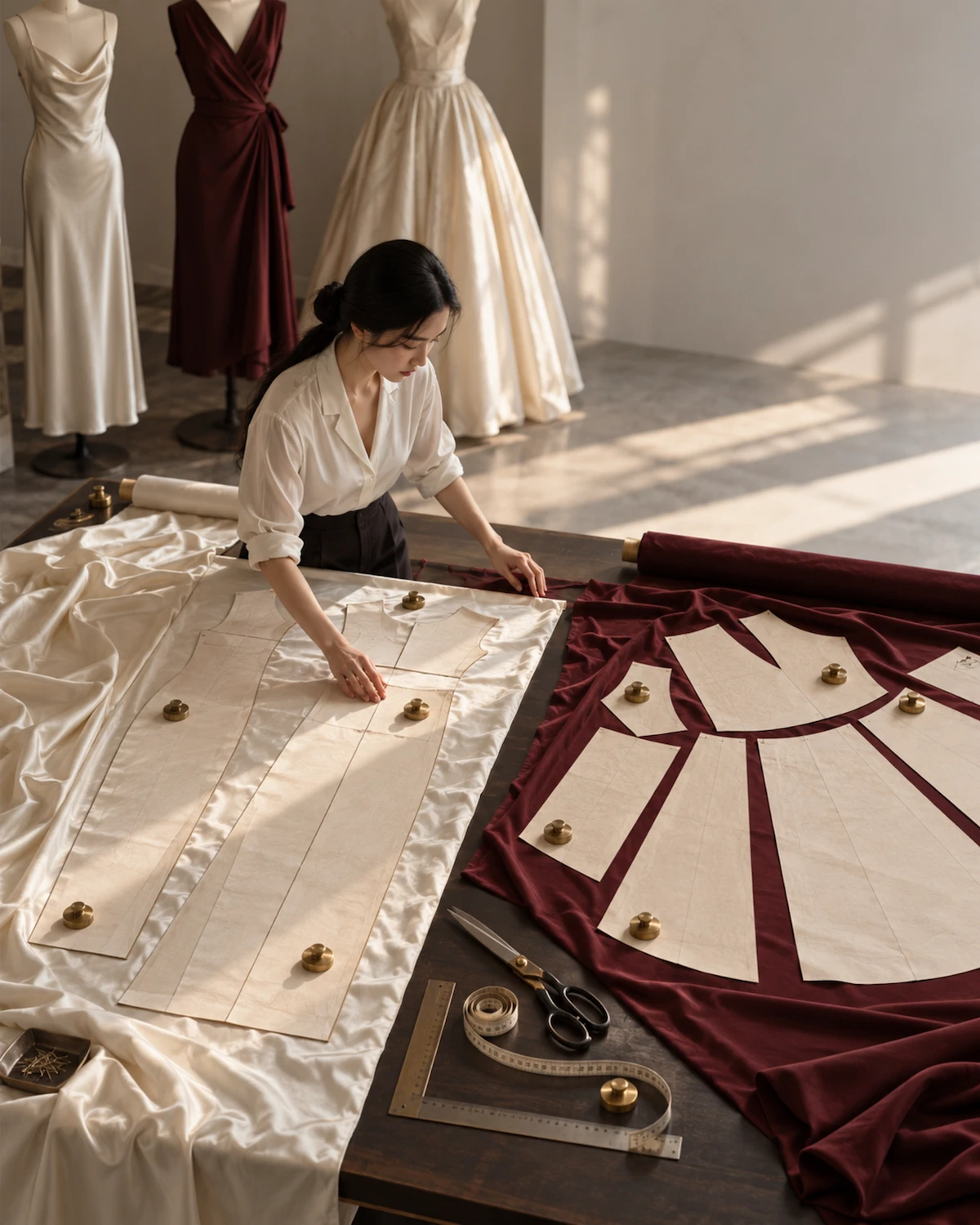
A lay plan is what the factory calls the marker. The marker is the map of every pattern piece for your size run, drawn and nested onto the full width of the fabric. The cutter does not cut one dress at a time. We spread the cloth in a long flat layer, sometimes a hundred plies deep, and the cutting knife follows the marker once through the whole stack. One pass. One marker. Everything you will ever know about fabric efficiency sits in that drawing.
Three things in the marker decide how many metres a style burns.
The first is fabric width. Most woven dress fabrics we buy arrive at either 145cm or 110cm usable width after we account for the selvedge. A 145cm cloth is not just thirty-two per cent wider on paper. Because pattern pieces are rectangular-ish and the waste lands at the ends and edges, the real saving is closer to twenty-five per cent fewer metres on a 145cm marker than on a 110cm one for the same dress. We will show the numbers below.
The second is the shape of the pieces. A straight column dress has long, narrow panels that pack tightly side by side. A swing dress has a hem circumference that is two or three times the waist, which means wide panels and curved edges that leave cloth in the gaps between them. The fabric between pieces is offcut. Offcut is not free. We pay for it by the metre and it goes to waste, so the metre count you are quoted already carries every gap the marker could not fill.
The third is directionality. Some fabrics have a one-way nap, a one-way print, or a stripe that must run the same way on every piece. Directionality forces the marker to lay every piece pointing the same direction, which kills the interlock packing you get when a left panel and a right panel nest face to face. When a fabric is directional, the marker often cannot turn pieces to fill the gaps, and consumption jumps. A non-directional solid colour is the cheapest possible lay. A directional print is the most expensive, and stripe matching sits in between but closer to the top.
None of this is abstract. We build the marker on a computer now, but the logic is the same as the cardboard pattern cards our cutters used thirty years ago. The planner sets the fabric width, drops in every size from the grade, and lets the nesting software rotate and slide pieces to close the gaps. Then a human walks the result, because software will happily leave a usable rectangle of cloth between two curved hems and call it efficient. That rectangle is offcut, and offcut is the number we are always fighting. On a swing dress the offcut after a good nest can still be a fifth of the lay. On a column dress a careful planner gets it under eight per cent.
Ply height matters too. A lay is not one dress laid flat. It is the cloth spread in many layers, sometimes sixty, sometimes one hundred plies deep for a big run, and the knife cuts through all of them in a single pass. Wider, heavier fabrics cannot be spread as high because the knife loses accuracy and the cloth drags, so a dense wool crepe might run at forty plies where a light viscose runs at ninety. Fewer plies means more markers printed and more starts and stops, which is another quiet cost that traces back to the fabric you chose and the silhouette it has to carry.
Put those three together and you see why two dresses of the same length do not cost the same cloth. The cutting room is where the first forty per cent is won or lost, and most buyers never see it because the marker is finished before the quote leaves the building.
Six silhouettes, side by side
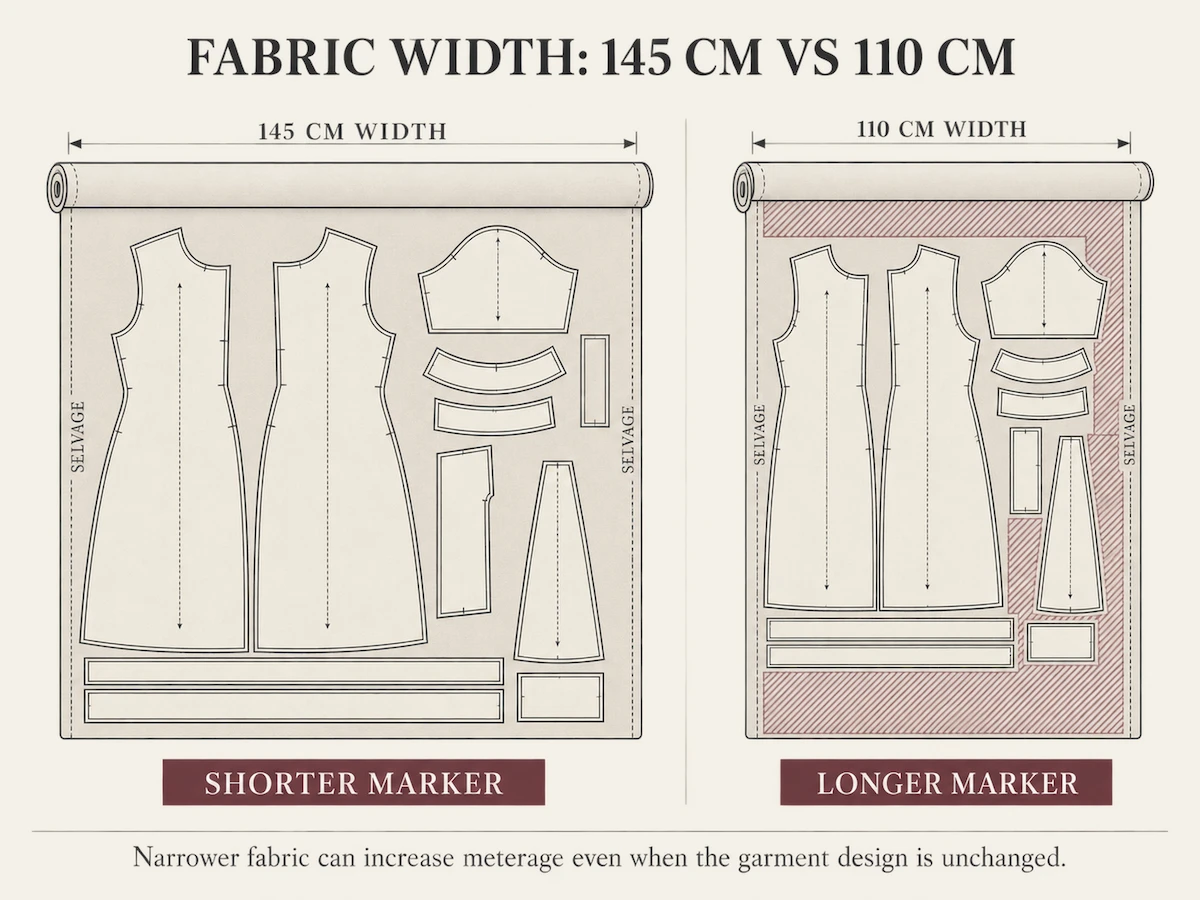
The table below is built from our development markers for a size M midi dress, on 145cm width cloth, solid colour, no matching, no directional print. These are typical meterages, not the absolute floor or ceiling. Every style has a range because length, size grade, and fabric behaviour move the number. The Basis column says what each figure assumes.
| Silhouette | Typical fabric (m, size M, 145cm) | Range (m) | Basis |
|---|---|---|---|
| Column (straight) | 1.40 | 1.20 to 1.70 | Narrow straight panels, minimal flare, lays compact |
| Fishtail (mermaid) | 1.90 | 1.70 to 2.30 | Fitted through hip, flares below knee, longer back hem |
| A-line | 1.70 | 1.50 to 2.10 | Gradual flare, needs hem width, modest waste |
| Swing (circle, skater) | 2.30 | 2.00 to 2.80 | Full hem circumference, large panels, high offcut |
| Bias cut (slip) | 2.60 | 2.30 to 3.10 | All pieces at 45 degrees, marker cannot pack straight |
| Lined sheath | 2.20 | 1.90 to 2.60 | Shell 1.80m plus lining 1.40m, shared marker nets to 2.20m |
Read the column top to bottom and the story is clear. The column dress is the leanest because its panels are almost as narrow as the body they cover. The swing dress nearly doubles the column because the hem wants cloth the body never touches. Bias cut sits at the top even above swing in many cases, and it earns that place for a reason we get to in a moment.
The lined sheath looks like an outlier because it is a different kind of entry. It is not a wider silhouette. It is a fitted dress that happens to carry a full lining, so its number is shell plus lining minus the overlap we recover by sharing one marker for both layers. We list it because lining is the hidden multiplier most buyers forget to ask about, and we treat it on its own further down.
One more thing the table hides. These are size M figures. Grade the same dress up to XL and the panels widen, the marker gets less efficient per piece, and the typical column number drifts toward 1.55m while the swing drifts past 2.50m. Grade down to XS and the reverse happens, but only slightly, because the offcut between pieces does not shrink as fast as the pieces do.
Why bias cut eats the most fabric
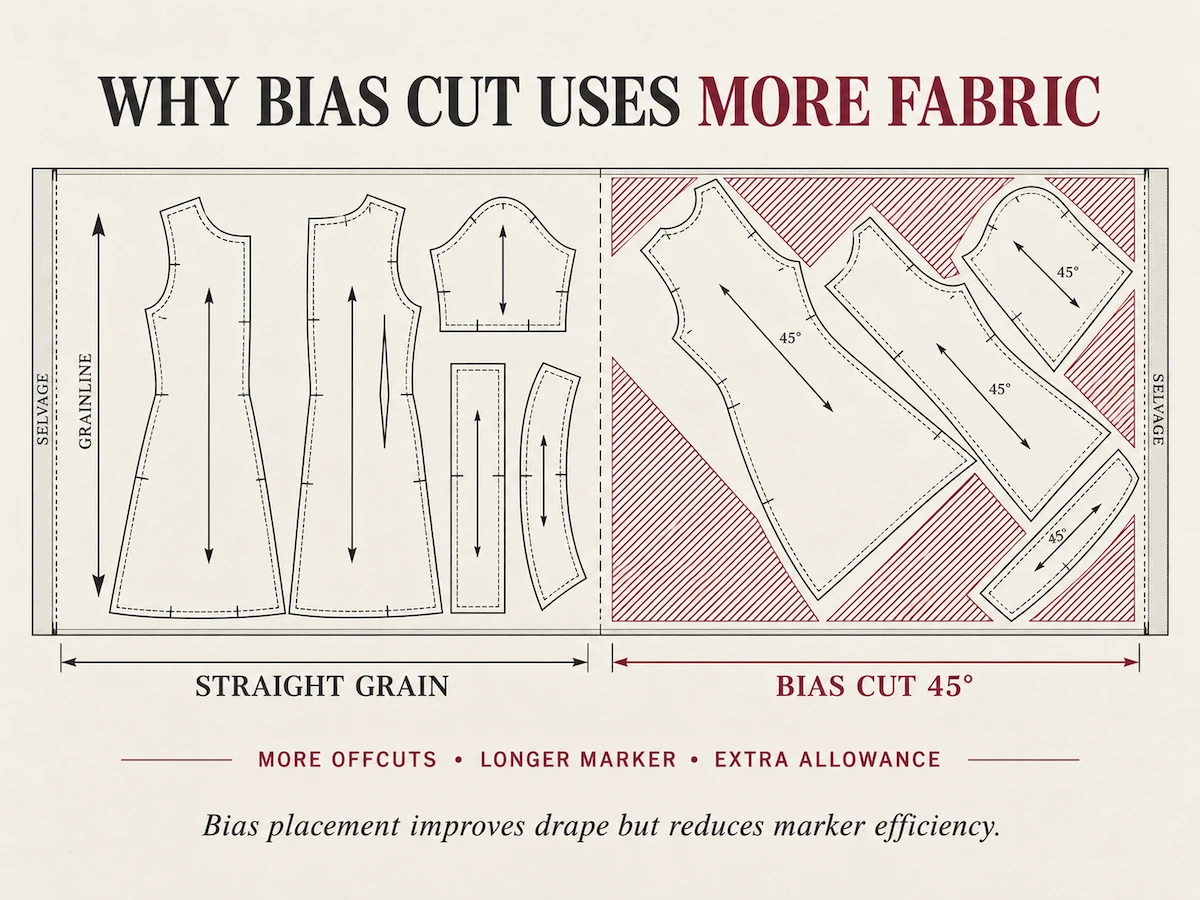
Bias cut deserves its own section because it confuses buyers more than any other construction. A bias dress is not cut on the straight grain. The pattern is rotated forty-five degrees so the fabric's diagonal runs vertically on the body. That is what gives a silk slip its liquid hang and its curve-hugging drag.
The cost is pure geometry. On a straight-grain marker, a long narrow panel lies parallel to the cloth edge and packs tightly against its neighbour. Turn that panel forty-five degrees and it now spans a diagonal across the width. Two diagonal panels cannot share a straight edge the way two vertical panels can. The marker is forced to lay each piece as its own diamond, with cloth left in every corner. On 145cm cloth a bias slip that would take 1.40m on grain will take closer to 2.60m. That is roughly eighty-five per cent more cloth for the same amount of fabric touching the body.
There is a second penalty. Bias fabric relaxes and stretches on the diagonal as it is handled, so we often lay it with more tension control, slower spreading, and a rest period before cutting. That does not add metres but it adds floor time, and floor time is part of why bias styles carry a higher cut charge even before the cloth is paid for.
A third penalty shows up only at sewing. A bias panel has no grain to hold it, so it grows under the presser foot and the operator must stay the seam constantly or the hem waves. That is more handling per metre than a stable woven, so the cut charge and the make charge both rise. The cloth is the headline, but it is not the only line bias touches.
Bias is also fabric-specific in a way straight cuts are not. A stable poplin resists the bias stretch and sews clean. A fluid silk satin is exactly where bias looks best and exactly where it is hardest to control. So the same bias slip costs different amounts of cloth and different amounts of labour depending on what it is made from, and the meterage in the table assumes a fluid woven, which is the usual case. A bias cut in a stiff fabric would sit lower in the range because the planner can tension it harder.
If your design depends on the bias drape, there is no cheaper substitute that looks the same. What you can do is keep the bias garment short, keep the train or slit minimal, and avoid a bias cut on a fabric that also needs matching, because the two penalties stack. A bias-cut dress in a directional print can reach 3.10m on 145cm and more on 110cm. We mark those combined cases TBC against the real marker, because the stacking is too dependent on the actual repeat to guess.
Stripe matching and directional print wastage
A clean solid colour is the cheapest lay a factory can make. The moment the fabric carries a repeat, the marker pays a tax.
Stripe matching is the first tax. If your design asks for the horizontal stripe to meet at the side seam, or for a vertical stripe to align down the centre front, the marker cannot place pieces freely. Every piece must be shifted so its stripe lines up with its neighbour, which throws away the tight nesting and leaves stepped gaps. On a straight column dress we have measured stripe matching adding roughly fifteen per cent to consumption. On a swing dress, where the panels are already wide and curved, the same matching requirement can add closer to twenty per cent because the alignment steps compound across the hem.
Directional print is the second tax and usually the larger one. A floral that has an up and a down, or a placement print that must sit at a certain height on the body, means every piece faces the same way. No piece can be flipped to fill a gap. On a 145cm marker a directional print can add between ten and twenty-five per cent depending on how large the repeat is and how often a piece would otherwise have been flipped. Large repeats are worse than small ones because the wasted triangles between pieces grow with the repeat length.
The rule we give buyers is simple. A non-directional print, where the motif reads the same upside down, costs almost nothing extra. A directional print or a matched stripe is a real fabric cost that should be in your quote, not a surprise on the invoice. When we quote a directional fabric we state the wastage allowance separately, usually ten to twelve per cent above the marker metres, and we would rather show it than have you find it later.
A short example from the cutting room. A buyer sent a fitted shirt dress in a navy with a thin white pinstripe and asked for the stripe to meet at the centre front placket and at every side seam. On a solid version of that dress the marker would have been about 1.85m. With the stripe matched the same dress needed 2.15m, a sixteen per cent increase, and the cut took longer because the planner had to shift each piece by hand to keep the lines continuous. The dress looked exactly as intended. The cloth bill was a sixth higher than the buyer had budgeted, because the matching requirement never reached the brief until bulk. Stating it up front would have cost nothing and would have priced the dress correctly from the sample.
There is also a cheaper middle path we offer when a buyer wants the look without the full tax. Matching only at the centre front and ignoring the side seams cuts the penalty roughly in half, because the side seams are where most of the stepping happens. Most customers never notice the side seam mismatch on a busy stripe. We will propose this when the design allows it, rather than charging the full match by default.
Lined versus unlined, the hidden cost
Lining is the quietest way to add fabric to an order. A lining is a second garment inside the first, shorter at the hem and neck but covering most of the body and sleeves. On a sheath dress the lining alone is about 1.40m of its own fabric on 145cm cloth.
The good news is that lining does not simply add 1.40m to the 1.80m shell. We lay the shell and lining on one marker when both are the same width and non-directional, and the smaller lining pieces fill gaps the shell leaves. That shared marker typically nets the combined lay to about 2.20m instead of 3.20m. The saving is real but it is not free. You still pay for the lining cloth, the extra cut time to separate the two layers, and the extra sewing to set the lining in.
The hidden part is not the metres. It is the operations. An unlined dress ends its seams with a clean finish, an overlock or a fold. A lined dress hides those seams inside the lining, which means constructing the lining as its own sub garment, joining it at the zip and neck, and often under-stitching so it does not roll. That is roughly fifteen to twenty-five minutes of additional labour per piece on a midi dress, on top of whatever the shell already took. So lining costs you in two columns at once, fabric and labour, and most buyers only budget for the first.
There is also a quality reason we sometimes push back on lining a style that does not need it. A lined woven that is cut on a fabric with no give can feel stiff and can show press marks at the lining seams. For some designs a good facing and a clean bind does the job for a third of the cost. We will say so when we think the lining is doing no work.
Two fabrics are involved, and they need not be the same weight. The shell might be a 180gsm crepe while the lining is a 70gsm anti-static satin, chosen so the dress slides on and does not cling. The lining cloth is cheaper per metre than the shell, which softens the fabric hit, but it is still a second cloth to buy, inspect, and stock, and that is a planning load as much as a cost load. When we bulk a lined style we hold both fabrics on the same delivery schedule, because a lined dress is not finished until both are in the building, and a late lining delivery stalls a finished shell just as hard as a late shell stalls a finished lining.
The place lining hides most is in the minimum. A lined style needs both cloths to clear their mill lots, so the colour minimum of one hundred to two hundred pieces can be driven by whichever fabric has the stricter lot. If the lining only comes in a 500 metre lot and the shell in a 300 metre lot, your colour quantity is set by the lining, not the dress. We flag this early because it is the kind of thing that silently raises your first order.
How consumption data sets the quote and the MOQ
Fabric consumption is not a footnote in your quote. It is the first input. The moment we have your tech pack or reference sample we build a marker, either a real one or a measured estimate from a similar style, and that marker gives us the metres per piece. Multiply metres by fabric price and you have the single largest line in the cost sheet, often forty to fifty per cent of the ex-works price on a woven dress.
Consumption also sets the minimum order quantity in a way buyers do not expect. Our minimum is one hundred pieces per design, with one hundred to two hundred per colour depending on the fabric. That band exists partly because of fabric, not just sewing. Many of the cloths we buy are sold in minimum lot sizes from the mill, and a narrow or wide silhouette changes how many lots your colour needs. A swing dress at 2.30m per piece in two hundred pieces is 460 metres of one colour. A column dress at 1.40m in one hundred pieces is 140 metres. If the mill lot is, say, 300 metres, the column order in one colour cannot hit the lot on its own and we either combine your dye lot with another job or ask for a higher colour minimum. That is why colour minimums move with the silhouette, and why a wide dress sometimes needs more pieces per colour than a narrow one to price sensibly.
Sampling follows the same logic. We sample in seven to ten days, and the sample is cut from a real marker so the consumption you are quoted is the consumption you get, not a guess. Our production facilities in Guangzhou and Dongguan hold ISO 9001 and are amfori BSCI-audited, and the fabrics we source for these markers are OEKO-TEX STANDARD 100 and SGS-inspected, so the metre figure in your quote is measured off a real lay rather than estimated from a sketch. Bulk then runs twenty to twenty-five days in peak season and fifteen to twenty days off season. Wide, high-consumption styles take longer on the cutting table because the lay is longer and the knife pass is slower, so a swing or bias order can sit at the longer end of that window. A column dress might clear in sixteen days off season. A bias gown in the same period could take the full twenty, simply because the cutting floor spends more passes on it.
When you send a complete brief we quote within twenty-four hours. A complete brief includes the silhouette, the fabric, the size range, and the quantity. The silhouette is not decorative information. It is the number that tells us how many metres to price. Buyers sometimes send a sketch and a fabric swatch and assume we will infer the shape. We can, approximately, but approximation is how a quote drifts, and a drift on fabric metres is a drift on the largest line in the sheet. Naming the silhouette in one word removes that drift before it starts.
One more consequence worth stating. Because fabric is the largest line, the silhouette also sets how much working capital your order ties up. A swing dress order of three hundred pieces at 2.30m and a column order of three hundred pieces at 1.40m differ by roughly 270 metres of cloth before a stitch is sewn. At a typical woven price that is real cash committed at fabric booking, weeks before you see a garment. The silhouette is a finance decision as much as a design one, and the buyers who understand this are the ones who order the wide styles knowingly rather than by accident.
How to save fabric without changing the design
You do not have to redraw the dress to cut the cloth bill. Several moves save metres while leaving the look intact.
Specify 145cm width wherever the fabric is available in it. The table below shows what the same six silhouettes cost on 110cm cloth. The difference is not small.
| Silhouette | Metres at 145cm width | Metres at 110cm width | Extra at 110cm | Basis |
|---|---|---|---|---|
| Column (straight) | 1.40 | 1.75 | +25% | Size M, solid colour, no matching |
| Fishtail (mermaid) | 1.90 | 2.35 | +24% | Size M, solid colour, no matching |
| A-line | 1.70 | 2.10 | +24% | Size M, solid colour, no matching |
| Swing (circle, skater) | 2.30 | 2.95 | +28% | Size M, solid colour, no matching |
| Bias cut (slip) | 2.60 | 3.25 | +25% | Size M, fluid woven, no matching |
| Lined sheath | 2.20 | 2.75 | +25% | Size M, shared shell and lining marker |
Choosing 145cm over 110cm saves about a quarter of the cloth on every one of these dresses. Some prints and some heavy coatings only come in 110cm, and we will tell you when that is the case rather than pretend otherwise.
Keep the hem circumference honest. A swing dress does not need a three-metre sweep to read as a swing. Bringing the hem in by fifteen centimetres can drop consumption by a tenth of a metre with no visible change to the silhouette on a moving body.
Drop directional prints unless the design needs them. A non-directional version of the same cloth lays tighter and skips the matching tax entirely. If the print reads the same upside down, say so in the brief, because it changes the wastage allowance we build in.
Lengthen the size run instead of widening it where you can. Adding one more size in the middle of the grade often improves marker nesting more than adding a size at the extreme ends, because the middle sizes interlock best. This is a grading decision, not a design compromise, and we can model it on your marker before you commit.
What this means for your first order
The marker is the reason a factory asks for certain minimums and certain lead times, and it helps to see the link before you brief your first style. Our minimum is one hundred pieces per design, with one hundred to two hundred per colour depending on the fabric and whether it has to be dyed to order. A marker plotted for a tiny run is inefficient because the grading and plotting are fixed costs spread over few pieces, and a colour that needs its own dye lot has a floor below which the lot cannot be run economically. The silhouette feeds both. A bias or matched-stripe dress needs a more careful marker, so its sampling runs toward the longer end of our seven to ten day window, and its bulk sits at the upper end of our twenty to twenty-five day peak season window.
This is also where ready-stock helps a first order. If the silhouette you want already exists in our 260 ready-stock styles, the marker is already plotted and the cloth is already bought, so the consumption question is answered and the only variable left is quantity. For a new brand testing a shape, starting from a proven marker removes the single biggest unknown in the first quote. You still get the look. You skip the lay-plan risk.
A concrete case makes the point. A buyer came to us wanting a bias slip in a fluid viscose we had never run for her before. We laid it as a fresh marker and the consumption came in at 2.85m on 145cm cloth, which lifted the quoted fabric cost well above the same-length column she had roughly priced in her head. She switched to a ready-stock bias style we already ran, where the marker was proven at 2.60m and the cloth was already bought, and her first order landed at the lower number with no development wait and no sampling clock. The silhouette was the same. The marker was the difference, and starting from a proven one removed both the cost surprise and the lead time in a single move. That is the practical lesson under all of this. The silhouette is your design choice, but the marker it forces is a commercial choice too, and on a first order the cheapest way to control it is often to start where the lay is already solved.
Three things to tell your factory
If you take one paragraph from this article, take this one. These are the three lines we wish every brief arrived with.
State the silhouette in words, not just in a sketch. Column, A-line, swing, fishtail, bias, or lined sheath each carry a known consumption band from the table above. A sketch alone leaves us to interpret the shape, and interpretation is where metre estimates drift.
Name the fabric width you expect, or ask which width your cloth comes in. The 145cm versus 110cm gap is a quarter of your fabric cost on most dresses, and it is the easiest saving on the table.
Say whether the print or stripe must match, and in which direction. "Print is directional, match at centre front" is a sentence that changes your quote by ten to twenty-five per cent and prevents a dispute at bulk. "Non-directional, no matching" is the cheapest sentence in garment manufacturing.
None of these three asks you to change your design. They ask you to describe it precisely, and precise description is what turns a vague quote into a number you can read and trust.
Related reading
- Three Dresses, Costed: What a Factory Actually Charges For
- What affects clothing manufacturing costs
- How MOQ is calculated in clothing manufacturing
Ready to see what your silhouette costs in metres and dollars? Send us your tech pack or reference images with the fabric width and the silhouette named, and we will return a marker-based quote within twenty-four hours. You can also browse our 260 ready-stock styles with real RMB prices on file at /ready-stock/, or look at the dress and skirt categories at /products/womens-dresses/ and /products/skirts/.