On this page
- Quick answer: satin, crepe or chiffon?
- Why the three names do not describe what you think
- Satin: how it behaves and where it fails
- Crepe: how it behaves and where it fails
- Chiffon: how it behaves and where it fails
- From the floor: what each cloth asks of the line
- Practical example: one dress, three cloths
- How to choose between them
- Common mistakes when comparing these cloths
- What the choice does to cost and minimum
- What to send when you specify one of these
- How we work with fabric on a style
- Frequently asked questions
- What to take away
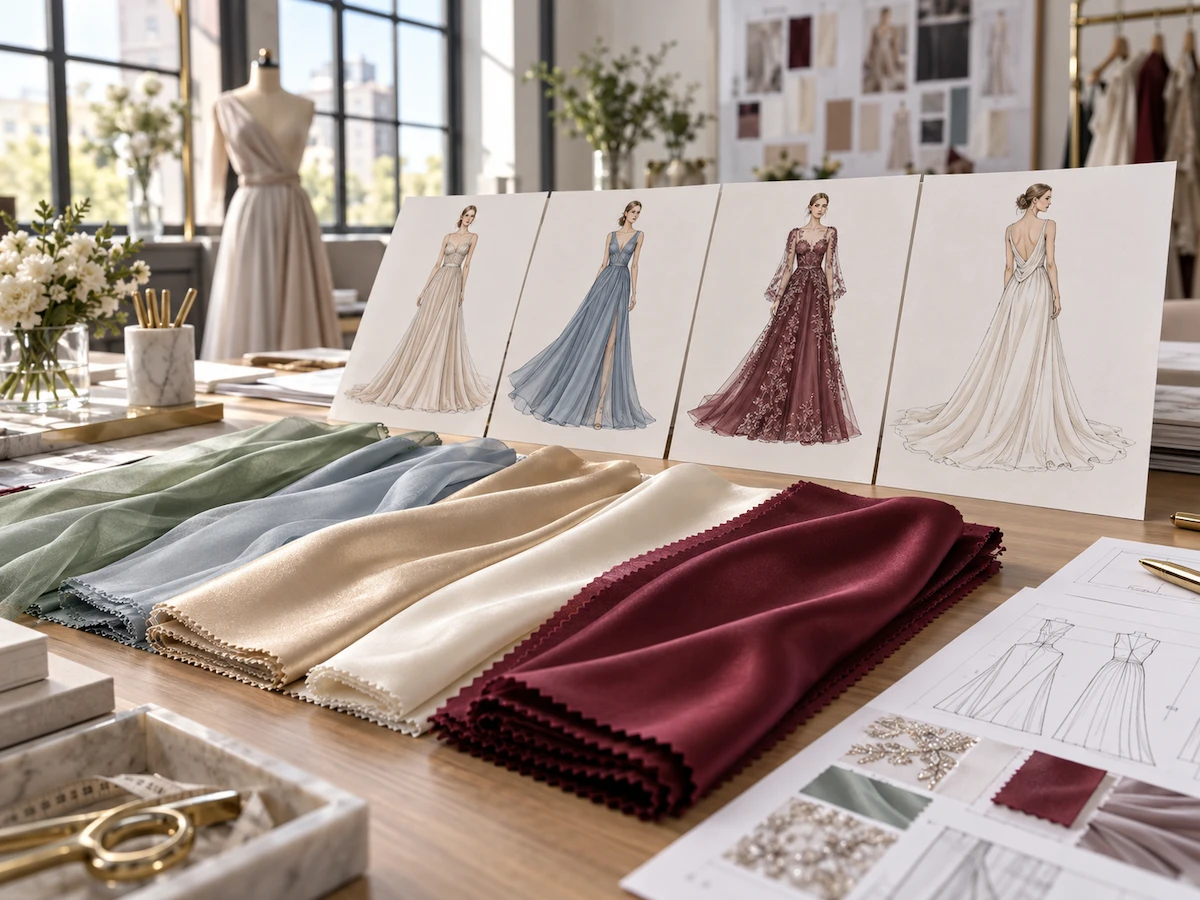
Satin, crepe and chiffon are the three cloths most often named in a dress brief, and the three most often treated as interchangeable. They are not interchangeable. They differ in how they are built, in how they fall, in how they take a seam and a press, and in what they demand from the line that has to sew them.
The confusion is understandable, because the names do not describe fibre. A satin is a weave structure; a crepe is a surface effect that can come from a twist, a weave or a finish; a chiffon is defined as much by weight as by construction. That means two mills can both ship you a correct crepe and hand you two different garments.
This comparison covers what each one actually is, where each one works and where each one fails, and how the choice propagates into sampling, sewing and cost. The wider question of how to run the selection process itself is covered in how to choose fabric for a dress design.
Quick answer: satin, crepe or chiffon?
Satin gives you a reflective face, a fluid fall and a body the cloth holds by itself. Crepe gives you a matte, dry surface with a slight texture and enough recovery to hold a structured line. Chiffon gives you lightness and movement, with transparency that almost always means lining. Choose by what the dress has to do; the weave is a consequence of that, not a starting point.
| Satin | Crepe | Chiffon | |
|---|---|---|---|
| Surface | Reflective one side, matte reverse | Matte with a fine texture | Sheer, soft, slight surface grain |
| How it falls | Fluid, with weight | Drier; holds a line better | Light and mobile, follows movement |
| Opacity | Usually opaque | Usually opaque | Transparent in most weights |
| Likely to need lining | Sometimes, for a better fall | Rarely | Almost always |
| Takes a press | Marks easily; needs care | Tolerant of pressing | Very sensitive; marks and shine easily |
| Usually chosen for | Evening, slips, bias-cut pieces | Structured dresses, tailored silhouettes | Overlayers, sleeves, flowing skirts |
The row to read first is the one about pressing. Pressing sensitivity is the property that most often decides whether the factory can hit your standard at all, and it is the last thing buyers think to ask about.
Why the three names do not describe what you think
A fabric name on a brief behaves as an instruction to the mill: match a known construction. It does not tell them the drape, the opacity, the weight band or the hand-feel you actually need, and a mill that matches the name and nothing else has done exactly what was asked.
What has to travel with the name is the rest of the specification. Take satin. The reflective surface comes from a weave in which floats pass over multiple yarns, and that structure can be built on very different substrates — a light one that behaves almost like chiffon, and a heavy one that behaves like a substantial duchesse. Both are correct satins. Neither substitutes for the other.
Crepe has the same problem from the other direction. The pebbled surface can be produced by a highly twisted yarn, by a particular weave, or by a finishing process. Each route gives a different hand-feel, a different recovery and a different cost, and the one the mill holds in stock may not be the one the dress needs.
Satin: how it behaves and where it fails
Where satin works
Satin earns its place where the surface itself is the design. Bias-cut slips, evening pieces and any silhouette that relies on reflected light moving across the garment all depend on the face of the cloth doing work that construction cannot. It also drapes with a weight that makes it forgiving on a body, which is why it recurs in the same shapes season after season.
Where satin fails
Satin shows everything. Press marks become shine. A needle hole does not close. A seam that has been unpicked leaves a line. It also slips at the machine, which makes it slower to sew and less tolerant of a rushed operator than almost any other dress cloth.
The practical consequence is that satin raises the quality ceiling on a production line rather than lowering the floor. On a line that sews it well, it is the most impressive cloth in the book. On a line that does not, it is the cloth that exposes it.
Crepe: how it behaves and where it fails
Where crepe works
Crepe is the most workable of the three for a structured dress. Its matte surface absorbs rather than reflects, which makes seams and darts visually quiet. It recovers well, so a fitted line holds through a day's wear. It presses cleanly, which matters more than buyers expect — a cloth that presses well is what allows a factory to deliver a crisp edge at scale.
Where crepe fails
Crepe can look flat, and its dryness means it does not catch light or movement the way satin does. On a dress where the design intent is the fluidity of the cloth rather than the line of the cut, it will read as heavy. It also varies more between mills than buyers assume, because the surface can be produced by different routes.
Chiffon: how it behaves and where it fails
Where chiffon works
Chiffon is chosen when movement matters more than line: overlayers, floating sleeves, gathered skirts and anything designed to look weightless. Light plain weave, very fine yarns, technically simple and demanding in production — it is one of the few cloths where the difficulty is entirely in the handling rather than in the structure.
Where chiffon fails
It is transparent, so it needs a lining or a layered construction in most applications. It frays readily, so seam finish is not a style choice but a requirement. It marks and shines under an iron with almost no tolerance. And because it is light, it does not hide anything underneath it: the lining and the internal construction are on display through the cloth.
That last point is worth sitting with. A gathered chiffon skirt does not conceal the waistband or the seam allowances below it. The construction you would hide inside a crepe dress is what the customer is looking at.
From the floor: what each cloth asks of the line
When a factory hears which of the three you have chosen, a set of consequences follows immediately, and those consequences are what actually appear in a quote.
Satin changes the seam allowance and the handling. Seams have to be sewn and pressed with the right side protected, which costs time and a slip sheet on the press. Chiffon changes the seam finish and the cutting method, because a light cloth shifts under a blade and a frayed edge inside a sheer garment is visible from the outside. Crepe changes almost nothing, which is precisely why it is the cloth that production managers prefer.
There is a second-order effect too. Cloths with low tolerance for rework — satin and chiffon both qualify — raise the cost of a mistake, not just the cost of a garment. An operator who can unpick and resew a crepe seam without trace cannot do the same on a satin face, and the difference shows up as a higher proportion of seconds rather than as a line item.
Practical example: one dress, three cloths
Take a single design — a fitted bodice, a soft skirt and a long sleeve. The sketch does not change across the three columns. Everything downstream of the cloth does.
| Decision | In satin | In crepe | In chiffon |
|---|---|---|---|
| Bodice structure | Structure has to be built in, because the cloth will not hold alone | The cloth carries part of the structure | The cloth carries none of it; a lining and structure are both required |
| Lining | Added for fall and coverage | Not usually needed | Required in almost every application |
| Seam finish | Overlock where hidden; particular care at the face | Standard overlock | French or bound, because fraying edges are visible through the cloth |
| Sleeve | Falls heavily; the shoulder seam has to be stayed | Holds a set-in shape | Floats; a gathered or puff treatment suits it |
| Sampling | Frequently two rounds — drape reads differently on the body than on the form | Often one | Two rounds if the layer structure is at all complex |
| Pressing risk | High; shine and marks | Low | High; marks and distortion |
| Repeatability | Good, if the same substrate and weight band are held | Good | Good, provided the weight band is specified and held |
Notice that none of the rows concerns appearance, which is the axis buyers normally compare on. All three cloths can produce a beautiful version of that dress. They differ in what the business around the dress has to look like — how many sample rounds, how much lining, how much freedom the line has to make a mistake.
How to choose between them
- Start with the design intent. If the design is the surface, satin. If the design is the line, crepe. If the design is the movement, chiffon.
- Then check the silhouette's support. Where does the garment hang from, and does the cloth hold that on its own?
- Then check the layering. Does the cloth need a lining, and does the lining change the fall you were designing for?
- Then check the line. Ask the factory directly whether they are set up to sew it, because a cloth the line is not confident in is a quality risk that no specification fixes.
- Then check availability. Stocked, booked or made to order, and whether a repeat order can be matched in shade.
- Fix the weight band in writing. Most disputes about these three names are disputes about weight, and weight is the one variable nobody writes down.
Common mistakes when comparing these cloths
- Comparing swatches of different weights. A light satin and a heavy satin have less in common than a satin and a crepe of the same weight.
- Assuming the name fixes the price. Crepe is not cheaper than satin. What drives cost is the substrate, the weight and the finish behind the name.
- Choosing on the photograph. Reflective cloths photograph quite differently from how they read in daylight, and the difference is largest for satin.
- Testing opacity in a studio. Chiffon is often approved under lighting that would make anything look acceptable.
- Forgetting the press. Pressing behaviour decides whether the factory can deliver the standard you saw on the sample, at volume.
- Specifying the cloth but not the weight band. Without it, a mill can deliver the right name and the wrong garment for two consecutive seasons.
What the choice does to cost and minimum
Buyers often assume these three sit in a price order, with chiffon cheapest and satin dearest. They do not. Cost follows the substrate, the weight and the finish well before it follows the name, and a heavy crepe can easily cost more than a light satin. The table below stays in directions rather than in amounts, because an amount is only meaningful against a specified cloth.
| Factor | Direction of effect | Why |
|---|---|---|
| Heavier weight in the same family | Increases | Material is bought by weight and by usable width |
| Lining introduced | Increases | Additional cloth and additional assembly operations |
| Seam finish changed to French or bound | Increases | More operations per garment and slower handling |
| Narrower usable width | Increases | More linear metres consumed per garment |
| Stocked versus made-to-order | Made to order increases | The mill's dyeing minimum applies per shade |
| Cloth that presses or frays badly | Increases | Slower handling and a higher rework rate |
The last row is the one that never appears in a quote. A cloth that costs the same per metre as another can still cost more per garment, because the line runs slower and loses more pieces to rework.
What to send when you specify one of these
- The dress, as a flat or a reference that shows the silhouette and the support point
- The design intent, stated plainly — surface, line or movement
- The weight band or a reference cloth the mill already makes
- The opacity you need, and where the garment will be worn
- The colour reference, physical rather than on screen
- Whether the style will be reordered, and whether the shade has to be matched again next season
A physical reference cloth the mill already produces is the single most efficient thing you can send. It removes the ambiguity in the name in one step, and it usually produces a faster and more accurate answer than any description.
How we work with fabric on a style
We keep a working library of cloths whose behaviour we already know on our own line, which means the conversation starts from what a cloth does rather than from what it is called. In practice:
- You send the style and the intent. What the dress has to look like and how it has to behave.
- We shortlist by behaviour. Cloths from the library that deliver it, with the trade-offs stated — including where a cheaper option costs you drape or where a costlier one buys only a surface.
- We send physical swatches. Where the choice is close, we send two weights of the same cloth so the difference is felt rather than described.
- We flag the production consequence. If a cloth needs a French seam, a lining or a second sample round, that is stated before you commit rather than after sampling.
- We hold the standard. The approved swatch becomes the reference the bulk delivery is checked against.
Fabric sourcing is described on our fabric sourcing service page. If you are weighing these three for a specific dress, send us the style and we will tell you which behaves the way you are describing — and what each one does to your sampling calendar.
Frequently asked questions
Is satin the same as silk?
No. Satin is a weave structure and silk is a fibre. Satin can be woven from many substrates, and most dress satin in commercial production is not silk. Saying "satin" tells a mill how the cloth is built, not what it is made of — if the fibre matters for your customer, it has to be specified separately.
Which is best for evening dresses?
It depends on whether the design is the surface or the line. Where the dress relies on reflected light and fluid movement, satin. Where it relies on a defined silhouette and a clean, quiet surface, crepe. Many evening programmes use both, with crepe carrying the structured styles and satin carrying the draped ones.
Does chiffon always need lining?
In most dress applications, yes. Chiffon is transparent, and a layered construction is the usual solution — a lining beneath, or chiffon layered over another cloth. On occasions where transparency is the design intent, no lining is needed, but that is a decision to take explicitly rather than by default.
Is crepe cheaper than satin?
Not necessarily, and often not. Price follows the substrate, the weight and the finish, so a heavy crepe can cost more than a light satin from the same mill. Comparing two cloths on name alone is one of the more common reasons a quotation comes back looking wrong when it is actually correct.
Which of the three drapes best?
Satin usually drapes with the most weight and the most fluid fall, which is why it suits bias-cut and draped styles. Chiffon moves more but falls lightly, so it is better for overlayers than for a main body. Crepe drapes least and holds a line most, which is what makes it the practical choice for structured dresses.
Which is hardest to press?
Satin and chiffon both mark easily, in different ways — satin shows shine and needle marks, chiffon distorts and shines under heat. Crepe is the most tolerant of the three. This matters more at production scale than on a sample, because a cloth that needs careful pressing on every piece slows the line.
Will a repeat order come in the same cloth?
If the weight band, substrate and finish were recorded and a physical standard kept, yes. If the specification said only "satin", the answer depends on what the mill holds at the time. That is the practical reason to write a short specification for even the simplest cloth.
What to take away
These three names describe how a cloth is built, not how it behaves, and the behaviour is what the dress depends on. Choose by design intent — surface, line or movement — then fix the weight band and the substrate in writing, then ask the factory whether they are set up to sew it. Do that and the cloth stops being a source of surprise, including on the order after this one.