On this page
- Structure vs Volume: What Each One Is For
- Weight Classes Within Each Family
- Using Both Together
- Effect on Silhouette, Hem and Fullness
- Fabric Consumption and Cost Consequences
- Sourcing the Two Fabrics
- Handling: Snagging, Static and Pressing
- Which One for Which Occasionwear Category
- FAQ
- Working With Luxudress
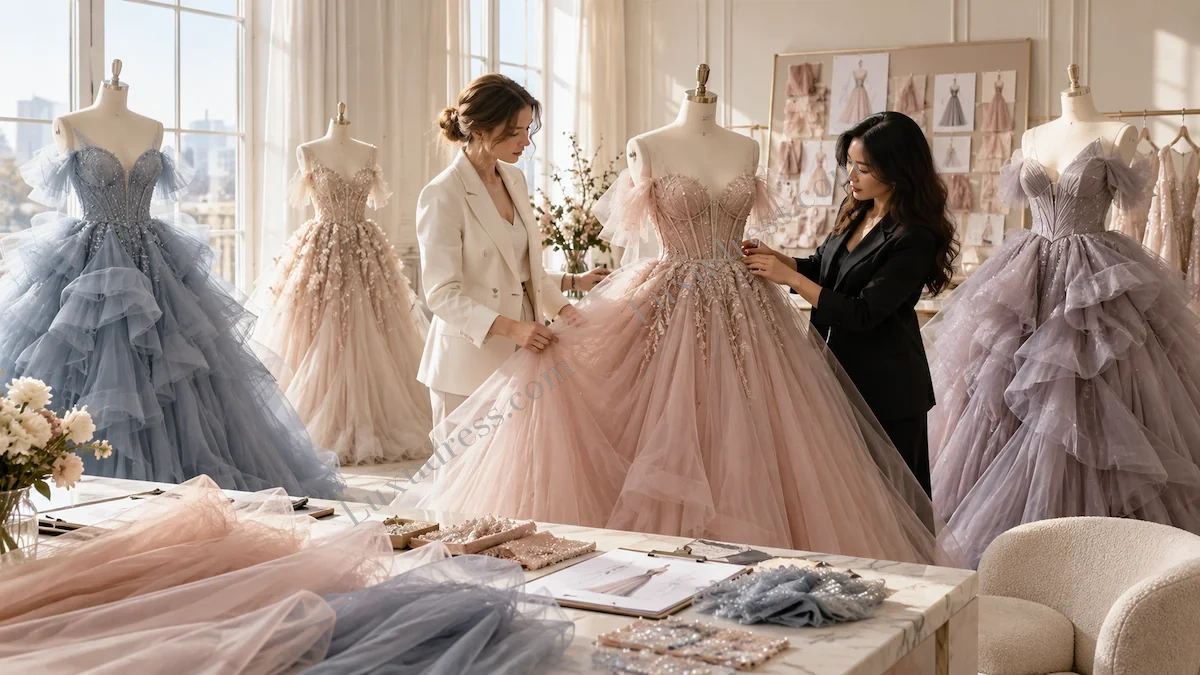
In a swatch book, organza and tulle are easy to confuse. Both read as light, crisp and translucent, and in a white they can look nearly identical at the size of a business card. Buyers who choose between them on that basis are choosing on appearance, and appearance is the one thing the two have in common.
The structural difference is simple and consequential. Organza is a woven fabric: it has warp and weft, a straight grain, a bias, and the ability to be cut on any of them. Tulle is a net: a mesh of threads knotted or knitted into a hexagonal grid, with no grain direction in the woven sense and a degree of stretch and recovery that a woven fabric does not have. That single difference determines how each one can be used, and it is why specifying one when the design calls for the other produces problems that no amount of careful sewing fixes.
It is also why this is worth understanding before the fabric is ordered rather than after the sample is made. The two are not interchangeable at the pattern stage, at the cutting stage, or at the hem. Choosing late means re-cutting, which on a layered garment means re-cutting several layers.
Structure vs Volume: What Each One Is For
The cleanest way to hold the two apart is to ask what job the layer is doing. In layered occasionwear there are only two jobs that these fabrics are hired for, and they are different jobs.
| Job | What it means in the garment | Which fabric does it |
|---|---|---|
| Structure | Holding a shape the shell cannot hold by itself: a defined hem, a standing collar, a crisp ruffle, a bodice panel that must keep its line | Organza, particularly the crisper weights |
| Volume | Adding fullness without adding weight, so the silhouette lifts away from the body: a skirt, a sleeve head, a back drape, a layered hem | Tulle, particularly the stiffer grades |
Organza's value is that it behaves like a fabric while being translucent. It can be cut on the bias to fall in a particular way, it can be gathered to a controlled fullness, it holds a pressed edge, and it can be given a shape that stays. That makes it the right choice whenever a translucent layer has to contribute to the garment's structure rather than only to its volume.
Tulle's value is that it delivers fullness at almost no weight. A single layer of a stiff tulle can hold a skirt out in a way that would take several layers of organza to match, because the mesh resists compression across its structure rather than relying on the stiffness of a woven yarn. That is why the classic ball gown and the classic layered prom skirt are built on tulle and not on organza: the silhouette is a volume problem and tulle solves it cheaply.
The confusion arises because both can be used for both jobs to a degree. A soft tulle can be used as a floppy overlay, and a soft organza can add a little volume. The reason to keep the distinction in view is that a fabric used outside its natural job is either doing less than it could or creating a problem — a soft tulle used as structure will not hold, and a stiff organza used as volume will stand away from the body instead of lifting.
There is a third use that is neither structure nor volume and that is worth naming separately, because it is common in occasionwear: masking. A translucent layer is sometimes specified purely to soften or conceal something underneath — a seam, a construction line, the top edge of a bodice, the join between a skirt and a bodice. Tulle masks by building layers of mesh until whatever is behind them becomes diffuse; organza masks by covering with a woven surface that reads as a single tone. Which effect the design wants decides which fabric, and neither one is a volume decision.
That distinction also explains a common and expensive mistake. A designer who wants the masking effect that organza would deliver in one layer, but specifies tulle, will usually try to reach it by adding layers — and the layer count was never the variable that mattered. The garment gets heavier, the silhouette changes, and the masking is still not what was intended.
Both fabrics are also used on sleeves and bodice overlays, where the job is closest to masking and where the fabric is seen at close range on a moving body. There, the snag risk of a net and the fraying and marking risk of a woven are both fully exposed, so the choice is often settled by handling considerations rather than by the visual effect the two produce at a distance.
Weight Classes Within Each Family
Neither fabric is a single material. Each covers a range, and the range within each family is wide enough that the fabric name alone tells you very little.
Organza
- Crisp organza holds a line, presses to a sharp edge and stands away from the body. Used for defined hems, structured ruffles and panels that must keep their shape.
- Soft or draped organza falls and gathers rather than standing, and is used where the translucent layer has to move with the shell rather than hold away from it.
- Silk organza is the reference version — a finer hand, a higher cost, and a behaviour that is difficult to match in a synthetic at the same weight.
- Synthetic organza varies more between suppliers, which matters because the difference between two synthetic organzas of nominally the same construction can be larger than the difference between silk and a good synthetic.
Tulle
- Stiff or “crinoline” tulle holds a fullness with very few layers. It is the fabric that makes a large skirt possible without weight.
- Soft tulle drapes and layers gently, and is used for overlays, veils and soft gathered effects where the stiffness would read as a fault.
- Illusion and fine tulle are chosen where the layer has to be almost invisible close to the body, such as a neckline panel or a sleeve.
- Bridal tulle is a category rather than a structure: bridal weights sit across the range and are distinguished by hand and by how they gather, not by name.
The consequence is that “we will use tulle” is not a specification, and neither is “we will use organza”. On a single garment, a stiff tulle in the skirt and a soft tulle at the neckline are two different fabrics doing two different jobs, and both may be correct. Recording the grade — or at least the hand — alongside the fabric name is what makes a sample reproducible.
Using Both Together
The most common high-value use of these fabrics is in the same garment, where each is doing the job it is good at. The classic layered construction uses three distinct layers, and understanding which layer does what explains most of what goes wrong when a skirt looks flat or a hem looks heavy.
- The shell. The visible outer fabric — a satin, a crepe, a lace, an embroidered mesh. This carries the design.
- The structural layer. Often organza, captured into a seam or used as a facing, holding the edge of the shell or the top of the skirt so that the visible fabric does not have to do the holding. Where a crisp hem is wanted, this is the layer that delivers it.
- The volume layer. Often tulle, sitting under or between the other layers, lifting the silhouette away from the body. On a large skirt it may be several layers, and the number of layers is a silhouette decision rather than a fabric decision.
There is a fourth arrangement that is used frequently in eveningwear and that buyers often misread: the tulle or organza layer is placed between the shell and the lining rather than underneath everything. That changes how the garment moves and how the layers separate in wear. Which arrangement is right is a design decision, but it has to be made consciously, because the two produce visibly different garments from the same three fabrics.
The reason this matters commercially is that the layer order determines how the garment behaves on the body over an evening. A volume layer placed under everything tends to stay where it was put; a layer placed between the shell and the lining can migrate or bunch, and on a fitted bodice that shows as a ridge. Getting the order right at sampling is far cheaper than correcting it in bulk. The general approach to that layering is set out in how a tulle prom dress is constructed.
Effect on Silhouette, Hem and Fullness
The choice between the two fabrics shows up in three places on the finished garment, and all three are visible to a customer.
- Fullness. Tulle adds volume efficiently, so the same visual fullness can be achieved with less weight and less fabric. Organza adds fullness less efficiently but with more control, because a gathered woven layer gathers evenly.
- Hem behaviour. A crisp organza hem holds a defined edge and can be shaped; a tulle hem has a soft, indefinite edge that reads as lightness. If the design depends on a sharp hem line, organza is the layer that delivers it. If the design depends on the hem dissolving, tulle is.
- Fall and movement. A woven layer falling on the bias moves with a shape that a net cannot produce. A net layer moves as a springy mass. On a skirt that is meant to swirl, that difference is the whole character of the garment.
There is also a body-relationship effect that is easy to miss on a stand. Stiff tulle holds the garment away from the body, which reads as generous on a small silhouette and as bulky on a fuller one. Organza, being a woven, can be controlled more precisely where it hugs and where it stands away. On a style intended to be sold across a wide size range, that control is worth having, because the same volume that looks deliberate at one size can look like an error at another.
Finally, the layers affect how the garment reads in a photograph, which for occasionwear is not a trivial consideration. Layered tulle photographs as an even mass of fullness; layered organza photographs with visible edges and structure. Brands shooting a collection in one session will notice the difference, and it is a reason to settle the fabric before the shoot rather than after.
Fabric Consumption and Cost Consequences
Two fabrics that look similar in a swatch book can have very different consequences in a cost sheet, and the difference is not only the price per metre.
- Cutting efficiency differs. A woven organza is cut in panels to a marker with controlled grain and known wastage; a tulle is generally cut in fuller pieces and the marker behaves differently.
- Layers multiply. A volume layer that needs several tulle layers needs to be costed as several layers, and the layer count is easy to underestimate at sampling and correct at bulk.
- Panel size differs for the same silhouette. A fuller skirt spreads wider on the cutting table, and the fabric cost moves with the spread rather than with the garment's weight.
- Handling time differs. A net is harder to manage at the machine and at the press than a woven, and the difference in labour is real even though it is invisible in a fabric price comparison.
- Waste differs. Offcuts that are unusable in one fabric may be usable in the other for facings or linings, which changes the effective yield.
The practical implication is that comparing the two on price per metre answers the wrong question. The comparison that matters is consumption at the actual silhouette, including every layer and including a realistic marker. On a layered occasionwear skirt, that comparison is often closer than the fabric prices suggest — and sometimes the apparently cheaper fabric costs more once the layers are counted.
Where a collection has several styles built on similar silhouettes, it is worth doing that calculation once for the family rather than style by style. The relationships between weight, drape and the achievable silhouette are consistent enough across a range that the analysis carries over, and the fabric-side view of that relationship is set out in how fabric weight shapes fit and drape.
Sourcing the Two Fabrics
Buying organza and buying tulle are two different purchasing conversations, and treating them as one is how a collection ends up with layers that do not match.
- Dye lots behave differently. A white tulle and a white organza in the same garment are unlikely to be the same white, and the difference is more visible when the two layer than when either is seen alone. If the design depends on them reading as one colour, they have to be matched deliberately.
- Lot-to-lot variation is larger on tulle. Because the fabric is a net rather than a woven, small differences in how it is made change the hand and the spring noticeably. Two lots of nominally the same tulle can produce visibly different volume.
- Organza varies by supplier more than by name. “Organza” describes a construction rather than a specific fabric, so two suppliers' organzas can differ in weight, hand and how they press. A specification that names the construction without naming the reference is a specification that will drift.
- Availability differs by season. Both fabrics move with the season, and a colour chosen for one collection may not be repeatable for a re-order — which matters most for bridesmaid programmes that run across several months.
- Minimum order quantities are set by the mill, not by the garment. On a small first run this is often the practical constraint, and the same logic that governs a fabric minimum applies here — it is covered from the ordering side in how minimums are actually calculated.
The practical consequence is to buy both layers from a position of knowledge rather than convenience. A layered garment is a single colour impression made of several fabrics, and the fabrics have to be chosen together. Where a supplier cannot supply both, the matching has to be done by comparison rather than by assuming that two whites will agree.
It is also worth deciding early whether the style is likely to be repeated. A layered style that sells well will be re-ordered, and a re-order depends on the same fabrics still being available in the same grade. Recording the reference and the mill for each layer at development is the difference between a repeat that works and a repeat that has to be re-developed.
Handling: Snagging, Static and Pressing
Both fabrics are more difficult to handle than their appearance suggests, and the difficulties are different for each.
Organza
- It frays at the raw edge, so seams need to be finished deliberately rather than left raw where they will show.
- It takes a crease well, which means it also holds a bad crease set during handling.
- It marks with a needle and with pins, so pin placement and needle choice are visible decisions rather than housekeeping.
- It is transparent at the seam, so a bulky seam finish reads through the layer.
- It can be pressed to a crisp edge, which is an advantage — but the same heat can glaze the surface if applied directly.
Tulle
- It snags on any roughness on the machine, on the table and on the operator, and a snag in a net is not repairable.
- It generates static, which makes layers separate, cling and misbehave during cutting and sewing.
- It cannot be pressed flat without either melting or losing its spring, so it is generally handled with steam and shaping rather than a hot plate.
- It resists being cut cleanly, so the edge of a tulle layer is usually a design decision rather than a finished edge.
- It has no grain, which removes some cutting constraints but also removes the predictability a woven gives you when the layer is on the bias.
None of that is a reason to avoid either fabric. It is a reason to expect that the same construction method cannot be used for both, and to be suspicious of a sample room that treats one as a substitute for the other. The construction difficulties of layered and netted garments are the same ones that produce the defects listed in the defects that recur in dress manufacturing, and they are worth a specific check at sampling rather than a general one.
Which One for Which Occasionwear Category
The category does not decide the fabric, but it narrows it, because the silhouette expectations in each category are fairly consistent.
| Category | What the silhouette usually needs | Where the choice typically lands |
|---|---|---|
| Prom and graduation | Large, supported volume with lift | Stiff tulle for the volume layer, organza for any crisp edge or boned panel |
| Bridesmaid | Soft matching layers across several sizes and several wears | Soft tulle for the overlay, organza only where a defined edge is required |
| Gala and eveningwear | Controlled drape with visible fabric quality | Organza for structure and edge control, tulle only where lightness is the point |
| Cocktail | A short, defined silhouette that reads as deliberate | Organza, because the crisp edge is visible at short lengths |
| Flower girl and childrenswear | Volume without weight, and comfort in wear | Soft tulle, with organza used sparingly because a crisp edge can scratch |
Two things are worth drawing out of that table. The first is that bridesmaid is the category where the tulle choice is least about lift and most about repeatability: several garments in the same fabric, often across a broad size range, worn once and photographed together. Consistency between units matters more there than any specific drape quality. The second is that gala and eveningwear tend to be the reverse — a single garment, expensive fabric, and a design that depends on the fabric behaving in a particular way, which is why organza appears more often at that level.
For bridesmaid programmes specifically, the fabric choice interacts with grading and with how the layers fall across a range of body sizes, which is covered from the pattern side in grading bridesmaid styles. For gala and eveningwear the fabric decision sits closer to the overall fabric story of the collection, which is covered in choosing fabric for evening dresses.
FAQ
Can tulle be substituted for organza if the match is close?
No, not on a garment where the layer is doing structural work. Tulle has no grain, so it cannot be cut on the bias, it will not hold a pressed edge, and it behaves as a springy net rather than as a cloth. Where the layer is purely decorative volume, a substitution can sometimes work — but it changes how the garment moves and should be re-approved rather than assumed.
How many layers of tulle do I need for a full skirt?
That is a silhouette question rather than a fabric question, and it depends on the fabric grade, the skirt shape and how the volume is distributed. The way to settle it is on the stand at sampling, with the actual tulle, rather than by a rule — and then to record the layer count, because that is what the bulk run has to reproduce.
I want a crisp hem on a sheer skirt. Which fabric?
Organza, and generally a crisp one, because it is a woven fabric that can be pressed and shaped to hold a defined edge. Tulle will give you a soft, indefinite edge — which is a good design in its own right, but it is not the same thing.
Can tulle be pressed?
Not flat, and generally not with direct heat. Tulle is shaped with steam and with the way it is handled rather than with a plate, because pressing a net flat destroys the spring that provides the volume. Organza is the opposite: it takes a crisp press well, provided the surface is protected.
How do we prevent snagging during production?
Snags in a net are not repairable, so prevention is the whole strategy: a clean, smooth work surface, no rough jewellery or watch straps on the operator, correct needles, and careful handling of the cut pieces. It is worth raising specifically with the factory on any style that uses a fine tulle.
Is organza more expensive than tulle?
Per metre it usually is, and the difference is larger for silk organza than for a synthetic. But the useful comparison is total consumption at the actual silhouette, because tulle often needs more layers to achieve the same volume and organza needs more careful handling. On a layered skirt, compare the two on the costed style rather than on the fabric price.
Which is easier to care for?
Both are usually dry-clean for occasionwear, and the care instruction should be settled on the actual fabric with the actual construction rather than assumed from the fibre. A net that snags and a woven that creases are different care problems, and the label has to reflect the one you have.
Working With Luxudress
Luxudress is the factory-direct front end for womenswear production across production facilities in Guangzhou and Dongguan, covering development, sampling, material sourcing, manufacturing, inspection and export packing. Layered occasionwear, from bridesmaid programmes to full-skirted gala pieces, is a routine part of what we build.
On a layered style we will tell you which job each layer is doing, settle the layer count on the stand with the actual fabric rather than on a rule, and cost the silhouette on total consumption rather than on a fabric price per metre.
If you have a layered style in development, send the silhouette and the fabric direction. You can also see how we approach bridesmaid production, look at our gala and eveningwear work, browse the style library for layered constructions, or order from ready stock by the piece to examine a layered skirt before committing to a production run.
Request a quote and we will return a costed plan including the layer structure it assumes.