On this page
- The four routes, in one table
- Route 1 — pre-sequinned and pre-embroidered fabric
- Route 2 — all-over machine sequin embroidery
- Route 3 — placement machine sequin embroidery
- Route 4 — hand-applied sequins and mixed embellishment
- What happens at the seam
- Cutting rules for sequin fabric
- Density control: why "denser" is not "better"
- Comparing the four routes
- Choosing a route: a decision table
- What the inspector is looking for
- Why sequin runs get their own production window
- How to specify embellishment so quotes become comparable
- Route selection checklist
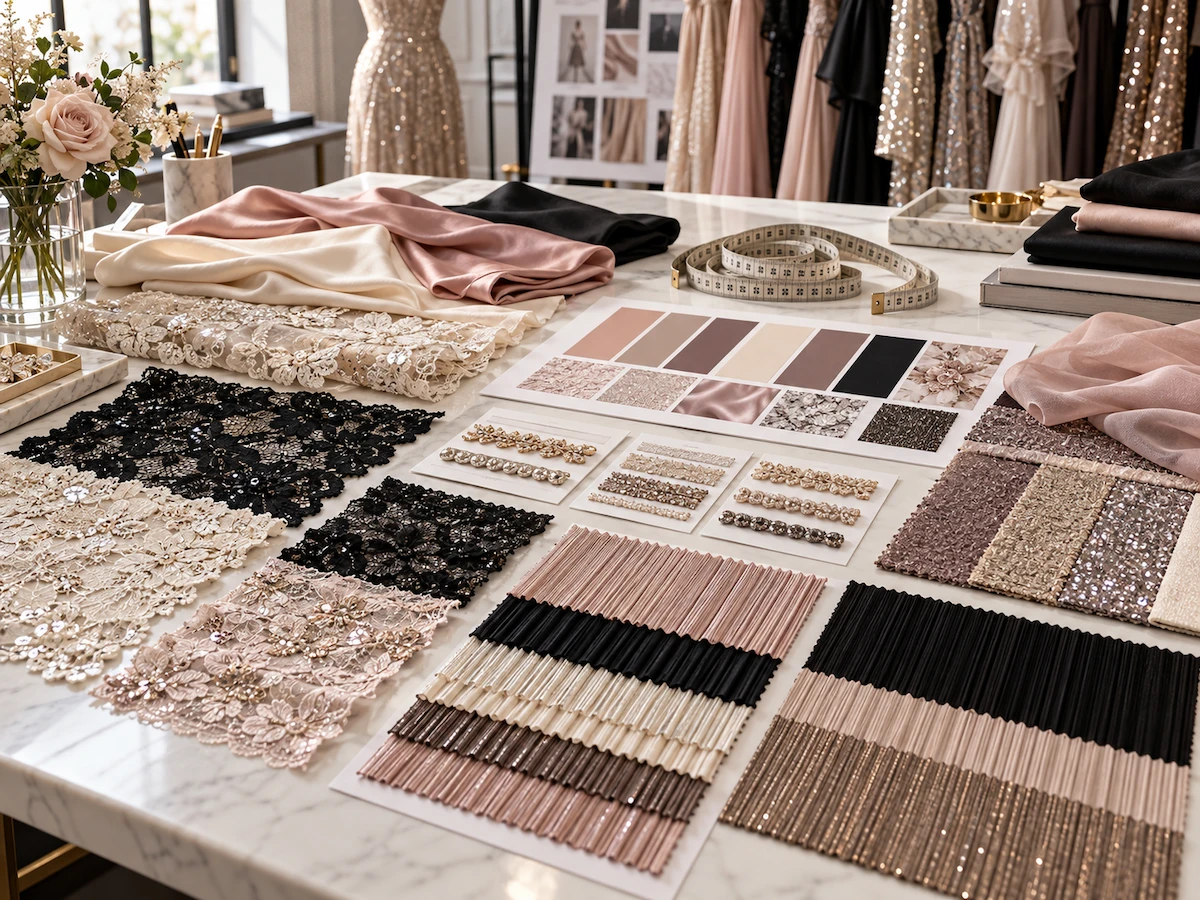
Two dress photos sit side by side in a buyer's sourcing folder. Same silhouette, same colour family, same amount of visible sparkle. One is quoted at roughly half the other. The buyer concludes that one factory is expensive and the other competitive, and sends both designs out for pricing against the cheaper reference.
The two garments are not the same product. One is cut from fabric that arrived already sequinned. The other has been embroidered panel by panel, with the sequins laid to a layout across hundreds of thousands of stitches. From a metre away they are indistinguishable. In the hand, on a body, through a machine and on a cost sheet they are different garments that share a photograph.
Sequin is the most commonly underestimated material in womenswear manufacturing, because it is bought as a look and produced as a process. And the process has four routes, not one. Getting them straight before the design is locked is the difference between a repeatable garment and a season of rework.
The four routes, in one table
None of these is a variation of another. They have different weight, hand, seam behaviour, scheduling and cost structure.
| Route | How the garment is built | What the cost scales with |
|---|---|---|
| 1. Pre-sequinned / pre-embroidered fabric | Fabric bought already sequinned or sequin-embroidered; the garment is cut and sewn from it | Fabric metres, at a premium |
| 2. All-over machine sequin embroidery | Sequins embroidered across the whole surface of a base cloth to a layout | Covered area, embroidery time and sequin volume |
| 3. Placement machine sequin embroidery | Sequins embroidered only in defined zones — a bodice, a border, a gradient | Embellished area x layout complexity |
| 4. Hand-applied sequins and mixed embellishment | Sequins sewn or applied by hand, alone or combined with bead, stone or cord work | Bench hours and skill level |
The first three are machine routes; the fourth is a different production model with its own capacity constraints, which is why it sits in the same decision as the machines rather than beside it. If you are weighing hand application seriously, how hand embellishment is done on womenswear covers the bench model in full — it is a capacity question as much as a craft one.
Route 1 — pre-sequinned and pre-embroidered fabric
The fabric arrives already embellished. The garment then enters the cutting-and-sewing route as a pre-embellished textile, which is not the same thing as being cut and sewn like plain cloth.
What it is good at. Speed and predictability on the construction side. There is no embroidery queue, no per-size layout to position, and the production plan looks like a normal woven dress. For a fully sequinned look produced in a short window, this is often the shortest path.
What it costs. The fabric itself, by the metre, usually at a significant premium — and there is no way to spend less by reducing coverage, because coverage is a property of the cloth. You buy the whole surface whether the design uses it or not.
Where it fails. In handling and at the seam. The cloth is heavy and abrasive: it dulls needles and blades, it does not press, it marks where it is folded, and once a piece is cut there is no adjusting the placement. Because the sequin sits on the surface, every seam cuts through sequins along its whole length — and that becomes a bald stripe unless it is engineered for.
Route 2 — all-over machine sequin embroidery
A base fabric is embroidered across its entire surface to a defined layout. The sequin becomes part of the cloth's construction rather than an applique laid on top of it.
What it is good at. Consistency. Coverage is even because the layout is even, and the surface behaves predictably across a panel. It also lets the base fabric be chosen for the behaviour you want, with the sequin added as a layer — which is the opposite of Route 1, where the base is decided for you by whatever the mill sells.
What it costs. Time on the embroidery machine, plus sequin volume by the square metre. Both scale with covered area, which means a longer skirt or a fuller sleeve is a direct cost increase rather than a fixed one.
Where it fails. At edges and seams. Embroidery that runs close to a seam line creates a thick, stiff band that will not press flat, and the seam becomes the place where the surface distorts. On a fitted garment the problem concentrates at the waist, where the garment has to shape rather than hang.
Route 3 — placement machine sequin embroidery
Sequins are embroidered only where the design wants them: across a bodice, along a shoulder line, inside a defined panel, or scattered in a gradient. Everything else is base fabric.
What it is good at. Design control — the highest of the four routes. Placement lets a designer decide exactly where the sparkle sits, which is usually why it was chosen; it allows one garment to move between plain and embellished, and it keeps weight where the body can carry it.
What it costs. More than all-over per embellished area, because layout accuracy matters more. The embroidery has to start and stop cleanly, hold position across pattern pieces that were cut separately, and land the same way on every garment in the run. A gradient or a scattered layout is the hardest version, because there is no edge to align to.
Where it fails. At the boundary. The line where sequins meet plain cloth is where grading and layout have to agree precisely, or the boundary drifts between sizes. A placement layout approved on a size M sample has to be re-checked at the extremes of the range. On a full range, that check belongs in the same conversation as how pattern making works in womenswear, because the layout is being graded along with the block.
Route 4 — hand-applied sequins and mixed embellishment
Sequins are applied by hand — sewn individually or in small motifs — either alone or combined with beads, stones and cord work.
What it is good at. Effects the machines cannot produce economically: sparse scattering that has to look random rather than repeated, hand-set motifs that follow a drape, mixed component work where a sequin sits beside a bead and a stone, and small runs where a machine layout would not be worth programming.
What it costs. Bench hours, and skill. Hand work is priced by time per component, so it scales with the number of components and the difficulty of the substrate rather than with area alone — and it occupies a workbench, which is a capacity that has to be booked. That is the same constraint described in the hand embellishment article: handwork competes with other handwork, not with machine time.
Where it fails. In consistency and attachment. A hand-applied surface has to hold a density and an orientation that a machine produces automatically, and a hand-set sequin that is not properly secured is a repair waiting to happen — one that cannot be hidden.
What happens at the seam
This is the part of sequin manufacturing that decides whether a garment reads as expensive or cheap, and it is almost never discussed at the design stage.
On any sequinned surface, the seam allowance contains sequins. When the seam is sewn, those sequins are in the way, and three things can happen if nothing is done about it:
Sequins are cut by the needle. A sequin is a hard disc. Sewing through it breaks or cracks it, and a broken sequin along a seam is a sharp edge and a visible fault.
The seam line reads bald. Where sequins have been cut away or crushed, a strip of bare base cloth runs the length of the seam. On a plain dress a seam is a line. On a sequinned dress it becomes a stripe, and the eye goes straight to it.
The seam becomes too thick to press flat. Sequins stacked in a seam allowance will not compress. The result is a stiff ridge, which distorts the surface on either side and shows through on a fitted garment.
What is actually done about it, in practice:
- Clear the seam allowance. Sequins are removed or pushed clear of the stitching line before the seam is closed, so the needle passes through base cloth rather than through discs.
- Choose seam position with the surface in mind. Where a design allows it, seams are moved away from the most visible area, or into a place where a matte trim or a covered seam can absorb the disruption.
- Replace what was cleared. After the seam is closed, sequins are restored along it — by hand, or by a narrow re-embroidery pass — so the surface reads continuous rather than interrupted.
- Line for comfort. Sequinned seams are abrasive against skin. A lined or faced interior is not a style choice on these garments; it is what makes the garment wearable, and it is also part of the construction that carries cost.
- Protect tooling and the operator. Needles, blades and presser feet all meet the surface. Tooling is changed more often on a sequin run, and handling is slower by necessity.
A supplier who cannot describe what happens at the seam has not costed the garment properly. Ask, on any sequinned style, and the answer tells you more than the price does.
Cutting rules for sequin fabric
Sequin fabric does not behave like cloth on a cutting table, and the differences are the source of a specific family of losses.
| Consideration | What it means in the cutting room |
|---|---|
| Direction and nap | The surface reflects differently depending on which way it faces. All pieces in a garment must be cut in one direction, or the panels will catch light differently and the difference will be visible in wear |
| Motif placement | Where the fabric carries a motif or a directional embroidered pattern, placement has to be planned per pattern piece, not per marker — the layout is now a design constraint |
| Single-ply cutting where necessary | Some sequin and heavy embroidered fabrics cannot be cut in a stack: the sequins interlock, the layers slip, and the blade drags the surface. Cutting single ply is slower and costs fabric, and on some constructions it is the only way to hold the layout |
| Blade and needle wear | Abrasive sequins dull tooling quickly. Consumables are part of the cost of the style, and a factory that has not allowed for it will find the money somewhere else |
| Handling and marks | The fabric marks where it is folded or clamped. Spreading, bundling and transport all have to be planned around the surface |
| Sequin loss at the edges | Cutting sheds sequins at panel edges, and those edges then go into a seam. This is the same problem as the seam, met one stage earlier |
The practical upshot: a sequin style has a higher fabric consumption per garment than the marker suggests, because the layout constrains the marker. That is one reason two quotes for the same "look" can sit far apart — see what affects clothing manufacturing costs for where these losses sit in the build-up.
Density control: why "denser" is not "better"
Density — how closely sequins sit — is the variable buyers reach for first and understand last.
Higher density means more sequins per unit area. It reads as a richer, more solid surface and increases weight, stiffness and cost together. Lower density lets the base fabric show through, reads lighter and more transparent, and keeps the garment's hand closer to plain cloth. Neither is inherently better; they produce different garments.
Four practical consequences:
Density is not uniform across a garment by default. A bodice and a skirt can be specified at different densities, and often should be: the bodice needs to hold a line, the skirt needs to move. Specifying one density for the whole dress is a decision, not a neutral default.
Density interacts with the base fabric. The same sequin count over a firm base and a light base produces very different drape. Change the base and the density has to be re-checked.
Density changes with size. If a layout is fixed per pattern piece, visual density can shift slightly as the piece grows. On a graded range this is usually acceptable; on a design where the density is the point, check the extremes.
Density is not evenly achievable at every component. A dense layout on a small panel — a strap, a narrow belt, a collar — is harder than the same density on a skirt, because the embroidery has to stop and turn in less space.
Where density is treated as a design variable rather than a quantity, the garment usually ends up with two or three densities across its zones — which is also the most production-intensive version, because each zone becomes a separate layout decision.
Comparing the four routes
| 1. Pre-sequinned fabric | 2. All-over embroidery | 3. Placement embroidery | 4. Hand application | |
|---|---|---|---|---|
| Weight in the garment | High, set by the cloth | High — scales with area | Medium — concentrated where placed | Variable, controlled by component count |
| Hand | Uniform and heavy throughout | Firm where covered; the base disappears under the sequin | Two distinct hands in one garment | Depends on the substrate and the component mix |
| Movement | Drapes like a heavily embellished cloth | Better on loose shapes; fights fitted ones | Depends on where the zones sit | Can follow drape closely if placed to a body |
| Design control | Lowest — the cloth decides | Coverage is even by definition | Highest of the machine routes | Highest overall, at the highest unit cost |
| Rework risk | Cut sequins at seams; handling marks; needle damage | Seam and press issues; stiff bands at edges | Layout drift between sizes; boundary edges | Attachment failures; consistency across a run |
| Scales with | Fabric metres | Covered area | Embellished area x layout complexity | Bench hours and component count |
| Lead time driver | Fabric lead time, then normal sewing | Embroidery queue | Embroidery queue plus layout setup per zone | Bench capacity, which competes with other handwork |
| Best for | A fully sequinned look on a short timeline | All-over sparkle as a property of the cloth | Defined zones, borders, gradients, two-look garments | Sparse or irregular effects, mixed components, small runs |
The row that changes quotes is weight. Routes 1 and 2 both add mass; Route 3 adds it only where it is placed, and Route 4 adds it wherever the design puts components. On a fitted dress, that difference is a fit difference, which is why the embellishment decision belongs in the same conversation as the pattern and the construction.
Choosing a route: a decision table
| Your priority | Route that usually fits | What to watch |
|---|---|---|
| The sparkle is the design | All-over embroidery, or pre-sequinned fabric | Weight and drape; the garment has to be designed for a heavy cloth |
| Two looks in one garment | Placement embroidery | Layout drift across sizes; the boundary edge |
| Fastest, most predictable production | Pre-sequinned fabric | Seam visibility through cut sequins; handling marks |
| Movement and drape with some sparkle | Placement embroidery, or all-over on a loose shape | Density at the bodice versus the skirt |
| An effect a machine cannot repeat convincingly | Hand application | Bench capacity is booked, not ordered; attachment security |
| Lowest cost per garment | Depends on quantity, coverage and whether the layout is reused — model it, do not assume | Pre-sequinned is not automatically cheaper at low volume |
That last row is deliberate. The cheapest route is a function of how many garments, how much coverage, and whether the layout can be reused — not a fixed ranking. A short run of a fully sequinned look is often cheaper on pre-sequinned fabric; a long run with dense placement is often cheaper embroidered, because the layout setup is amortised across the run.
What the inspector is looking for
Sequin QC is not a general garment inspection with more attention. It has its own defect family, and a style without a written list of them will be inspected inconsistently — including between the sample you approved and the bulk you receive.
| What is checked | What the defect looks like |
|---|---|
| Missing sequins | Gaps in the layout, particularly after a seam has been closed |
| Loose attachment | Components that lift at a corner or rotate when touched; on hand-applied work, an attachment that was never secured |
| Orientation | Sequins facing inconsistent directions, which changes how the surface reflects — obvious in daylight, invisible under a straight-on light |
| Bare seam lines | The stripe where sequins were cleared, cut or crushed and never restored |
| Abrasion and snags | Surface damage from handling, transport or folding, which cannot be repaired locally without re-creating the layout |
| Sharp or broken components | Cut or cracked sequins with an edge, which are a skin-contact and wear problem as well as a visual one |
| Surface consistency across panels | Panels that read differently because they were embroidered at different times, or cut with different direction |
Two of these deserve emphasis. Bare seam lines and surface inconsistency are the two faults that make a sequin garment read as cheap at a distance — closer inspection is not required, and the customer sees them in a photograph. And loose attachment is a fault that appears in wear rather than in inspection, which is why attachment security belongs in the spec and in the sample check rather than only in the final inspection list.
Why sequin runs get their own production window
Sequin is not difficult to sew. It is difficult to schedule, because it changes the rules in five places.
Embroidery capacity is a separate queue. Where the garment goes through an embroidery machine it does not move at the pace of a sewing line. Embroidery has its own capacity, its own setup per layout, and its own throughput. A sequin order planned against sewing-line timing will be wrong on the calendar even when everything else is fine.
Hand application books a bench, not a machine. Where Route 4 is involved, the constraint is people and benches. That capacity is shared with every other hand-embellished style in the factory, so two handwork-heavy orders in the same window compete with each other.
Handling is slower and more careful. Pre-sequinned and heavily embroidered pieces cannot be treated like plain cloth. They mark, they blunt tooling, and they cannot be pressed in the ordinary way. That changes how work is laid out on the floor, not just how long each operation takes.
Repair is skilled and visible. A dropped sequin or a damaged patch cannot be hidden. Rework has to re-create the layout locally, which is why sequin garments carry more inspection attention per piece than plain ones.
Press and finish have to be rethought. Standard pressing damages sequin surfaces and flattens the cloth underneath. Finishing a sequin garment is a separate method, agreed per style rather than inherited from the plain range.
None of this is exotic. It is simply not visible in a photograph — which is why a sequin style is a specification, not an order for a dress with sparkle on it.
How to specify embellishment so quotes become comparable
The reason two quotes on "the same" sequin dress are not comparable is that neither quote names the route. An embellishment specification fixes seven things, and once they are fixed, factories are quoting the same product.
| # | What to state | Why it changes the quote |
|---|---|---|
| 1 | Route — 1, 2, 3 or 4, or a stated combination | Sets the cost model: fabric metres, embroidery time, or bench hours |
| 2 | Zones — which panels are embellished, and where the boundaries fall | Placement work is priced by zone, and boundaries drive layout accuracy |
| 3 | Density — sequins per unit area, per zone where it varies | Drives weight, hand and cost, and decides whether the garment still drapes |
| 4 | Base cloth — the fabric the sequin sits on | Determines behaviour, and whether the density still works |
| 5 | Sequin spec — material, size, finish, colour, and how components are secured | Changes weight, light behaviour and attachment risk; a size change is a layout change |
| 6 | Seam treatment — how the seam allowance is cleared and how the surface is restored | This is the difference between a seam and a bald stripe, and it is real work |
| 7 | Finish method — how the garment is pressed and finished | Sequin cannot be pressed normally; the method has to be named per style |
Written this way, the brief is short — and it is the document that makes a sequin order schedulable, because items 1, 3, 6 and 7 are the ones that decide the production route.
The lines buyers forget
Seam treatment. Nothing about a sequin dress is decided later than this. It is invisible in the quotation and highly visible in the garment, and it is the single line that most often separates two quotes that looked like the same request.
Density at the bodice versus the skirt. Specifying one density for the whole dress is a decision, not a default. A garment that needs to hold at the bodice and move at the skirt usually wants two densities.
The finish method. Press and finish are inherited silently from the plain range, and then the first bulk arrives with flattened sequins or a dulled surface. Naming the method is one line in the brief and the only reliable way to keep sample and bulk identical.
What to ask for in return
Alongside the quote, ask for the route in writing, the density per zone, the seam treatment and the finishing method. If a quote names none of them, it is a price for a photograph.
Two further questions are worth asking on any embellished style, because both change the critical path:
- Which production queue does it enter? Embroidered work moves at embroidery speed, and hand work at bench speed. Neither is sewing-line speed.
- What is the repair method? Rework on a sequin garment is skilled work that has to re-create the layout locally. Knowing the method up front tells you how the style will behave in inspection.
On the construction side, embellishment interacts with everything it sits on: a lined, closed garment behaves differently from an unlined one, and a bodice that has to hold a line needs its structure agreed before the sequin is added — how structured bodices are made covers that layer build in full.
Route selection checklist
Before the design is locked, answer these seven questions in writing. They take a meeting to settle and they decide the garment's weight, hand, schedule and price.
| # | Question | Why it decides the route |
|---|---|---|
| 1 | How much of the surface must sparkle — all of it, defined zones, or scattered? | This is the first split: full coverage points to Routes 1 or 2, defined zones to Route 3, irregular effects to Route 4 |
| 2 | Can the design tolerate the weight the chosen route adds? | A fitted silhouette and a heavy surface are in conflict, and the conflict shows up in fit rather than in the spec sheet |
| 3 | Does the surface need to move, or to hold a line? | Movement favours placement; holding a line favours structure underneath, and both together usually mean a compromise density |
| 4 | Is the layout reusable across sizes and colourways? | Reuse amortises setup across the run, which is often what makes embroidery cheaper than pre-sequinned fabric |
| 5 | How short is the window? | Fabric lead time, embroidery queue and bench capacity are three different clocks |
| 6 | Who restores the surface at the seam, and how? | If nobody has answered this, the garment has not been costed |
| 7 | How will attachment security be checked, on the sample and in bulk? | Loose attachment is a wear problem, and it is not always visible at inspection |
Answer those and you have chosen a route on purpose. Leave them open, and the route gets chosen by whoever quotes first — which is how two visually identical dresses end up in the same sourcing folder at half the price of one another.
If you are developing an embellished style, send the design and tell us which route you are considering — we will tell you what it does to weight, drape, seam behaviour and finish before you commit. Sequin and structured work sit inside eveningwear and gowns, and OEM manufacturing explains how the approved sample and the written specification are kept in agreement through to bulk.