On this page
- Route A: Sequin Fabric
- Route B: Hand-Applied Sequins
- The Same Eight Criteria, Both Routes
- Where the Two Routes Cross
- Weight, Drape and Comfort
- What the Sample Room Reveals
- Sourcing Sequin Fabric
- Sourcing Hand Work: Capacity and Timing
- Failure Modes, Side by Side
- Which Route for Which Category
- What to Write in the Spec
- FAQ
- Working With Luxudress
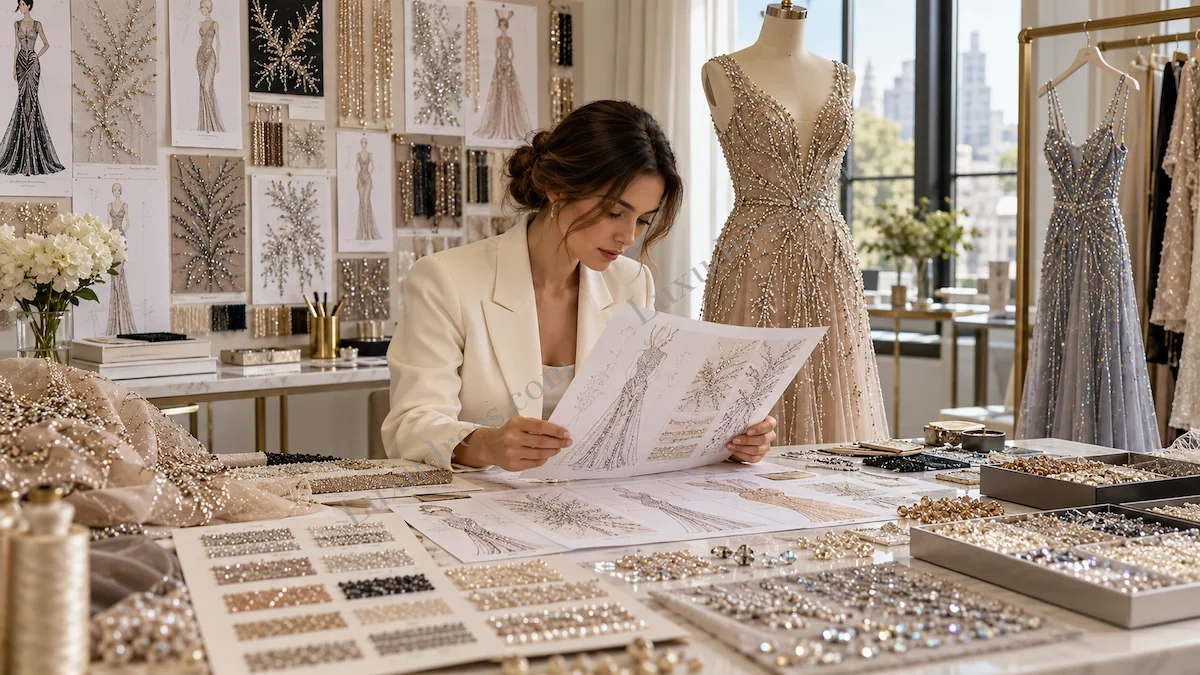
Buyers usually arrive at this decision having seen both, liked both, and formed the impression that the difference is a matter of quality or of budget. It is neither. It is a construction decision, and the two routes produce garments with different physics.
Sequin fabric is a textile: sequins attached to a ground during the fabric's manufacture, sold by the metre, cut and sewn like any other cloth. Hand-applied sequins are an operation: a plain fabric, a marked placement, and a person attaching pieces to it one at a time until the design is complete.
That difference in where the work happens determines everything else. It decides where the cost sits, how heavy the garment is, how it moves, and what goes wrong. What follows runs the same eight criteria across both routes rather than describing them separately, because the useful information is in the comparison.
Route A: Sequin Fabric
What it is. A ground fabric — mesh, tulle, jersey, or a woven — with sequins attached across its surface in a continuous or repeating pattern. Bought by the metre from a converter. Sometimes the sequins are all-over, sometimes arranged in stripes, gradients or motifs printed onto the layout.
Where the cost sits. Almost entirely in the material. Cutting and sewing a sequin fabric is not fundamentally different from cutting and sewing a heavy woven, so labour stays close to what a comparable plain dress would cost. The variable is the fabric price, which moves with the sequin size, the density, the ground quality and the colour.
What it does to the garment. Density is uniform, because it was decided at the mill rather than at the design. The shine is even across every panel including the ones behind the arms. The weight is consistent and typically significant — a dense sequin fabric is a heavy cloth, and the weight is distributed evenly rather than concentrated where the design wants it.
Its main advantage. Speed and predictability. A metre of sequin fabric is a known quantity with a known look, and a dress cut from it will look like the sample. For a range that has to be produced consistently across sizes and across re-orders, that predictability is worth a great deal.
Its main limitation. The design is confined to what the mill makes. Placement cannot be concentrated on a shoulder or faded towards a hem unless the mill produces that fabric specifically — and a custom sequin layout is a minimum-order conversation rather than a metre-by-metre one.
Route B: Hand-Applied Sequins
What it is. A plain ground fabric with sequins attached by hand or by machine-guided placement in a designer-specified layout: a spray up one shoulder, a dense panel across the bust, a gradient down a skirt, an edge along a neckline.
Where the cost sits. Almost entirely in labour, and the labour scales with the number of pieces and the complexity of the layout rather than with the garment. This is the crucial structural difference from Route A: the cost of a hand-applied design is a function of the design's ambition, not of the fabric's price.
What it does to the garment. Weight is concentrated where the design puts it, which is both the point and the risk. A dense panel on one shoulder adds weight that the bodice has to carry. A gradient means the hem is lighter than the bust, which changes how the garment moves compared with an evenly weighted one.
Its main advantage. Placement, and therefore design. Fading, concentrating, edging and drawing with the sequins are all available, and none of them is available in a metre of all-over fabric. On occasionwear, where the difference between a good dress and a memorable one is often where the shine sits, this is the whole argument for the route.
Its main limitation. Time and consistency. Every garment carries the labour of its own placement, and the consistency of that placement across a run depends on the quality of the marking and the template rather than on the operator's memory. Two garments produced a month apart can differ visibly if the placement was not controlled.
The Same Eight Criteria, Both Routes
| Criterion | Sequin fabric | Hand-applied |
|---|---|---|
| Where the cost sits | Material; labour similar to a plain dress | Labour per piece; material is a plain cloth |
| What drives the cost | Fabric price, sequin size and density, ground quality | Number of pieces applied, complexity of the layout, size of the area |
| Minimum order | A fabric minimum, sometimes a custom layout minimum | No fabric minimum beyond the plain cloth; labour scales with the order |
| Weight and distribution | Even across the garment, and typically high | Concentrated where the design puts it; can be uneven by design |
| Effect on drape | Adds body and reduces flow; a dense sequin fabric does not drape softly | Depends on the base cloth; a light base with a light placement still drapes |
| Consistency across a run | High — the fabric is the same fabric | Depends on marking and templates; the main risk area |
| Repairability | Difficult — removing a damaged area means removing ground | Easier — a piece can be reattached or the placement touched up |
| Main failure mode | Sequin loss across a whole panel; weight-related distortion of the silhouette | Placement drift between garments; weight pulling on a bodice |
Read across the weight and drape rows together and a useful rule appears. Sequin fabric is suited to garments built from shine — a bodice, a fitted sheath, a structured piece where the shine is the material. Hand application is suited to garments that carry shine — a flowing skirt, a draped gown, a sheer layer — because the base cloth can still behave like a cloth.
The consistency row is what buyers underestimate. Sequin fabric is the safer route for a large run because the variable is bought rather than made. Hand application is the better route for a design that needs placement and a riskier one for a run that will be re-ordered months later unless the placement is templated.
Where the Two Routes Cross
There is a point at which the cheaper route changes, and it is worth understanding its shape even without figures, because the shape is what you plan against.
Start with a design that is fully covered. In that case both routes produce a similar surface, and the comparison is straightforward: the fabric price against the plain cloth plus the labour of applying pieces across the same area. At full coverage, labour is at its highest and the fabric route is usually competitive — which is why all-over sequin dresses are almost always cut from sequin fabric.
Now reduce the coverage. As the design moves towards a partial placement, the fabric route does not get cheaper because you still buy the same fabric by the metre. The hand route does get cheaper, because the labour falls with the area. Somewhere on that curve the two cross, and beyond it hand application becomes the cheaper route by a growing margin.
Two consequences follow. The first is that a design with a modest amount of shine is almost always cheaper by hand, even though hand work sounds more expensive. The second is that a design with heavy coverage is almost always cheaper in fabric, even though the fabric sounds expensive per metre. Buyers who assume hand work is always the premium route get this backwards on partial placements.
The third variable is the complexity of the layout rather than the area. A dense block of sequins in one panel is fast to apply because the placement is simple. The same number of pieces scattered in a gradient across a skirt takes longer, because each piece is positioned individually rather than following a repeating pattern. On a hand-applied design, complexity costs more than quantity.
Weight, Drape and Comfort
This is the part of the comparison that customers notice and spec sheets omit.
- Sequin fabric is heavy and evenly heavy. The garment weighs roughly the same at the hem as at the shoulder, which means the shoulders carry the hem's weight. On a sleeveless or strapless style, that load lands on the bodice.
- Hand application can be heavy in one place and light in another. That is a design opportunity and a structural risk at the same time: a dense panel on one shoulder changes the balance of the whole garment.
- Coverage reduces drape. A densely sequinned cloth stiffens. If the design depends on a soft fall, neither route delivers it at high density, and the answer is a lighter base cloth with a lighter placement rather than a heavier fabric.
- Comfort is a real cost. Sequins abrade the skin where they sit against the body, and under an arm they are a genuine wearability issue. This is decided by the placement as much as by the fabric, and it is worth checking on a fit model in the actual garment rather than on a stand.
- Seams in sequin fabric are hard. Sequins at a seam have to be removed or displaced before the seam is sewn, which is an operation in its own right and is frequently underestimated in a costing sheet that treats the fabric as ordinary cloth.
The last item is the one that most often makes a sequin fabric dress cost more than expected. Cutting through the material requires managing the sequins at every seam, and the labour of that is invisible in a fabric price comparison.
What the Sample Room Reveals
A sequin sample can look correct and still tell you that the route is wrong. Four checks, all of which need the finished garment rather than a swatch.
- Pick it up by the shoulder. The weight tells you more than the swatch did. A garment that is heavier than the sample suggested will behave differently in wear and in packing, and the difference is more pronounced on a strapless or sleeveless style.
- Put it on a body and raise the arms. Sequins under the arm are a comfort and abrasion question that a stand cannot answer. On a fitted style with heavy coverage, this is where a design gets abandoned.
- Hang it and look at the hem. A heavy sequinned cloth pulls the hem; a garment with a concentrated placement pulls unevenly. An uneven hem on a formal dress is one of the most visible faults there is, and it is a weight problem rather than a sewing one. If the hem pulls, correcting it at the machine treats the symptom; the answer is a lighter coverage, a different base cloth, or a lift built into the construction — and it is cheaper to decide that before the fabric is bought than after the samples are made.
- Look at the seams with the garment inside out. Where sequins meet a seam, the treatment is either there or it is not, and it is the operation most often omitted from a costing sheet and most visible on a garment that is finished.
Add one more that is specific to hand work: compare two samples from the same run if you can. Placement consistency cannot be judged from a single garment, and it is the failure mode most likely to appear in bulk rather than in the sample you were shown.
Sourcing Sequin Fabric
If the route is fabric, the questions are about the material rather than the design, and they are worth asking before the style is priced.
- Sequin size and density. These two decide the look and the weight, and they are the variables a mill actually offers. Density is usually quoted as a coverage or a count per unit area rather than as a description, and the description is what buyers usually receive.
- Ground construction. The sequins are decorative; the ground is doing the structural work. A mesh ground behaves nothing like a jersey ground, and the same sequin layout on the two produces different garments.
- Attachment method. Sequins can be sewn or bonded, and the method determines how they behave in wear and in cleaning. Ask which it is rather than assuming.
- Direction and stretch. Sequin fabrics frequently have a direction, either in the pattern or in how the cloth behaves, and a panel cut the wrong way will behave differently from the sample.
- Lot consistency. Sequin fabrics show colour and density variation between lots more visibly than plain cloth, because the pattern creates areas of different density that take dye and light differently.
- Minimum and lead time. A custom sequin layout — a gradient, a stripe, a specific motif — is a mill development project with a minimum attached, not a metre purchase.
The last item is where the route's flexibility actually ends. If the design wants a specific sequin layout and the volume is small, the honest answer may be that the layout cannot be bought as a fabric and either the design changes or the route changes to hand placement.
Sourcing Hand Work: Capacity and Timing
If the route is hand application, the constraints are different and they are operational rather than material.
- Capacity is measured in hours, not metres. A hand-embellished design consumes a person's time in a way a fabric purchase does not, and the time is not compressible by ordering more of something.
- It is frequently subcontracted, and that is normal. Specialist hand work is often done by dedicated workshops rather than on the garment floor. What matters is that the subcontractor is declared, named, and held to the same standard — which is exactly the disclosure question a due-diligence buyer will ask about.
- Lead time scales with the design, not the order size alone. A simple dense panel scales well with volume because the operation is repetitive. A scattered or gradient layout scales poorly, because each placement is individual.
- Quality depends on the brief rather than on the skill. A skilled hand worker given an unmarked garment will produce a beautiful placement that differs from the last one. The marking and the template are the quality system.
- Repair capability is part of the offer. One of the route's real advantages is that a piece can be replaced, but only if the same material is retained. Ask whether offcut sequins are kept with the order.
The comparison to hold in mind is that fabric is bought and hand work is scheduled. A delayed fabric delays a cutting date; a delayed hand operation delays the garment after it is otherwise finished, which is a later and more expensive position to be in. On a style with a fixed launch, that is the risk to weigh when the route is chosen rather than when the delivery date slips.
Failure Modes, Side by Side
| Failure | More likely in | What causes it |
|---|---|---|
| Sequin loss across a panel | Sequin fabric | Weak attachment during fabric manufacture; abrasion in wear |
| A scattered pattern of missing sequins after one wear | Either | Attachment quality, and it is worth inspecting the fabric before cutting |
| Placement inconsistency between garments | Hand-applied | No marked placement or no template for the operator |
| Silhouette distortion from weight | Hand-applied, concentrated designs | A dense panel carrying more weight than the structure was built for |
| Seam puckering around sequins | Sequin fabric | Sequins not managed at the seam before sewing |
| Lining wear where sequins sit against it | Both | Abrasion between the embellishment and the lining over time |
| Colour mismatch between panels | Sequin fabric | Dye lot variation, and sequin fabrics show it more than plain cloth |
Two of the seven are shared, which is worth noting because it means some of the protection is common to both routes: inspect the material or the components before production, and line the garment with something that will survive abrasion. The remaining five are route-specific, and each of them is prevented by a decision made at development rather than at inspection.
Which Route for Which Category
| Category | Usually the better route | Why |
|---|---|---|
| Prom and graduation | Sequin fabric for the bodice, hand application for accent | Volume production with a defined shine, and structure that tolerates weight |
| Evening and gala | Hand application | Placement is the design, and the base cloth has to keep its drape |
| Cocktail and party | Sequin fabric | Small garment, full coverage, weight less of a problem |
| Bridesmaid | Sequin fabric, or none | Consistency across a run and across sizes matters more than placement |
| Red carpet and photoshoot | Hand application | The design is the placement; the garment is worn once or twice |
| Childrenswear | Neither at high density | Weight and abrasion are the limiting factors rather than cost |
The prom row is the most commercially useful. A prom dress usually wants a densely sequinned bodice, which is a fabric purchase, with a designed accent — a spray across a shoulder, a border at a hem — which is hand work. Using both routes on one garment is normal, and it is usually better than committing wholly to either.
What to Write in the Spec
| Line | Why |
|---|---|
| Which route for which part of the garment | The two routes can coexist, and the spec should say where |
| For fabric: reference, sequin size, density, ground, lot | Density is the look; the ground is the behaviour; the lot is the colour |
| For hand application: marked placement and a template | Consistency across a run depends on this and nothing else |
| Coverage area, expressed as a fraction of the panel | It is what makes the cost estimable and comparable |
| Number of pieces per garment, where applicable | The dominant labour driver, and a checkable figure at first-piece |
| Lining specification and abrasion treatment | Where both routes fail over time |
| Seam treatment through the sequins | The operation most often omitted from a costing sheet |
| Weight of the finished garment | It predicts silhouette and comfort problems before bulk |
Only two of those eight lines are about buying something. The other six are about how the shine is placed and how the garment is built around it — which is why the decision belongs in development rather than at the fabric supplier.
FAQ
Which route is cheaper?
It depends on coverage. At full coverage the fabric is usually competitive; at partial coverage hand application increasingly wins, because the labour falls with the area while the fabric price does not. Assuming hand work is always the premium option gets the answer backwards on lighter placements.
Will sequins make the dress too heavy?
Density decides it, and weight is more of a problem on drape and on structure than on the wearer. A heavily sequinned cloth will not fall softly, and a concentrated placement loads whatever it sits on. Check the weight on a finished garment rather than estimating it from the fabric.
Can hand-applied sequins be consistent across a large run?
Yes, if the placement is marked on the pattern and a template is used for the operator. Without those two things, consistency depends on individual memory and will drift. It is the single most improvable part of the route.
Can a sequin dress be cleaned?
With difficulty, and the care instruction should come from testing the actual construction. Sequin fabric can lose sequins in cleaning, hand application can be rubbed loose, and the lining abrades against the embellishment either way. Whatever the label says has to be something the garment has survived.
Will a re-order look the same?
With sequin fabric, probably, provided the same fabric reference and lot can be sourced — which is the question to ask at the first order rather than the second. With hand application, it depends entirely on whether the placement was templated. A re-order produced from a written description and a photograph will differ; one produced from a marked pattern and a template will not.
Can we use both routes on one garment?
Yes, and it is often the best answer — a sequin fabric bodice with a hand-applied accent down a skirt, for example. The spec simply has to say which route applies where, because the costing, the consistency controls and the failure modes are different for each part, and a single spec line reading “sequins” leaves that difference to the floor.
Working With Luxudress
Luxudress is the factory-direct front end for womenswear production across production facilities in Guangzhou and Dongguan, covering development, sampling, material sourcing, manufacturing, inspection and export packing. Sequin and embellished occasionwear is a routine part of what we build.
On a sequin style we will tell you which route your design is actually asking for rather than assuming the more expensive one, quote the two routes against the same coverage so the comparison is real, mark the placement on the pattern and make a template where hand work is used, and specify the seam treatment through the sequins — because that operation is where a sequin fabric dress most often costs more than expected.
If you have an embellished style in development, send the sketch and the intended coverage. You can also see how we approach sequin dress production, read how sequin dresses are made, or look at hand embellishment in production.
Request a quote and we will return a costed plan including the embellishment route it assumes.