On this page
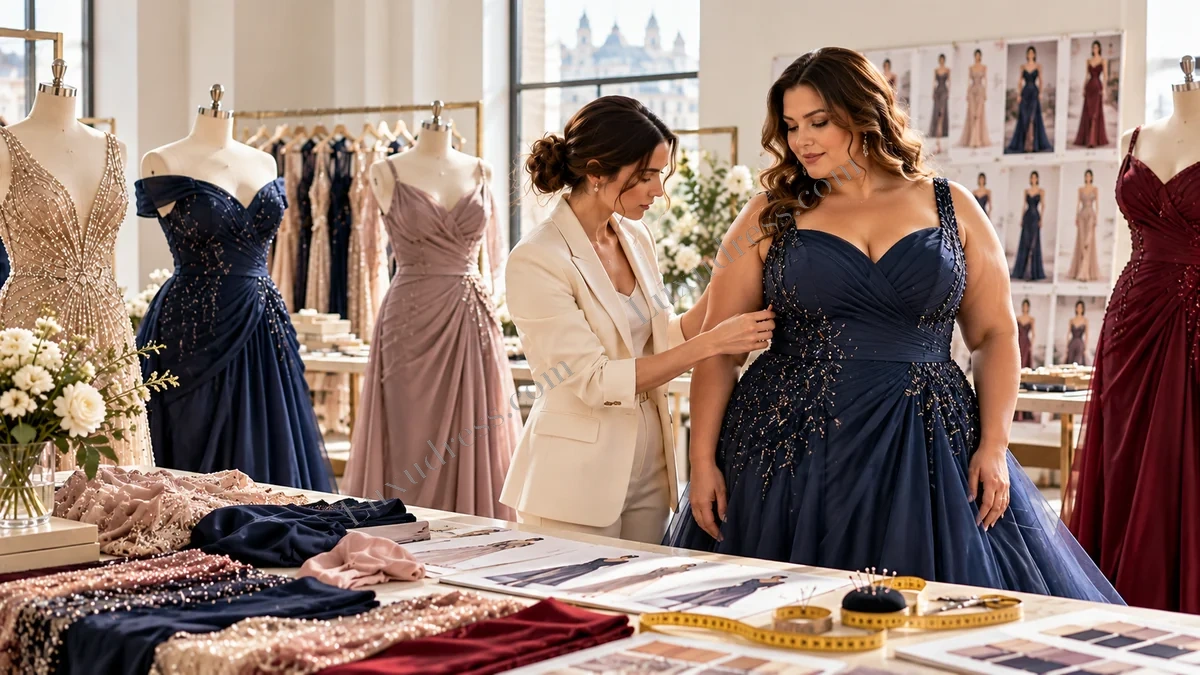
Ask a fit model where a strapless dress feels wrong and the answer is rarely the waist. A waist that is a little tight or a little loose is a fit adjustment, and on most styles it can be corrected in minutes at the fitting stage. The bust is a different kind of problem. A strapless bodice has no shoulder to hang from, so everything above the waist has to be held in place by the garment's own structure, and no adjustment to the waist changes that.
The commercial consequence is that bust problems surface late. A dress can pass the sketch, pass the fabric selection, pass the first fit on a size small, and only reveal its weakness when it is worn by someone whose bust is larger than the fit model's — which is to say, when it is worn by a customer. By then the bodice block is set, the cups are ordered and the grade has been run, so the correction is not a fitting adjustment but a re-cut.
It is worth saying at the outset what a cup is not. A cup shapes and covers the bust; it does not carry the garment. Support comes from the bodice: a fitted inner layer or corselette, an underband anchored to something structural, bones placed where the bodice wants to fold, and a closure that can take tension. A cup asked to do the supporting job as well will fail regardless of its quality — which is why the most common complaint about strapless styles, that the dress slides down, is usually a structure problem being reported as a cup problem.
That distinction is the whole point of specifying cups deliberately. If you know which job you are buying, the specification is short. If you treat the cup as a single vague requirement called “support”, you will buy the wrong component and then have no vocabulary for describing why the dress still does not work.
The Three Options and What They Are Made Of
In practice the choice comes down to three families, and they are not three grades of the same product. They differ in construction, in what they can hold, and in what they do to the rest of the pattern.
| Type | What it is | Where it belongs |
|---|---|---|
| Soft cup | A shaped pad of foam, fibre wadding or light sheet, sewn into the bodice lining | Styles where the bodice already supports the bust and the cup only needs to shape and cover |
| Foam cup | A die-cut or moulded foam shell, sometimes laminated, sometimes set into a stabilising frame | Fitted and strapless bodices that need the shape retained through movement |
| Moulded cup | A seamless three-dimensional cup formed over a mould, usually in two layers | Smooth, seam-free fronts where the cup must stay invisible under a close-fitting fabric |
There is a fourth category that confuses the picture: the moulded pad that is only a volume filler and carries no structure at all. In a supplier conversation it is often described as a cup, which is where specification errors begin. The question worth asking is not what the component is called but what job it is being asked to do — and, separately, whether the bodice is going to be doing the part that actually holds.
A soft cup is the lightest and the least demanding to work with. It adds shape without adding bulk, it presses flat, it does not resist the pattern, and it is inexpensive. It is also the family most often misused, because it is the cheapest and therefore the default. On a bodice with real structure behind it, a soft cup is entirely sufficient; on a bodice with none, it will not rescue the fit.
A foam cup is a structural component. It holds a three-dimensional shape against the body's tendency to compress it, and that is exactly what a strapless or heavily fitted bodice needs above the waist. The trade is that it is stiffer, it has its own geometry which must match the block, and it is less forgiving of a pattern that is slightly wrong.
A moulded cup is chosen for how it looks, not for how much it holds. Its value is the absence of seams and darts across the bust, which matters on a smooth satin or a fine crepe where any seam in that area reads as a defect rather than as a design line. What it does not do is escape the pattern: a moulded cup has a fixed three-dimensional form, and the bodice has to be drafted to receive that form rather than the other way round.
Volume vs Support: They Are Different Jobs
Volume makes the bust look fuller. Support keeps the bust where the pattern put it. The two are related but they are not the same, and a component that adds volume without adding support can make a bodice fit worse rather than better.
- Volume without support shows up as a bust that spills over the top edge of the bodice, or as a bust that has visibly changed position by the end of an evening.
- Support without volume shows up as a bodice that keeps its shape but reads flat, which is a commercial problem in a category that sells a specific silhouette.
- Neither, reliably is the common outcome of buying a cup on price: a light pad that does a little of both and does not do either consistently from one batch to the next.
- Both, in the right order: the bodice structure carries the weight and fixes the position, and the cup then defines the shape the design was drawn around.
- Confusing the two in a complaint is what makes a fix take three attempts. “The bust does not sit right” can mean the cup is in the wrong place, or that the bodice has no structure, and the two have completely different remedies.
In a fitting, these are separable by observation. If the bust shape is correct standing still but drifts when the model moves, the problem is support. If the shape is wrong standing still and stays wrong, the problem is the cup or its position. If the top edge of the bodice cuts into the bust, the problem is the neckline edge relative to the cup, which is a pattern question. Naming which of the three you are looking at is most of the diagnosis.
It is also worth remembering that the customer's bra is part of the equation and not part of the pattern. A strapless dress has to work on a body essentially as it arrives, since the whole point of the style is that there is nothing to wear underneath. That is a reason to design the support into the bodice rather than assuming it will be supplied by the wearer.
Cup Position Sits on the Pattern, Not the Cup
The single most common cause of a badly fitting cup is not an unsuitable cup. It is a suitable cup sewn into the wrong place. Cup position — the height, the separation and the angle — is drafted into the bodice block, and once it is set, no change of cup manufacturer corrects it.
- Height determines where the fullest part of the bust sits relative to the waistline and the neckline.
- Separation determines how the two cups relate across the centre front, and whether they can be joined by a bridge or have to be separated by a panel.
- Angle determines where the cup points, which is what makes a bodice read as intended on the body rather than in the photograph.
- Depth determines how much the cup projects, and therefore whether the bodice front has enough room drafted into it.
Because all four live in the block, they are set before the samples are made and they carry down the grade. On a style that is going to be produced in a size range rather than a single size, that makes them expensive to change later — every size has to be re-drafted from the corrected block and re-cut.
There is also an interaction with the neckline that catches people out. A cup positioned for a sweetheart neckline will not suit a square neckline, because the edges of the two are different shapes and they have to meet correctly. A style sold in several necklines, or a collection where one bodice block is used across several designs, has to accept that the cup position is a shared constraint rather than a per-style adjustment.
The practical guidance is to settle cup position at the block stage, on a real body, before any of the design's own details are added. A block that fits correctly with a neutral neckline can carry almost any neckline afterwards. A block whose cup position was never properly resolved will fight every neckline it is given, and the symptoms will look like design problems.
Why Moulded Cups Change Your Pattern and Your Freight
Moulded cups are the option buyers most often choose for the wrong reason. They are chosen because the front of the dress looks clean, which is a real and legitimate benefit. What tends to be underestimated is that a moulded cup is a fixed three-dimensional object, and everything that touches it has to be built for it.
- The bodice is drafted to the cup, so the cup is a pattern input rather than a component fitted into a finished block.
- The cup cannot be adjusted at the machine the way a soft pad can, so an error in position is a re-cut rather than a resew.
- Cups are size-specific, which means a size range multiplies the number of cup references to buy, warehouse and reconcile.
- Cups occupy volume, so a carton of moulded cups takes more space and costs more to move than the same number of flat pads — a consideration that lands in freight and in packing rather than in the cost sheet.
- They interact with the press, because a moulded cup does not want to be flattened, and a garment that is pressed flat for packing may not arrive looking like the sample.
The freight point is the one that surprises brands, because it is not a garment cost at all. A bodice that relies on a moulded cup can be harder to pack flat and compress into a carton than the same bodice with a soft cup, and on a large order the difference in shipped volume can be material. On a style that is going to travel by air, that difference is worth calculating before the cup is specified rather than after.
None of this argues against moulded cups. It argues for choosing them for the reason they are good — a clean, seam-free front on a fabric where seams would show — and accepting the pattern and logistics consequences deliberately, rather than discovering them at packing.
Cup, Lining and Interfacing as One System
A cup is never installed into nothing. It is installed into a stack of layers, and what those layers do determines whether the cup performs. Specifying the cup without specifying the layers around it is one of the most common half-specifications in occasionwear.
- The lining carries the cup. A lining that is too light for the cup's weight will sag away from the bodice; a lining that is too stiff will make the bodice boardy and defeat the point of the cup.
- Interfacing stabilises the edge, not the cup. The top edge of a strapless bodice needs to hold its line, and that is an interfacing decision made at the neckline rather than at the cup.
- The inner structure is what actually supports. A fitted inner layer, an underband and correctly placed bones are what keep a strapless bodice in position, and they are chosen on a different logic from the cup.
- The layers have to be fixed to each other in the right places, or the cup migrates inside the bodice between the sample and the bulk run.
- All of it has to survive the care instruction. A cup that is fine dry-cleaned and collapses when washed is a specification fault rather than a customer error.
The reason to treat them as one system is that the failure modes look similar from outside. A bodice that loses its shape after an evening can be a cup that compressed, a lining that stretched, an interfacing that failed, or a bone that moved — and the complaint will be the same sentence in every case. A specification that names all four layers gives the factory something to check and gives you something to point at when a correction has to be made. The boning and inner-structure side of that system is set out in how a bodice is built to hold.
There is also a sequencing point. The layers are assembled in a fixed order, and each step constrains the next: the structure goes in before the lining closes, the lining closes before the cup position can be finally checked, and the cup position has to be verified before the neckline is finished. A factory that tries to correct a cup position after the neckline is sewn is working against the construction, which is why cup problems are expensive in a way that hem problems are not.
Sizing Across a Grade
A cup that fits at the sample size is not a solved problem. Grading a fitted bodice changes the relationship between the bust, the underbust and the waist, and a cup specification that was correct at one size can be wrong at both ends of the range.
- The cup is not simply scaled. Cup volume does not increase in proportion to the bodice, so a size range usually needs more than one cup reference even when the garment itself is a single grade.
- The underbust changes more than the bust across a range, which changes how much of the support can come from the band and how much has to come from the cup.
- The centre front moves. On larger sizes, the space between the cups changes, and a bodice drafted to place the cups close together will not sit correctly.
- The top edge is the first thing to fail. A neckline that is comfortable at the sample size can cut in at the top of the range, and the garment then reveals itself as too small even though the body measurements match.
- Structure has to grade with the cup, or the larger sizes get the support shortfall that the smaller sizes never had.
The practical consequence is that a size range for a fitted bodice should be checked at the extremes before bulk rather than at the middle. It is common for a style to be approved on a size small and for the largest two sizes to be unsaleable, which is not a grading error in the arithmetic but a structural one in the design. The fitting checks that catch this are the same ones described in grading from an approved sample, and the range-extension questions are the ones covered in manufacturing for a fuller size range.
There is a commercial argument for resolving this at development rather than at production. A style that only works across the middle of its nominal range is effectively a smaller range than the size label suggests, and the returns on the outer sizes will show up in the selling data long before anyone connects them to the bodice block.
Spec and First-Piece Checks
The specification for a cup does not need to be long. It needs to name the decisions that the factory cannot make on your behalf.
| What to state | Why it belongs in the spec |
|---|---|
| Cup family, and the job it is being asked to do | “Support” and “shape” lead to different components |
| Cup reference and size break, if the range needs more than one | Otherwise the factory buys one reference for the whole grade |
| Cup position: height, separation and angle, referenced to the block | The most common cause of a badly fitting cup is a correct cup in the wrong place |
| The inner structure that provides the support | Separates the cup decision from the holding decision |
| Lining and interfacing at the cup and at the top edge | The layers around the cup determine whether it performs |
| Assembly order, and the point at which cup position is verified | A cup position corrected after the neckline is a re-cut |
| Care instruction and what each layer must survive | A cup that fails when washed is a specification fault |
| Extreme sizes to be checked before bulk | The ends of the range fail first |
Only the first two lines are about buying a component. The rest are about the bodice the cup lives in. That ratio is the honest picture of where the outcome is decided, and it also explains why a style can be approved with a good cup and still fail at the top of its size range.
On a first piece, three checks catch most of the problems: the cup position measured against the block rather than judged by eye, the top edge of the bodice checked on the largest size as well as the sample size, and the bodice inspected after a period of wear rather than only on the stand. A strapless bodice that looks correct on a hanger and correct for the first minute on a body is not evidence of anything.
FAQ
Which cup should I use for a strapless dress?
The cup is the smaller part of that decision. A strapless bodice needs structure in the bodice — an inner supporting layer, an underband that is anchored, bones in the right places — and then a cup that holds its shape through movement. A foam or structured cup supports what the bodice is already doing. A soft cup on a bodice with no structure will not hold the garment up.
Do I need to specify cup sizes, or is one cup enough?
It depends on the range. Cup volume does not scale in proportion with the bodice, so a single reference often works across part of a range and not across all of it. The place to decide is at the extremes: check the smallest and the largest size before bulk and let that determine how many references the style needs.
Are moulded cups worth it?
On a smooth fabric where a seam across the bust would read as a fault, yes. On a textured or heavily embellished bodice, the seam-free advantage largely disappears and you are paying for a fixed-geometry component you do not need. Choose them for the surface, not for the support — a moulded cup is not automatically a more supportive cup.
Can cups be removable, so the customer can adjust?
Removable cups exist and are sometimes specified for easy-care styles, but on a structured occasionwear bodice they are usually the wrong answer. The cup is part of what gives the bodice its shape, and a cup that can be taken out is a cup that can be put back in the wrong position. Where adjustability is the goal, it is better achieved through the closure and the inner structure.
Can we just rely on the customer's own bra?
For a strapless or backless style, no — the whole premise of the design is that there is nothing underneath. For a style with straps and a normal back it is more reasonable, but it still leaves the fit depending on something you do not control, which is a poor foundation for a size range.
The fit model says the bust is wrong. Where do I start?
Separate the three questions. Does the shape read correctly standing still? If not, it is the cup or its position. Does it drift when the model moves? Then it is support. Does the top edge cut in? Then it is the neckline relative to the cup. Each answer points at a different part of the specification, and the three are fixed differently.
How much difference does the cup make to the cost?
On the component itself, less than most buyers expect. The cost difference between cup families is small next to the cost of a re-cut, a second sample round or a return. That is the argument for resolving the cup and the bodice structure at development: the component is cheap, and the consequences of getting it wrong are not.
Working With Luxudress
Luxudress is the factory-direct front end for womenswear production across production facilities in Guangzhou and Dongguan, covering development, sampling, material sourcing, manufacturing, inspection and export packing. Structured bodices and fitted occasionwear are a routine part of what we build.
On a fitted or strapless style we will check the cup position against the block rather than against the photograph, tell you which size is likely to fail first, and name which layer of the bodice a fit complaint belongs to — the cup, the support, or the neckline edge.
If you have a bodice style in development, send the block and the intended size range. You can also browse the style library to see structured bodices already developed on similar constructions, see how we approach prom and formal bodices, or order from ready stock by the piece to examine a cup and bodice construction before committing to a production run.
Request a quote and we will return a costed plan including the cup and bodice structure it assumes.