On this page
- Why Boning Decides Whether a Dress Holds Its Shape
- The Three Families: Spiral Steel, Flat Steel, Plastic
- What Each One Does Under Load
- Choosing by Silhouette
- Channel Placement: How Many Bones, and Where
- Why Cheaper Boning Costs More Than It Saves
- The Pattern Has to Come First
- Sourcing Boning: What to Buy and What to Avoid
- Boning, Care Instructions and Transit
- What to Write in the Specification
- What to Check on the First Piece
- FAQ
- Working With Luxudress
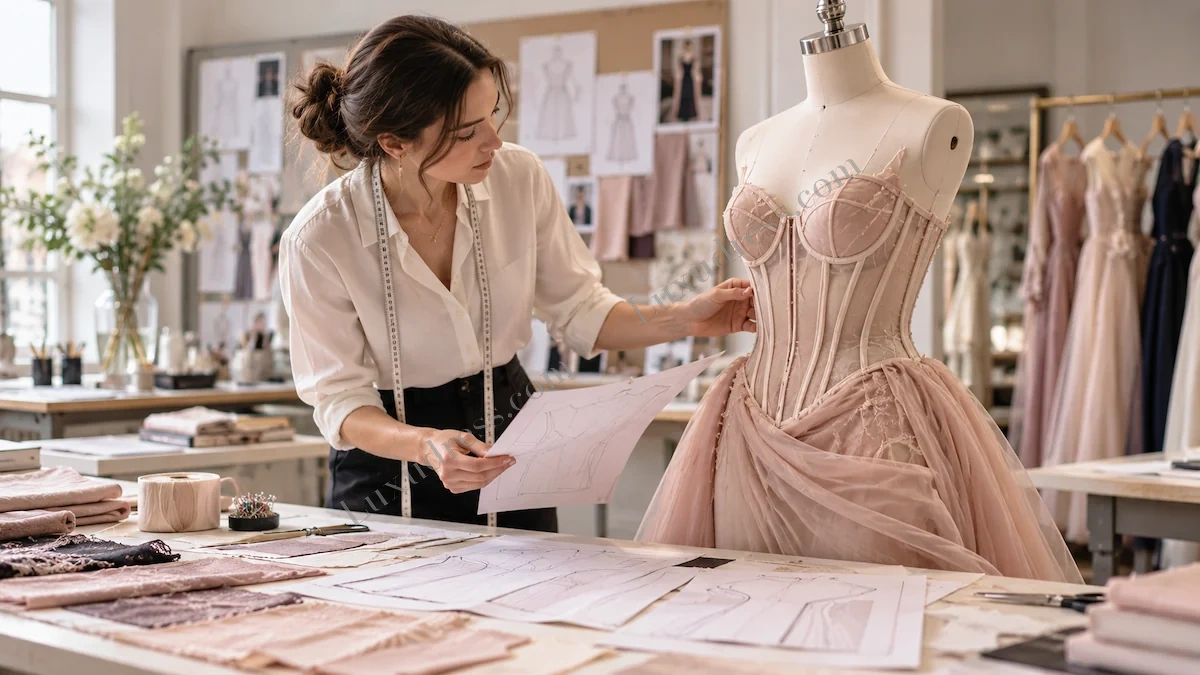
A corset dress is judged twice. The first judgement happens on the hanger or in a photograph, where almost any bodice looks convincing. The second happens four hours into an event, when the fabric has warmed up, the wearer has sat down twice, and the bodice is either still doing its job or has quietly given up.
Boning is what separates those two outcomes. It is a small component, it is largely invisible from the outside, and it is the single easiest place to save money on a specification without the saving being visible at the point of sale.
That is why it is worth a proper decision rather than a default. The three common families are not better and worse versions of one thing; they are three different tools, and the mistake is usually not choosing a cheap one but choosing the wrong one for the silhouette.
Why Boning Decides Whether a Dress Holds Its Shape
A bodice without internal support relies entirely on the fabric and the fit. That can work on a loose garment, a knit, or a style with enough seams to structure itself. It does not work on a fitted strapless bodice, a corset waist, or a boned bodice with an open back, because there is nothing to stop the fabric from folding where the body bends.
Boning supplies that resistance. It does three jobs, and buyers usually only think about the first:
- It keeps the panel flat and vertical. Without support, a fitted bodice ripples along the vertical seams and the top edge rolls.
- It carries load away from the seams. A strapless dress puts lateral tension across the bodice; boning distributes it instead of letting two or three seams absorb all of it.
- It maintains the intended line over time. Fabric relaxes with body heat and movement. Boning is what keeps the designed shape rather than the shape the fabric settles into.
The third job is the one that produces returns. A bodice that looks correct in the studio and sags at the waist by the end of an evening will not be described by the customer as a boning failure. It will be described as a badly made dress.
The Three Families: Spiral Steel, Flat Steel, Plastic
Almost every boned womenswear bodice uses one of three materials, or a deliberate mix of them. The differences are mechanical. None of them is a newer or better version of another; they are three different answers to the question of how a panel should resist a force.
| Boning | What it is | How it behaves | Where it belongs | Failure it prevents |
|---|---|---|---|---|
| Spiral steel | Two steel wires wound into a flat spiral | Flexes in both directions; returns to shape; follows a curve | Curved seams, waist and hip of a fitted bodice, side seams | Rippling along vertical seams; uncomfortable rigidity |
| Flat steel (spring steel) | A single flat strip of spring steel | Resists bending across its face; bends along its length only | Centre front, centre back, busk edges, straight panel edges | Front panel buckling; a bodice that bows outward |
| Plastic boning | Extruded plastic, often with a ribbed profile | Light, flexible, softens with heat, does not hold a shape long | Light shaping, decorative seams, low-cost bodices, light support | Minor rolling on light styles at low cost |
Two things follow immediately from that table. Spiral and flat are not interchangeable — one is for curves, the other for straight structural edges — and a bodice that uses only one of them is usually doing something the other would have done better.
Plastic is not a defective version of steel. On a lightweight dress with modest shaping, it is a reasonable material and it keeps the garment soft and foldable. It becomes a problem when it is used to substitute for steel on a garment that structurally needs steel, which is a specification decision made for cost reasons and paid for in customer experience.
What Each One Does Under Load
Wearing a dress is a load test that lasts hours. Understanding the three failure mechanisms makes the choice straightforward.
Bend direction
Spiral steel bends readily when the force comes from the direction its coils face, and resists force applied edge-on. Flat steel does the opposite: it is stiff across its width and flexible along its length. That is why flat steel sits on straight structural edges and spiral steel follows a curved side seam.
A bodice built with flat steel along a curved side seam will fight the body and pucker. A bodice built with spiral steel on a centre front will not hold the panel straight. Both mistakes look like a pattern error and are not.
Memory and recovery
Steel boning is spring material. It flexes and returns, which is what allows a fitted bodice to move with the wearer and still hold its line. Plastic deforms: once it has been bent into a shape under body heat, it tends to stay there rather than return. This is the difference between a bodice that recovers after sitting down and one that becomes progressively softer over an evening.
Heat and pressing
Steel is unaffected by the heat of normal garment pressing, though it must still be kept clear of direct contact with the plate. Plastic softens at temperatures ordinary finishing can reach, which is why a bodice containing plastic boning has to be pressed with the channels protected — and why a garment that has been badly pressed during production may already be compromised before it reaches the customer.
Choosing by Silhouette
The silhouette determines which panels exist, where the load sits, and therefore which boning belongs where. The table below is the working logic rather than a fixed recipe — quantities follow the size range and the length of the bodice.
| Silhouette | Where support is needed | Usual combination |
|---|---|---|
| Strapless bodice | Top edge stability and lateral tension across the whole bodice | Spiral through the side and princess seams; flat or a rigid strip at centre front so the panel cannot bow |
| Corset waist | Vertical structure front and back, with movement over the ribs | Flat at centre front, flat or heavy spiral at centre back, spiral at the side seams |
| Mermaid or fishtail | Structure through the hip so the flare starts where it is designed to | Flat along the straight flank panels; spiral where the body curves |
| Open or low back | Support has to come from the front and sides because there is no back panel | More structure forward of the side seam; back edge needs a rigid finish rather than the boning itself |
| Soft A-line with light shaping | Very little; the emphasis is softness and drape | Light spiral or plastic, often only in the bodice front |
| Lace or sheer overlay bodice | Same as the bodice beneath, with the channels hidden in the overlay | Follow the base garment; the overlay is not a structural layer |
Note what the table implies about mixing. Almost every structural bodice uses both materials, because almost every bodice has both curved and straight edges. A specification that names one material for the whole garment is usually a simplification made for quoting convenience rather than a construction decision.
Channel Placement: How Many Bones, and Where
How many bones a bodice needs is the most-asked question and the one least answerable as a number, because it depends on the body range the dress has to fit, the length of the bodice and how much shaping the silhouette requires. What can be described is the logic.
- Bones belong at seams and mid-panel. A seam channel is straightforward because the seam already runs where the structure is wanted. Mid-panel channels look after the areas between seams, which is where fabric ripples first.
- Spacing matters more than count. Channels that are too far apart leave a panel unsupported between them; channels that are too close stiffen the garment and can make it uncomfortable without adding much support.
- More shaping means more channels. A dress graded across a wide size range needs support distributed more finely, because a single channel cannot hold a large panel flat across several centimetres of body difference.
- The top and bottom edges need finishing, not just boning. A rigid or stabilised edge is what stops the top of a strapless bodice rolling. Boning channels alone do not achieve this — see how internal structure shapes a bodice.
- Channels must be secured at both ends. A channel that is only stitched at the top allows the bone to migrate downward, which is one of the more common defects to appear after a few wears.
Why Cheaper Boning Costs More Than It Saves
The saving on boning is small per garment and the cost of getting it wrong is not. Three routes run from a reduced boning specification to a real loss.
- A dress that sags is returned or reviewed badly. The customer does not diagnose boning. She describes a dress that did not hold its shape, and the review follows the brand rather than the component.
- A bodice that cannot be re-worn is a lost repeat customer. Occasionwear is often bought for one event and then worn again at the next. A garment that has already softened does not get a second outing.
- Wholesale and rental channels notice first. A rental customer wears a dress many times, and a boutique sees the returns. Both are more sensitive to structural durability than a photographic review is.
There is also a subtler cost. Once a bodice has been developed with insufficient support, correcting it later means reworking the pattern and the channels rather than swapping a component. That is a development cycle, not a purchase-order change, and it lands at the point where the style is already selling.
The Pattern Has to Come First
It is tempting to treat boning as a component choice made after the pattern is settled. The order is the other way round, and getting it backwards creates problems that no component can fix.
Boning channels run along seams or mid-panel, and their positions come from the pattern. If the pattern does not have enough structure in it — too few seams through the bodice, no princess line, a waist that depends entirely on a side seam — there is nowhere to put the support, and the bodice will rely on fabric stiffness alone no matter what is specified. That is a pattern limitation showing up as a component failure.
- More seams give you more places to support. A bodice built from a centre front, two princess seams and two side seams has five natural channel positions; a bodice with only side seams has two, and the panels in between will ripple regardless of what is inserted.
- Seam direction matters. A channel follows its seam, so a seam running diagonally across a panel supports a direction the body does not load, and the support is largely wasted.
- Curved seams suit spiral, straight seams suit flat. If the pattern has no straight structural edge at centre front, a flat bone has nowhere sensible to go — which is often why a bodice bows outward.
- Grading changes the panel widths. A pattern that supports well at the base size can leave unsupported fabric at the larger end of a grade, because the panel between two channels gets wider while the channels stay in the same places.
This is also why structural corrections belong at the pattern stage rather than at the component stage. Adding a seam is a development change that improves the garment permanently. Adding more bones to the same panels is a patch that stiffens the bodice without solving the underlying problem, and on a fitted dress it usually makes the garment less comfortable without making it hold its line any better.
Sourcing Boning: What to Buy and What to Avoid
Boning is bought by the metre or in pre-cut lengths, in a range of widths, and the specification has as much effect on the result as the material family does.
- Width follows the channel. A bone that is too wide distorts the channel; one that is too narrow moves inside it and can rotate so that it presents its flexible face to the load.
- Pre-cut lengths are convenient and constrain you. If the available lengths do not match your bodice, you end up cutting, and a cut steel end is a sharp edge that will eventually work through a channel lining.
- Ends need finishing. Steel boning is normally supplied with tips or with a finished end. Where it is cut on site, the finishing is part of the specification rather than a detail for the operator to solve.
- Coating and colour matter under sheer layers. A bone visible through a light fabric changes the garment's appearance, and on an unlined or sheer bodice that becomes a design decision rather than a hidden one.
- Consistency across a run matters more than the brand. Two suppliers' spiral boning of nominally the same width will not necessarily behave identically, and a substitution mid-run produces garments that feel different from one another.
The practical consequence for a buyer is that boning belongs on the bill of materials with its own line, its own specified width and its own end treatment — not as an allowance for "boning" that a purchasing team interprets. The general principle is the same one that applies to zips, interfacing and elastic: any component the customer can feel but cannot see is a component that has to be written down.
Boning, Care Instructions and Transit
Two practical consequences of the boning choice sit outside the bodice itself.
The first is the care instruction. Steel boning tolerates the cleaning methods a formal dress is likely to receive, but the question is not really about the steel — it is about the fabric and the channels around it. A boned bodice still has to be handled so that pressing does not flatten the channels or leave a mark, and the care instruction should not promise a treatment the structure cannot take. That is a testing question rather than a boning question, and it is covered in testing fabric behaviour before bulk.
The second is packing and transit. A bodice with flat steel does not fold the way a soft garment folds, and a dress compressed into a small carton may arrive with channels bent — a defect created in logistics and discovered by the customer. For structured occasionwear the packing specification has to acknowledge the structure: folded where it can fold, and not compressed where it cannot. That decision is worth making at the same time as the boning choice, not after the first shipment.
What to Write in the Specification
Boning is one of the components most often left to the factory's discretion, which is how two production runs of the same style end up feeling different. Writing it down is a few lines.
- The material by family at each position — not "boning" but which boning, and where.
- Whether the specification is mixed, and which edges take the rigid material.
- Channel construction: how the channel is formed, its finished width, and how it is closed at both ends.
- The finished shape the bodice must hold, described in terms of the silhouette rather than a number of bones.
- Whether the top edge is stabilised, and how.
- The care instruction the structure is expected to survive, confirmed against a test rather than assumed.
- The packing method, stated explicitly for a structured bodice.
The third and fourth items are the ones that get skipped, and they are the ones that determine whether a second run matches the first. It is also worth stating what the specification does not need to contain. It does not need a count of bones as a fixed number, and it does not need a tolerance on the bone itself — those are the factory attempting to hit a described result, and the result is what you are buying.
What to Check on the First Piece
A boned bodice cannot be assessed properly on a hanger. The checks that matter happen on a body and over time.
- Put it on a fit model and sit down in it: does the top edge stay against the body, and does the bodice recover when the wearer stands?
- Feel the panel between seams: is there unsupported fabric that will ripple, or has the bodice been over-boned into stiffness?
- Check channel ends: is the bone captured at both ends, and can it be felt moving?
- Check the straight edges: does the centre front stay flat, or bow outward under tension?
- Check the seams beside the channels: boning presses on the fabric it sits behind, so weaknesses show there first.
- Press a sample and re-check: pressing changes a bodice more than buyers expect.
- Leave it on a hanger loaded, then look again a day later — relaxation is where a marginal specification reveals itself.
That list takes twenty minutes on a first piece and is the difference between a specification that is understood and one that is assumed to be understood. The checks are also worth repeating at the first production piece of a reorder, because the component that was specified is not always the component that was bought. It belongs in the pre-production sequence alongside the other checks described in what to confirm before bulk production starts.
FAQ
Which boning is best for a corset dress?
There is no single answer, and a supplier who offers one is simplifying for quoting. Spiral steel suits curved panels and movement; flat steel suits straight structural edges that must not bow; plastic suits light shaping where softness matters more than structure. Most real bodices use a deliberate mix.
How many bones does a bodice need?
It follows from the silhouette, the bodice length and the size range, so a single count would be wrong for most garments. What matters more than the count is spacing and placement: support at the seams, support between the seams, and both ends of every channel secured.
Is plastic boning always a poor choice?
No. On a lightweight style with modest shaping it is a sensible material, and it keeps the garment soft and easy to pack. It becomes a problem when it is used to replace steel on a bodice that structurally depends on steel — a cost decision that shows up as sagging after wear.
Can boning channels be visible?
Yes, and on corset-style designs they often are deliberately, stitched on the outside as a design feature. The construction requirement is the same — the channel still has to capture the bone at both ends — but the finish quality is much more visible, so the stitching standard needs to be specified.
Does a lace or sheer overlay bodice need its own boning?
Usually not. The overlay is decorative and the support belongs to the bodice beneath it. What the overlay does need is channels positioned to hide the structure, and enough stability that the lace does not distort when the bodice underneath moves.
Will boning survive dry cleaning?
The steel will. The relevant risk is what the cleaning process does to the fabric, the channels and the pressing — which is why the care instruction should be written from a test on the actual construction rather than from a template.
Why does my second production run feel different from the first?
Most often because the boning was never written into the specification, so the factory bought to the same budget rather than to the same material. Recording the family, the positions and the channel construction is what makes a reorder reproducible.
Working With Luxudress
Luxudress is the factory-direct front end for womenswear production across production facilities in Guangzhou and Dongguan, covering development, sampling, material sourcing, manufacturing, inspection and export packing. Corsetry and structured occasionwear are a large part of what we build.
We will tell you which boning a silhouette actually needs rather than which is cheapest to quote, — and where a design intent and a construction budget pull in different directions, we would rather say so at sampling than explain a returned dress later. That conversation is cheapest at the pattern stage. and we will write it down so a reorder reproduces the first run. Where a design intent and a construction budget pull in different directions, we would rather say so at sampling than explain a returned dress later.
If you are developing a corset or structured bodice, send the silhouette, the size range and the fabric direction. You can also browse the style library to see constructions already developed, or order from ready stock by the piece to examine a real corset construction before committing to development.
Request a quote and we will return a costed plan including the internal structure it assumes.